Jesus Christ, you guys are super sweet. Thank you 😀

I would just like to point out that I’m going to be brief here. I’ve already covered this topic and don’t typically re-answer questions. I have a post directory and it’s your responsibility to read it along with the ask guidelines before you send in an ask! [x]


image

Anon 1: Any material that isn’t deleted is still canon, which includes the old characterizations, unfortunately. 

What I can’t stress enough is the use of discretion in recognizing that the way the characters are portrayed is far different now. Years of material have consistently proven that Himaruya’s learned from his mistakes and has grown as a creator. 

It’s just as wrong to hold on to previous characterizations as ‘evidence’ as it is to completely ignore and deny their existence.

Anon 2: It’s not a DNA/ deterministic behaviour type of thing. My understanding is that it stems from custom and tradition. 

We’ve seen this before with America. How he behaves in world meetings goes against conventional norms.

image

Notice how Russia mentions that they’re [as in those nations who are older than America] are bound by tradition, (Together with Russia, Volume 5). 

image

From what I can recall, there is one instance where a nation goes against their bosses’ wishes. 

Occurs during the Anglo-Japanese Alliance Arc…

Japan claims that his boss “went on his own accord” in speaking to Russia and apologizes to England, who at the time didn’t have good relations with Russia [x].

image
image

Anon 3: That’s one thing about Hetalia that’s a bit confusing. Its rules are flimsy and there are several exceptions. Perhaps with France the matter was the question of the legitimacy of the government.

Anyways, we do know what happened to him in canon. He went to live with England after the Nazis occupied him (Volume 5, Liberté, Égalité, Fraternité and…)

image

I’m a bit confused about the “nations need to follow their boss’ orders” thing. Didn’t France side with his people against his government during the French Revolution? (Or was that a fanart I saw… Oops.) The whole obeying thing’s kinda sad. They represent the people but have to obey the government that does not always do what the people want. I have to thank you for doing all these theories and explanations and things because I’ve learned lots about how the world of Hetalia works through you.

Any time, and not quite!

France sides with his
people after the Revolution. The rule of thumb is that whoever is in power acts
as the personification’s boss.

In the case of the French
Revolution, there was a shift in government from the divine rule of the French
Monarchy to the alleged democratic rule of his people. (Didn’t really play out
that way, oops.)

You see France suffer
from the turmoil of the Revolution on the sidelines as his people overthrow the
government [x].

image

It’s only after the
people are in power, in the government more importantly, that he sides and celebrates
with them.

He later tries to convince other European nations with monarchies to let citizen-rule prevail. Instead, they perceive him as a threat; abolishing monarchies would be an end to the social order that had organized their lives for so long.

[x] [x] 

image
image

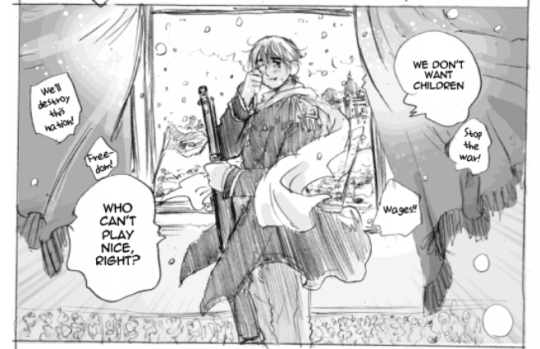
Russia is a clearer
example of how government changes are depicted.

He’s tasked with
quelling a protesting group of citizens during Bloody Sunday, despite evidently
not wanting to do it. Notice how he’s crying [x].

image

The process of changing governments
and respective boss changes is well demonstrated in chapter 61 of World Stars [x].

image
image
image

Best Hetalia Quotes

America: 

“Hey England, I will choose liberty after all. I’m no longer
your child or your baby brother. From now on I’m independent,” [x].

[Speaking to Canada]—

“Aren’t you the one who’s been all England this and England
that lately? …You’ve been obliging England and eating nothing but marmalade,
even though you actually like maple syrup more, right? Your will’s like a
fluffy feather,” [x].

“I guess it’s because laughing off the negative as something
positive is my style,” [x].

Canada: 

“J-Jackasses…saying whatever they want…yeah, okay, fine, I’m
Mr. Blandy Bland! Dammit!—Argh, today I’m going to show-em! But what argument can I make—?” [x].

To a sick and bedridden England following the American Revolution— 

“Please don’t say such sad things Mister England…I’m…I’m not
as strong as America and I don’t think I can make much money. I might be
useless, but is there anything I can do to help..?” [x]

(About America)—

“It’s true that we’ve been together since we were born, and
I do think we’re more than brothers. But the paths we’ve taken are completely different
and most importantly, our personalities are polar opposites…” [x].

China: 

“War has really changed Japan, aru…Japan is not Japan
anymore, aru…I don’t like it, aru…” [x].

“Time goes so quickly when you are having fun…I’ve lived for
several thousand years and yet…really, the good things are over in the blink of
an eye…” [x]

England: 

After becoming young America’s guardian—

“So, somehow I managed to kick France out and become this
boy’s big brother. But since that means I’m his guardian, it’s also a big
responsibility for me…I’ll have to give him more than he’s ever been given,
always keep him safe…I’ll have to work hard. He’ll have many obstacles and hard
times ahead. Hard trying times. And even this wide and bountiful land must give
him his share of misery. Now It’ll be the two of us. He and I. We’ll support
each other. That’s how we’ll live,” [x].

During the American Revolution—

“Eh…it couldn’t be…? Does this mean you’re all turning
against me? Why is it turning out like this? [Have I handled things so poorly
that I have nothing but enemies now!?]” [x].

“I will teach you a good word; ‘Discretion.’ Have you ever
heard of it? Seeing you reminds me of my old timid self. Make sure to fix that
before we meet again,” [x].

France:  

“If you can’t be stylish everyday, isn’t life just cloudy skies?” [x].

Talking about his immortality to one of his citizens—

“If you’d like to put it into words, it’d be like a ship!
The Government is the mast, the citizens are the wind and they are swimming on
the sea of time—or so
it was said. If the mast is standing straight and a good wind is blowing, the ship
goes forward. But well, of course, there’s also the possibility of the ship
suddenly getting stranded!

As long as there is
someone who can fix the ship, you can keep on using it forever, right?” [x].

Talking about Jeanne d’Arc to someone he believes is her reincarnate—

“Yes, her execution was on May 30, 1431. The
king abandoned her and no one lent a hand to save her in her final moments. Her
patriotic volition was unbound. She gave everything for the sake of her
country. It’s sad to see that those who have patriotic volition like hers tend
to meet tragic ends…

That’s enough history! Now it’s time for me to share
something about myself. It’s a thought I always keep in mind. I believe that
anyone who’s been toyed with by history is always reborn. They’re born under
normal circumstances. They laugh, they play…and even fall in love just like
anyone else.

In their next life, they live out a happy and peaceful life
somewhere in this world. That’s what I truly think. When I first saw you, I
thought God was pulling a cruel trick on me…but I see you’re living a happy
life. It seems like my wish has been granted.”

—Volume 4, A Bientôt! (Until We Meet Again). 

Russia: 

During the Bloody Sunday Revolt—

“I finally made this nation stronger and more prestigious
than others by myself… I worked so hard. Why is it that nothing goes right…? Why
do they always end up hating me? Everyone says it’s my fault, my fault. I’ve
endured it for centuries. Why can’t everyone just get along nicely with each other…? [x].

Lithuania asks him about a dream that he wishes to come true—

“Living in a warm place…surrounded by sunflowers,” [x].

Germany:

“Geez! I don’t know if you meant it as a joke, or if you really didn’t know, but instead of a collection of shady people, surely there’s much more to Italy that’s charming?! For example, the ancient ruins that speak volumes of history, the amazing works of art, and the unparalleled wealth of culture…the sun that shines upon this beautiful land…” [x].

“Compared to my daily life, torture from you bastards would only be about as bad as getting bitten by a mosquito!”

—Volume 1, Axis Powers.

Italy: 

“Sometimes I get tired of seeing the same people all the
time, but then when I see them so much, it’s like they’re new and refreshing
again, these sort of things happen,” [x].

“Ah, sorry Germany, but I just remembered. If we go back the
way we came, there’s a really amazing ristorante! A ristorante known as ‘my
home’..!” [x].

Japan:

“Well, since you arrived, America, the environment and the people
around me have changed so much. Right after I opened up so many things happened
in rapid succession. I feel that knowing people and cultures of countries I had
only heard the names of before is wonderful…but I’m still a little anxious on
whether I’ll be able to get along well with all of them from here on out.”

—Volume 2, Japan and the Footsteps of Westernization.

“When I don’t get out of my house and only communicate with
those I can read the minds of, I start to forget how to speak verbally…” 

‘The so-called isolationist country’ [x].

image
image

In previous posts, I’ve touched on the notion that pets in
Hetalia often function as a mouthpiece for their respective nation. Put another
way, while they are separate physical beings, symbolically they serve to
represent the psyches of their owners (i.e., their thoughts, feelings, and
emotions) [x].

image

Thus far, I’ve picked up on three consistent themes.

1)     
They tell the nation something they need to hear.

2)     
They speak what the nation doesn’t dare to say
out loud.

3)      In conjunction to #2, they often reveal what the nation is
feeling.

That said, let’s tie this back to the strips.

America: 

The best example where America’s pets mirror his feelings is
their fondness of Lithuania.

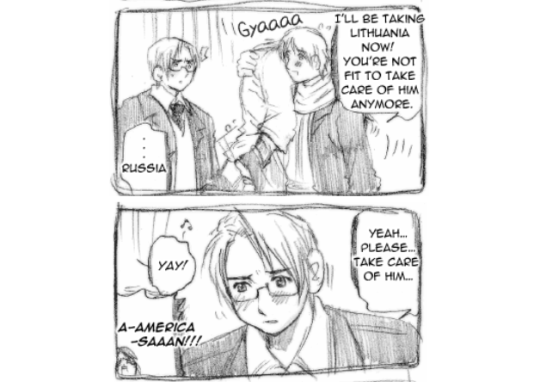
America becomes disheartened when he can’t afford for Lithuania
to live with him anymore [x].

image

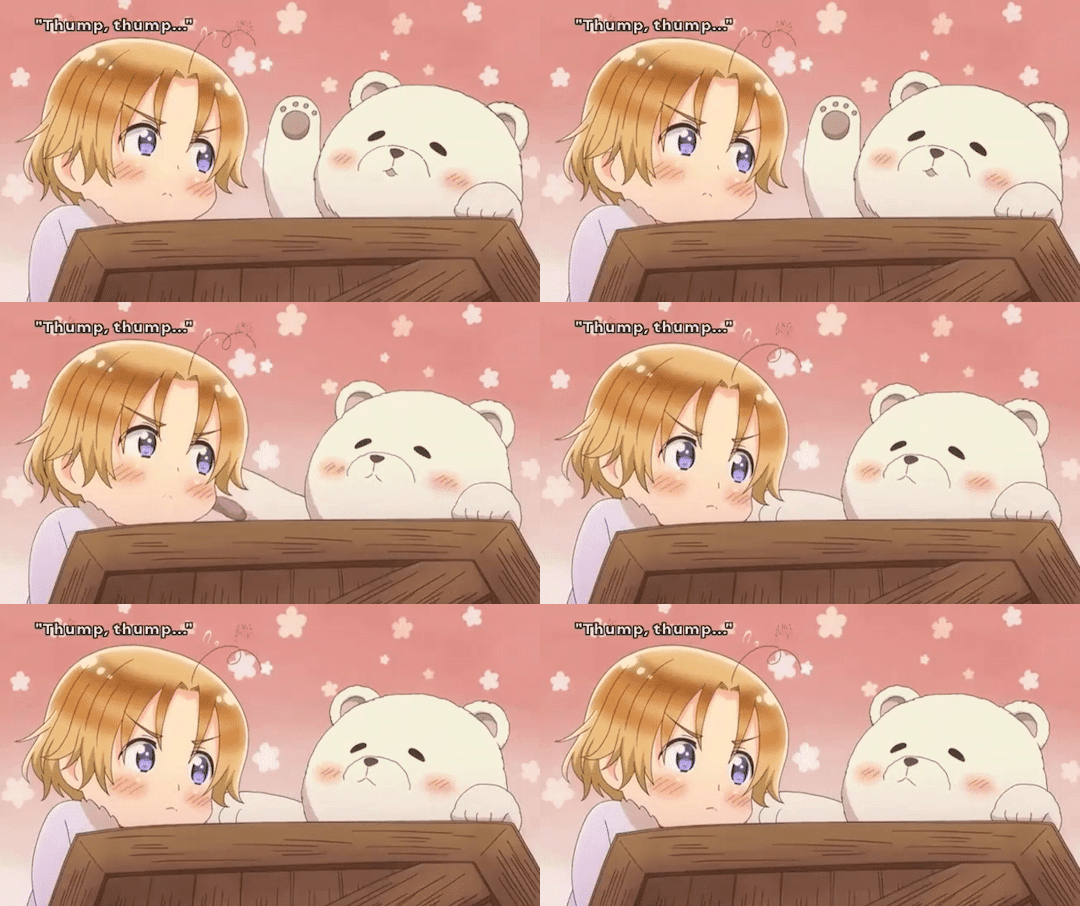
However, in earlier strips, we learn that America’s pets
hold a similar affection for Lithuania [x].

image

Canada:

Before, I’ve speculated that Kumajiro represents Canada’s
psyche.

The focal point of Canada’s characterization is his struggle
to form a stable and memorable identity and overcome his invisibility. As such,
neither Canada nor Kumajiro getting each other’s names correctly figuratively reflects
how Canada still hasn’t figured out who he is.

Hence, Kumajiro’s infamous “Who are you?” catchphrase has another
level of depth to it [x]. He’s not just asking Canada who he is [as in his name]
but also who Canada stands to represent as a person and a nation. His identity and
self-concept is something that he continues to negotiate and work his way
around.

image

Some other examples would be…

Canada is too shy to ask England to have lunch with him.
Kumajiro then reassures Canada that it’s okay to be more demanding and urges
him to speak up for what he wants.

image

In the aftermath of the American Revolution, England diverts
most of his attention toward America. Kumajiro uses stuffed animals to convey Canada’s feelings. The puppet story depicts how Canada feels
neglected and excluded [x].

“I think the well-behaved baby bear should be loved more,
but what do you think, whoever you are over there?”

image
image
image

England: 

England becomes dismayed after watching a fantasy movie and
laments over his desire to live in such a world. His magical friends don’t hesitate
to give him a required dose of reality [x].

image

Iceland:

Mr. Puffin acts as both a mentor and mouthpiece for Iceland.

He’s able to see right through Iceland and recognize what he’s truly
feeling. In this case, he’s aware of how lonely Iceland is [x].

image

On the other hand, when he first meets baby Iceland, he comforts
him. At the time, Iceland was still figuring out his existence and questioned
why ‘no other guys like him’ existed. Mr. Puffin assures him that other
nations do exist, just in far geographic proximity [x].

image

He also teaches Iceland knowledge about the world from his
travels [x].

image
image
image
image

Here’s just a list of
terms that have a completely different meaning in the manga. This is aside from
their literal denotation.

Being Bullied: 

When a nation is referred
to as a bully and/or is bullied, this refers to them being conquered or sought after
by more powerful nations.

Ex: Both Italy brothers being conquered after Rome’s death [x].

image
image
image

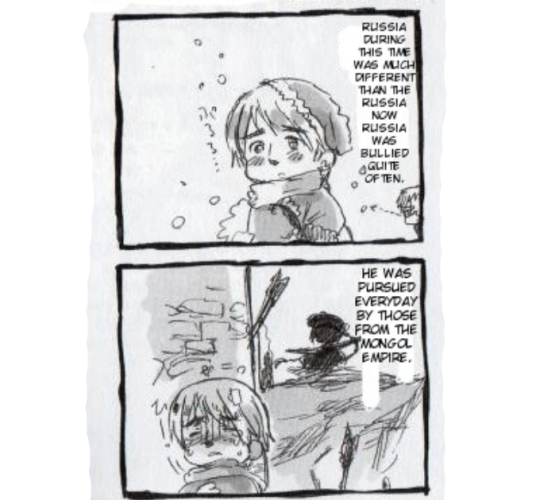
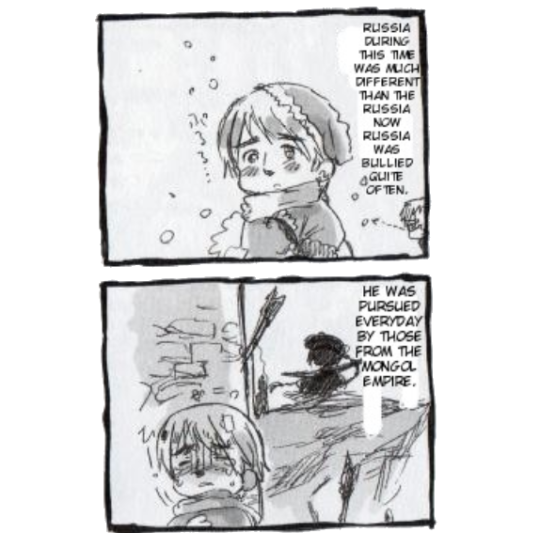
Ex: Russia being ‘picked on’ by Mongolia, Denmark, Sweden, and Prussia.

image
image

Boss: 

The nation’s leader.
Pretty self-explanatory [x].

image

Honour Student:

While it is possible for
nations to become students and attain degrees, the term “honour student” is
used in reference to how well a country succeeds politically or economically.

Ex: Italy’s referred to as an honour student in the EU [x].

Ex: Seychelles, being among the wealthiest African nations, is referred to
as an honour student.

image

House:

House refers to the
actual country itself.

“My house [country] is
known for…”

Ex: Italy expressing confusion at the foods that tourist destinations in
his country try to pass off as authentic Italian cuisine [x].

image
image
image

Note: This post will explore the mystery behind why Russia
covers his neck. This isn’t a theory, as I use facts to come up with a
speculation that, while probable, hasn’t been substantiated in canon. I find it
very important to distinguish between facts, theories, headcanons, and
opinions.

What’s the deal with Russia’s heart?:

I know, I know. This
post is about Russia’s neck, but I have to do some backtracking first.

All right. In canon, it’s normal for Russia’s heart to
spontaneously burst out from his chest. 

image
image

In earlier posts, I’ve speculated that
this acts as a metaphor for how Russia’s conception of love has been equated
with violence.

He grew up being routinely conquered and chased after. 

image
image

Not
only that, but General Winter – who acted as Russia’s de facto parent figure
due to the protection he provided the latter with – also attacked [abused]
Russia on an annual basis [x]. 

image
image
image

As such, what Russia
grew to understand as love and friendship became irreparably warped.

Ex: He thinks that anyone he meets is his friend. This
includes General Winter, his abuser.

image

Ex: He uses violence as a solution to his problems. He’s
normalized it [x].

In conjunction with the first reason, I also believe that
Russia’s heart falling out so violently symbolizes being cut up from the inside.
Since the personification’s body is a physical representation of their nation’s
landmass, this would relate to the act of partitioning and being partitioned. The
heart and soul of a nation are tarnished upon being conquered.

Ex: Russia’s hobby during WW2 is partitioning Poland [x].

image

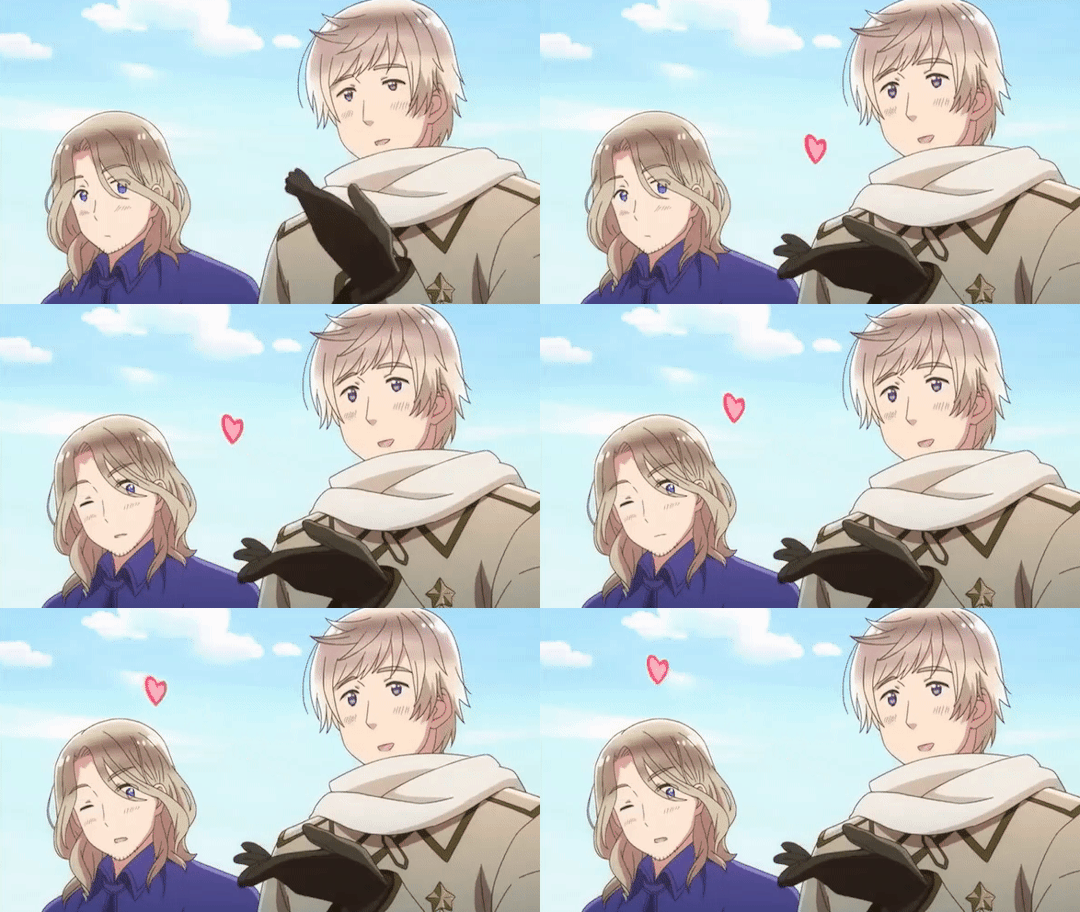
Ex: When he exerts political pressure on Japan, notice how
Russia sends a heart. Again, I interpret this as another example where Russia
has conflated love and violence [aggression], confusing the two of them.

image
image

Russia’s Neck: 

As many others in the fandom have pointed out, there is a mystery
surrounding why Russia takes great lengths to cover his neck, most notably with
his scarf. It’s not just his neck, but I’ll get back to that in a moment.

Originally, the scarf was a gift given to him by Ukraine.
While she wanted him to keep warm, she also did this to get him to make Kiev
successful in return.

image

On the other hand, the scarf has taken on a much darker
meaning in Russia’s adulthood.

Ex: In Italy’s Chest Test Series, instead of his usual
scarf, Russia’s wearing bandages around his neck [x].

image

Ex: In the History Copy Book, there’s a strange panel with
an angle that reveals Russia wearing a single bandage around his neck [x].

image

What I haven’t seen people mention is that it’s not just his
neck that Russia tries to cover.

1)  He’s often spotted clutching his chest, an
action that I believe is done to prevent his heart from falling out.

image
image
image

2) Russia takes great lengths to cover his chest
too [x] [x].

image
image

Putting this all together:

The answer I have that possibly explains all this isn’t
grandiose or complicated. It’s simply medical. I think that by covering up his
chest and neck, Russia’s concealing the physiological effects of heart failure.
The heart failure here is his heart falling out.

Conditions like Congestive Heart Failure occur when the
heart is unable to pump enough blood to give your body the sufficient oxygen it
needs. A symptom of this failure in the right side of the heart can cause
bulging tube-like veins to appear on the right side of the neck – jugular vein
distention.

If that’s the case, then no wonder Russia wants to cover up
his neck. Not to mention that he would without a doubt have massive scars and
damaged unhealed tissue from his heart popping in and out like a revolving door.

image