Misconception: She has big breasts because fanservice
Reality: She’s characterized this way since Ukrainian news supposedly
often focuses on breasts.
If anything, Ukraine is insecure about her breasts. It’s to
the point that she’ll wear restrictive clothing that prevents them from moving
too much [x].
There’s also a strip in volume 2 titled “I hate my big
boobs!”
The ironic comic gag of this is the childhood advice she
gives to Russia. When fighting her enemies, Ukraine speaks to their hearts by
showing them her breasts– I’m dead serious here. [I can’t believe I’m actually writing this…]
She also advises Belgium to show off her breasts
to get noticed [x].
Misconception: Belarus hates her.
Reality: While Belarus would rather be with Russia, there
are moments where their sibling relationship shines.
Ex: They take a cute Christmas photo together. The fan
request is to see a happy Ukraine [x].
Ex: Another fan request wants to see Italy interacting with female nations. When it’s her turn, a weird shadow appears behind Ukraine.
Some have speculated that this is Belarus being protective of Ukraine,
especially because Belarus is included in the panel right above [x].
Misconception: She’s a weak crybaby.
Reality: While she is a crybaby, she’s not weak.
Ex: She cries when she has to leave the Soviet Union,
knowing that it’s the best for them politically, but perhaps not personally as
siblings.
Once again, the differentiation between a nation following
their bosses’ orders against what they want is shown as Ukraine remembers that
her boss forbade her from giving milk to Russia. Although the subject of the order
is trivial, it’s the fact that she’s been ordered to avoid her own brother
altogether that’s important. It takes a lot of resilience for a nation to
juggle personal and political lives.
Ex: She cries when her attempts to establish relations –‘friends’
– in the EU doesn’t work out right away.
Ex: In a Volume 4 character note, she’s described as “Russia’s
fearsome sister who will stand her ground to the last” [x].
Ex: A young Russia perceives Ukraine to be evil-minded when
she gives him his infamous scarf. The reason she does so is not only to keep
Russia warm. She also wants him to thank her by making Kiev successful.
Bonus facts:
She herself is poor as a result of her country’s poor
economic performance.
Ex: She delays paying her oil bill to Russia.
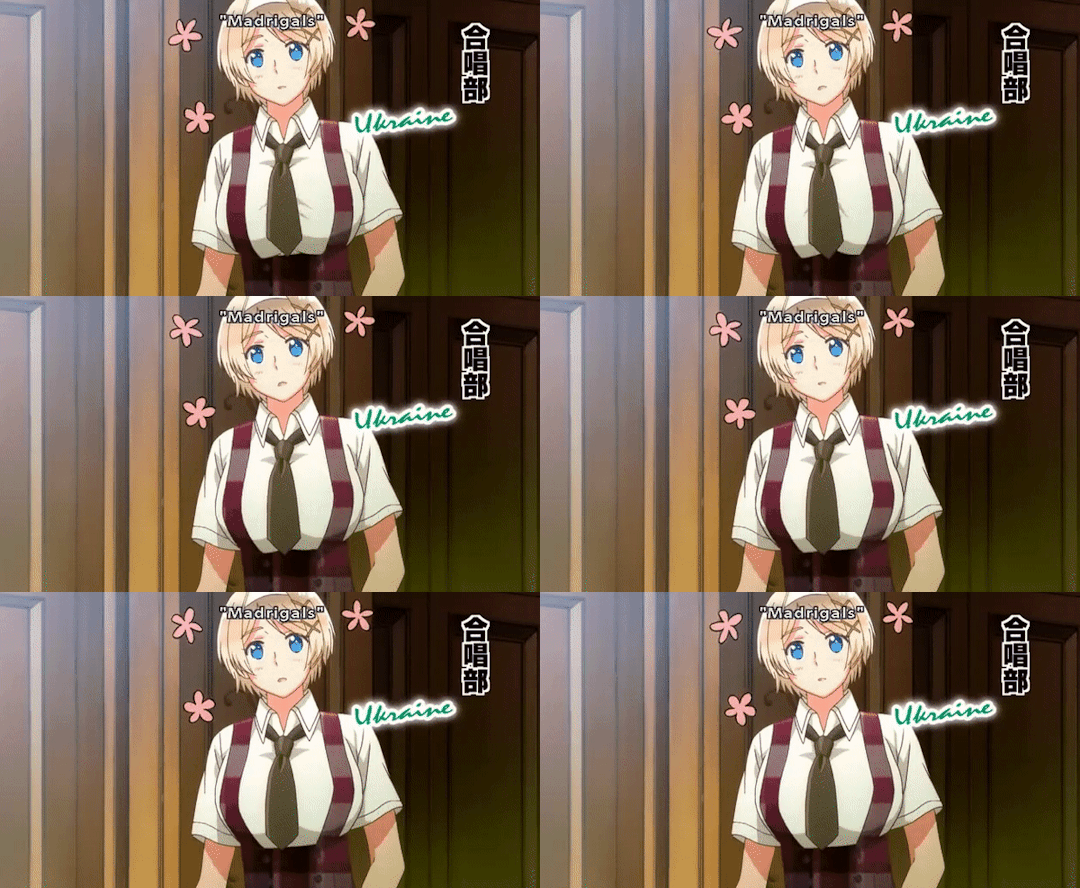
In the World Academy AU, she’s part of the Choral Club along
with the other Baltics.
Her nyo – male version – looks almost exactly like Russia [x].
Me any time I voice a controversial opinion on the internet.
I just want to preface this post by stating that Russia isn’t
evil, as stated in his volume 3 character note. Instead, he’s described as “naturally
scary.”
On the other hand,
the spirits, ghosts, and entities that follow Russia may, in fact, be evil.
Is Russia Cursed?:
Yes.
There are several sources that describe and/ or hint at his curse,
his cursing ability, and the cursed beings that follow him.
1) The
Russo-Japanese war. The Russian Orthodox Church was allegedly able to curse
Japan.
Russia’s also able to curse Japan after the fact, once
causing the latter to develop a stomach ache.
It’s no wonder that Japan is so opposed to Germany forming
an alliance with Russia during WW2. Notice the supernatural-esque words that Japan
uses to describe Russia:
“A monster created by fallout from nuclear tests”[x].
2) To get his revenge on America, England intends
to have him sit on the infamous Busby Chair, a chair that’s rumoured to kill
all those who sit on it.
Instead, Russia sits on the
chair, only to cause it to explode. Something about his aura appears to be too
overwhelming for the chair to handle.
3) After the failed Busby Chair incident, England
decides to summon a being to “crush America.” Russia appears instead.
There are two reasons why I believe Russia may have appeared in the circle. One, Russia fits the description of what England wanted to summon; he’s large, mentally twisted in that he has a warped sense of reality [x], and as the USSR would have been strong enough to crush America. Two, just the fact that Russia’s cursed.
Of critical importance is that not only does Russia admit to
having a grudge on England – likely stemming from their relations during England’s
Splendid Isolation period – but England also retaliates by claiming that the
two settle their grudge with a magic duel. No such duel occurs, but it’s the
fact that Russia’s capable of using [dark] magic that I want to place stress
on.
4) The remaining seven G8 countries mistake Canada’s
presence as something creepy and off. Nonetheless, France’s first thought is
that it may be General Winter, ghosts, or Russia’s old emperors following him.
5) Why does Russia say KolKol?
This part is theory. It hasn’t been confirmed
in canon.
A fictional tale included in the fourth original chapter of
the webcomic details how the Allied leaders – Roosevelt, Stalin, and Churchill –
reacted when the plane they were on was suddenly attacked by a demon [x]. As the
demon sets out to destroy the plane’s engine, neither Churchill’s nor Roosevelt’s
negotiations were able to stop it.
It’s only when Stalin threatens to throw the devil into a
Kolkhoz – a collective farm, commune – that the demon disappears. The story ends with
this quote:
“At the moment the
devil heard those words,
it flew away, never to be seen again.
From the kolkhoz that even the devil fears.”
The reason I mention this story is because,
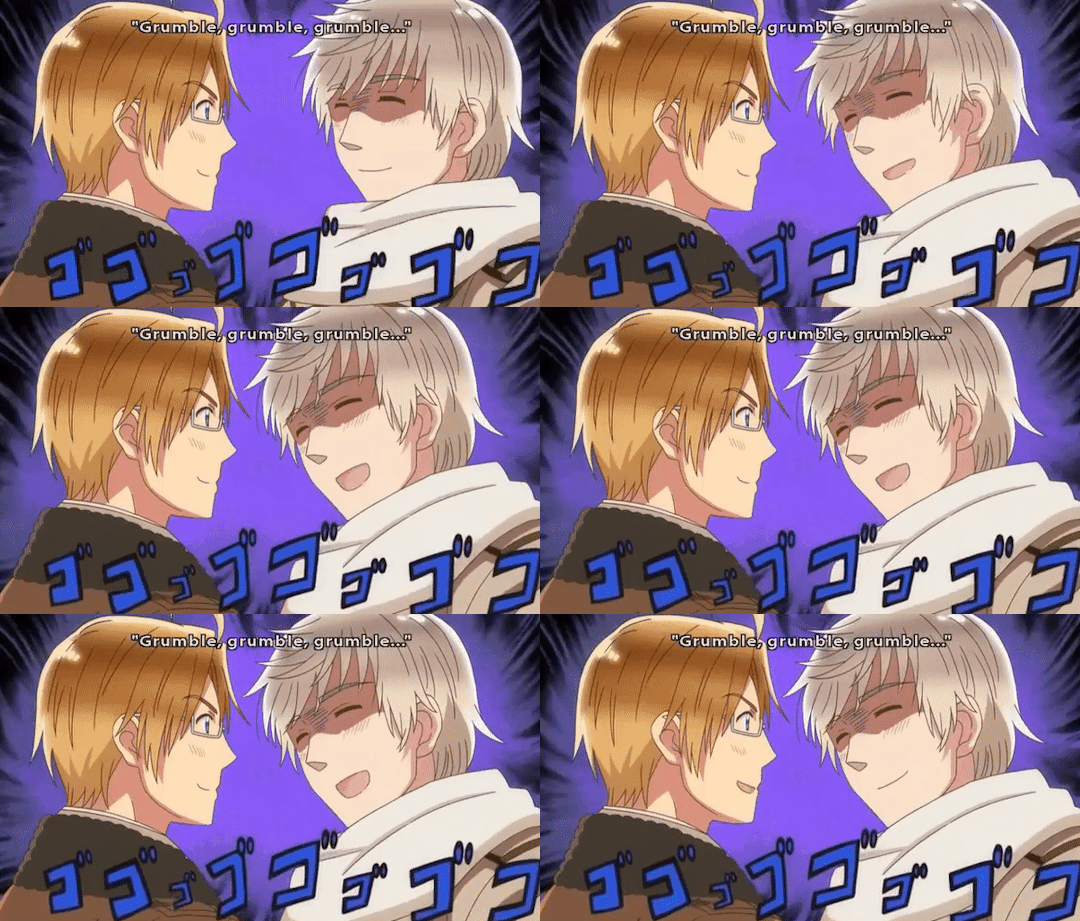
in the panel above, we see Russia muttering “kolkolkol” in reaction to
Lithuania’s unfavourable remark aimed at his “old-fashioned” uniform.
If that’s the case, then perhaps
when Russia mutters “kolkolkol” it’s a form of repelling anything that he doesn’t
like, similar to how a priest repels a devil.
Bonus: Although unmentioned, there’s
also the curse that Rasputin allegedly cast on the Russian royal family before
he died.
What does England have to do with this?
You’ll notice that throughout the
manga, England is consistently wary and distrustful of Russia.
Ex: During WW2, Russia offers
England some of his tea. England’s immediately skeptical and suspects Russia of putting
something strange in it [x].
Ex: England calls Russia a psychotic bastard when the latter’s
heart falls out during a meeting. England had initially thought that the heart
wasn’t Russia’s.
Ex: England doesn’t hesitate to express his desire to kick
Russia out of the G8.
Ex: When he falls asleep during a world meeting, England has
a weird dream and blames it on Russia.
As mentioned above, the hostility isn’t only one-sided.
Russia doesn’t always get along with England either.
Ex: During the Splendid Isolation strips, England
acknowledges that Russia wants him dead
Ex: In the same strip where England falls asleep during a
meeting, Russia’s solution to wake him up is to hit him with a sickle.
Evidence of a demonic presence:
Given the evidence I’ve presented,
my answer is that because England is magical himself, he’s able to sense the
dark presence emanating around Russia. In other words, Russia spooks him.
Ex: England claims that Russia
being depressed is a dangerous omen.
Ex: During the 2013-2014 Christmas Event, right
before Russia arrives [with America and Japan], all ghosts, mythical beasts, fairies,
and monsters present feel a dangerous aura [x].
They later flee to avoid being
taken over by something evil. I don’t think this is a coincidence [x].
It’s for this reason that I believe
that Russia is once described as the person that England doesn’t want to meet
in private [x].
In the Merry Halloween strip, the
gag is that England and America host an annual competition where the two
attempt to out-scare each other. England brings a fairy friend to scare
America. Meanwhile, America uses Russia. The fact that England’s terrified of
Russia makes sense if you look at it from the perspective that Russia harbors
many dark spirits around him.
In sum, it would seem that England
is hostile toward Russia because he’s canonically cursed, can give curses
himself, and has malevolent spirits that follow him.
I’m not particularly big on headcanons, but I sometimes do charts like this 😀
Most insecure nations
–
America, Canada, England, Germany, Italy,
Romano, and Poland.
Loneliest nations
–
America, England, Iceland, Prussia, and Russia.
Happiest nations
–
Denmark, Finland, Seychelles, and Sweden.
Most sarcastic nations
–
England, France, Norway, and Romano.
Nations we need more of
–
Belgium, Belarus, India, and Vietnam.
Not much is known about
this phenomenon, especially since most of the coverage of these events are
glossed/ skipped over. On the other hand, there are some things that I can potentially
clarify and shed light on.
First, let’s go over
some examples.
America:
We get a brief – albeit shallow
–depiction of America’s Civil War in chapter 211 of World Stars. No insight is
given, other than the fact that America is visibly distressed [x].
Spain:
We get two strips that
cover Spain’s Civil War.
One involves Romano
getting mad at Spain for not participating in WW2. Romano had fought in the Spanish
Civil War and got shot in the butt during the conflict. Meanwhile, Spain is too
poor to give a significant contribution to the war effort [x].
Another strip involves
Romano calling Spain after he and Veneziano were taken as prisoners of war by
England. Spain explains that he can’t bail the two out because he was too busy
making roses. This seems to occur at the end of the Spanish
Civil War [x].
Russia:
We get a brief look at
Russia’s title change from Russia to the USSR in this panel here. It’s from one of
the first original webcomics [x].
Unpacking this information:
It’s a common headcanon
that during civil wars, a separate personification develops. For example, the
US Confederates would have developed their own personification.
While this hasn’t been
shown, rules in canon can potentially support this.
In chapter 1 of World
Stars, it’s stated that personifications can exist for as little as a few days
to several centuries – or millennia if you consider the Ancients, China, Japan,
and Turkey [x].
There’s also the
hypothetical example where Canada dreams of Quebec becoming an actual country [x]. What’s important is that the new nation is born after the secession is
legally recognized, thus differentiating the situation from the American Civil
War.
Something that’s always
puzzled me about this scene is its ambiguity. When Canada states “anything but
Montreal” it could easily be interpreted as Montreal – as a municipal personification
– evolving to represent Quebec as a nation. Given that states and Japanese
prefectures are personified, it’s not far-fetched for a city to be personified
as well. We just haven’t seen this yet in canon.
On the other hand, we
also know from the above panel that personifications can change their personalities
as a result of a title change.
In that case, when two gov’ts fight for power in
a civil war, there isn’t a need for a second personification except in the case
where two legitimate states form. The end result is that if a new gov’t assumes
power and changes the name of the country, the personification can undergo a
personality change.
That said, since very little information is known about civil wars in Hetalia, it’s difficult to draw anything conclusive about them.
Q: i read on one of the hetawikis that italys curl was added as a last
minute thing to make him cuter, but himaruya said that now the curl is
“important.” any thoughts?
A: There’s one character note that states that the curl represents “the
sexual something of the Italians” [x].
Q: Your post on how fascism isn’t promoted in the manga was
extremely helpful, so thank you. Just wondering. Is there any strips that
depict how the people react to the war?
A: Disclaimer: This is
coming from someone who’s half Jewish. I shouldn’t have to say this, but
knowing the internet…
All that’s shown is how hopeful the people are [x].
You have to situate the context and realize that the German people had just
come out of a massive economic recession. The war promised them a solution. (Unfortunately, this solution and the many years leading up to it involved scapegoating, unjust persecution, assaults, and discrimination).
Point is, Hetalia never promoted Fascism. As
discussed in this post [x], all it does it situate the reason why the Germans
went to war – namely because of how stringent the compensation mandated by the
Treaty of Versailles was. It doesn’t tackle anything past that. Given the young targeted demographic, the atrocities committed during WW2 aren’t covered or touched on.
Again, there’s a difference between situating a
historical context vs promoting a horrible political ideology.
A: Thank you! I’m by no means a gun expert, but in one
of the first original web comics, he does appear to be holding a sniper rifle [x].
There’s also the famous Finnish sniper Simo Häyhä “White Death” from WW2 that might have made such a headcanon
to be taken as fact. Other than that, you’re right. I don’t recall any of his
character notes mentioning this ability. Most of them can be found here [x].
Q: What’s your favorite time Germany
wasn’t being “strict follow the rules never smiles” in the manga. ( I just saw
a picture of Germany putting on a puppet show for America and Russia and he
said “don’t nuke it out, hug it out” and I was like man I need more of this
side of Germany).
A: Chapter 20 of World Stars! Italy asks Germany
to help him clean Romano’s messy room. Germany seems looser here and even
returns some of Romano’s snark, although still being up to the challenge [x].
Q: Can Norway and England see General Winter?
A: It seems to be Northern countries who experience winter that have interactions with
General Winter.
What I’ve always found to be insane is that not
only is Finland immune to the cold, but he’s friends with General Winter [x].
What this post will explore is
how other nations – to lesser degrees – are able to possess greater physical
strength than the average human. While it’s not necessarily the extreme strength
that we see with America and Russia, the
additional strength gained by nations at different points in history is still
very much present.
The Rules:
As stated by Finland, America and
Russia are super humans, whereas the rest of the other nations aren’t so
different from regular humans in terms of their physiology – aside from the obvious facts
that they’re immortal, don’t age and heal faster. After all, they are referred
to as “strange” and “odd” beings [x]. Some things about them are abnormal.
How I’ve interpreted the panel with
Finland before is that the superhuman
phrase is a reference and pun for the Cold War, where America and Russia emerged
as economic and political superpowers.
They were the two most powerful nations during this period.
The rules for this are laid out
in the strip titled “In just two minutes you can grasp the exterior of the European
economy.”
There, it states that when a
nation experiences political strife/ economic recessions, their health worsens
and they develop a cold. It would follow, then, that if a nation’s politics are
stable and their economy is performing abundantly well, they become stronger –
literally.
“In this manga, a nation having a cold = something like a recession. By the way, when they’re physically unwell, the nation’s politics or economy is having problems.” [x]
That’s why young America
initially gained his super strength. His economy was doing exceptionally well [x].
As such, this
would also explain why during times where America’s economy is strained and his
political affairs at home aren’t stable, he loses some of this strength and
appears to be weak. (Longer post on that here [x]).
Ex: The Great Depression – one of
the largest economic recessions to date.
Likewise, as a result of the Soviet
Union gaining steam [and territory], Russia had already acquired super strength
during WW2.
Ex: Russia was able to stop a
tank with his body.
The reason that America and
Russia’s strength is so extreme is that their power was globalized.
Meanwhile,
consistent with the rule above, other nations who gained economic and political
power also got physically stronger, albeit not nearly as strong as Russia or
America given that their influence wasn’t as reaching (e.g., European
superpowers instead of global superpowers).
I should also mention that the English empire was indeed a global superpower; on the other hand, the political sphere hadn’t yet been globalized during their prime (e.g., the UN and global international relations).
That said, let’s go over some of
these examples.
Austria:
A referenced European superpower
that became weakened during the War of Austrian Succession [x].
Pay attention to the specific
wording as France loots from the defeated Austria.
Hungary:
When Hungary acts as Austria’s
reinforcement during the War of Austrian Succession, she’s referred to as “freakishly
strong back then” [x]. The back then is especially important, as it proves that the
country’s strength and position reflects itself in the personification’s
physical strength.
France:
France became strong as a result
of the Napoleonic Conquests [x].
Again, notice how exhausted the enemy
nations are after they finally defeat him [x].
Bonus Case: Canada
It’s also hinted that super
strength, even when the nation isn’t particularly powerful, can be tapped into
by the personification.
After the American Revolution,
England falls ill. America visits Canada’s house, begging to see England. When
Canada refuses him entry, America attempts to force his way in. In the end,
Canada is able to shut the door on America [x][x].
It would seem that during moments
of adversity/ stress, an adrenaline instinct kicks in, thereby allowing the
personification to temporarily tap into this super strength. Put another way,
all nations are capable of acquiring super strength if their country is
powerful enough; however, in astringent circumstances, the personification can attain
it nonetheless.
In sum, super strength, albeit in
differing degrees, isn’t something exclusive to America and Russia. As shown in
the strips, other nations have become stronger in reciprocation to their
country’s strength and power.







 Ellawritesficssometimes