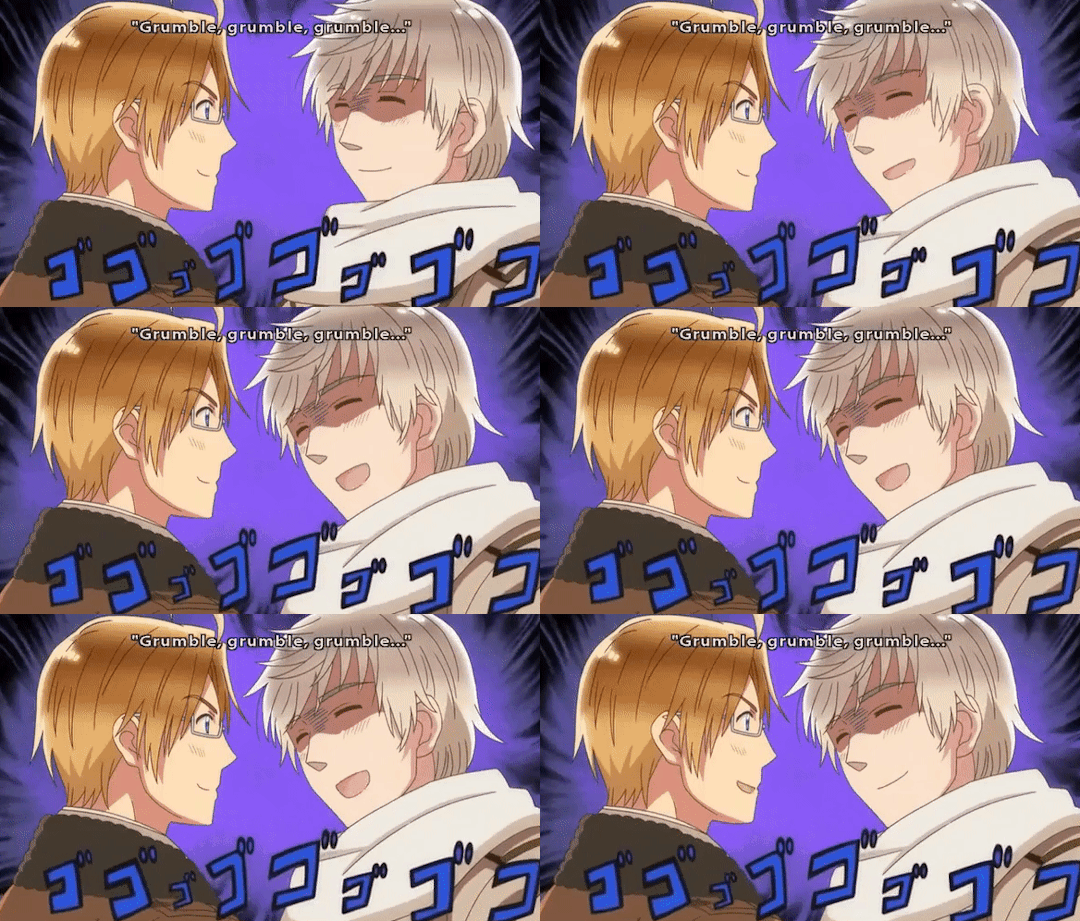
It’s somewhat similar, but Russia sends [political] pressure
in the form of hearts. Since he grew up under repressive rule himself and considers
anyone to be his friend regardless if they abuse him or he abuses them, force
is the only way he knows how to communicate with others.
Similarly, to end the hyphen dispute between Czechia and Slovakia, he squeezes them together in a hug.
Sure thing! This could easily be a massive essay, but I’ll try to sum things up as briefly as I can. Post on the Soviet Union coming up tonight!
Russia (the
personification) represented the USSR at world meetings.
Ex: The Baltics either stayed at Russia’s house or
acted as servants when Russia attended world meetings on their behalf. [x]
Ex: Bulgaria stopped attending the World Academy while he was under Turkish rule and didn’t come back until he was independent
again. [x]
The same
thing occurred with Romania too.
In previous posts [x][x], I’ve laid out the rules that explain what
affects a nations’ health. This post, however, will elaborate in more detail to
show the different ways in which they can be affected and why that is.
For one thing, we know that the personification’s health is
predicated on their economic and political situation. That is, if they are
suffering from political issues (either domestic or international) or are
experiencing an economic recession, they will fall ill.
That said, let’s go through the symptoms they can experience.
They can get colds or fevers:
Ex: Several nations develop fevers or colds in reaction to
the Great Depression.
Ex: Austria will develop a high fever and eventually collapse if
Germany acquires a cold [from an economic slump].
“A reliable country that likes to approach things with a sober seriousness. He approves of and supports lots of Germany’s ideas so he may look like one of the helper countries, but in reality the level of his dependency is pretty high.
So high that when Germany catches a little cold, Austria goes straight to high fever and eventually collapses, and so he doesn’t have much of a choice than to take good care of himself.”
Ex: England develops a cold after the American Revolution.
They can suffer from fatigue and exhaustion:
Ex: The aftermath of the Napoleonic Wars.
They can die:
Ex: Spain nearly dies during an economic recession before
Romano starts helping him recover with imports.
They can cough up blood:
This symptom in particular is depicted more as a consequence
of war (which includes separate battles/attacks) or civil strife. You’ll often
see the most devastated nations coughing up blood in panels where Hima
introduces different sides of the conflict.
Ex: Prussia, Spain, and Italy during the Napoleonic Wars.
Ex: Prussia during the American Revolution.
Ex: China during WW2 after being betrayed by Japan.
Ex: The disunity in the Holy Roman empire causes Holy Rome
to fall ill and cough up blood. His political situation isn’t stable, which, in
turn, is reflected in his poor health.
Bonus case:
The nations cough up blood and get sick during conflicts,
but are nonetheless able to heal from these wounds with time as their country’s
situation stabilizes.
But, what if a personification never healed emotionally from
a conflict and keep reliving it over and over again?
Wouldn’t that explain why England coughs up blood and falls
ill every year during the fourth of July? The event is still fresh in his mind,
and regardless if it’s over and done with, his body reacts as if it’s still
happening.
I think it goes unsaid that how the nations relate to one
another is not only based on their present political relations.
In other words, while they may not be on good terms with
each other, these relations don’t define their relationship in whole. There are
times where nations get along, and there are times where they will fight
frequently and ‘hate’ each other. Point is, the hate doesn’t typically last.
While current relations do cause tensions, their pasts have
the most impact on how they view one another. It would therefore be shallow to
say that if nation A and nation B grew up together, only to go to war centuries
later, that they would unequivocally hate each other and be unable to reconcile.
Relationships don’t work like that, and this is especially the case for
immortals who have lived several lifetimes.
I’ve stressed this in other posts before, but the nations
don’t represent their government. They represent their people – they’re cultural,
not political representations. The irony is that they’re forced to serve their government, which may or may
not represent their peoples’ best interest. [x] [x]
It is for this reason that even in times of war, nations on
opposing sides are shown to be getting along with each other when they’re not
on the battlefield.
Ex: America’s occupation of Rome. He doesn’t treat the Italy
brothers as enemies, but rather friends.
Ex: England, Russia, and Germany share their military
rations with each other.
While humans from other nations may bear present grudges
towards each other, this doesn’t always reflect itself in the personification.
It’s important to remember that they’re people themselves, and have had more experiences
that influence their outlook on life.
That said, what this post will set out to demonstrate is
that nations rumoured to canonically hate each other don’t actually. The hatred
isn’t deep-set or genuine. It’s more like a rivalry between someone who constantly
gets on your nerves…someone who you routinely get into arguments with and can
never see eye-to-eye. On the other hand, old war grudges have been shown to heal with time.
Although, some take far longer than
others.
With all that in mind, let’s go over some of the most common
characters that are mistakenly depicted to be in hate-hate relationships. And
yes, while this is intended to be ship neutral, all of these examples can be
used to counter bashes against your ship.
Russia and America:
While they may have been on thin ice with each other in the Cold
War, their history runs far deeper than that. Unfortunately, we get very
minimal insight into American-Imperial Russia relations. The strips only depict
Russia’s participation in the American Revolution.
Either way, the two countries don’t hate each other,
regardless of how tense their political relations were and still are. They even
acknowledge this tension as they spend time with each other in the present.
Russia in particular admits to how much America gets on his nerves.
China and Japan:
Japan’s betrayal in WW2 caused China to develop a strong
grudge towards him.
Nonetheless, in recent strips, we do see China attempting to
reconcile with Japan through diplomacy.
Hungary and Romania:
The two are noted to fight like cats and dogs. Each nation
depicts each other in a negative historical light. They may have resented each
other, and still do from time to time. However, it’s not true, long-lasting hatred.
Ex: Hungary’s somewhat smug reaction to Romania and Bulgaria fighting with
each other.
Regardless, they’re still capable of getting along.
Greece and Turkey:
The two bicker every time they see each other.
Comic gags
aside, the two still care for each other and are mentioned to be making some grounds
in their relationship.
Ex: Turkey’s form of bullying Greece is taking him to a
bathhouse and massaging him.
Switzerland and Japan:
Switzerland yells at Japan to be more assertive and voice
his opinion. It has nothing to do with hatred. If anything, it’s an aggressive form of encouragement.
Veneziano and Romano:
Romano suffers from an inferiority complex in comparison to
Veneziano, who received most of their grandfather’s attention. As such, he is
often very hostile to Veneziano, referring to him as “stupid little brother”,
or something similar to that depending on his mood.
However, this is only done to Veneziano’s face. When he’s
not around, Romano’s been shown on several occasions to look out for Veneziano.
America and England:
Short story short, the two have been able to reconcile their
rocky relations in the years following the Revolution. England’s bitter and
scathing nature towards America has softened considerably over the years.
It’s said that England once suffered from one hundred years
of heartbreak, presumably a hint to the American Revolution.[x]
Ex: England still goes to America’s centennial celebrations, despite
how sick it makes him.
He also offers to fix a crack in the first liberty bell he
gave to America, and gives him another one for his bicentennial.
Ex: The two are close enough to make fun of each other’s
politics.
America and Canada:
Canada doesn’t hate America. Instead, he hates America’s
egocentrism and often calls him out for this.
France and England:
While these two are notorious for fighting, having their own
designated preserve to quarrel in…
…they can get along with each other just as well too.
Ex: France used to be England’s cook.
Ex: England proudly calls on France’s cooking skills again
when he opens a butler café.
Ex: A summary of how their relationship’s progressed.
Prussia and Austria:
The two don’t get along with each other.
However, that doesn’t stop them from spending Christmas together as ‘family.’ Prussia, of course, initially [teasingly] refuses to accept Austria and Hungary as guests.
…
Real Hatred – Prussia and Russia:
Albeit the fact that it’s one sided, Prussia’s hatred of
Russia is deep. It’s probably one of the only case examples where it’s not a
matter of two nations simply not getting along.
Ex: Prussia will cough up blood if Russia touches him.
Either that, or he will lose four eyelashes.
With all that in mind, long-lasting hatred between nations
is rare in canon. Similarly, while current political relations may have an
influence on how nations interact with each other, the influence of the past –
on a personal level – is much greater.
The nations are two-fold representations. By that I mean
that they have a literal body and a figurative body.
Bear with me, things get a bit tricky, but I’ll break it
down to the best of my ability.
Basically, the figurative body is what influences the nation’s
physical body.
The figurative body
is composed of two parts.
1) There’s the geography of the nation. The landmass is sometimes referred to as their body or house,
despite the real physical one that they possess.
The geography can influence both the physical appearance and
personality of the personification.
Ex: Since Sealand’s geographic body is small, so is his physical
one.
Ex: Iceland’s contrasting volcanic and freezing temperatures respectively
causes him to have a hot and cold side.
2) There’s the personality
of a nation. The personality of a nation (not to be confused with the
personification’s personality) is defined in terms of culture in the manga [x]
If the culture is well-developed
and thriving, then the personification will also thrive and be able to grow; to
age. However, if the culture is repressed, then the personification’s growth
will also be stunted.
The reason I’m outlining this is essentially to show how
geography/climate and historical events are reflected in the personifications’
appearances and personalities. Information on the impact that this has on their
health can be found here [x][x]
What this post will focus on, however, is why some nations
have scars and either suffer from or are affected with other physical symptoms.
Let’s go over some examples.
Ancient Rome:
Before dying, Rome was noted to have many wounds and scars –
a physical reflection of the turmoil his people suffered from.
Lithuania:
We know from his time spent in the USSR that Lithuania acquired
several scars on his back. The military repression of several revolts and the
banning of diverse cultural practices in favor of an atheist state very likely
had a role in causing these scars to appear.
Latvia:
Latvia’s case is similar to Lithuania’s. While we don’t know
if he has any scars, we know that Russia pushing down onto his head ultimately
stunted his growth. How I interpret this is that it’s a metaphor for political repression.
Put another way, Russian control stunted Latvia’s growth,
which, in turn, was reflected in the personification’s physical body.
China:
It’s hinted that China gained scars after being betrayed by
Japan in WW2. It’s both a literal and symbolic stab to the back.
Germany:
Each time America engages in reckless financial activities,
a new wrinkle develops on Germany’s forehead.
Finland:
Estonia’s quest to become a Nordic causes Finland’s back to
be itchy whenever he’s talked about.
Bonus cases that aren’t so clear…
Russia:
When he’s not wearing a scarf, Russia is shown to be wearing
bandages around his neck.
Netherlands:
An unknown event caused him to develop a scar on his
forehead.
We already know from
chapter 1 of World Stars that the nations let their bosses order them around.
As such, they often have no choice over what they’re commanded to do.
I always use this
example, but it’s still important to point out that Germany’s sense of duty overrode
his personal unwillingness to annex Austria.
The control that
national leaders have over their personifications is pervasive. While Finland
is joking in part, he still alludes to the possibility of Germany’s boss [Hitler]
being more than capable of imprisoning Germany should he disobey orders.
In that regard, the
nations are just like regular citizens. They may cast votes…
…and hold meetings to
discuss world issues, but for the most part, they have little to no control
over what happens in their government. They recognize that there’s corruption
present, but don’t seem to be able to do much about it.
That doesn’t mean to say
that they have no agency, either. They’re not complete puppets in that they
have a mind of their own. It rarely happens, but some nations have in fact
resisted or gone against their boss’s wishes.
Either way, boss control
over personifications has historically been all-encompassing. While in present
times it’s not as extreme as what we saw during both world wars, the control is
still there. For example, England’s boss has control over his sweets and alcohol
intake.
Point is, there’s an
evident and wide power differential between a personification and their leader.
If that’s the case, what
happens to a personification when they’re captured?
The answer is nothing,
as Finland implies in this line of dialogue. More importantly, this strip takes
place in the present [2010].
The only material that
we have to work with on the subject can be found in
the instances where the nations are taken as prisoners of war.
Even when they are
rescued, it’s the personifications who do the liberating, not other human
soldiers. As you’ll see, when a nation is taken as a POW, they’re treated just
like any other soldier; no special treatment or protection is offered to them.
Let’s go over some
examples:
Russia:
As I’ve stated before,
Russia isn’t exempt from being exposed to the brutal conditions that his
soldiers had to endure.
The war-time conditions
are so bad that Russia even thanks Germany when he’s taken as a POW. He claims
that Germany is heaven compared to what he was used to dealing with.
Further, Russia’s bosses
are notorious for their brutal treatment of him. They clearly didn’t give a
damn about Russia given that they tortured him when they were bored.
That said,
I don’t think they would care all that much when news of Russia’s capture
reached them. Again, we don’t see any rescue attempts depicted.
There’s also the fact
that Russia was once given the order to stop a tank with his own body. What’s
crazy is that he actually obeyed this.
Germany:
When taken as a prisoner
of war, Germany claims that the torture there is nothing compared to what he
has to experience back home on a daily basis.
Italy:
Italy seems perfectly
comfortable upon being captured by Germany in WW1, citing that he doesn’t want to leave
as it would mean fighting again.
Usually it’s Germany who
rescues Italy when he gets into trouble on the battlefield. Of course, these strips take place during WW2.
However, in this case, Germany didn’t have to rescue Italy
from the Allies. He was so useless that they mailed him back.
England:
We also see that it’s
America who rescues England when he’s taken as a POW by the Italy brothers and
Germany.
In sum, when captured, it seems that the nations aren’t given any
special treatment or priority by their bosses. Instead, they’re treated just
like any other citizen. It would follow, then, that this type of treatment
would also carry into the present given the time in which Finland’s statement
was made.
They owe their
existence to them.
Ex: France lays out the rule that as long as the nation
possesses a stable government and a large enough citizenry to identify with
said national identity, the respective personification will remain and continue
to be immortal.
This rule is further confirmed in World Stars, where France
explicitly admits that he exists because of his citizens.
They openly interact with one another + humans know of their existence.
A common misconception that people often make is that the
nations’ identities are a secret kept from the public and that only their bosses
know about them. That simply isn’t true.
In fact, while some humans are shown to be perplexed by the
nations’ immortality, their overall existence is known to the public.
Ex: France introduces himself to Lisa, Jeanne d’Arc’s
reincarnate.
Ex: Italy flirts with his own citizens.
Interestingly, Italy’s also admitted to getting tired of
seeing the same faces of his citizens every day – a consequence of his
immortality. However, he does add to this and claims that seeing
these same faces can also be refreshing.
Point is, on top of their being no knowledge barrier of
their existence, the personifications openly interact with their citizens.
The Nations are Citizens Themselves.
Ex: Romano has his own passport.
Ex: Russia isn’t exempt from civilian duties, such as manual labor.
He’s forced to build a waterway alongside his people under
impoverished conditions.
He fought alongside his people in both world wars (as well
as any other personification), and endured the same notoriously terrible living
conditions that his soldiers were exposed to.
Ex: Coinciding with the last example, the nations serve in
their military. Here, America is tasked with tightening security among his
troops after Germany and Prussia successfully infiltrated them.
Population Demographics Affect the Nation’s Personality Traits, Behaviours, Habits, and Physiology:
Given that this is a series predicated on stereotypes, this
isn’t all that surprising.
Ex: China has a video game addiction resulting from this
becoming a rising problem among Chinese youth.
Ex: Germany strictly adheres to the directions of his GPS.
Hima drew this from a news story of a Bavarian who caused an accident by
following GPS directions.
Ex: Post WW1, several Lithuanians immigrated to America to
outsource their labor so that they could send money back home. As such,
Lithuania lived with America during this time.
The same thing happened with Romano. He went to live with America
during the first Industrial Revolution –a direct effect of his own people
migrating there for work.
Ex: As a result of his shifting cuisine (i.e. Indian and
Chinese influences), England is beginning to learn how to cook.
Ex: A nation’s obesity rate likewise impacts the weight of
the personification.
This subject is rarely touched on in the manga, but it did
happen with France following his Revolution. He was forced to give up aristocratic
clothing, otherwise he risked being beat up by his citizens.








 Ellawritesficssometimes