Hallo Frau. Ellawritesficsometimes..Would you
be able to make a post on the relationship between India and China. Well I have
been researching about relations and have found that even though India and
China don’t have an amazing diplomatic relations they have a lot of cultural
relations such as cinnamon and fishing nets and also a lot of trade.
Sorry, friend. I can’t
make a post on that given that they’ve had one canon interaction. It should be
more, but that’s all we have to work with [x].
wait…I was going through your blog and I saw
you tag a post with ‘taiwan x ukraine’ what’s that about? keep up the good
work!
Mhhhmm.
I’ve made a post on
that. Taiwan has had some considerably gay moments. [x]. With Vietnam too.
America’s hero is
George Washington I will drown and die with this headcanon GLADLY goodbye-
Considering that Prussia sees Fritz as a role model and father figure, it’s not entirely impossible.
Here, have American presidents dressed in
steampunk attire.
Source: Hetarchive (Bamboo Thicket, eng trans., Oct 29th, 2014).
Hi! Could you explain why
England didn’t want little America to call him big brother. I remember in an
episode he starts remembering spain, france, and his own brothers when America
asks if he can call him that. I didn’t really get why he was bothered by it.
Hi, I hope I’m not bothering. I just wanted to say something
maybe obvious(??). With Genoa being a republic of its own as some kind of
city-state first and soon being brought in history to be part of the whole
kingdom of Italy in the unification, does it make sense that the
personification is still there as Genoa but the nowadays version? As an Italian
we have lots of stereotypes on Genoans (like with uhh every bigger city and
region and part of Italy) could that have changed its personality?
The personifications are
cultural personifications. It doesn’t matter if they aren’t official countries.
The word nation is a much broader term. If Genoa’s culture is truly unique and
the people there identify with it, there’s no reason for him not to be alive. We
just haven’t seen a confirmation in canon yet.
Anyways, this post fleshes out what I’m saying in more detail [x].
To understand why micronations and provinces/ states
–aside from the country they’re part of– exist, it’s important to understand
how broadly nationhood is defined in the manga. Nationhood and the respective immortality it
brings is not exclusively given to formally recognized nations. In fact, the
modern nation today is a fairly recent method of human organization. Humans
used to organize themselves far differently, ranging from city-states, clans,
tribes, empires, kingdoms, etc..
I say this only because the personifications exist
as reflections of their people, regardless of how they organize themselves.
What’s important is that they all share a common identity. As such, nation in
the manga doesn’t strictly apply to the sovereign countries that exist today.
Ex: Prussia and the Knights Templar represented
Catholic Religious Orders.
As reflections of people located within a specific
geographic region of a larger country, territories, provinces, states, and
prefectures are also personified.
Ex: In one
post, Hima created a dialogue with several American states. While this is a
hypothetical scenario, as they haven’t been canonically personified, it’s the
possibility of their existence that matters.
Ex: China’s provinces are personified.
Please note that all examples of intra-state
personifications can be found by searching up the “states and provinces tag” on
the English translation of Hima’s blog, Bamboo Thicket [x].
Put another way, personifications exist because
they represent a culture and a personality. How I interpret personality is that
it’s a reference to evidence/ remnants of the personification’s existence, such
as historical artifacts or architecture.
If no one remembers or cares about the
personification, then their existence is threatened. The same goes for culture.
Without a culture, the personification can’t exist [x]:
“Usually, when the culture or
the country’s personality dies/disappears, the country would gradually
disappear or entrust him/herself to the country that takes over him/her.”
With all this in mind, it should be noted that not
everything about the nations’ existence is logical.
Ex: In the first chapter of world stars, they’re
described as odd and strange beings.
That said, what this post will explore is the
abnormalities of the micronations’ existence. While not everything can’t be
explained, there is some logic to it that I’d like to run through.
Let’s go through some examples.
The Republic of Niko Niko:
Niko Niko is easily the most abnormal micronation.
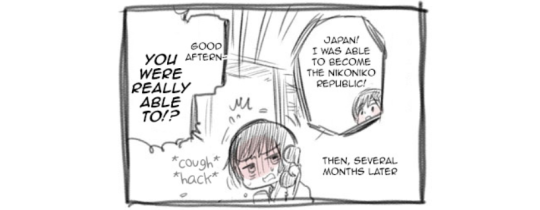
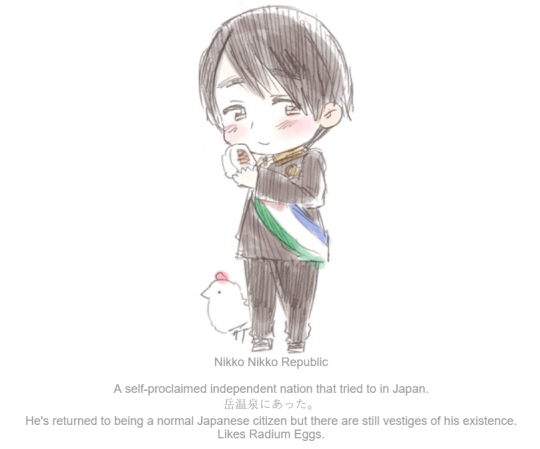
He’s a human who attained micronation status, representing a section of a city in the Fukushima prefecture.
He had previously told Japan that he planned to become a micronation, but the latter didn’t believe him.
Japan’s reaction to Niko Niko becoming immortal attests to the fact that this isn’t a typical case of nationhood.
How Niko Niko experiences nationhood, such as
having his health and well-being be based on his economic performance and
halting aging all together, is normal. What’s abnormal, or rather, “irregular”
is how Niko Niko was able to attain nationhood.
Likewise, Niko Niko
gives up his nationhood and becomes a normal Japanese citizen again. He also
resumes aging and is able to have a son.
It’s noted in another strip that in
contrast to Niko Niko, it would be more difficult for a regular nation to
become a human [x] – which is possible in canon, by the way, post on that here [x].
Sealand:
Sealand is also noted to
be abnormal, regardless of the fact that he’s not officially recognized.
For one thing, his body
(geographic landmass) is small. This causes other nations to have concern over
Sealand’s ambitions to become a formal nation, as it would be too hard on his
body and heart.
Seborga:
Seborga is interesting
because he used to be an independent nation, became a part of Italy, and then
later declared independence again despite still living as an Italian.
His experience of
nationhood confirms my “organization” argument. Before, Italy used to be composed
of several independent city-states.
Those were the ‘nations’ of the time, given how vastly different they
were and how people organized and identified themselves.
If that’s the case, then
I wouldn’t be surprised to see Genoa still existing in the present, albeit this
not being confirmed in canon. Point is, the Genoan identity and culture are
still prevalent enough today to warrant his existence.
Ladonia:
Ladonia is an internet
personification. Notice again that it’s how people organize themselves, not the
officiality of the title the matters in prompting the personification’s
existence.
Wy and Age:
One last abnormality
about the micronations that differentiates them from traditional [formal]
nations is their age.
Traditional nations are
usually born as babies, with the exception of Germany.
Meanwhile, micronations
vary in age.
Ex: Wy emerges as an older child.
There’s really no
explanation for this. The micronations are supposed to be strange and irregular
as we’ve seen from the above reactions toward Sealand and Niko Niko.
In sum, while many
things about the micronations are inexplicable, there is a consistent logic to
their existence in that they represent an organization, culture, and
personality of people. Nationhood applies to all personifications – it’s not
the title of the region that matters but instead the title in which citizens
identify themselves.
It’s, uh, complicated. The micronations are both similar and vastly different from ‘regular’ nations. While I’ve touched on this before, there’s lots more that I didn’t and would like to discuss!
One, I don’t appreciate your tone. I’ve already said before that my word isn’t law. This is a place for discussion, not me indoctrinating or forcing my outlook onto others. You guys are my check and balance, and in no way are you obligated to agree with me.
Two, calling someone an uncle is not mutually exclusive from being a father figure. They can go together.
My justification is that all the other Nordics are waiting for Santa Claus and Finland to appear. Ladonia generically refers to them as Uncles.
Denmark comments that any kid would refer to them as an uncle. Ladonia later refers to them as Swe’s friends. I think this correction and differentiation on Ladonia’s part is him being embarrassed by Iceland’s initial confusion at the label of being called an uncle.
Considering how Ladonia first uses uncles generically as they all wait, which happens to include Sweden, this is why I believe that he grouped them together to fall in line with how he perceives his relationship with Sweden. Like you said, Sweden acts as a father figure to Ladonia, but given how much pride Ladonia takes in his independence, I don’t think he sees him this way.
Further, what differentiates Sealand and Sweden’s more explicit parent-child relationship is that Sweden actually adopts Sealand, not to mention the fact that Sealand isn’t autonomously recognized.
[Side note: I know who you are :O …You asked me this first off anon???]
So, about the whole Prussia situation: since nothing is
confirmed in canon, I’m going to keep coming up with possible theories and
explanations. All of which, in my opinion, make some sort of sense. This time,
I’ll be presenting evidence that suggests that Prussia is neither dying, a
nation, nor quite a human.
In “It’s a treasure box of countries”, we’re given a
goldmine of information with regards to the rules of nationhood. We learn that NikoNiko,
a human who achieved micro-nation status, went back to being a regular citizen
and human. It’s also stated that it was difficult for NikoNiko to revert back
to being a human, despite resuming normal aging again.
However, the last two bits of information are crucial.
First, we learn that when a nation’s culture or personality dies, said nation
in question will fade; that or the nation entrusts themselves to their
successor. That’s what most people, including myself, have speculated about
Prussia’s fading status as the personification of East Germany.
On the other hand, Hima also drops this last little bomb on
us.
Yes! It’s possible for the ex-nations to become political
representatives, as opposed to personifications. What’s more, we’ve seen
Prussia attend world meetings with Germany. For example, in the strip titled
“Germany’s Playing an Impossible Game”, Prussia is seen attending an EU
meeting.
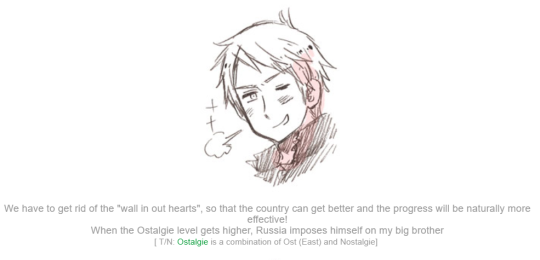
Further, I think this may be a typo on the translator’s
part, but Prussia at the end of the strip states:
For the sake of this post, I’ll be making the assumption
that he actually said, “the wall in our hearts.” Why? Because we’ve already
seen with Sealand that the nation’s landmasses are reflected in their physical
bodies. What I mean by this is that because Sealand’s landmass is a minuscule
fort, being a nation would be hard on his heart.
Simply put, it would seem the hearts Prussia is referring to
relates back to German Reunification following the fall of the Berlin Wall. Yes,
we get it, it’s very heavily implied that he’s East Germany (especially with that nostalgia pun, geez). Just call him it already, damn it! Enough with these
roundabout East and West nicknames.
Anyways, why do I think Prussia’s a representative then?
Well, aside from the fact that he’s attending world meetings, we’ve seen in the
“Private Concert” strip that he doesn’t heal from his injuries quite as fast as
a regular nation would.










 Ellawritesficssometimes