

Nationhood:
To understand why micronations and provinces/ states
–aside from the country they’re part of– exist, it’s important to understand
how broadly nationhood is defined in the manga. Nationhood and the respective immortality it
brings is not exclusively given to formally recognized nations. In fact, the
modern nation today is a fairly recent method of human organization. Humans
used to organize themselves far differently, ranging from city-states, clans,
tribes, empires, kingdoms, etc..
I say this only because the personifications exist
as reflections of their people, regardless of how they organize themselves.
What’s important is that they all share a common identity. As such, nation in
the manga doesn’t strictly apply to the sovereign countries that exist today.
Ex: Prussia and the Knights Templar represented
Catholic Religious Orders.


As reflections of people located within a specific
geographic region of a larger country, territories, provinces, states, and
prefectures are also personified.
Ex: In one
post, Hima created a dialogue with several American states. While this is a
hypothetical scenario, as they haven’t been canonically personified, it’s the
possibility of their existence that matters.

Ex: China’s provinces are personified.

Please note that all examples of intra-state
personifications can be found by searching up the “states and provinces tag” on
the English translation of Hima’s blog, Bamboo Thicket [x].
Put another way, personifications exist because
they represent a culture and a personality. How I interpret personality is that
it’s a reference to evidence/ remnants of the personification’s existence, such
as historical artifacts or architecture.
If no one remembers or cares about the
personification, then their existence is threatened. The same goes for culture.
Without a culture, the personification can’t exist [x]:
“Usually, when the culture or
the country’s personality dies/disappears, the country would gradually
disappear or entrust him/herself to the country that takes over him/her.”
With all this in mind, it should be noted that not
everything about the nations’ existence is logical.
Ex: In the first chapter of world stars, they’re
described as odd and strange beings.


That said, what this post will explore is the
abnormalities of the micronations’ existence. While not everything can’t be
explained, there is some logic to it that I’d like to run through.
Let’s go through some examples.
The Republic of Niko Niko:
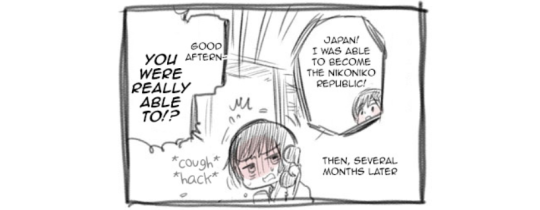
Niko Niko is easily the most abnormal micronation.
He’s a human who attained micronation status, representing a section of a city in the Fukushima prefecture.
He had previously told Japan that he planned to become a micronation, but the latter didn’t believe him.
Japan’s reaction to Niko Niko becoming immortal attests to the fact that this isn’t a typical case of nationhood.
How Niko Niko experiences nationhood, such as
having his health and well-being be based on his economic performance and
halting aging all together, is normal. What’s abnormal, or rather, “irregular”
is how Niko Niko was able to attain nationhood.

Likewise, Niko Niko
gives up his nationhood and becomes a normal Japanese citizen again. He also
resumes aging and is able to have a son.


It’s noted in another strip that in
contrast to Niko Niko, it would be more difficult for a regular nation to
become a human [x] – which is possible in canon, by the way, post on that here [x].
Sealand:
Sealand is also noted to
be abnormal, regardless of the fact that he’s not officially recognized.
For one thing, his body
(geographic landmass) is small. This causes other nations to have concern over
Sealand’s ambitions to become a formal nation, as it would be too hard on his
body and heart.


Seborga:
Seborga is interesting
because he used to be an independent nation, became a part of Italy, and then
later declared independence again despite still living as an Italian.


His experience of
nationhood confirms my “organization” argument. Before, Italy used to be composed
of several independent city-states.
Those were the ‘nations’ of the time, given how vastly different they
were and how people organized and identified themselves.
If that’s the case, then
I wouldn’t be surprised to see Genoa still existing in the present, albeit this
not being confirmed in canon. Point is, the Genoan identity and culture are
still prevalent enough today to warrant his existence.

Ladonia:
Ladonia is an internet
personification. Notice again that it’s how people organize themselves, not the
officiality of the title the matters in prompting the personification’s
existence.


Wy and Age:
One last abnormality
about the micronations that differentiates them from traditional [formal]
nations is their age.
Traditional nations are
usually born as babies, with the exception of Germany.

Meanwhile, micronations
vary in age.
Ex: Wy emerges as an older child.

There’s really no
explanation for this. The micronations are supposed to be strange and irregular
as we’ve seen from the above reactions toward Sealand and Niko Niko.
In sum, while many
things about the micronations are inexplicable, there is a consistent logic to
their existence in that they represent an organization, culture, and
personality of people. Nationhood applies to all personifications – it’s not
the title of the region that matters but instead the title in which citizens
identify themselves.


 Ellawritesficssometimes