Most canon? I’m not sure
what you mean by that, but this is Okinawa’s character [x].
Do you think Czechoslovakia could be considered canon? I
mean, they were married and all and the split was called a divorce, so…
While it is hinted that they miss living with each
other, (i.e., Czechia not having Slovakia to hand her a towel when she takes a
shower and Slovakia realizing that Czechia makes better toast), as well as the
fact that they both get flustered and embarrassed whenever this topic arises,
they haven’t explicitly confirmed feelings for each other. Therefore, it’s not
canon [x].
Additionally something I’ve noticed, in the post where
America grumbles that England didn’t give him any chocolate: Not only was
America eating it in a gluttonous seeming manner to show England he didn’t
care, he had a whole bucket of it. That kind of ideology ‘if i have much more
of ___ then i can be happier and better than other people’ seems excessively
America-esque.
It is very much “America-esque!” It’s part of his
characterization. He hoards things in bulk due to being poor and not having had a
lot of possessions when he was younger—notice the link with the chocolate again! [x].
If you want to analyze this psychologically, he filled the void of his loneliness with material objects that would only fulfill him temporarily. It didn’t adress his lacking interpersonal life.
Is there a reason
for why a nation’s immortality can spread to other living beings?
Not that I can recall. My guess is that because time functions differently for them, an
invisible forcefield envelops around their body. Humans or pets that get close
to the nation and the different pace of this time forcefield for prolonged
periods of time subsequently causes them to experience time differently too.
I also forgot to mention something! We do have an instance
of a nation’s immortality rubbing off on a human: Howard the Spy from volume 3 [x].
Himaruya notes that while England took precautions not to spend
too much time with Howard, it’s possible that he may have lived and stayed
youthful longer than the average human [x].
Hey, do you remember the time where himaruya
promised that the story of chibitalia and holy rome will have a happy ending?
What do you think about that?
I’ve done a longer post on this, but I’m 90% sure that the
Chibitalia storyline mimics Disney’s version of Cinderella [x].
Making the unconfirmed assumption that Holy Rome is, in
fact, Germany, I think the big reveal is going to pan out with Germany finding
the old pair of panties that Chibitalia gave to Holy Rome as a parting gift [x].
Since objects in the manga have proven to trigger repressed
memories [x], I think that’s how Germany’s officially going to find out/ not
being able to deny anymore that he’s Holy Rome.
I mean, how else would they have a happy ending if Holy Rome isn’t alive?
Over the course of the series, I’ve
found several clever ways that Himaruya uses the nations physical bodies and
interactions to reflect wider historical, social, and political circumstances.
Political pressure and suppression:
Typically, I’ve noticed that the
use of physical force between a dominant and subordinate nation reflects
political pressure and suppression. Russia is a prime example of this. You’ll
often see him squeezing, bending, and pressing down on other nations—obliviously,
of course. Remember that he’s unaware of his cruelty [x].
Ex: I’ve speculated before that
the reason Latvia is so short is a symbolic representation of how he has been
politically marginalized and controlled for a significant part of his history [x].
In other words, he lacked the
independence and autonomy that would have allowed him to achieve growth and
flourish on his own. His growth was stunted by virtue of him being pushed down
into submission.
Latvia citing the reason for his
shortness as a result of Russia pushing down on his head, to me, acts as a
wider metaphor for political suppression.
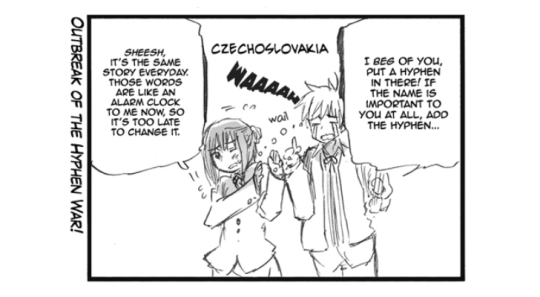
Ex: Russia squeezes and hugs Czechia and Slovakia to end
their dispute over whether they should include a hyphen in their name. In this
context, the hug is Russia asserting pressure over not what he thinks should be
their name but rather what their name will be [x].
Ex: In the strips depicting the Baltics path to independence
from the USSR, Russia squeezes Lithuania’s shoulders [x].
Conflicts:
Wars and battles can also be depicted in seemingly trivial
interactions between nations. The battles occur literally but are repeated figuratively
in these interactions.
Ex: To symbolize how France picked at the remains of some of
Austria’s lost territories after the War of Austrian Succession, France also
loots from Austria directly [x].
Servility and Class:
Different classes and social status are reflected in the
clothing that dominant and subordinate nations wear. Nations who are
conquered, annexed, or made to be under the control of another nation are
adorned in servants’/ maids’ clothing.
Ex: Chibitalia becomes a servant to Austria after being
conquered [x].
Ex: Lithuania acting as Russia’s servant while the latter
attended a world meeting on both of their behalves.
Do you think America trusts his own gov?
currently only 18% of the us trusts the gov and the rest doesn’t. I’m not really
sure if they’ve gone over that in hetalia, the only time I can actually think
of one time were america was unsure(??) of his gov, is that one ep where he
finds Tony but his boss or gov tells him that he can’t tell anybody and that it
didn’t happen. Maybe I haven’t found anything yet or I’m just looking too deep
but yeah I was kinda wondering that.
It’s not clear on
whether he trusts them or not, not that he really has a choice on obeying them anyway. Nations are
forced to comply with their bosses’ orders regardless of their own will/
opinion over the matter [x].
You’re talking about the
Roswell incident where he was deliberately lied to about the UFO by his boss
(the president) and was instead told that it was a weather balloon. (Source: Assault☆The neighbor’s Roswell Incident.)
Because
that’s one of the minimal scenes where we see him interacting with his boss
(another example would be in the “Black Ships have sailed” strip), there isn’t
enough information to form a solid conclusion on what you’re asking.
@amuamoami asked: Are
there any other african (black) characters in hetalia besides Seychelles? The
only issue i have with hetalia is that I dont see much color diversity.
There
is color diversity (e.g., Ecuador, the Asian nations, Spain, and Portugal— not to be confused with race, which doesn’t exist in Hetalia).
Cameroon is the only other official black character with a full
design [x].
There’s an unconfirmed female who may or may not be an African nation that visits Seychelles in Volume 6 (most people speculate that it’s Madagascar due
to the use of third person in one panel).
Lastly, there were some “chibi head”
illustrations that appeared in Gauken Hetalia [x].
I understand your sentiment. On the other
hand, Himaruya does have a habit of travelling to countries before he creates a
character for them. There’s also the whole matter of how messy and complicated
it would be to try to depict the subject of colonialism intersected with race.
It would be pretty unavoidable if he were to create these characters.
What are your personal opinions on Czechia and Slovakia?
They’re some of my favourite characters!
They’re hilarious
together! I love them! Taken out of context, this scene is even funnier for
some reason [x].
There isn’t much to base
my opinion on, unfortunately. There are very few interactions between them.
Ex: India comes to
England’s aid after the American Revolution and heals the latter [x].
Do you have any particular mischaracterizations of Hetalia
characters that you absolutely hate? This can also include falsely portrayed
relationships and such.
Hate is a strong word, but I definitely get irritated.
People’s inability to reconcile the idea that
deleted material is deleted material and that the shock “perverted” humour used
in the past by Himaruya, while incomprehensible, is no longer incorporated in
the series. France, in particular, would be a prime example of this.
This post will use attachment
theory to analyze Russia’s attachment style – how he forms relationships with
others – in adulthood. Unlike the case of Romano’s characterization [x], where
you can argue that attachment theory is actually used, this post applies
attachment theory to Russia for the sake of amusement. Although, things
strangely make a lot more sense when you look at him from this
perspective.
What is attachment theory?:
Attachment theory focuses
on the relationship between a child and their caregiver. Central to the theory
is the concept of needs. A child relies on their caregiver to protect them,
provide for them, and care for them. If all these needs are consistently met,
the child develops a healthy attachment to their parents. This healthy attachment style positively
affects both the child’s personality and their capability to establish and
maintain healthy relationships as they grow older.
However, if needs are not met at all, or are sometimes met and
at other times are not, this inconsistency causes the child to develop unhealthy attachment styles. As
such, they develop unhealthy personalities and form unhealthy relationships
with others.
The Ainsworth experiment was where this theory
originated. To test the attachment styles between toddlers and their
caregivers, they would put them in a room together at first. After a while, the
parent would leave and the child would be left on their own. Then, a stranger
would be introduced to the room and leave after the toddler had a chance to react.
The last part of the experiment analyzed the toddler’s reaction once they were
reunited with their parents again.
Being in a “strange situation” – a foreign room, absence of a
parent, and meeting a stranger [danger] – created a lot of
stress in the child. Since children seek protection from their caregivers, this
stress and fear would typically cause the child to become upset and seek
reassurance from their caregiver. It’s a survival instinct that innately kicks
in.
Those with a secure [healthy] attachment style would
cry or be upset for a bit but would be easily calmed once their caregiver
soothed them. The healthiness of this attachment style means that the child
knows that the parent is there for them – they can be relied on to satisfy
their needs.
While there are several
different unhealthy attachment styles, only one is important for this
post. An organized/ unresolved categorization is where Russia fits best. A
child with this attachment type functions better when their parent isn’t
around.
This is typically seen in
children who are abused and view their parent (s) as a source of fear. The
parent’s care is inconsistent in that they provide for the child and the child
attaches themself to them out of an instinct to survive; however, the abuse also
makes the parent the enemy. In the strange situation experiment, these children
would often approach their parent with hesitation or be paralyzed with
fear.
As adults, their attachment
system is subtle and needs to be activated. If they’ve had past traumas, such
as abuse, then they become disorganized. This often involves dissociation and
slipping in and out of consciousness. So long as they have trauma(s), they’ll
be disorganized. Sometimes, they’ll act in ways that are completely dependent
on others (activation), and at other times, they’ll be completely detached – perhaps from
reality.
What’s Russia’s attachment style?:
Russia’s organized/
unresolved attachment style, for the most part, stems from his relationship
with General Winter, who acted as his parent figure. The inconsistency of
General Winter’s care for Russia is seen in how he protected Russia from
invaders and yet attacks (abuses) Russia on an annual basis [x].
It’s far
from a healthy relationship. Not to mention that General Winter wasn’t always
able to protect Russia from countries who were accustomed to colder climates,
thus adding to the inconsistency of care that Russia received.
On the other hand, General
Winter wasn’t the only one who altered Russia’s conception of what a normal
human relationship is like. Having been conquered over and over again, in this
case by the Tatars, Russia normalized unequal power in a relationship.
This is why I believe that he
rejected becoming Lithuania’s friend when they first meet as children. They
didn’t have enough “power.” Notice how Russia’s environment has completely
misconstrued how he associates and attaches himself to others. What you’ll see
is that just like General Winter, Russia will repeat this abuse once he assumes
a position of power over others.
Point is, with a character
like Russia, there is no right and wrong. He’s not evil, and he’s not good. He
can’t have morals if he doesn’t realize that what he’s doing is wrong,
especially if it’s all he’s ever learned.
As such, Russia’s
understanding of friendship is warped. He believes that everyone is his friend,
including General Winter, his abuser.
A good example of this would
be when Lithuania points out to Russia that he shouldn’t really consider the
Allies to be his friends, given how they’re all ruled by self-interest. Russia
becomes dejected at this; he truly thought that they were his friends.
Russia’s Trauma:
We also know that given
Russia’s particularly rough and bloody history, he’s carried a lot of trauma.
Ex: A happy New Year’s for him
was not freezing to death [x].
Ex: He’s had several dramatic
shifts in government [x].
Ex: His bosses have tortured him. In this example, they ask him to stop a tank with his body.
Ex: During the Stalinization
era, he’s tasked with building a canal with no food or adequate clothing while
his boss – presumably Stalin – eats in front of him and wears a parka [x].
As mentioned above, because
Russia was subjected to so much violence, it’s been normalized for him. While
this is obviously wrong, violence is how Russia’s learned to solve his
problems [x].
Although, this isn’t canon,
Russia’s heart falling out – to me – acts as a metaphor for the fact that he’s
never learned what love is, let alone experienced it. Yes, he has his sisters,
but they couldn’t always be around for him.
Russia’s Dissociation:
There are several instances
in the manga where Russia dissociates to cope with a stressful situation.
A common coping mechanism for Russia is to
imagine being in a warm place, a long-time wish of his [x].
He also appears to
disassociate when he’s threatened with punishment if he doesn’t build a steam
engine [x].
In response to Latvia’s
trembling, Russia starts shaking him around and then snaps his neck –
presumably killing Latvia temporarily. Notice how Russia doesn’t even realize
the scope of what he did [x].
Activation:
While Russia is childish –
and therefore arguably detached from reality – there are moments where his
attachment system gets hyperactivated. His
childhood trauma is kicked into overdrive, and he becomes…terrifying.
Ex: When Lithuania outsources
himself to America after WW1, Russia isn’t exactly keen to see the latter off [x].
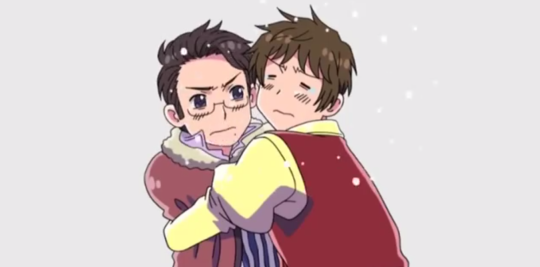
Ex: He’s commonly spotted
hugging and squeezing Soviet countries from behind to communicate his
possession over them/ desire to possess them.
Ex: He asks Moldova to call
him older brother [x].
Ex: In the present, Russia
wonders whether the ex-Soviet countries consider him as a friend.
Obviously, given the physical
abuse they were subjected to, they’re not very keen to be close to Russia. At
the same time, they also appear to realize that how Russia experiences his
reality and relationships isn’t normal. Again, he doesn’t realize that what he
did was wrong.
Just to put things into perspective, from a criminal law point
of view, Russia probably wouldn’t be convicted for his abuse, given that he
lacks the mental capacity – mens rea – to fully understand what he did.
In sum, Russia’s not an inherently
evil figure that maliciously inflicts abuse onto others. Instead, he’s a character
who has experienced his fair share of evil, and because it’s all he knows, he
inflicts this same evil on others. Of course, none of this pardons or justifies
his past actions, but hopefully it gives perspective into why he acts the way
that he does.
It’s somewhat similar, but Russia sends [political] pressure
in the form of hearts. Since he grew up under repressive rule himself and considers
anyone to be his friend regardless if they abuse him or he abuses them, force
is the only way he knows how to communicate with others.
Similarly, to end the hyphen dispute between Czechia and Slovakia, he squeezes them together in a hug.
Marriage with the nations is a lot different than
traditional, primarily Western notions of it. It arises more out of a sense of
political duty, an arranged alliance or
partnership, and sometimes it just so happens that a romance forms between
the two countries involved.
Typically, what I’ve seen is that marriage at its core in
the series involves two countries merging together, either into a co-state empire,
a co-state kingdom, or a separate sovereign nation with distinct ethnic groups
and cultures. There aren’t any ceremonies, but rather, it entails a mutual dependence
and relative respect between two political entities.
That said, it’s important to mention that two countries joining
together via annexation does not fit into this marriage equation. There’s a
difference between being conquered and subordinated and forming a mutual
union. On the other hand, that doesn’t go to say that there’s perfect equality or
power balances in marriages between nations; Austria’s control over Hungary is
a perfect example of that.
All right. Let’s go over some examples of marriages, shall
we?
Austria’s character is known for his quirky tendency to
solve his problems through marriage.
First, there was arguably his early ties with Switzerland. I’m
counting this as a marriage mainly because it involves the use of the word
partnership and honeymoon (albeit jokingly).
Notice how as soon as one tries to control the other, the partnership ends. While Switzerland does
reveal some fondness over his early memories spent with Austria, there’s
nothing particularly romantic about it, especially given the fact that they
were young children at the time. Again, marriage for them is essentially the
joining together of nations.
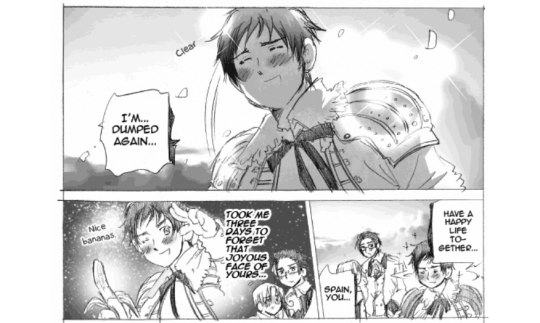
Next, Austria marries Spain via the Hapsburgs Monarchy.
Here, you actually see a hint that Spain harboured romantic feelings for
Austria during the Austrian Wars of Succession. It was a political merger
that likely later involved the development of some intimacy between the two.
Then, you have Hungary. After the dissolution of the Austro-Hungarian
empire, it’s very heavily hinted that Austria still bears feelings for Hungary.
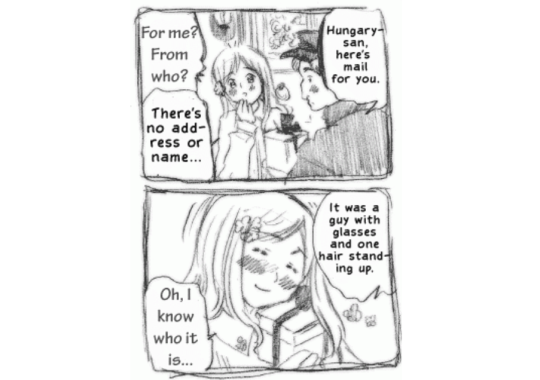
In Buon San Valentino, Hungary receives roses from an anonymous man that’s
conveniently described as having glasses and one hair sticking up.
On the other hand, there are marriages that involve little
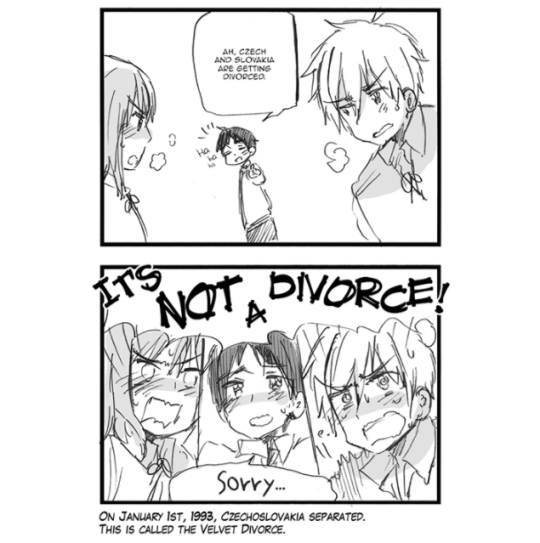
or no romance at all. Take Czechoslovakia for example, two countries united by a
hyphen. Yes, that’s an actual joke in the series.
Still, what’s interesting is that when Bulgaria talks about
their separation in terms of a divorce, they’re quick to deny the claim, mainly
because of the romantic connotation marriage carries.
How I interpret this is that the two may have developed
feelings, but never told each other.
Bulgaria bringing up the topic of marriage in a casual political
sense merely may have caused them to get defensive because of these unvoiced feelings.
This isn’t confirmed, so don’t take it at canon value.
I know I’m repeating this, but it’s important that I make
this as clear as possible:
Marriage = a merger between two countries.
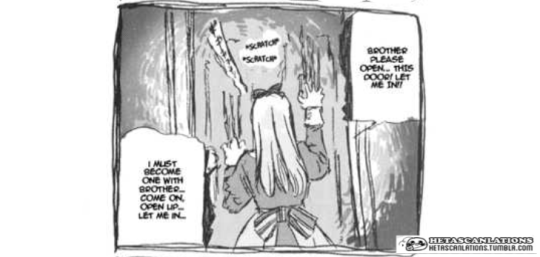
I say this because I’m going to apply these rules to Belarus
and Russia. Belarus wants to marry Russia and loves him to the point of obsession.
She’s even forgotten her own language at one point in favour of learning Russian.
But, does it ever say that Belarus loves Russia in a
romantic way?
No.
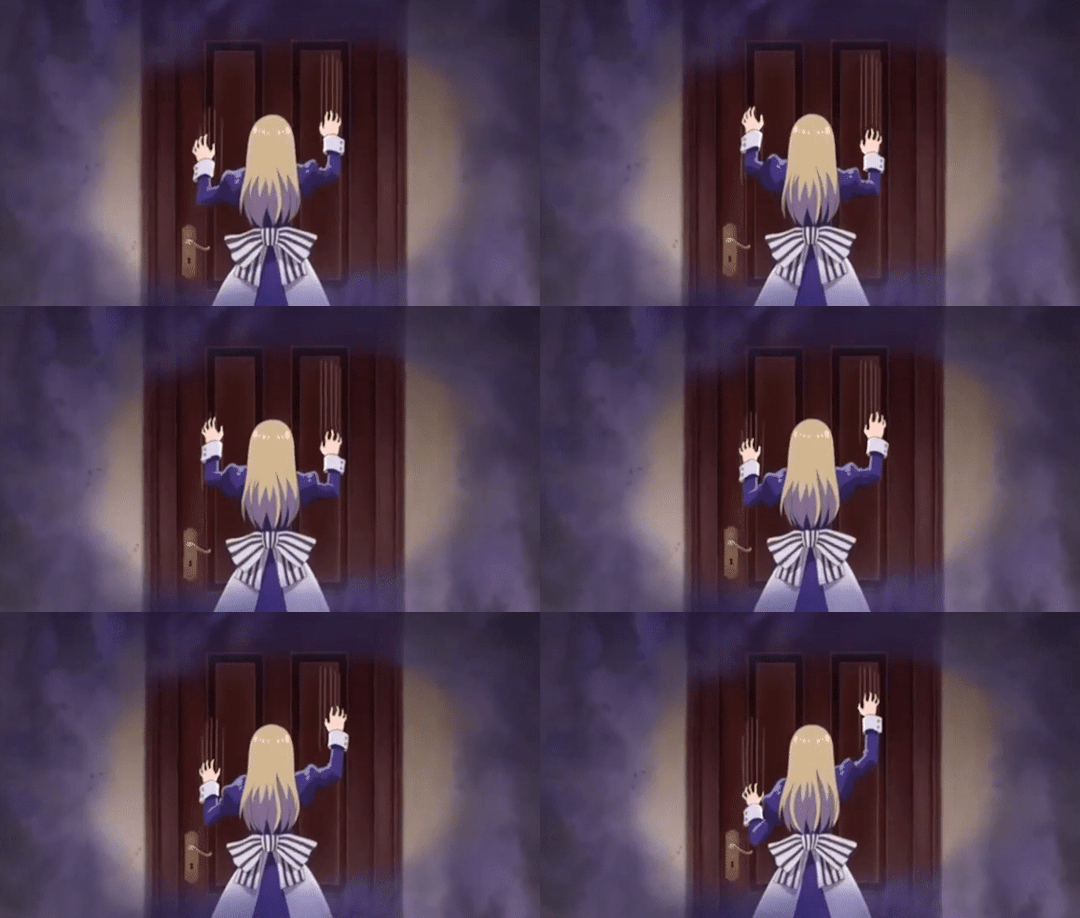
What it does say is that she wants to “become one” with him.
Sounds like a merger if you ask me.
When Belarus says marriage, she wants their countries to
join together. There’s nothing romantic about it, so hopefully this stops
people from misinterpreting their relationship.
In summary, marriage between the nations seems to involve a political
merger between two countries (partnership, co-ruled kingdom/empire). It can have
a romantic element to it, but this isn’t always the case.







 Ellawritesficssometimes
![[x].](http://hetalia.kitawiki.net/index.php?title=File:Okinawa-tan.jpg)