image
image

What this post aims to do is cover Japan’s relationship with
other Asian nations. While a tricky subject for good historical reasons, I
think that while he initially had a rough start, Himaruya does a fair job of
balancing a narrative that promotes worldwide peace and reconciliation without
trivializing or obscuring the tragedies of the past.

By that, I mean that while there are many unresolved
historical issues between Japan and other Asian nations, Himaruya is still able
to have the respective personifications get along amicably. They’re not
portrayed as close personally, but they are nonetheless civil and friendly. To
portray them in the former fashion would be insulting, especially given how there
are still tensions regarding how these unresolved historical issues are to be
properly compensated for and addressed. 

Nonetheless, Himaruya is able to work
around this and the narrative of world peace by portraying them as being civil
with each other. He even offers several instances where Japan expresses regret
for his past actions—albeit implicitly.

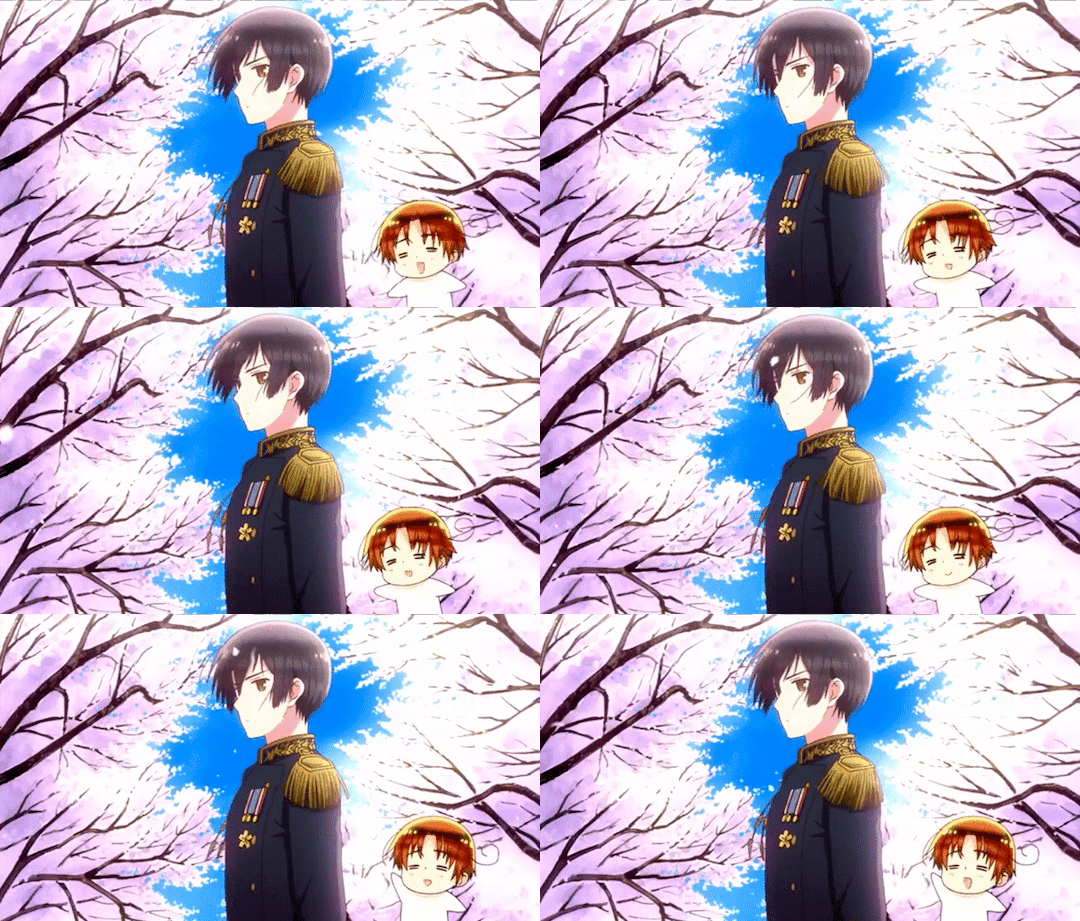
There’s this panel, which alludes to his desire to make
peace in East Asia and achieve reconciliation. I’ve done a longer post on this
here [x], and there’s also a scholarly article that covers the meaning behind this
specific panel in much more detail. Point is, Hetalia doesn’t trivialize or
obscure these dark historical realities but rather it offers hope for the
potential of reconciliation and co-operation as well as the capacity to
overcome grudges.

Article:

Sands, A. T. (2013). Belittling japanese nationalism in hetalia: axis powers. Humanities and Social Sciences Review, 2(3), 125-144.


Source
: Volume 3. 

That said, let’s go over some examples:

China:

There’s the infamous scene where China is betrayed by Japan
during WW2. What I want to place particular stress on is how Japan disconnects
from the situation emotionally—notice how blank his expression is—and asks
China to forgive him.

Source: Hetarchive, The Story about the Early Days of China and Japan.

image
image
image

Chafed and devastated, as he raised Japan and considered him
to be a younger brother, China fears that war has changed Japan and that the
two will never reconnect. Russia reassures him that time will heal their wounds…and
they do.

Source: Hetarchive, The Story about the Early Days of China and Japan.

image
image

It takes a long time, but the two do in fact reconnect. China’s
character song, “Aiyaa 4000 years” expresses China’s longing to look under the
same moon as Japan again (i.e., to reconnect.) China’s signature verbal tick—aru—is scattered throughout the whole song; it’s not until World Stars that
we learn that his aru is symbolic of his hopes, dreams, and romance.

Source: Hetascanlations, World Stars Chapter 43. 

image

In the same World Stars Chapter, we see the two of them
working on improving their diplomatic relations.

image

Another example of their co-operation would be them
designing postcards together.

Source: Hetarchive (Bamboo Thicket, eng trans., Oct 26th, 2011). 

image
image

Again, they may not be as close as they used to be, but they’re
nonetheless on relatively good terms with each other.

image

South Korea:

As mentioned, Himaruya had a rocky start and many lessons to
learn after his characterization of South Korea received a lot of [warranted]
flack.

South Korea claims to hate Japan and will disagree with
anything he says at world meetings, yet he also seems to aspire for Japan’s
approval by mimicking him and showing the latter his creations.

Source: Hetarchive, It’s My First Appearance and All I Get Are Some Scribbles!  + Hetarchive,  Opening of the Meeting at the Center of the World

image
image
image

Unfortunately, that’s the brink of their relationship, since
South Korea’s poorly chosen perverted tendencies have caused Himaruya to
ultimately abandon using the character. Because of this, I can’t comment on any
progression in their relationship. The point I want to emphasize is that they
don’t outright hate each other. Although, South Korea’s grudge is certainly
present in what little interactions that we have.

Taiwan:

Taiwan is the Asian nation whom Japan probably shares the
closest relationship with.

From the inception and early sketches of the series, she is
seen defending Japan, telling China to back off from him.

Source: Hetarchive, Taiwan’s Web Profile.

image

In the present, the two also get along just as well.

Taiwan is very friendly with him.

Ex: She tells his fortune for fun.

Source: Volume 4, Ilha Formosa ~Beautiful Island~

image
image

Ex: She gives him chocolates for Valentine’s day. It’s
hinted that she may even have romantic feelings for him, judging by France and
Italy’s suggestive expressions.

Source: Hetascanlations, World Stars Chapter 42. 

image

Hong Kong:

This relationship is more indirect, but it still tells a
lot. Hong Kong considers China to be his teacher, as they currently reside
together. The fact that Hong Kong finds it suitable and acceptable to ask Japan
for favors is indicative of China having no problem with them interacting.
Although, it is humorous that Hong Kong turns to Japan rather than relying on China to
help purify the air in his country.

Source: Volume 6. 

image

All in all, it’s not so much that Hetalia leaves tragedies
of the past unacknowledged. It’s satirical genre in tandem to its promotion of
world peace limits what it can cover and what stories it can tell. On the other
hand, it doesn’t trivialize or erase these tragedies either. Instead, while
seemingly simple, it’s able to promote narratives of co-operation and civility
in spite of past and current political tensions.

image
image
image

As most people already know, the nations’ body parts represent
different geographical landmarks/ land within their territory..

What I’ve found particularly interesting about Hetalia is
that it plays around with the idea of Cartesian Dualism, conforming to its
rules at times, while at other times subverting it.

The basic and essential principle is that the mind and the
body are two separate things. Himaruya, on the other hand, blurs those
boundaries.

I’ve broken down representation of this dualism into a model
consisting of three categories.

1)     
Physical body part = geographical elements

2)     
Geographical element –> personality influence

3)     
The sociological collective –> bodily influence

Let’s break down these categories.

Physical body part = geographical elements

Fairly self-explanatory. As mentioned above, geographical
elements of the nation are reflected in the personification’s body.

Source: Comic Diary 2, Hetarchive.

image

Geographical element –> personality influence

The body in question here is the
body of land as opposed to that of the personification’s.

In these instances, the geography
and/or climate of the country affects the personification’s personality.

Ex: Iceland’s volcanoes and cool
weather are reflected in his canon hot and cold personality. He’s quick to rise
with anger but just as quick to cool off. 

Source: World Stars Chapter 114, Hetascanlations. 

image

The sociological collective –> bodily influence

This last category has more to do with the collective unconscious
of the society in question.

Ex: Both Italy brothers’ curls represent the “sexual
something” of Italians and function as an erogenous zone.

Source: Notes and Etc, Hetarchive.

image

Ex: Austria’s mole is said to have a similar function to the
Italy brothers’ curls.

Source: Hetarchive (Bamboo Thicket, eng trans., June 26, 2008).

My best guess is that this is a reference to Freud, who
believed that humans at their core are primarily sexual and aggressive beings
and that civilization exists only by repressing these urges into the unconscious mind.

Lastly, although it doesn’t exactly fit into this category, Austria’s glasses also represent his “musical something.” It would stand that this is a larger reflection of Austrian culture considering that classical music is something they are known for. 

Source: Hetarchive, Notes and Etc. 

image

In sum, while I understand that Himaruya likely didn’t have
an intent of tracing out and implicating Cartesian Dualism into his characterizations,
it still provides us with an interesting lens to analyze his work. It also proves
that a lot more thought and consideration was put into the characters than he’s
given credit for.

Q & A

image

I wanted to ask about Belarus. Does she have an
outdated personality like France? Should I consider her old appearance as
inaccurate?

I’ve said this before, but very
little is known about Belarus. She’s a bit of an anomaly, so I’m not inclined
to form a solid opinion on her.

Most of the canon information about
her personality is from an untranslated PC game that Himaruya created and posted
on his blog. As for any changes? She appears in a few non-linear strips and the
first three printed volumes but makes a marginal appearance in World Stars.

Where we do see her more often is in
the Holiday Events (e.g. in Halloween 2011 and Halloween 2013-2014 you get
larger glimpses than in the Christmas Holiday Events where she also appears).

Judging by her character there,
she’s still obsessed with Russia and has violent/ impulsive tendencies, yet
she’s also calm and almost…regal at other moments [x]. However, it’s nowhere near
to the same extent as some of the borderline insane information given from the
PC game.

image
image
image
image

(She mistakes Taiwan’s greeting as normal lol). 

I’d prefer to have a recent arc of
chapters/ strip deliberately focusing on her before I assess what aspects of
her characterization have remained and/or if it hasn’t changed at all.


Since Mochis are versions of the countries they
represent, does that mean that America’s strange dad complex can be backed up
by the weird lettuce-daddy Mochi comic strips? Cause Lol, I hope so.

I really wanted to
say no to this but knowing Himaruya, that literally might be a factoring
reason lmao. Although you have to remember that this lettuce also once wanted to
take over the world, only to be eaten by Canadamochi [x]. 

image
image

Okay so this has been in my mind for a while. I
was reading over some chapters from the manga to establish notes for myself and
came across the terms ‘junior’ and ‘senior’ used. Specifically in the It’s a
Treasure Box Full of Countries and Ch. 201. I was wondering if it’s meant to be
out of age establishment (Hutt River calls Wy, Molossia, and Sealand juniors
and himself Wy’s senior) or ranks (Australia calls himself Canada’s senior but
could also mean age… )? What are your thoughts?

Most of the time it has to do with
chronological age.

Then again, you also have South
Korea asking Japan and China (who in the
series
are older than him) to call him older brother [x]

image

I saw something saying that romano has more
arabic(?) blood than italy, that’s why he’s darker than him (hair, skin, etc)
but I wasn’t sure if it was someones headcanon or canon

It’s considered to be canon by most
since his hair still remains darker than Veneziano’s. It’s listed in his Hetarchive
article [x]. Some LJ posts also link to Japanese fans who have saved old trivia
information that Himaruya later deleted from his blog. 


By the way, in one of your posts, you mentioned
that “in WW2 when he’s occupied by the Nazi regime, England takes France
into his home”. Can you show me which strip that’s in? (I can’t find
it…) Thanks!

It’s from Volume 5: “Liberté, Égalité, Fraternité and…”

image
image
image

Interpersonal
relationships:

Their perception of time is different, which makes it
difficult for them to establish close relationships with their citizens.

Ex: Canada spent
an entire weekend staring at Kumajiro’s eyelashes without realizing it [x]

image

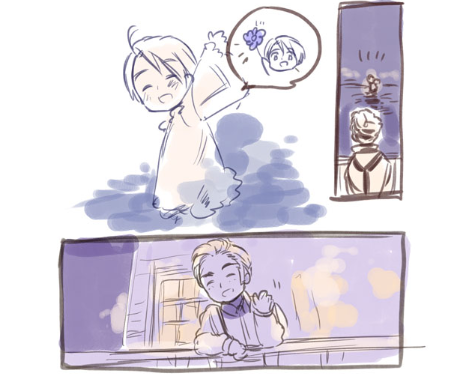
Ex: Young America
befriends Davie, and the two spend their time searching for a blue flower. America
leaves and goes, finding Davie as a young adult and again as an old man with grandchildren. 

image
image
image

Since time runs differently for nations, it’s dangerous for
humans to be close to them for too long. Himaruya cites that because time is so
warped for the nations, a human wouldn’t be able to be around one for so long
without losing their mind. Essentially,
the nations’ immortality would rub off on these humans but at a grave cost [x].

Ex: England was
careful not to spend too much time with Howard. Nonetheless, in a blog post, Himaruya claimed that it’s possible that Howard may have retained his youth and lived longer than the average
human [x]. 

On the other hand, the nations’ immortality can rub off onto their pets without any consequences. Animals don’t possess the same cognitive
skills to comprehend time the same way as a human can. If an animal remains as
a nation’s companion, they’ll age so long as they’re constantly with each
other. Should the pet not be around their nation, they would resume aging [x]. 

Lastly, another factor to consider is that the nations are
too preoccupied with “diplomatic talks, fights, and being commanded around by
their bosses.” This makes it even more difficult for them to form external personal relationships,
although there are instances where the nation forms strong relationships with their
bosses [x].

Status and Class:

I’ve talked about this before, but the nations aren’t celebrities
warranting high-end protection with limitless wealth.

Instead, they’re treated casually as if they’re any other
citizen.

Ex: They have passports [x]. 

image

It’s not “Oh my God! That’s France!”

but more like…

“Yeah, that’s him. Go, see him
for yourself,” [x]. 

image

The nations aren’t inherently wealthy either. Their wealth
and well-being depends on their economy (primarily their GDP).

Ex: France experiences an economic crisis and his wallet
runs dry [x]. 

image

In terms of housing, Himaruya’s said that the homes the
nations live in change depending on the era.

Ex: America first lived in a log cabin, then an “austere
English-style building in the suburbs, and now lives in an apartment building
near New York. Meanwhile, Italy’s lived in the same house and has remodeled it
over the years [x]

Ex: The American trait of living lavishly is reflected in
America’s present “luxurious” style of life. Using Italy again, he can’t afford
his electricity bill because he spends all his money on clothes instead [x] [x].  

image

Ex: During “periods of peace” (I’m guessing the original
question was referring to eras without political conflict), Japan is said to be
“a young man leading an ordinary life with a strangely high rank that nobody questions
(i.e., for someone so youthful, he’s doing pretty well for himself) [x]

As mentioned in previous posts, we already know that the nations
are subordinates to their heads of state. Said control is very extensive [x] [x]

image
image

Ex: England’s boss once limited his consumption of alcohol
and sweets [x] [x].

image
image

Work:

The nations all work for their bosses and attend meetings
(e.g., world meetings, EU meetings) [x] [x]. 

image
image
image

Some nations even go to school for post-secondary education. 

image
image

The type of work depends on their national industries.

Ex: America has done a hair iron commercial before [x]. 

image
image

Q & A

image
image

Not 100% sure, but
Himaruya has cited Osprey’s publishing work as his main source for military
uniforms [x]. If you would like more insight into the resources he uses, you can
skim through Bamboo Thicket. He lists dozens of the books that he uses as
history sources.

Side note: If
anyone’s ever wondering why some of the facts on the Roman emperors are a bit
off from mainstream understandings, Himaruya is really into new theories about
them that contradict traditional historical narratives.


Speaking of ancients, am I the only who thinks
it’s weird that Korea’s portrayed to be so young? I think the theory is because
of the division of Korea, but it kinda irks me when fans make him out to be
this immature little perv (I know Hima wrote him as such but still) because
Korea has almost 2000 years of culture and history; the fact that he’s seen as
“younger” than Japan is kinda wild too considering the south half of the
peninsula was the one to filter tech from China to the island.

No, I get that. Those choices were made in poor taste.
However, there’s also the possibility that Korea is second generation,
just like Egypt and Greece are with their ancient counterparts. It really
depends, because you also have Japan, China, and Turkey who don’t have ancient
counterparts,

Just laying out the possibility, but it’s important to note
that this hasn’t been confirmed.


Is the BTT a canon trio?

Their dynamic is, not the name [x] [x] [x]. 

image
image
image

Ok so I’m not sure
if America’s glasses are fake or real because I remember I was reading the
manga and he was talking to Canada and said “I tried wearing glasses how do
they look” (chapter 207)so that had to be around 1845 or early 1846 so if his
glasses are real glasses I guess he would start to need them as Texas became
more powerful. The stronger Texas is the worse America’s vision is and the more
he relies on his glasses.

He got them in an
unspecified period after his independence. However, given that they represent
Texas, I’m fairly certain it’s 1845 [x]. 

image

In consistency with the
rules from chapter 1 of world stars, France and England note that America’s
personality changed after he gained them (*title changes) [x]. 

image

They’re not real glasses,
though. In addition to representing land, they serve the purpose of a superhero
trope (e.g., Clark Kent taking off his glasses and becoming Superman) [x] [x]

image

image

They can eat, but I don’t recall them every being shown to
have any teeth…or any internal organs for that matter…[x] [x]

image
image

They have limbs and can produce flags. 

Why
Hetalia isn’t racist + why it doesn’t promote Japanese imperialism/nationalism

Before I start, it’s important to get a few points out of the
way given that many of the misinformed critiques of Hetalia have been made by
people who haven’t read the original source material (i.e., the manga).

  • There’s a difference between historical
    situation and promoting a horrid ideology. Just because a series depicts war
    and Nazis doesn’t mean that they’re inherently glorified. Of most importance is
    that Hetalia promotes peace and reconciliation in spite of depicting war.
  • The wars that are depicted are general and the atrocities
    are deliberately glossed over. This is necessary because Hetalia is comedic in
    nature.
  •  Hetalia is based on stereotypes, good or bad.
    While some of the jokes are admittedly offensive, no nation is singled out nor
    are any specific nations made to be superior in comparison to others. Every
    character is made fun of for their stereotypes. Its humour isn’t meant for everyone.
  • Hetalia is satire. It mocks war and nationalist
    sentiments rather than promoting it.
  • The dub is not canon. That includes many of the
    insensitive jokes that Funimation scripted. 
  • The anime itself is unrepresentative of the
    manga. It can only cover so much material. Don’t judge a manga by its anime
    just the same as you wouldn’t judge a book by its cover.
  •  It’s also important to note that Seychelles has
    always been dark-skinned in the manga, unlike in the anime where she was drawn
    as pale-skinned. However, I do concede that even in the manga, her skin should
    be darker [x].

Since I’ve already created many posts on this subject, here
are some resources corroborating the above points
: [x] [x] [x] [x] [x].

In addition, I’ve also found a scholarly article in a
university publication that does a fantastic job of not only dismantling many
of the misconceptions about Hetalia but also many of the baseless critiques
that have been aimed toward it:

  • It’s a fair, level-headed piece that uses original source material to prove that
    Hetalia mocks and undermines sentiments of Japanese imperialism and nationalism
    while also demonstrating that it takes a definitive anti-war stance.
  • What I particularly like about it is that it
    acknowledges that some of Himaruya’s early choices were made in poor taste but
    is still able to substantiate the stance that this insensitivity isn’t
    supportive of racist sentiments.
  • It also shows artwork/content that glorifies
    Japanese imperialism and nationalism and then compares it to Hetalia.

Overall, it’s very well-written, sourced, and informed. Below
will be a list of important quotes that I took from the article. I highly
encourage for people to read the whole thing, as it breaks down a good amount of examples from both the manga and anime [x]. The article can be found through Google Scholar.

Source: 

Sands, A. T. (2013).
Belittling japanese nationalism in hetalia: axis powers. Humanities and Social Sciences Review, 2(3), 125-144.

Quotes: 

“Hetalia does not
portray violence or accurate portrayals of history; Hetalia is a collection of
gags mocking militarism and stereotypes,” (125).

“Hetalia condenses
history for comical effect but retains an anti-war sentiment by belittling
wartime axis beliefs…In Hetalia, each character’s nation is targeted for
ridicule through its stereotypes, and I argue the stereotypes are not intended
to create a sense of racial inferiority,” (126).

“A close examination of
plot, character development and imagery reveals a subtle disdain for
nationalism, which purposes racism and false history,” (126).

“Manga and anime can be
a good outlet for nationalists to use, but it can also be a tool to combat
nationalism,” (128).

“For every Hetalia fan,
there is another furious anime blogger appalled by it. As the battle over
Hetalia’s purpose rages in anime and manga circles, academia has of yet not
entered the discussion with earnest,” (129).

“Hetalia does gloss over
almost all of the war, especially the darker parts of the war, but if you watch
the whole show, it is easy to realize the show is not about WWII,” (129).

“Korea as an ‘other’ in Hetalia is not nearly as
physiologically different from his Japanese counter part… Although Korea is not
portrayed physically inferior to the Japanese, critics argue his immature personality
and actions are racist. Himaruya’s choice to make Korea an immature teenager
rather than an adult may not have been the most sensible of choices, but it was
also necessary for him to create jokes tailored to Japanese stereotypes of
Koreans, which he could then subvert…On some levels, the jokes are insensitive,
and they are not politically correct,” (130).

The author also goes
on to mention how inappropriate and weird some of the “sexually charged” jokes
were, starting from page 131.

“In Hetalia, every nation has its moments when its actions
are designed to make people laugh at it, and Japan is no exception. Rather than
idolizing Japan, Hetalia’s representation of Japan is a socially awkward,
emotionally repressed, and sometimes obsequious character to be laughed at. He
is neither the proud solider in Sensoron nor the charismatic scholar of
Kenkanryu…

If Japan’s character had been a fearless soldier immune to
cultural gaffes, I would argue Hetalia would be purporting an idealized notion
of the “self” in order to promote nationalism. Himaruya’s version of Japan,
however, could not be farther from an “idealized self,” nor does he try to
blatantly dichotomize or attack a perceived “other,” (132).

“Hetalia does have politically incorrect and at times
racially insensitive caricatures. Gag comedy is based on jesting stereotypes
and thus has to have some degree of politically incorrect imagery and character
personalities. Neither in the original web comics nor in the anime version that
followed it did Hetalia attempt to isolate Japan as the dignified “self” people
should idolize. The “others” are often portrayed at the butt of the jokes, but
each nation also has its turn to be the dominant character, even at the expense
of Japan’s pride. Critics can dislike Hetalia for being tactless at times, but
I argue their accusations of supporting malicious racism are based on curt
examinations of the show, which do an injustice to Himaruya’s true intentions,”
(133).

“Hetalia’s critics decry it for more than just its perceived
racist notions; they also denounce it for its interpretation of WWII and other
historical events, which lack acknowledgement for grievances against Japan.
Gag-comedy constrains Himaruya to a small amount of time to touch on important
historical events, such as China’s discovery of Japan, Russo-Japanese War, and
WWII amongst others. The time constraints naturally appear as historical omission
for the sake of defending the nations; however, Hetalia does not attempt to
omit history to protect Japan’s pride, but rather it condenses history for
comical effect,” (133).

“By mocking the tools and ideas of war and degrading it into
a minute-long gag, Himaruya expresses his contempt for war and the foolishness
of man to pursue it, thus creating an anti-war message rather than glorifying
the imperial state as Kobayashi did,” (135).

Page 136: a good
example of how the Axis were anything but glorified, season 1 episode 18.

“Himaruya may have glossed over the atrocities of war, but
he did not glorify Japan,” (136).

“I believe that in season 4 episode 26, the final three
fragments before the credits represent Himaruya’s sincere belief in the need
for reconciliation amongst East Asian nations and Japan…Japan informs the viewer
he wanted to wait until the last to show his final technique, and in a close up
of Japan’s emotional face he proclaims, ‘But if you’re serious, I’ll get
serious, too! My final secret technique: Expression of Regret!’…

“The simplicity of the idea that peace could be solved by a
pair of underpants is the joke’s punchline, but I believe, underneath the surface,
it represents a metaphor that the path to peace and reconciliation in East Asia
is far simpler than assumed. For Japan, the path is regret,” (136-137).

“Himaruya is trying to make a comedy out of history. Hetalia
does omit many historical facts, but it was never trying to be a serious
historical discussion. When Hetalia condenses history for comical effect, the
imagery and dialogue indicate the scene is solely a gag. Himaruya’s metaphors
and cinematography suggest he views war as senseless. Rather than supporting right
wing nationalism, Hetalia appears to be a satirical anti-war anime,” (137).


Conclusion:

With all that in mind, Hetalia may have had its faults—and
still does to a far lesser extent—but
it has never advocated for war, racism, or nationalist and imperialist drives.
If anything, interpretations of the series have caused the exact division that
Himaruya’s writings have long been opposed to.

image
image
image

The answer to the title is yes, yes indeed. While the nations
aren’t overtly terrified at the sight of America, they’re still nonetheless
wary of him. From their perspective, what’s worrisome about America is his
youth and impulsivity. Now add the fact that he’s one of the leading powers in
the world, and you’re in for some destructive outcomes.

What you’ll see is that America is often equated to a child
given how he had been isolated from the world after gaining his independence. He’s
unpredictable, naïve and bossy. In other terms, he’s inexperienced, and this
leads to a growing sense of wariness and caution among the other nations.

It’s like handing over the reigns of the world to a toddler.
They may have good intentions, but only end up creating an even bigger mess than
before.

This fear of America, then, is often the result of how ridiculous
and childish some of his ideas are. England even states that America has a “flawed
sense of reality.”

image

Again, given America’s dominant position on the world’s stage,
this isn’t something you want to see in a leader.

Here, America’s ideas are perceived as “nightmarish.” To be
fair, his world defense plan was to construct a ranger squadron, whatever that
means. 

image

Either way, notice how he’s also referred to as a “brat” and “child.”

image

This child-like imagery comes up in how America interacts with
the other nations too. In that same meeting regarding his squadron defense plan,
America asks for a vote to be taken on it. What’s important here is that when
he offers the possibility of other nations disagreeing with him, he snaps a
bundle of spoons.

image

To me, that seems like an obvious intimidation tactic of someone
who is incapable of hearing alternative opinions. That said, I want to point
out how well child development patterns fit in with America’s characterization.

Children are inherently egocentric until about 6-8 years
old, as they lack the capacity to think outside of themselves. They only focus
on their own personal world and bubbles of fantasies before eventually
realizing that there’s a much larger world out there. Please note that this
egocentrism is not intentional; they just haven’t matured yet.

Still, this panel clearly illustrates that America believes himself
to be the only “player” [in the game of life].

image

America’s egocentrism for the most part is unintentional.
His isolation has made it hard for him to think from the perspective of others,
as he had previously grown accustomed to only looking after himself. That’s
where the “not being able to read the atmosphere” running gag likely comes
from.

However, as seen with the spoon incident, America is more
than capable of reading the atmosphere when he wants to if it means getting
what he wants…

…and that’s often other nations agreeing with him. Pay
attention to how uncomfortable South Korea gets here when claiming that he
agrees with America. Even more important is how in the panel above, South Korea
had no qualms in disagreeing with Japan.

image

No doubt, America is
bossy. Said bossiness and desire to get his way all the time is what’s
intimidating to the other nations.

Another display of this child-like bossiness would be when German-occupied
France and England are having an argument (big surprise), only for America to
step in and declare that he’ll decide on whose opinion is right.

There’s a bit of a discrepancy in the translation, but this
version has France say, “America, you scary boy!”

Meanwhile, my print version says, “What a frightening child,
you are!”

Regardless, both convey the same message. America does in
fact scare the other nations, sometimes.

image

One last example would be Netherlands warning Isolationist
Japan of America’s impending arrival. Once more, you see America’s youth being touched on.
Likewise, this youth is formulated as a reason of warning and caution.

image

With all that in mind, and for transparency’s sake, I’ll end
on this note: While America does often make the other nations feel uneasy, he’s
also frightened very easily himself.

Whether it’s ghosts, occasionally Russia, or sleeping alone, America is
possibly and ironically one of the biggest fraidy-cats in the series.

image
image
image

China after Japan betrays him in WW2.

image

South Korea uses mind-reading binoculars, only to find out that China is annoyed by him.

image

An insecure Italy having Germany repeat that he doesn’t
hate him.

image

Russia during Bloody Sunday.

image

Davie.

image

What I presume you all look like now:

image