Q: If
the UN has a personification does that mean the EU also has a personification
or is it not significant enough to have one? Another question is that why do
you think certain countries haven’t been given a personification in the hetalia
series, countries like aph Indonesia and Hawaii, is there a reason for this or
is it just a creative choice by the creator?
A: The EU does not have a personification.
There’s no real reason for this. It doesn’t have anything to do with
significance.
As for creating other characters, Hima typically cites that he
wants to travel to the country in question before he personifies them.
Q: How
much does France like anime?
A: A
significant amount considering that it’s so popular among his people.
Characteristics of the population are often reflected in the personification’s
attitude, behaviour, habits, and overall personality.
Ex: He’s
involved in a debate over anime voice actors with Japan, Taiwan, Vietnam, and Thailand.
Q: Any
theory of why France has some perverted tendencies? I know that he just likes
to show affection to others, but sometimes it goes too far.
Q: Why does France strip people, like that’s a pretty recurring
theme from the napoleon strips he was shown to have the thing stripping people from their clothes
and during the Christmas event of 2007 he stripped a bunch of nations naked.
A: It
did go too far. The old characterization of France is pretty awful. However,
the sexualized humour of it is not what people think. It’s honestly just bizarre,
but it does have a logic to it.
France’s stripping of people doesn’t have to do with a French
stereotype of sexuality from my understanding. It’s a historical representation
of how France picked and reaped at leftover territories after European conflicts…
a scavenger if you will. A good idiom in relation to this would be stripping something to the bone.
Just like France stripped Austria for winnings after the War of
Austrian Succession, this was likewise translated into how he interacted with
other nations – by stripping them. [x]
Hopefully, this makes sense, yes?
Q: Do
you think that England has some “big brother” trauma?
A: 100% he does.
Ex: England tears up when he’s faced with the prospect of
becoming America’s guardian. At first, he actually hesitated in accepting the ‘big
brother’ label because of how poorly he was treated by his own older brothers. [x]
The bad memories of his older brothers’ treatment of him that England doesn’t even accept the label of ‘big brother’ at first when he assumes responsibility for America.
Also…
Q: Are
the nations’ homes and/or things provided by the state or they work and earn
money themselves to pay for their own stuff?
A: It’s not clear whether the state provides anything for them.
All we know is that the nations work for their bosses and that the wealth of
the country is reflected in how much money the nation has (e.g., GDP).
Ex: France’s wallet is empty as a result of his economy’s poor performance. [x]
The personification is a physiological embodiment of their nation. Each city/ landmark is reflected in one part of their body.
That’s why, when France ‘rubs’ Italy’s chest during an economic recession, he’s looking for territory to leech money off.
Do you see what I mean by bizarre logic?
On top of aspects of Freudian theory, I’m also of the
mindset that Hima has incorporated aspects of attachment theory. The dialogue
at one point directly makes reference to it, as I’ll soon reveal.
What this post will explore is how Romano’s inconsistent upbringing
caused him to develop hostile feelings and a distrust of others when he was a
young child.
What is Attachment Theory?:
Attachment theory focuses on the relationship between a
child and their caregiver. Central to the theory is the concept of needs. A
child relies on their caregiver to protect them, provide for them, and care for
them. If all these needs are consistently met, the child develops a healthy attachment
to their parents. This healthy attachment style positively affects both the
child’s personality and their capability to establish and maintain healthy
relationships as they grow older.
However, if needs are not met at all, or are sometimes met
and at other times are not, this inconsistency causes the child to develop unhealthy attachment styles. As such, they develop unhealthy personalities and
form unhealthy relationships with others.
The Ainsworth experiment was where this theory originated.
To test the attachment styles between toddlers and their caregivers, they would
put them in a room together at first. After a while, the parent would leave and
the child would be left on their own. Then, a stranger would be introduced to the
room and leave after the toddler had a chance to react. The last part of the
experiment analyzed the toddler’s reaction once they were reunited with their
parents again.
Being in a “strange situation” – a foreign room, absence of a parent, and meeting a stranger [danger] –
created a lot of stress in the child. Since children seek protection from their
caregivers, this stress and fear would typically cause the child to become
upset and seek reassurance from their caregiver. It’s a survival instinct that
innately kicks in.
Those with a secure [healthy] attachment style would cry or
be upset for a bit but would be easily calmed once their caregiver soothed
them. The healthiness of this attachment style means that the child knows that
the parent is there for them – they can be relied on to satisfy their needs.
While there are several different unhealthy attachment
styles, only one is important for this post. An insecure ambivalent/
preoccupied attachment style is seen where the caregiver returns but is unable
to sooth the child. The child often responds with anger, and sometimes they can
even become aggressive.
The unhealthiness of this attachment style means that the
parent inconsistently meets the needs of the child. In other words, their care
for the child is inconsistent. They’re either overbearing when they meet the
child’s needs, or they’re completely unavailable and don’t meet them.
This inconsistency causes a sense of hostility and distrust
to develop in the child. They don’t want to rely on their parent, but know that
they have to if they want to survive… a love-hate relationship if you will. The
anger and aggression are symptoms of this contradiction.
Let’s tie this back to the strips.
What’s Romano’s attachment style?
What you’ll see with Romano is that he has an ambivalent/
preoccupied attachment style stemming from two parental relationships. His needs
were not consistently met since Ancient Rome spent most of his time rearing Veneziano. The unavailability of care.
Then, Romano falls under Spain’s rule, someone who goes out
of his way to care and provide for Romano. The
overbearingness of care.
Romano’s Hostility:
As stated above, children who don’t have their needs met
consistently react hostilely to their parents. This is especially the case when
the inconsistent parent attempts to provide or care for the child – the child
doesn’t receive it well.
Ancient Rome’s parenting style left a mark on Romano. He
developed a hostility towards parental figures. This is why I believe he
reacted to Spain so harshly at first.
Spain babied Romano. He cleaned for him, cooked for him, and
clothed him. Romano wasn’t used to having these needs being met and responded
with anger because it was the only feelings he had to express. It was likely
the first time he had received affection and care on a consistent basis.
This would explain what happened when Spain went out of his
way to buy Romano new clothes. He blushes, unsure of how to process this
foreign experience, and simultaneously insults Spain.
Why is it that Romano doesn’t clean and Veneziano does? It’s
the constant presence of a parental figure that I believe accounts for their
differences. Veneziano had someone to care for him more often, and as such, he
adopted the modelled behaviours that he was exposed to. Meanwhile, Romano doesn’t
know how to take care of himself because he wasn’t cared for.
[This doesn’t mean to say that Rome didn’t love Romano. Not at all.]
Spain changed that. He became Romano’s protector and
caregiver. Romano, while still possessing feelings of hostility, grew to accept
this given that, like a young child, he sought out protection in Spain during
the uncertain and dangerous circumstances of war.
This consistency in care eventually results in Romano
learning to trust Spain. The problem is that Spain was initially oblivious to
this. He refers to Romano’s outbursts as “uncute” and expresses confusion
over why Romano acts out like this.
More importantly, he questions why Romano isn’t attached to him.
What Spain grows to learn is that Romano’s anger is how he
expresses affection – his reciprocal need
for care and affection.
For example, when Spain meets with German soldiers, Romano
perceives them as the enemy and begins to attack them. He tells Spain to run
and ‘sacrifices’ himself. In his mind, he was returning the favor by assuming
the role of the protector.
When Spain reprimands Romano for this, the consistency in
care is broken.
Spain doesn’t recognize this right away, but Romano helps him
by expressing his frustration at having Spain getting angry with him.
This was a big step in Romano’s perspective. You have to
step into his mindset, childish as it is. He was putting Spain first by ‘sacrificing’
himself to the soldiers, only for Spain to criticize him for it. Of course, he’s
going to get upset.
What’s sad is that Romano doesn’t know how to process these
conflictual feelings. He feels both affection and hostility for Spain. Once
again, it’s the inconsistency of care in the relationship that’s causing this.
The beautiful part of this strip [x] is that Spain finally
enters Romano’s world and understands that Romano’s “uncute” behaviour is
actually how he expresses his affection.
Hence the teasing strip title of “Boss Spain Doesn’t
Understand.”
This understanding, where Spain apologizes for criticizing Romano’s
‘sacrifice’ allows the two to reconcile and meet each other half-way.
In sum, Romano’s hostility toward Spain was not him being an
ungrateful and spoiled brat. If anything, this behaviour stems from a child who
had nothing, only to receive everything and being confused as to how to react
to it.
Up next: How some of Romano’s childhood hostility and attachment
style still resides in his adulthood.
The way that Spain obliviously gets on Romano’s nerves
always makes me laugh…
Spain’s apologizing to Romano here, but only ends up
irritating him by rubbing a tomato against his face.
I mean, to be fair to
Spain, it’s an accurate comparison. [x]
In previous posts [x][x], I’ve laid out the rules that explain what
affects a nations’ health. This post, however, will elaborate in more detail to
show the different ways in which they can be affected and why that is.
For one thing, we know that the personification’s health is
predicated on their economic and political situation. That is, if they are
suffering from political issues (either domestic or international) or are
experiencing an economic recession, they will fall ill.
That said, let’s go through the symptoms they can experience.
They can get colds or fevers:
Ex: Several nations develop fevers or colds in reaction to
the Great Depression.
Ex: Austria will develop a high fever and eventually collapse if
Germany acquires a cold [from an economic slump].
“A reliable country that likes to approach things with a sober seriousness. He approves of and supports lots of Germany’s ideas so he may look like one of the helper countries, but in reality the level of his dependency is pretty high.
So high that when Germany catches a little cold, Austria goes straight to high fever and eventually collapses, and so he doesn’t have much of a choice than to take good care of himself.”
Ex: England develops a cold after the American Revolution.
They can suffer from fatigue and exhaustion:
Ex: The aftermath of the Napoleonic Wars.
They can die:
Ex: Spain nearly dies during an economic recession before
Romano starts helping him recover with imports.
They can cough up blood:
This symptom in particular is depicted more as a consequence
of war (which includes separate battles/attacks) or civil strife. You’ll often
see the most devastated nations coughing up blood in panels where Hima
introduces different sides of the conflict.
Ex: Prussia, Spain, and Italy during the Napoleonic Wars.
Ex: Prussia during the American Revolution.
Ex: China during WW2 after being betrayed by Japan.
Ex: The disunity in the Holy Roman empire causes Holy Rome
to fall ill and cough up blood. His political situation isn’t stable, which, in
turn, is reflected in his poor health.
Bonus case:
The nations cough up blood and get sick during conflicts,
but are nonetheless able to heal from these wounds with time as their country’s
situation stabilizes.
But, what if a personification never healed emotionally from
a conflict and keep reliving it over and over again?
Wouldn’t that explain why England coughs up blood and falls
ill every year during the fourth of July? The event is still fresh in his mind,
and regardless if it’s over and done with, his body reacts as if it’s still
happening.
It depends on their position within the global economy.
As such, a nation’s health depends on their political and economic situation. They catch colds during economic recessions.
The Great Depression strips are a good source for this, as each negative number assigned to a nation has a differential impact on their health. Since America was a manufacturing powerhouse at the time, his stock market crash affected them all.
Ex: Japan obtains a cough, meanwhile Poland runs a high fever.
In modern strips, we’re also provided with the fact that Austria will slip into a high fever and eventually collapse if Germany even so much as catches a cold.
“A reliable country that likes to approach things with a sober seriousness. He approves of and supports lots of Germany’s ideas so he may look like one of the helper countries, but in reality the level of his dependency is pretty high. So high that when Germany catches a little cold, Austria goes straight to high fever and eventually collapses, and so he doesn’t have much of a choice than to take good care of himself.”
As for how serious it can get? Spain almost died from an economic recession.
In an earlier post, I talked about the lesser known sides of
Spain. This post will focus on the more obvious, yet ironically ignored,
positive aspects of his character. Spain has never been a plain character. The
problem is that his personality is often watered down, either as a result of
the anime or people choosing to selectively represent certain aspects of his
personality.
That said, let’s go over some examples.
He’s not a cheerful
ditz all the time:
Ex: He didn’t
take chibi Romano’s constant complaining without any resistance. On several occasions,
Spain’s shown to be calling him an idiot.
Ex: He’s an
emotional or “violent” drunk. It depends on which translation you have, but it
pretty much conveys the same thing.
My translation is a bit different from the one above:
“As long as you keep him away from booze, and don’t get on
his bad side, you should be fine.”
Ex: Prior to the
strip, teenage Romano had a huge obsession with fantasizing about/ role-playing
the medieval chivalric romance novels that he read. In comes Prussia, recklessly
spouting out keywords that seem to trigger Romano’s obsession again, much to
the latter’s dismay. Mother hen Spain quickly swoops in to give a deadly warning.
Ex: He melancholically
looks back on his and France’s rough childhoods.
Ex: When the
topic of discussions falls to what each nation is known for, Spain laments over
being known for cows and tomatoes.
He’s more than capable of reading the atmosphere:
Ex: His reaction
to America after the Stock Market crashes in 1939.
Ex: He’s
heartbroken when Veneziano chooses Austria over him during the Austrian War of
Succession. The scene alludes to the fact that Spain was deeply saddened in the
years following his divorce from Austria. Likewise, the way Spain revs up his
cheery attitude in light of being rejected seems to be more of a defense
mechanism, a guarded mask of emotions, than it is of his true personality.
I say this because Romano finds Spain weeping in the next
panel.
Ex: He solemnly hints to Chibitalia of what’s to become of him right before he and his brother are
both conquered.
His optimism is not out of sheer stupidity:
It’s more like it’s a desperate sort of optimism. The way
that Spain convinces himself to push forward with a smile is eventually
internalized until he himself doesn’t even realize that what he’s doing is
unrealistic and naive. As mentioned above, it’s also a coping mechanism.
Nonetheless, there are moments where he shows a deep awareness
of his economic/ political situation.
Ex:There’s a clear recognition that he’s lost his international
standing due to poverty.
Ex: Once again, his [desperate] optimism shines through in
how he copes with his weakened economy. He sings songs, and acts happy…
…but he’s more than aware of how deep and serious his money
problems are. He’s literally clinging to Germany, albeit for exaggerated humorous effect.
He may have a laid-back personality…
…but once he gets worked up about something, his passion
replaces his typical lazing around.
Ex: He fought to have olive oil continually be marketed as a staple product
of the EU.
Again, with Spain, it seems that the happiness he forces
onto himself allows him to get too carried away in what he does (e.g., over-manufacturing and then causing a property bubble).
That’s why he comes off as naïve and a bit air-headed. You could even argue
that it’s a slight dissociation from reality to help minimize any anxiety that
he feels.
His constant smiling is also a play on the fact that the sun
never set in the Spanish Empire.
He’s selfless:
Ex: Despite all the complaining and constant belittling that
he had to endure with Romano, Spain still saves him from Turkey.
Ex: Spain spent all his money on improving Romano’s
wardrobe. [Please note that Romano was too young to realize this]. Meanwhile,
his own clothes were in tatters.
Ex: When Romano immigrates to America, Spain is the first
person he calls. Their relationship is noted to be much deeper than the one
Romano shares with Veneziano.
Immediately, Spain’s mother hen mode gets switched on as he
asks Romano how he’s been and if he’s been eating well.
He also lets Romano know how proud he is of him working and
taking responsibility for himself for once.
That said, it wouldn’t make sense for a character predicated
on a stereotype of passion to be flat and static. He’s anything but.
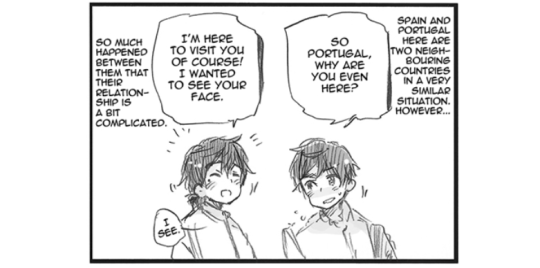
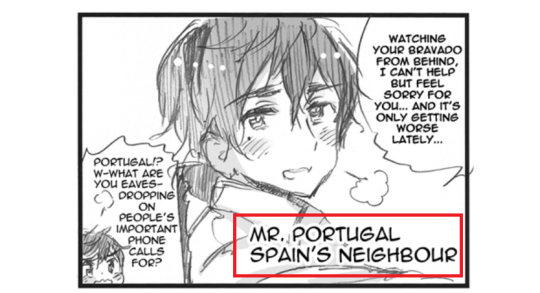
Thank you 😊! Here’s a basic rundown of the most relevant strips pertaining to Portugal. I’m not sure if there would be enough on him to do a full characterization post given how recent he is in the canon verse.
Portugal’s introduction can be found in chapters 77-80, and 83-84 of World Stars.
It covers his relationship with Spain, the Netherlands, Macau, Japan, and England. [x]
Ex: He had a close relationship with England, Macau was his underling, he had rocky trading relations with the Netherlands over Macau, and he had good trading relations with Japan. There’s also his hilarious teasing/ somewhat belittling relationship with Spain.
Here’s part of his first character note:
Now for your question:
I know for a fact that he’s not related to Spain. They’re simply listed as neighbors with a similar ancestral influence.
They’re noted to be similar in appearance, but not once are they ever mentioned to be brothers. They even recognize this upon being mistaken for each other.
Given the context, if they were brothers, they would have attributed the similarity of their looks to a blood-relation. They don’t, so it would follow that they’re not related.
I wouldn’t say this annoys me greatly, but it’s definitely a
bit of a pet peeve of mine. Hardly any Hetalia characters are plain or
undeveloped. Even the less developed characters such as Seychelles or Belgium
are given enough depth and personality [don’t worry, I’ll eventually cover
them, as requested]. Unfortunately, the anime doesn’t showcase this due to time
constraints.
Spain isn’t plain. He never was, and some people’s
description of him simply doesn’t give his character justice. Claims that Spain
doesn’t stand out from other characters are unfounded. It doesn’t even take a
lot of digging to find many highpoints in his character. They’re all there; let’s
not sell him short in light of falling back on the lazy and cheap argument that
Hima’s portrayal of him is basic.
While I’ve done a post highlighting the lesser known sides
of him [x], I think now would be a good time to highlight how wonderful and
selfless his personality is.
You’re very welcome. I
would like to point out that both nations you mentioned are not always cheerful
or empty-headed. They can actually be quite threatening and terrifying (especially Russia).
While
they don’t remember everything in vivid detail, they still carry their dark
pasts with them. It affects their
personality, and these temperaments show up when you least expect it.





 Ellawritesficssometimes