
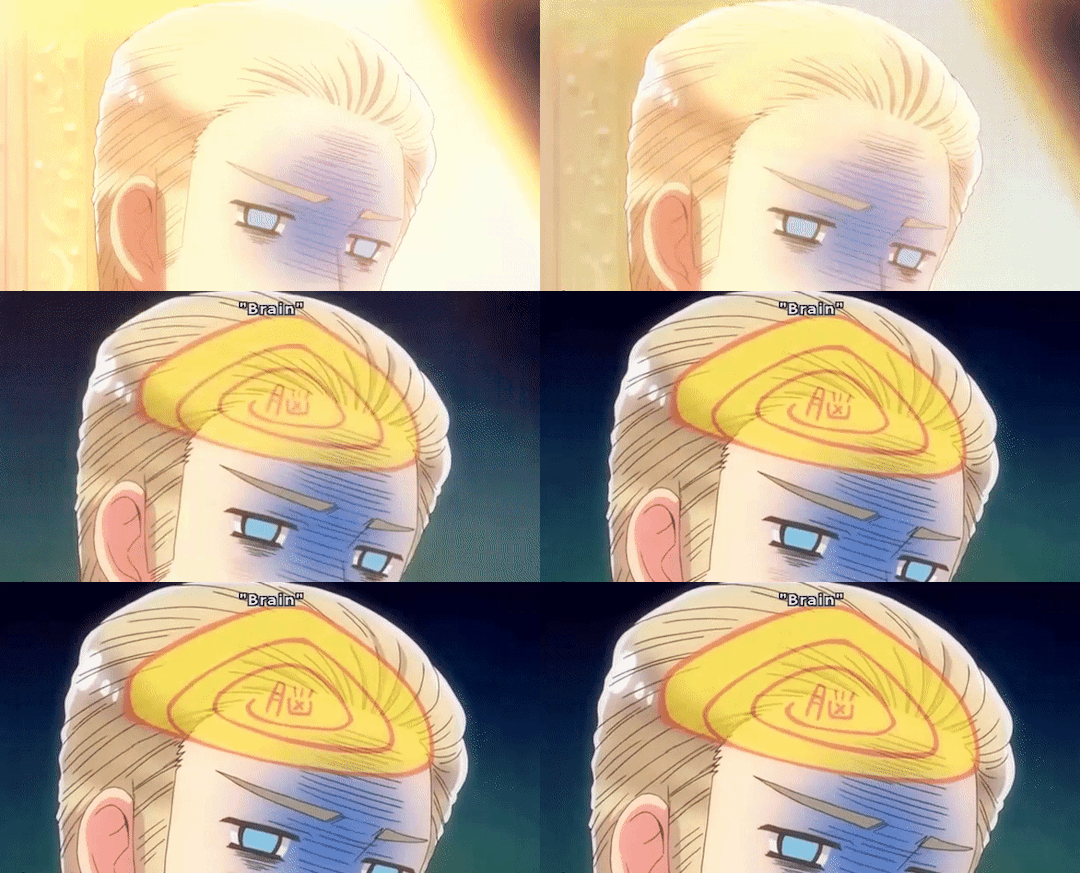
Before I start, it’s important to lay out some ground rules.
Thanks to Finland we know that the nations aren’t that
different from humans with regards to their physical strength and anatomy (with
the exceptions of Russia and America who are exceptionally strong).

The point in this is that the “not-so-different from a human
rule” pertains to their basic physiological structure. On the other hand, there
are immortal perks of nationhood, such as being impervious to experiencing the fatality of illnesses. They still can
fall ill, though. This happens when they’re….
1) Suffering from political instability.
2) They’re experiencing an economic recession.
3) There’s a rampant illness in their population (i.e Romano’s
Chorea).
With that said, we know that the nations are stronger than
normal humans regardless. They don’t age as fast, and as such, their memories
don’t deteriorate at nearly the same rate.
What this post will explore are the different examples where
nations have been shown to have gaps in their memories.

The thesis I’m putting forward includes a variety of
reasons to account for this:
One, older nations such as Japan and China have even larger gaps
in their memories as a result of their physical bodies aging. They’re therefore
unable to recall memories as fast as younger nations [This in part goes with my
third argument].
Two, the influence of their citizens pertaining to whether
or not the nations can see and therefore remember the existence of magical creatures.
Three, the nations simply aren’t able to remember
everything; it would be impossible.
And four, some
nations actively repress bad memories to minimize the anxiety and trauma they
previously experienced.
Without further ado, let’s go over some of these examples.
Age:
As stated above, the nations’ chronological age, while
influenced by their economic and political affluence, also seems to be affected
in part by how long they’ve lived (I.e. Both Japan and China refer to
themselves as old men.)
If Japan is shown to have higher blood pressure levels and hip pains as a
result of his old age, then it wouldn’t be too farfetched to assume that his
memory wouldn’t be as up to par as it would be in comparison to a nation younger
than him. Put another way, his age would cause him to have greater slips in his
memory.
It’s the body that’s old, despite not looking like it.


Ex: He’s unable
to remember who Lithuania is, and almost mistakes the latter to be Livonia.

Ex: While looking
through an album of him and Pochi throughout different periods, Japan
mistakenly recalls the chronology of them.

Likewise, China’s also referred to as an old man.

Ex: He admits to
being forgetful.

The Ability to See Magical Creatures:
We’ve also seen the impact on how a population’s belief in
magical creatures respectively influences whether or not the nation will be
able to see them.
Ex: During the
Meiji Era, England could see the kappa and youkai spirits, meanwhile Japan couldn’t
as a result of his people no longer believing in them as strongly.

However, just as a nation can forget about magical
creatures, they can also re-remember them if popular culture strongly believes
in them again – presumably it would have to go past folklore superstitions.
While enjoying Japan’s hot springs, the two talk about
folklore.

Notice how Italy spots a strange creature beginning to approach them.
Although it’s not shown, the discussion of the topic could possibly mean that
Japan [and not just Italy] is also able to see the creature.

There’s also an exact replica of this hot spring scene
dating back to when they first met during WW2. I don’t think Hima did this for
no reason:


Repression of Traumatic/Guilt-Ridden Memories:
As Russia darkly puts it, perhaps it’s a good thing that the
nations don’t remember everything.

When Lithuania and Germany allegedly meet for the first time
during WW2, Lithuania expresses relief over Germany not remembering him. It’s
noted that Lithuania once beat-up one of Germany’s family members. This is
possibly a reference to when Prussia became a lackey to Poland under the
Lithuanian and Polish Commonwealth.

This is highly indicative of Germany existing well before
his ‘birth’ in 1871 given that Lithuania is fearful of being remembered and/or triggering
Germany’s memory. If anything, Lithuania’s fear of this points further in the
direction of Germany suffering from amnesia.
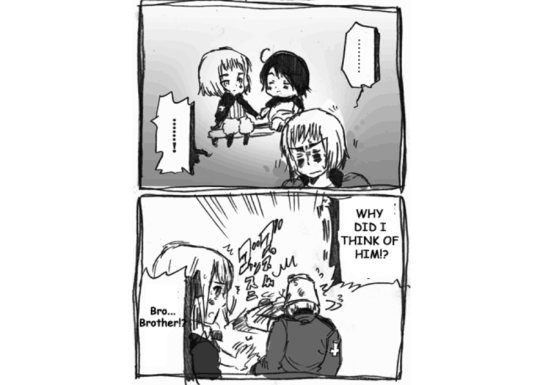
Why else is there a childhood version of Germany/Holy Rome pushing to be acknowledged in older strips? I’ve theorized before that this is
simply a part of his unconscious mind trying to get him to remember about his
forgotten childhood.

Or why is it that he’s seen to confusedly hold up Chibitalia in another strip?
“It’s me.” Jogging his memory much?

Similarly, Italy also dreams of a childhood version of
himself pushing to be acknowledged by him, only for Italy to refuse in doing so. Like
Germany, it seems that Italy has actively striven to forget his childhood.

Lastly, the most obvious hint of repressed childhood
memories is found in Buon San Valentino, where Germany appears to recall fuzzy
images of Chibitalia.

They Can Only Remember So Much:

Prussia is the one to confirm this rule, considering that he’s
taken to recording every experience as a method in circumventing the inability
to recall them. It’s simply a matter of jogging his memory.

In sum, while the nation’s memories are limited, there are
different factors and contexts that account for this phenomenon. Age, trauma,
civilian belief, and limited physiological brain capacity seem to be the most
common reasons in accounting for this.











 Ellawritesficssometimes