image
image

Misconception: He’s
emotionless.

Reality: He’s
expressive through non-expressiveness.

image

Ex: A smile for
him isn’t expressed as obviously as it is for some of the other characters.
Still, that doesn’t negate the fact that he has feelings. I mean really now.

image

Misconception: He’s
humourless.

Reality: He has
an implicitly “evil” and “mischievous” side. In other words, he’s often
playful, albeit subtly.

image

Ex: He’s the one
to come up with France’s punishment after the 2007 April Fools’ Event. This entails
getting France to praise everything about England’s culture for a whole day.

image
image

Ex: When at war
with each other, he was glad to have a legitimate reason to punch Denmark.

image

Ex: He goes along
with the Nordics’ plan to host a secret birthday party for Iceland. 
image

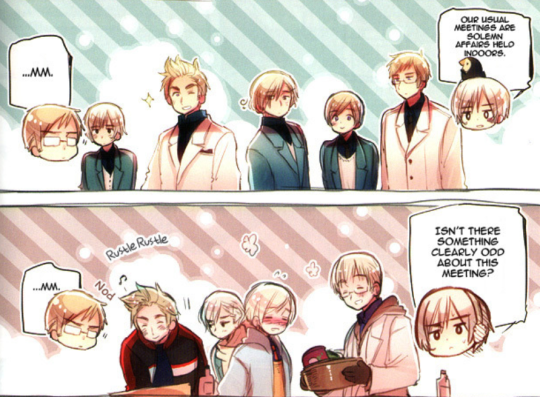
Again, the
humour is subtle as he wordlessly teases Iceland and makes light out of the
latter’s confusion over them meeting outside.

image

Misconception: He’s
intimidating inside and out.

Reality: His
external appearance is intimidating, but he’s tender and sweet on the inside.

Ex: During the
stereotypical café arc, Sweden’s customer is initially terrified of him.
Nonetheless, Sweden gives away the meal for free.

image

Ex: He acts as a
parent to Sealand.

image

Ex: Ladonia
refers to him [and the other Nordics] as an Uncle.

image
image

Ex: He’s good at sewing + uses this skill to adjust smaller clothes for Finland.

image

Misconception:
SuFin is canon.

Reality: Sweden
has confirmed feelings for Finland, but Finland doesn’t reciprocate.

In a lost 2007 blog post, Hima confirmed that Sweden has
homosexual feelings for Finland and only acts this way towards Finland. [That’s
literally what the translation says].

Ex: Finland has
repeatedly denied being Sweden’s “wife.”

image

Nonetheless, the two do share a close relationship, enough for Finland to refer to Sweden as “Swe.”

Ex: The two spend
their New Years’ Eve together in 2009.

image

Ex: This one-sidedness
is seen as early as when they were first colonizing America. Finland spots
America in the wild, and Sweden proposes the option of them having kids.

image

Bonus facts:

It’s left unclear as to whether Sweden can see magical
creatures.

image

He and Denmark used to hate each other, but have recently
calmed down in their temperaments. Of course, this is to be expected from their present welfare
and collectively-oriented nations.

Regardless, the two still tease each other in
the present time. 

image

[Denmark and Finland are imitating Sweden here.]

image

All in all, a somewhat mysterious, yet thoroughly entertaining character.

image

I really admire your blog :) If it interest you, would you be willing to do a character study of either one of these (your choice): Sweden, Iceland, Denmark, Estonia or Russia.

This was asked a while back 😅

image

Okay, Sweden it is today! 

I just want to point out that these characterization posts aren’t analyses or theories. I’m simply presenting canon material. 

It’s unfortunate and a bit tedious, but I have to play catch up for others by clarifying common misconceptions. Only then will I be able to get into the really deep and long theories that I have in store for later 😉

Post coming up tonight!

image
image
image

I get asked
about this a lot, so I thought I would clarify a few things…

“Why do the nations’ eye colors keep changing?”

Hima
directly answers this question on his blog by stating that there’s “sufficient
freedom” regarding the eye colors of the nations. This would include sometimes
adding light brownish or greenish tints.

image

Although,
this obviously doesn’t explain why Sweden and Finland have solid brown eyes (and darker hair) in the first episode of
the anime. Regardless, that’s an animation inconsistency, not a canon one.

image

Likewise,
if you’re wondering why eye colors go from blue to violet to green, as seen
with the Nordics, there’s actually a justified reason for this.

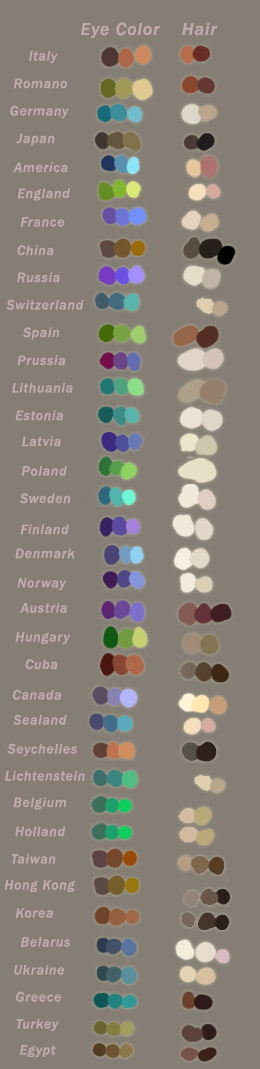
Hima
provided a chart years ago revealing the different range of hues/mixes that each
nation’s eye and hair colors can assume.

“I tried to put every character’s hair and eye color in order. Being that this is something like an approximation, they do things like change in illustrations. But it’s like this, and I hope it’s good and easily understandable.”

image
image

That said,
there isn’t really one correct eye color for the nations, nor is there one
correct hair color; it’ll always differ slightly.

Make sense
now?

image

You can find the chart here:

image
image

Iceland, huh? For such a minor character, he’s perhaps one
of my favourites, mainly because his personality is so interesting and, well,
relatable.

Let’s get some clarifications out of the way first: Norway is Iceland’s older brother. They’re
related.

After having an excavation done on his land, Iceland finds
out that he has no strictly Icelandic indigenous people. Instead, it was
Norwegians who had first settled there before travelling elsewhere.

image
image
image

Now, this is important in establishing a tentative ground
principle in understanding the family trees in the series. I’ve found a pair of
relatively consistent rules too: It seems that nations are biologically related
when…

1) There is one dominant nationality of sibling #1’s people living on the other
sibling’s land
– Ex: in this case, it would be early Norwegians initially
settling on Iceland.

And/ Or

2)  The
nations of the siblings are typically next to one another
– Ex: America and
Canada, Netherlands and Belgium, Germany and Prussia, &
Russia, Belarus, and Ukraine.

I know it’s messy, but remember that these rules are exceptive
and only apply when Hima explicitly makes them siblings. You can have
nations, like Spain and Portugal, who look alike due to similar ancestral
influences on their histories and cultures, and yet, they’re only listed as
neighbors with no biological
relation.

It’s important that I make this distinction only because the
Nordics all refer to each other as brothers in an affectionate way, despite us
knowing that they’re not actually related. Again, the only ones who are
confirmed to be related are Norway and Iceland.

There’s also the presence of brother figures in the series. Regarding Iceland, he sees the other Nordics as older brothers.

image

What’s
sad is that he didn’t get to meet most of the Nordics until the 18th
century.

image

While Denmark may have raised him…

image

…right from birth Iceland sensed that Norway was his older
brother.

image
image

Now for Iceland’s personality.

Predicating from his childhood and geographic isolation,
Iceland is unsociable. The irony is that he also feels lonely.

image

No one really knows anything about him, and he’s often the
odd man out.

image
image

Despite this alleged unsociability, Iceland still worries
about making friends.

image

Arguably,
Iceland is closest with Norway, who likes to “stick” into the former’s business.

image

While Iceland may snap at Norway and the other Nordics, he
secretly appreciates their concern – especially Norway’s. He doesn’t hate any
of them.

image
image

In fact, this somewhat erratic moodiness is actually part of
Iceland’s personality.

His contrasting warm (volcanoes, hot springs) and freezing
climate gives way to a polarizing temperament. As such, he’s noted to have a
hot and cool side.

image

This unpredictability in mood, metaphorically understood in
terms of how you never know when a volcano will explode, is seen in Iceland
right from birth.

image

His cool side relates more to his unsociability and shyness.

What’s more, his hot side doesn’t always have to do with his
temper or irritability. It can also mean the playfulness and mischievousness of
a young child.

image

Another fun fact is that Iceland is able to see Norway’s
magical creatures, albeit refusing to acknowledge this ability.

image
image

All in all, akin to his climate and geography, Iceland isn’t
static and is therefore far from your typical stock character. He has a
profoundly rich and complex personality stemming from a childhood filled with
neglect, isolation, and loneliness; the problem for him now is whether he’ll be
able to reconcile all this and open himself up to others more.

image
image

What would you say if I told you that a lot of the nations had
Roman look-alikes – more like clones
in the far past? Insane, right? Well, believe
it or not, it’s true.

First, there’s Augustus and Agrippa.

image

It’s crazy to me how uncanny they both look to North Italy
and Romano respectively. Despite some personality differences, they also share
a lot in common. Augustus is charming, charismatic, and weak at fighting.

Meanwhile, Agrippa
wasn’t given the inheritance he expected from Caesar (the title of Emperor). We
see the same thing happen with Romano and North Italy, as the latter inherits
most of Ancient Rome’s wealth once he passes on.

image

Further, Agrippa also shares Romano’s reserved nature, and
is only kind to those whom he is close with.

image

There’s also this picture that Germany draws of Italy. It’s almost
identical to the facial expressions Augustus makes. 

Note: It’s manga Germany is referring to, not a textbook.

image

Now here’s Augustus again:

image

But it doesn’t stop there. There are plenty more Roman look-alikes.
Here are just a few more examples.

Tiberius looks scarily similar to a Sweden without glasses. He
is also feared by those around them and is perceived as anti-social.

image
image

Mark Antony looks a lot like Denmark.

image
image

Japan resembles Ancientus quite a bit too.

image

Gothicus looks like Genoa.

image
image

Probus too looks a lot like
Norway, and is even stated that he perplexes people and is often misunderstood
for this.

image
image

Now, I know what you’re all
thinking, and as much as I want to blow the whistle and say that there is, there
actually isn’t any reincarnation present. Sorry to disappoint. Anyways, what’s happening
here is extremely strange, but also fascinating.

In a brief inter-text character
note, it’s stated that Quintillus is able to break dimensional boundaries and
travel through time. For example, he’s visited Japan and China before. What I want
to talk about more is Quintillus’s recent visit to Germany.

image

Prior to Quintillus’s visit,
Germany was doing research on Roman history, reconstructing it to make old records
more accurate. It’s for this specific reason that Quintillus visits Germany; to
clarify that his older brother Gothicus wasn’t as bad as people have portrayed
him to be.

image

Of course, true to his love for
science, Germany doesn’t believe that Quintillus is the ghost of a real Roman
emperor and dismisses him. What’s odd is that in the last panel,
Germany says, “That Roman boy is interesting.”

image
image

I don’t know, but to me this
indicates that Germany might know that Quintillus is a supernatural being, but
is only able to acknowledge this in private. You’ll see with Hima that he’s
obsessed with linking Germany to Italian culture and Roman history. Another
Holy Rome hint perhaps?

Nonetheless, let’s get back to the
proof against reincarnation. One would think that maybe as Germany is reliving
history, he imagines it with the faces of those around him, hence the
look-alikes. A sound argument, but the strips prove
otherwise.

Here,
Ancient Rome is seen talking to Probus, Norway’s Roman look-alike. 

image

Then, Gothicus, Genoa’s Roman
look-alike enters the scene and talks about how he’s not positively talked
about in modern textbooks. This confirms that the look-alikes are in fact real
and are not just a product of Germany’s imagination.

image
image

If I had to guess, I’d say that they’re
all in heaven in this scene, since they’re long dead. If they exist seperately now, then
clearly, they haven’t been reincarnated into their nation look-alikes.

Still, I can’t help but wonder why
Hima has made them look so uncanny to one another.