I do! If you click on my blog’s url, you’ll find a fanfic/ blog recommendations page with a list of guidelines.

I do! If you click on my blog’s url, you’ll find a fanfic/ blog recommendations page with a list of guidelines.
The comic gag is that while he genuinely cares about his
friends, claiming to be a hero, he’ll also say obnoxious things like “I’m
number one!”, “NPCs” or won’t tolerate deviating opinions.


If you think about it, this isn’t too far off from what American
foreign policy has historically been like.
The key difference is that America genuinely thinks
he’s helping, as do most Americans when they’re polled.

I think I read somewhere that Belarus can see
ghosts? Do you know if this is true.
I don’t have a direct English translation to link you to, but it is
revealed that she can see ghosts in “Desktop Buddies” [x].

This is
the anon from earlier asking about your askbox status. I’ll send the ask now
then. So I was wondering if the canon human names that Himaruya’s picked out
for the countries have any historic relation, significance, or connotation to
be kept in mind? I believe that Hima in the past has explained some of his
reasoning to an extent, but a lot of it I think he’s left up for debate so I
was wondering if you could provide a list of plausible reasoning for their
canon names. Thanks!
The human names were deleted, so some people don’t take them as canon. Many speculate that this was because the names and surnames were not well-researched on Himaruya’s part (which is true).
Hetarchive has an entire page dedicated to extracting the possible historical references and/or significance from each of the names [x].
Although the nyos were later given names, they’re not official or canon. Himaruya stated that fans could name them however they please [x].
I love your post on
micronations and states. I’m hoping hima will put Mexico and Texas in there. I
know mexico was mentioned once. I just am hoping Texas will be
official-official since Texas used to be a country and hima saying nations
continue living if the become territory’s.
Thank you!
The strip where Mexico was mentioned is from Comic Diary 2. America speaks of the Alamo grudge [x].

As for statetalia? While state personifications exist for other nations, they don’t [officially] for America.
On the other hand, Himaruya does create a dialogue and panel in which the American states hypothetically existed [x].
I think I saw somewhere that Prussia asked
Italy on a date once- is that true?
Yup! It’s from Prussia’s Drama CD, titled “The CD of the Awesome Me,” [x].
Hi Ella! Can nations teleport? (France
disappeared after talking to Joan so I was wondering) Or maybe he just ran away…
Hello! They can transport; however, distance and the ability to travel on foot conventionally seems to be a major factor (e.g., Finland can’t transport to Seychelles and vice-versa during the 2010 Christmas Event).
*After talking to Lisa, Jeanne’s presumable reincarnate*
It’s not confirmed, but that could be the reason why France disappeared so quickly. Either that, or he was just being dramatic for flare.


Do you know some moments that Italy may looks naive, but he knows more
then he looks?
Italy’s not canonically naïve.
Yes, I’m aware that the comic gag is that he’s a “Hetare” but even in the
original webcomic, he’s not clueless at all. In fact, he constantly worries
about how he’s perceived by his allies in terms of his worth and ability to
contribute to the alliance [x].
Overall, he’s incredibly
intelligent and perceptive. He puts on a front of cheerfulness but is keenly
aware of what’s going on around him. Most of the time he brushes it off and
chooses not to focus on it.
You see this more when he refers to corruption in his nation’s
politics [x].


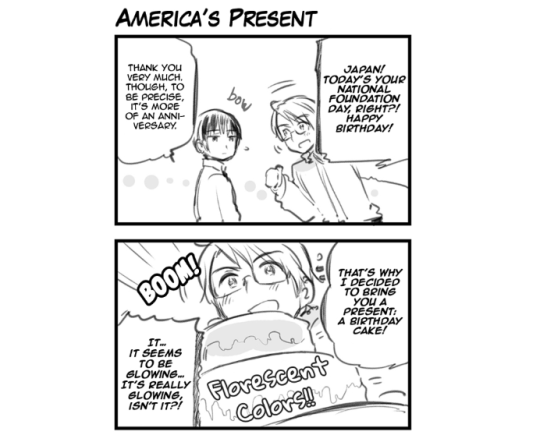
MORE WHOLESOME AMERICA PLEASE
Your wish is my command [x].
Why are Austria and Switzerland suddenly so
distant from each other? Okay their relationship was cut because of their boss,
but after that, why are they like cold towards each other like ex lovers or
something?
As far as I’m concerned, it’s
literally just that reason. There isn’t much of a romantic overtone (they were kids). It was more like a very tight partnership or camaraderie. I say this because Switzerland has flashbacks of the times he spent with Austria when he experiences similar moments of fondness with Lichtenstein.
He’s still bitter over the loss, having been discarded and mistreated by someone he trusted. Please remember that nations follow their bosses orders, so it’s not like Austria had any malicious intent [x].
Okay, just a quick question. Do you remember
that strip where Romano wanted his room of hopes and dreams cleaned? There was
a roman emperor looking statue on the front. Maybe he wanted to rule the empire
once? I’m feeling curious y’know.
That’s an interesting thought. My personal take on it is that it represents Romano’s failed hopes to live up to his grandfather’s legacy and inheritance [x].

You see this complex with him when he’s younger too [x].

Veneziano isn’t exclusive to failing up to this legacy either. Germany actually overestimates him when they first encounter each other in WW1 (Volume 1, Prologue).

Which character do you think is least accurate
to the country they are based upon?
Poland 100%


One thing I’ve noticed is that fans approach and analyze
relationships between the nations from a human perspective. The problem with
this is that it doesn’t capture the elasticity and interchangeability of
titles of beings who are immortal– not mortal– go through. In other words,
aside from direct biological relations which don’t change, you can’t apply
words of human organization to immortal beings who routinely change how and who
they relate to.
For example, just because a nation lives with another
nation, doesn’t automatically make them family. In the case of a nation, they
don’t live with other nation(s) by choice but rather circumstance. Often
enough, it was the product of being conquered.
Some nations living together will choose to identify as a family,
as their bond as a unit most closely resembles one. Nonetheless, these
families, or households rather, are temporary.
Ex: Hungary refers to Holy Roman Empire’s household as a
family [x].

Ex: Having lived with France in Rome’s household
for some time, young Italy referred to France as big brother.

Out of respect, some nations will continue to refer to the
other nations they lived with as an older brother. In Japanese, “onii-chan” is
a term coined out of affection and adoration for a figure. It doesn’t mean
older brother in a blood sense.
Ex: France claims to be the older brother figure of the
world. Meanwhile, only Italy and Monaco choose to refer to him with this title
of affection [x]. Again, not to be mistaken with a relation.

A nation can be a guardian for several centuries and later
evolve into a companion, friend and/or mentor figure.
This is best seen with America and Canada, biological
brothers who temporarily held a family unit with their colonizers. Although,
they didn’t physically live together, settling for occasional visits instead.
For one thing, it’s important to distinguish the fact that biological relations are inherently sensed by the nations.
There’s a difference between Iceland, who senses Norway to
be his brother from birth [as does Norway]… [x].


…and England and France, who make America and Canada their
family [x].


Ex: America doesn’t inherently sense a brother among his
colonizers, Finland, France, and England.
Instead, they fight over who will assume the role of
America’s brother [x].


As mentioned, it’s difficult to apply human words for
relationships to capture relationships between immortal beings. It doesn’t
quite fit. Think of it this way: The nations have unique experiences that we as
humans will never have. So, why are we using words that describe our
experiences to describe theirs?
Respectively, England has trouble deciding what America
should call him.


Again, notice America’s choice of the word onii-chan.
Titles like guardian and older brother, two very different
terms, are loosely thrown around. Of course, older brothers can be guardians, but you’ll see what I mean by this muddled distinction in a moment.

It’s hard to make sense of a relationship
using words that don’t describe but instead confine and water down the
complexity of the colony-colonizer and simultaneous guardian-adoptive
relationship they’ve established.
This uncertainty and fumbling to find words that best
describe their relationship is seen again when America declares his
independence. Even he doesn’t know if what they had entailed a parent-child or
sibling relationship [x].
Nonetheless, he cuts off these ties and no longer views
England as this type of figure for him.

The point I want to emphasize is that due to political
circumstances, the nations’ relationships with each other are dynamic. It’s not
as rigid as human forms of organization; therefore, it doesn’t make sense to
approach these family-like dynamics from a human perspective. It’s like
comparing apples and oranges.
Lastly, to avoid falling into a trap of reasoning, there’s a
stark difference between conquering/ colonizing a nation and living together and
willfully forming a union [economic or political] and living together.
Ex: Switzerland adopted Liechtenstein into his household and
the two consider each other to be siblings. Because this is how they presently
identify and relate to each other, they are siblings.


Thank you for sharing this! It’s a very interesting and well thought-out take on his character [x].
What we know for sure is that it’s in reference to his prickly personality.


Misconception: He’s a rude ‘hedgehog-type’ character.
Reality: He’s a hedgehog-type with a soft underbelly.
Following this hedgehog metaphor, while Switzerland can be abrasive
and rub others the wrong way, he still has a notable soft, compassionate, and
sentimental side. In some cases, his tone may be aggressive, but it’s the
intention of what he’s doing that truly matters.
What Switzerland is most known for is his ruthlessness.
Ex: He’s indifferent toward how money is obtained and will
protect the bank accounts of cronies and criminals [x].

Ex: He’s easily irritated by other nations [x].

Ex: He supplies weapons to Germany during WW2.

He can also be quite grumpy.

On the other hand, it’s important to understand this from
the perspective that Switzerland’s a survivor. He didn’t have the privilege of
having fertile land and turned to banking as a way to sustain himself and later, Liechtenstein.


His sweet side is something that is often neglected.
Ex: He’s described to be rather affectionate toward
Liechtenstein.

Ex: He wears the frilly pajamas that Liechtenstein made for
him.


Misconception: He doesn’t care about anyone but himself.
Reality: He puts up a guarded front, having been used and
betrayed in the past. He very much cares about others but will, of course, put his and Liechtenstein’s best-interest first.
Ex: He took Liechtenstein in and gave her food, despite running out of it himself.

Ex: Switzerland teaches Liechtenstein self-defence, but later
succumbs to her request to make more cute drawings.


Ex: In the present, he advises Liechtenstein to boost her
tourism. Liechtenstein soon realizes that Switzerland is projecting his past
onto her. He wants to protect her with a back-up plan; that way, she won’t be
treated as disposedly as he had once been [x].
“I don’t want you to go through the same mud and misery that
I did and be used as a shield by other people.”


Ex: Switzerland also projects himself onto Japan. He
reprimands Japan for not stating his opinions. In other words, he wants Japan
to stick up for himself.


Ex: He helps France after he’s defeated by Spain in war.

Ex: Back when their countries were united, Switzerland saved
Austria fifty-two times. While he’s still grumpy and complains a lot, that doesn’t
stop Switzerland from exercising his loyalty [x].

This brings me to my next point.
Misconception: Switzerland hates Austria.
Reality: Switzerland has mixed feelings toward Austria
resulting from their past partnership. While he claims to be independent and indifferent
[economically and politically], Switzerland is far from neutral when it comes
to his emotions.
Ex: Switzerland is revealed to still harbor complicated
emotions about his past with Austria. He experiences flashbacks when he
replicates fond moments with Liechtenstein (i.e., holding hands, exercising
table manners) [x].


Ex: The resentment over betrayal is seen in how Switzerland
constructs Austria as a shady figure during one of his lessons with
Liechtenstein.

Misconception: Switzerland and Liechtenstein are biologically
related.
Reality: Switzerland and Liechtenstein are not biologically
related, but Switzerland did adopt her into his household. They’re adoptive
siblings. Liechtenstein originally represented Austrian nobles [x].
Ex: Switzerland adopted Liechtenstein following WW1.


Bonus Facts:
Switzerland is described as thin with muscles [x].
In the “Can’t Escape from Italy” strip, it’s revealed that
the Italy brothers hired Switzerland to get England out of the ditch they entrapped him in [x].


Me: Hmmm.
👏
What ever shall I wear today 👏
Also me:

Of course. Switzerland acts rough and claims to put himself first, but he’s actually a very generous and considerate person.


Tumblr’s ask box isn’t working, so I can’t re-ask myself the asks you guys sent in. I’ve also gotten notifications for asks that haven’t shown up
😩
@staff this is a big problem across users, so please look into it.
Anyways, I’ve already done Prussia, so characterization post on Switzerland coming up tonight!


This guide will go over
the stereotypes that affect how the Germanic nations are able, or rather, unable
to express their feelings. The steely emotionless stereotype of Germans/
German-speaking countries often prevents the respective nations from being
understood properly. It’s not that they’re incapable of experiencing love or
feeling care and affection. It’s quite the contrary. Instead, they just have a
difficult time showing and communicating how they feel [x].

For the purpose of this
post, I’ll only be going over the Germanic nations that are listed in this
strip, as they are what Himaruya characterizes to be of German inheritance and influence.
I recognize that there are many more Germanic countries than this. I’m just
going by what we see portrayed in the manga.
That said, let’s go over
some examples.
The German stereotype of
being emotionally steely and hot-tempered is a complex that Germany is defined
by in the manga.
He’s sweet and
compassionate but is often mistaken to be angry by those around
him [x].

Germany also claims to
have trouble smiling. It’s not something that comes naturally to him [x] [x].


In terms of
relationships, Germany is emotionally withdrawn. This is most seen in Buon
San Valentino [x].
There, the premise of
the arc is that Germany has trouble defining what his relationship with Italy
is.
He first buys a popular
book in Germany titled “Communicating with your partner.” The comic gag
of this is the stereotype that Germans aren’t savvy at reading emotions; they’re
‘emotionless.’ Obviously, this isn’t truly the case.

As Germany reads this
first book, he begins to question whether Italy likes him as a friend or as a
romantic partner.
When Germany gives
details of his relationship with Italy to Austria, Austria is repulsed due to
the romantic overtones = seeing someone every day, kissing and hugging them,
bathing with them etc. The irony is that Austria later realizes that Germany
was talking about Italy, an anomaly of a person who normally does all these
things.


Unfortunately, Germany
doesn’t know this, and he forms the conclusion that Italy has romantic feelings
for him. It’s a “misunderstanding.”
Since he’s still clueless about this aspect of human relations, Germany then buys a book that gives dating advice.


His dismay grows when he remembers that Italy’s a guy [wow!] so of course, his next course of action is to ask Austria if he can practice these newly learned romantic gestures on him.


He later reveals to Austria that he has no previous experience with romantic relationships and that he’s only read romance novels.

The strip culminates in
Germany mistakenly proposing to a very confused Italy.

Despite having never
been married, Prussia is the most sensitive and emotionally-expressive Germanic
nation.
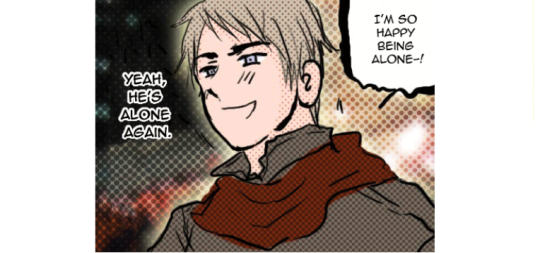
He’s often found crying
and lamenting over the fact that he’s single and “alone.”
Ex: He cries when he
spots Hungary and Austria spending their Christmas together during the 2007 Christmas event [x].


The Germanic stereotype
has more to do with the fact that he’s a poor socializer.
For example, he’s given a
book on “How to Socialize with People.” He sneezes and claims to be bored with
it [x].

In direct contrast to
Prussia, as someone who’s been in several marriages, Austria is arguably just as
clueless as the German brothers.
He may have solved his
problems with marriages…

…but when it comes to
relationship troubles, he’s read his fair share of manuals and guides too.
Austria had copies of both
books that Germany purchased in Buon San Valentino. Had he have known this
beforehand, he would have lent them to him.


He becomes flustered
when Hungary reads the dating book and laughs at how inaccurate it is. It would
be to his own embarrassment should he have admitted that he had been an avid
reader of it.

On the other hand, in his defense, it’s largely hinted that he’s the one who gave Hungary flowers on Valentine’s Day.

Switzerland’s similar to
Germany in that he’s an angry-type that’s soft on the inside and well-intentioned.
He shouts at Japan to
give his own opinion, scaring the latter despite the good intentions of this
action. It’s tough love in that he’s trying to get Japan to stand up for himself.


He cringes and gets
angry for remembering all the fond moments that he had experienced with Austria during
their childhoods. This is sometimes at the expense of ruining the fond moments that
he shares with Lichtenstein [x].


Nonetheless, Switzerland
shooting at Italy in the frilly pajamas that Lichtenstein made for him is
iconic, and you can’t tell me otherwise.

Sweden’s slightly
different in that his minimal facial expressions are intimidating to people.
Finland finds Sweden
scary at first… [x]

…but later warms up to
him and realizes that Sweden smiles and expresses his happiness subtly [x].


In reality, he’s also
quite the softie.
He sews smaller
clothes for Finland [x].

He acts as a father
figure to Sealand [x].

In sum, while the
Germanic nations may come across as hard and steely, they’re easily among some
of the sweetest, most considerate characters in Hetalia.

 Ellawritesficssometimes