image
image

I think it goes unsaid that how the nations relate to one
another is not only based on their present political relations.

In other words, while they may not be on good terms with
each other, these relations don’t define their relationship in whole. There are
times where nations get along, and there are times where they will fight
frequently and ‘hate’ each other. Point is, the hate doesn’t typically last.

While current relations do cause tensions, their pasts have
the most impact on how they view one another. It would therefore be shallow to
say that if nation A and nation B grew up together, only to go to war centuries
later, that they would unequivocally hate each other and be unable to reconcile.
Relationships don’t work like that, and this is especially the case for
immortals who have lived several lifetimes.

I’ve stressed this in other posts before, but the nations
don’t represent their government. They represent their people – they’re cultural,
not political representations. The irony is that they’re forced to serve their government, which may or may
not represent their peoples’ best interest. [x] [x]

It is for this reason that even in times of war, nations on
opposing sides are shown to be getting along with each other when they’re not
on the battlefield.

Ex: America’s occupation of Rome. He doesn’t treat the Italy
brothers as enemies, but rather friends.

image
image

Ex: England, Russia, and Germany share their military
rations with each other.

image
image

While humans from other nations may bear present grudges
towards each other, this doesn’t always reflect itself in the personification.
It’s important to remember that they’re people themselves, and have had more experiences
that influence their outlook on life.

That said, what this post will set out to demonstrate is
that nations rumoured to canonically hate each other don’t actually. The hatred
isn’t deep-set or genuine. It’s more like a rivalry between someone who constantly
gets on your nerves…someone who you routinely get into arguments with and can
never see eye-to-eye. On the other hand, old war grudges have been shown to heal with time.
Although, some take far longer than
others.

With all that in mind, let’s go over some of the most common
characters that are mistakenly depicted to be in hate-hate relationships. And
yes, while this is intended to be ship neutral, all of these examples can be
used to counter bashes against your ship.

Russia and America:  

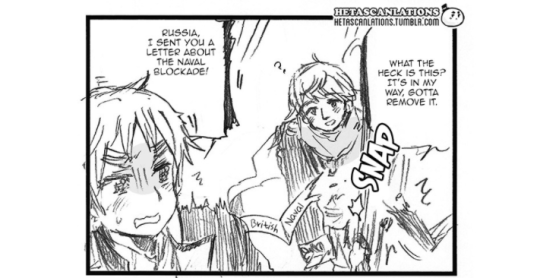
While they may have been on thin ice with each other in the Cold
War, their history runs far deeper than that. Unfortunately, we get very
minimal insight into American-Imperial Russia relations. The strips only depict
Russia’s participation in the American Revolution.
image
image

Either way, the two countries don’t hate each other,
regardless of how tense their political relations were and still are. They even
acknowledge this tension as they spend time with each other in the present.
Russia in particular admits to how much America gets on his nerves.

image
image

China and Japan: 

Japan’s betrayal in WW2 caused China to develop a strong
grudge towards him.

image

Nonetheless, in recent strips, we do see China attempting to
reconcile with Japan through diplomacy.

image
image

Hungary and Romania:  

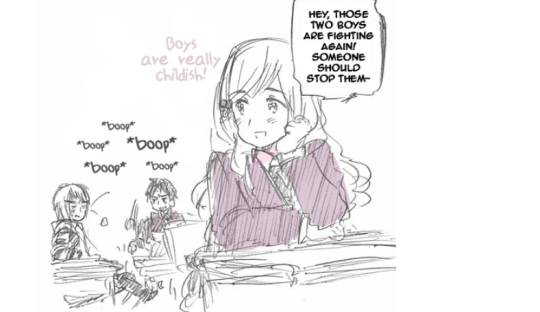
The two are noted to fight like cats and dogs. Each nation
depicts each other in a negative historical light. They may have resented each
other, and still do from time to time. However, it’s not true, long-lasting hatred.

image

Ex: Hungary’s somewhat smug reaction to Romania and Bulgaria fighting with
each other.
image

Regardless, they’re still capable of getting along. 

image

Greece and Turkey: 

The two bicker every time they see each other. 

image

Comic gags
aside, the two still care for each other and are mentioned to be making some grounds
in their relationship.

image

Ex: Turkey’s form of bullying Greece is taking him to a
bathhouse and massaging him.

image

Switzerland and Japan:

Switzerland yells at Japan to be more assertive and voice
his opinion. It has nothing to do with hatred. If anything, it’s an aggressive form of encouragement.

image
image

Veneziano and Romano: 

Romano suffers from an inferiority complex in comparison to
Veneziano, who received most of their grandfather’s attention. As such, he is
often very hostile to Veneziano, referring to him as “stupid little brother”,
or something similar to that depending on his mood.

image

However, this is only done to Veneziano’s face. When he’s
not around, Romano’s been shown on several occasions to look out for Veneziano.

image

America and England:

Short story short, the two have been able to reconcile their
rocky relations in the years following the Revolution. England’s bitter and
scathing nature towards America has softened considerably over the years.

It’s said that England once suffered from one hundred years
of heartbreak, presumably a hint to the American Revolution.[x]

Ex: England still goes to America’s centennial celebrations, despite
how sick it makes him.

image

He also offers to fix a crack in the first liberty bell he
gave to America, and gives him another one for his bicentennial. 

image

Ex: The two are close enough to make fun of each other’s
politics.  

image

America and Canada: 

Canada doesn’t hate America. Instead, he hates America’s
egocentrism and often calls him out for this.

image

France and England:  

While these two are notorious for fighting, having their own
designated preserve to quarrel in…

image

…they can get along with each other just as well too.

Ex: France used to be England’s cook.

image

Ex: England proudly calls on France’s cooking skills again
when he opens a butler café.

image

Ex: A summary of how their relationship’s progressed. 

image

Prussia and Austria:

The two don’t get along with each other.

image

However, that doesn’t stop them from spending Christmas together as ‘family.’ Prussia, of course, initially [teasingly] refuses to accept Austria and Hungary as guests.

image

                                                            …

image

Real Hatred – Prussia and Russia:

Albeit the fact that it’s one sided, Prussia’s hatred of
Russia is deep. It’s probably one of the only case examples where it’s not a
matter of two nations simply not getting along.

Ex: Prussia will cough up blood if Russia touches him.
Either that, or he will lose four eyelashes.

image

With all that in mind, long-lasting hatred between nations
is rare in canon. Similarly, while current political relations may have an
influence on how nations interact with each other, the influence of the past –
on a personal level – is much greater.

image
image

Before I start, it’s important to go over and situate a few
things. The nations’ immortality is more of a curse than it is a blessing.
They’ve experienced countless wars, plagues, political strife, and have even
died, only to be regenerated.

Now, unlike humans who have been blindsided with the rough
backhand of fate, the nations are forced to relive these pains over and over
again. It would be enough to drive a normal person mad.

In other words, their immortality was a prison that kept them
locked into a systemic cycle of bloodshed. What adds to this prison imagery is
that they’re obligated to listen to their bosses and fight in wars that they don’t
necessarily want to participate in.

image

Nowadays, this prison more has to do with loneliness. They
still follow their bosses’ orders, but the restrictions on their freedom are
not nearly as pervasive.

Ex: England’s sweet and alcohol intake is regulated by his
boss.

image

Regardless, Germania and Ancient Rome best exemplify how
their freedom was gained not by their immortality, but rather, the loss of it.
They were “liberated” from their bosses and war upon dying.

image

France is another good example of this. He gives better
insight into how heartless history can be in tossing peoples’ lives around. When
he first sees Lisa, Jeanne d’Arc’s reincarnate, he believed that God was
playing a cruel trick on him. On its own, this already proves how betrayed and
hurt France felt after her death.

image

Nonetheless, France still keeps his faith and believes that
humans who have had rough past lives will be reborn into happier ones. He
doesn’t have this privilege.

image

The purpose of this post will be to illustrate how the
nations’ immortality has historically caused them to live through many
traumatic events. It would follow, then, that being reared in such unhealthy
environments would cause some of them to develop PTSD.

In fact, there is a mounting pile of canon evidence that
depicts the nations having discomforting flashbacks, severe anxiety, and
nightmares. That said, let’s go over some examples.

America: 

When his settlers moved inland, America didn’t have many
belongings to his name. England ponders why America produces things in mass and
comes to the realization that America’s overconsumption of goods likely stems
from this impoverished period of his life.

image

Note the use of the word traumatized.

image

Lithuania:

image

Lithuania has a flashback to when he and the other Baltic
States declared their independence from the USSR. He then experiences another
flashback, where Russia squeezes his shoulder – it’s used as a metaphor to
represent political repression.  

image

Lithuania is so immersed in this second flashback that he
begins squeezing Estonia’s and Latvia’s shoulders without realizing it.

image

One of his character notes also mentions that he’s been rebilitating after his time spent in the USSR. 

image

England: 

England doubts his capacity to care for young America. The
stress of this new responsibility causes him to have a flashback of his older
brothers sending him hexes.

image

It’s noted that England once suffered from 100 years of heartbreak, presumably a reference to the American Revolution.

This is a theory of mine, as it isn’t confirmed in canon, but given that England coughs up blood and gets ill on the fourth of July, I think that it is meant to symbolize how he still hasn’t recovered emotionally from America’s independence. In other words, each year, England’s heart is both literally and figuratively ripped open on the inside.

image

Japan: 

While this example is a more subtle depiction of trauma, it’s
not surprising.

Although this isn’t covered in the strips, following WW2, Japan
would have become America’s underling. As such, the atrocities committed by the
atomic bombs would have made him visibly more compliant to America’s demands,
regardless if he agreed or not.

This is seen in a world meeting where Japan unanimously agrees
with America’s ridiculous global warming plan. Switzerland even calls out Japan
for not voicing his true opinion.

image

Switzerland: 

Switzerland’s mercenary past still haunts him. Lichtenstein
perceptively reads into this as she asks him why they’re working to boost her income through tourism.

image

Italy:

Italy’s perhaps one of the most anxiety-ridden characters in
the series.

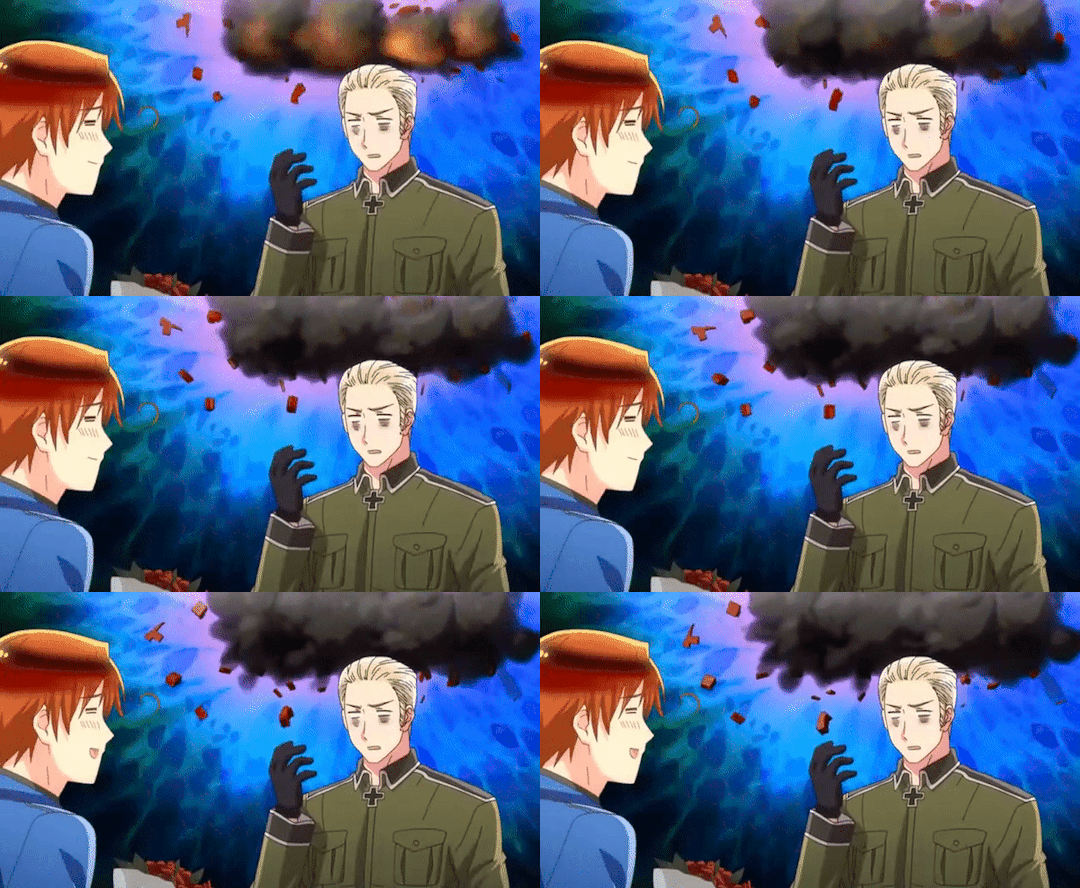
Ex: He worries that Germany hates him and has nightmares
about this. His greatest fear is being left behind to fend for himself.

image

This insecurity leads him to make Germany reaffirm to him several times that he’s not actually hated.

image
image
image

Ex: Italy has nightmares where a childhood version of himself
presses to be acknowledged.

image

The dream ends with Italy screaming and refusing to
acknowledge the child. To me, and as I’ve theorized in the past, I read this as
Italy repressing parts of his childhood to minimize and forget about the trauma
that he experienced. The child is merely a representation of his unconscious
mind.

image

Germany:

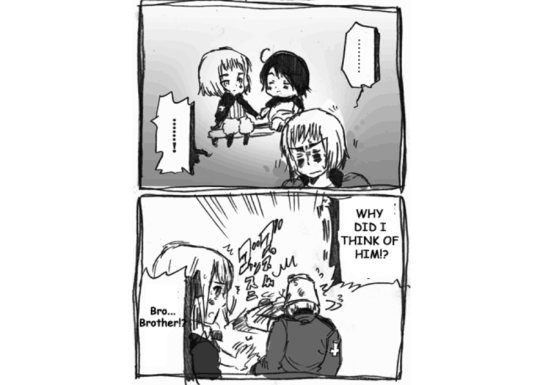
Germany also has a childhood version of himself pressing to
be acknowledged. Of course, this is running on the assumption that he’s
actually Holy Rome and has forgotten about his childhood.

image

Similarly, he’s once depicted to be holding Chibitalia,
looking visibly confused.

“It’s me.”

image

Again, how I see this is that perhaps Germany is repressing
aspects of his childhood. In that case, Chibitalia is an unconscious
representation of these memories attempting to pierce through to his conscious
mind.  

All in all, given how long the nations have lived, it’s not
novel to assume that they’re still traumatized by things that have happened to
them in the past.

image
image
image

Marriage with the nations is a lot different than
traditional, primarily Western notions of it. It arises more out of a sense of
political duty, an arranged alliance or
partnership
, and sometimes it just so happens that a romance forms between
the two countries involved.

Typically, what I’ve seen is that marriage at its core in
the series involves two countries merging together, either into a co-state empire,
a co-state kingdom, or a separate sovereign nation with distinct ethnic groups
and cultures. There aren’t any ceremonies, but rather, it entails a mutual dependence
and relative respect between two political entities.

That said, it’s important to mention that two countries joining
together via annexation does not fit into this marriage equation. There’s a
difference between being conquered and subordinated and forming a mutual
union. On the other hand, that doesn’t go to say that there’s perfect equality or
power balances in marriages between nations; Austria’s control over Hungary is
a perfect example of that.

All right. Let’s go over some examples of marriages, shall
we?

Austria’s character is known for his quirky tendency to
solve his problems through marriage.

image

First, there was arguably his early ties with Switzerland. I’m
counting this as a marriage mainly because it involves the use of the word
partnership and honeymoon (albeit jokingly).

image

Notice how as soon as one tries to control the other, the partnership ends. While Switzerland does
reveal some fondness over his early memories spent with Austria, there’s
nothing particularly romantic about it, especially given the fact that they
were young children at the time. Again, marriage for them is essentially the
joining together of nations.

image

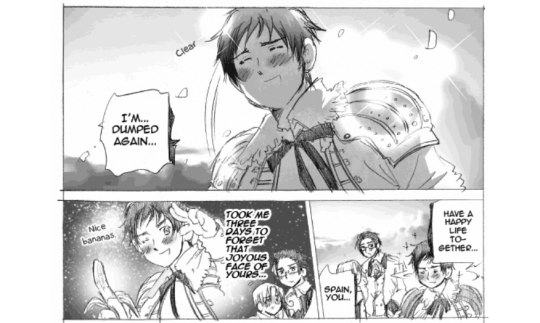
Next, Austria marries Spain via the Hapsburgs Monarchy.
Here, you actually see a hint that Spain harboured romantic feelings for
Austria during the Austrian Wars of Succession. It was a political merger
that likely later involved the development of some intimacy between the two.

image
image

Then, you have Hungary. After the dissolution of the Austro-Hungarian
empire, it’s very heavily hinted that Austria still bears feelings for Hungary.
In Buon San Valentino, Hungary receives roses from an anonymous man that’s
conveniently described as having glasses and one hair sticking up.

image

On the other hand, there are marriages that involve little
or no romance at all. Take Czechoslovakia for example, two countries united by a
hyphen. Yes, that’s an actual joke in the series.

image

Still, what’s interesting is that when Bulgaria talks about
their separation in terms of a divorce, they’re quick to deny the claim, mainly
because of the romantic connotation marriage carries.

How I interpret this is that the two may have developed
feelings, but never told each other.
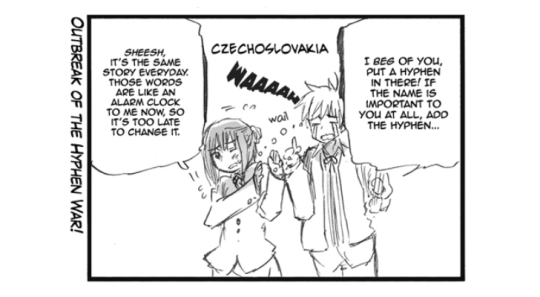
Bulgaria bringing up the topic of marriage in a casual political
sense merely may have caused them to get defensive because of these unvoiced feelings.
This isn’t confirmed, so don’t take it at canon value.

image

I know I’m repeating this, but it’s important that I make
this as clear as possible:

Marriage = a merger between two countries.

I say this because I’m going to apply these rules to Belarus
and Russia. Belarus wants to marry Russia and loves him to the point of obsession.
She’s even forgotten her own language at one point in favour of learning Russian.

image

But, does it ever say that Belarus loves Russia in a
romantic way?

No.

What it does say is that she wants to “become one” with him.
Sounds like a merger if you ask me.

When Belarus says marriage, she wants their countries to
join together. There’s nothing romantic about it, so hopefully this stops

people from misinterpreting their relationship.

image

In summary, marriage between the nations seems to involve a political
merger between two countries (partnership, co-ruled kingdom/empire). It can have
a romantic element to it, but this isn’t always the case.

It would be linked to your post of “how do the nations travel”. Why does Italy cross Switzerland’s territory when he goes to Germany’s house? There are others ways to go there, like via Austria’s territory, that would work well in the World War II.

Switzerland was neutral in WW2. There would be less fighting or interaction with soldiers if Italy crossed through there, as opposed to France or Austria. It’s the safer route, as Switzerland can only threaten to shoot, but won’t actually if he wants to maintain his neutrality.

Yes, Austria was Nazi-occupied and was on the Axis’s side, but Italy doesn’t like fighting and probably didn’t want to encounter any of it. Hiking over mountains would be more preferable than having to potentially pass through active battlefields.

image

I’m still not too sure about this one, but since this is
also another thing that’s been heavily requested, I have no problem explaining
what little I do understand from it. That is, if there is even any thing to
make sense of…

We’ve seen that the nations can transport or travel across
borders in a short period of time. The first thing I’ve noticed about this
ability is that it requires some sort of connection. In the “We’re Shipwrecked”
strip, since China has villas – China towns – all over the world, he’s able to
use them as a method of transport, travelling as far as the island of
Seychelles.

In the Christmas 2011 Event, this idea of connection comes
up again as Russia proposes to Japan that they build a bridge in order to
connect their houses, making it easier to travel.

However, there are times when transporting is difficult for
the nations. In my opinion, I think distance is the key factor here. For
example, we see that Italy travels to Germany by crossing over through
Switzerland on foot.

In the 2010 Christmas Event, we also see Finland travelling
to Sweden’s and Germany’s houses without any difficulties. On the other hand,
when asked to interview Seychelles and Greece, Finland either mails or texts
them.

For Seychelles, Finland states that “her land is a bit far.”
You also likely have to factor in the obstacles of water (or mountain ranges,
deserts etc.) in travelling, as not all countries are connected by land, or if
they are, it’s not always flat and easy to travel across.

It seems that distance and connections between landmasses is
what allows and/or inhibits the nations to travel on foot, as opposed to more standard
means.

Another mean nations anon! Who’s Janis Ian?

                                       Mean Nations: 

Switzerland as Janis Ian: 

“The money you make during
revolts is great, but money can be taken from you. What can’t be taken from you
is the safety and protection your neutrality gives you.” 

image

“Gott! I am so sorry, Austria. Really, I don’t know why you got kicked out of the Holy Roman Empire. I guess it’s probably because I have a raging homosexual crush on you and wanted us to unite again! Psych! Suck on that! Yodelayheehooooo!”

*Jumps off mountain range*

image

I need another one of your poems. Christmas themed perhaps?

Twas the night before Xmas, when all through the world

Not a country was stirring; the horror had not yet unfurled

Doors were bound shut with rigorous care

In the hopes that a certain American would not be there

The nations lay in their beds, unable to get a wink of sleep

For the safety of their homes they had to keep

Germany with his dogs, and Switzerland with his guns

(Meanwhile, Britain could not have been anymore done)

Suddenly, out in the sky there arose a bright light

Neon colours in the shape of a circular kite

Away from the windows those smart enough ran

There appeared a large metal craft, a tiny grey man

And a golden-haired driver, with the strength of a tank

Christmas was here, there was simply no escaping that yank

image