
What this post aims to do is cover Japan’s relationship with
other Asian nations. While a tricky subject for good historical reasons, I
think that while he initially had a rough start, Himaruya does a fair job of
balancing a narrative that promotes worldwide peace and reconciliation without
trivializing or obscuring the tragedies of the past.
By that, I mean that while there are many unresolved
historical issues between Japan and other Asian nations, Himaruya is still able
to have the respective personifications get along amicably. They’re not
portrayed as close personally, but they are nonetheless civil and friendly. To
portray them in the former fashion would be insulting, especially given how there
are still tensions regarding how these unresolved historical issues are to be
properly compensated for and addressed.
Nonetheless, Himaruya is able to work
around this and the narrative of world peace by portraying them as being civil
with each other. He even offers several instances where Japan expresses regret
for his past actions—albeit implicitly.
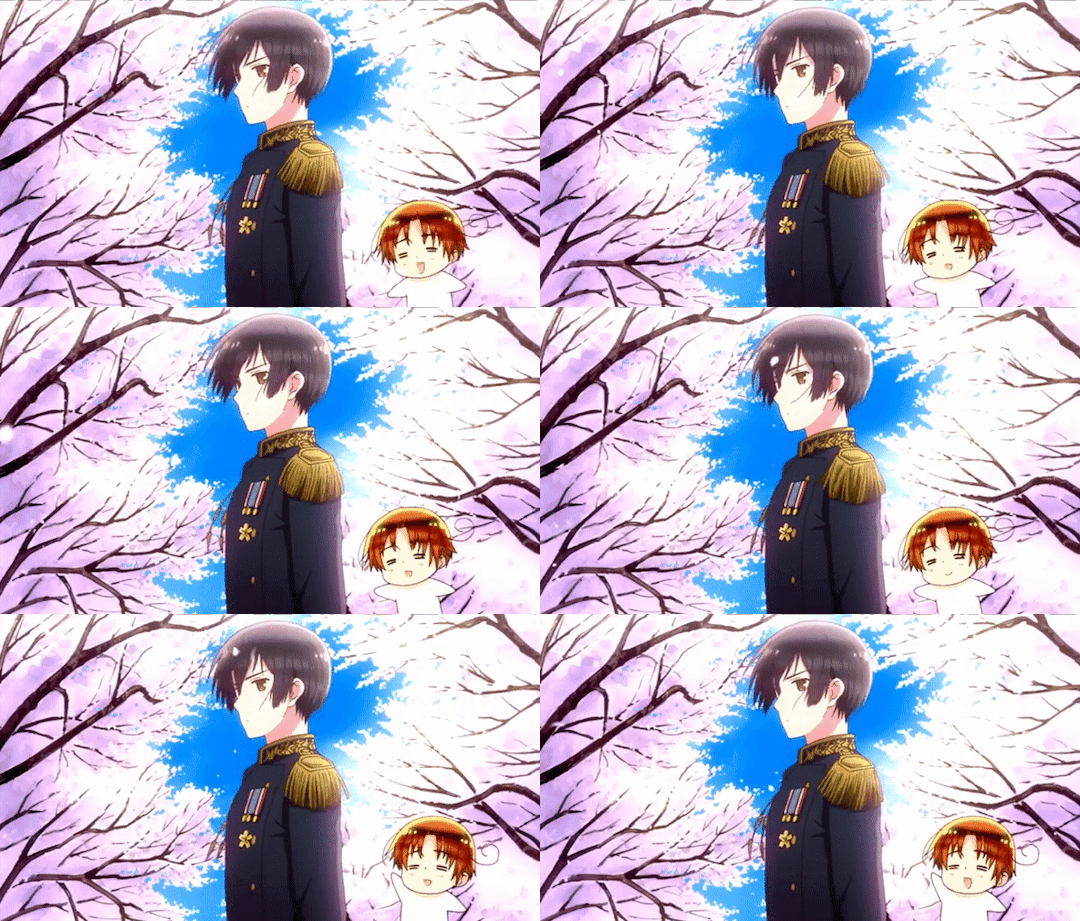
There’s this panel, which alludes to his desire to make
peace in East Asia and achieve reconciliation. I’ve done a longer post on this
here [x], and there’s also a scholarly article that covers the meaning behind this
specific panel in much more detail. Point is, Hetalia doesn’t trivialize or
obscure these dark historical realities but rather it offers hope for the
potential of reconciliation and co-operation as well as the capacity to
overcome grudges.
Article:
Sands, A. T. (2013). Belittling japanese nationalism in hetalia: axis powers. Humanities and Social Sciences Review, 2(3), 125-144.
Source: Volume 3.
That said, let’s go over some examples:
China:
There’s the infamous scene where China is betrayed by Japan
during WW2. What I want to place particular stress on is how Japan disconnects
from the situation emotionally—notice how blank his expression is—and asks
China to forgive him.
Source: Hetarchive, The Story about the Early Days of China and Japan.


Chafed and devastated, as he raised Japan and considered him
to be a younger brother, China fears that war has changed Japan and that the
two will never reconnect. Russia reassures him that time will heal their wounds…and
they do.
Source: Hetarchive, The Story about the Early Days of China and Japan.


It takes a long time, but the two do in fact reconnect. China’s
character song, “Aiyaa 4000 years” expresses China’s longing to look under the
same moon as Japan again (i.e., to reconnect.) China’s signature verbal tick—aru—is scattered throughout the whole song; it’s not until World Stars that
we learn that his aru is symbolic of his hopes, dreams, and romance.
Source: Hetascanlations, World Stars Chapter 43.

In the same World Stars Chapter, we see the two of them
working on improving their diplomatic relations.

Another example of their co-operation would be them
designing postcards together.
Source: Hetarchive (Bamboo Thicket, eng trans., Oct 26th, 2011).


Again, they may not be as close as they used to be, but they’re
nonetheless on relatively good terms with each other.

South Korea:
As mentioned, Himaruya had a rocky start and many lessons to
learn after his characterization of South Korea received a lot of [warranted]
flack.
South Korea claims to hate Japan and will disagree with
anything he says at world meetings, yet he also seems to aspire for Japan’s
approval by mimicking him and showing the latter his creations.
Source: Hetarchive, It’s My First Appearance and All I Get Are Some Scribbles! + Hetarchive, Opening of the Meeting at the Center of the World


Unfortunately, that’s the brink of their relationship, since
South Korea’s poorly chosen perverted tendencies have caused Himaruya to
ultimately abandon using the character. Because of this, I can’t comment on any
progression in their relationship. The point I want to emphasize is that they
don’t outright hate each other. Although, South Korea’s grudge is certainly
present in what little interactions that we have.
Taiwan:
Taiwan is the Asian nation whom Japan probably shares the
closest relationship with.
From the inception and early sketches of the series, she is
seen defending Japan, telling China to back off from him.
Source: Hetarchive, Taiwan’s Web Profile.

In the present, the two also get along just as well.
Taiwan is very friendly with him.
Ex: She tells his fortune for fun.
Source: Volume 4, Ilha Formosa ~Beautiful Island~


Ex: She gives him chocolates for Valentine’s day. It’s
hinted that she may even have romantic feelings for him, judging by France and
Italy’s suggestive expressions.
Source: Hetascanlations, World Stars Chapter 42.

Hong Kong:
This relationship is more indirect, but it still tells a
lot. Hong Kong considers China to be his teacher, as they currently reside
together. The fact that Hong Kong finds it suitable and acceptable to ask Japan
for favors is indicative of China having no problem with them interacting.
Although, it is humorous that Hong Kong turns to Japan rather than relying on China to
help purify the air in his country.
Source: Volume 6.

All in all, it’s not so much that Hetalia leaves tragedies
of the past unacknowledged. It’s satirical genre in tandem to its promotion of
world peace limits what it can cover and what stories it can tell. On the other
hand, it doesn’t trivialize or erase these tragedies either. Instead, while
seemingly simple, it’s able to promote narratives of co-operation and civility
in spite of past and current political tensions.


 Ellawritesficssometimes