image
image

The purpose of this post is to delineate the fact that
nations that have cultural influences on each other are not biologically
related. While the influencee may adopt traits from the influencer in some
cases, it doesn’t always constitute a biological relation. What’s even more
confusing is that there are specific adopted traits that the nations use to
mark a biological relation.

I know this sounds obscure, but it’ll make sense when I go
through some examples.

Romania and Bulgaria
vs Romano and Veneziano:

A gag with Romania in the series is that he claims that he’s
a descendant of Rome, and, therefore, an Italy brother.

However, even though Rome did, in fact, instill significant
cultural influence in Romania, Romano is quick to reject this claim. He
identifies the presence of a curl as proof of biological lineage from Rome.
Remember that Rome is said to have had many grandchildren and adopted
grandchildren.

Source: Hetascanlations, World Stars Chapter 163 + Hetarchive (Bamboo Thicket, eng trans., October 30th, 2014).

image
image

Later, we see the same rejection occur with Bulgaria, who
has Roman ruins.

Source: Hetarchive (Bamboo Thicket, eng trans., Oct 22nd, 2014).

image
image

England, America,
Finland, and France: (+ more)

As I’ve stated before, England and America are not
biologically related. England is stated to be the fourth and youngest sibling
in his family, consisting of Wales, Northern Ireland, and Scotland.

Source: Hetarchive (Bamboo Thicket, eng trans., Aug 4th 2010).

In the Battle for America, it’s explicitly stated that
England becomes America’s brother. We also learn that because America was a
“melting pot” of several cultures at the time, he inherited certain physical
traits from his colonizers.

Source: Hetarchive, The Battle of America.

image

For example, in the trio’s feud to make America their little
brother, Finland notices that America looks like him.

image
image

The distinction between cultural influence and blood
relation is necessary otherwise it would lead to a slippery slope where all
nations are related to each other. So, unless explicitly confirmed by Himaruya,
nations aren’t related to each other regardless of their histories. Arbitrary
as the biological relations may be, you work with what’s given to you.

Lastly, I’ve seen people comment that there’s a confirmed
biological relation between America and Finland. That’s not the case. Finland says that America has some genes from his people. Remember that America emerged as a personification representing several cultures. The genes are the traits, but because America has so many cultural influences, they don’t consider each other to be blood-related.

The fact that America didn’t identify with Finland as a
family member in the first place is telling of this cultural influence, as well
as the fact that Finland offers to become a father figure for America, who in
the context of the strip had been feeling jealous of kids who get presents from their fathers on Christmas.

Source: Hetarchive, Christmas 2010 Event.

image

France and Canada:

Similar to the situation with England and America, Canada
inherits France’s hair.

Source: Hetascanlations, World Stars Chapter 192.  

image

France, America, Canada, and Seychelles vs England, Hong
Kong, India, Australia, New Zealand, Hutt River, Sealand, and Wy:

We learn that France’s cultural influence is a dominant trait
that prevents America, Canada, and Seychelles from inheriting England’s bushy
brows. Although, interestingly enough, Seychelles had initially been designed
to have one thick eyebrow and one bushy one to represent English and French influence.

Source: Hetarchive, Seychelles profile.

image

Meanwhile, without French influence, Hong Kong, Australia,
New Zealand, Hutt River, Sealand, & Wy inherited the bushy brows.

Source: Hetarchive (Bamboo Thicket, eng trans.,Nov 12th 2013) + Hetascanlations, World Stars Chapter 269.

image
image

Of most importance and what I can’t stress enough is the
example of Hong Kong. It proves, with the most clarity, that cultural influence
does not have a causal relationship with biological relation.

After becoming English territory, Hong Kong’s eyebrows grow
bushy from the resulting English influence on his culture.

Source: Volume 6, A wise man has no specialty.

image
image

It’s said that England put a curse on him to have his eyebrows become so thick, but you also have to remember that England’s eyebrows themselves are cursed. The implications would be that his influence caused the curse to pass on.

Source: Volume 5, Special Booklet.

image

Point is, as far as Himaruya’s concerned with his
characterizations:

Cultural influence ≠ biological relation.

image
image
image

Nationhood:  

To understand why micronations and provinces/ states
–aside from the country they’re part of– exist, it’s important to understand
how broadly nationhood is defined in the manga.  Nationhood and the respective immortality it
brings is not exclusively given to formally recognized nations. In fact, the
modern nation today is a fairly recent method of human organization. Humans
used to organize themselves far differently, ranging from city-states, clans,
tribes, empires, kingdoms, etc..

I say this only because the personifications exist
as reflections of their people, regardless of how they organize themselves.
What’s important is that they all share a common identity. As such, nation in
the manga doesn’t strictly apply to the sovereign countries that exist today.

Ex: Prussia and the Knights Templar represented
Catholic Religious Orders.

image
image

As reflections of people located within a specific
geographic region of a larger country, territories, provinces, states, and
prefectures are also personified.

 Ex: In one
post, Hima created a dialogue with several American states. While this is a
hypothetical scenario, as they haven’t been canonically personified, it’s the
possibility of their existence that matters.

image

Ex: China’s provinces are personified.

image

Please note that all examples of intra-state
personifications can be found by searching up the “states and provinces tag” on
the English translation of Hima’s blog, Bamboo Thicket [x].

Put another way, personifications exist because
they represent a culture and a personality. How I interpret personality is that
it’s a reference to evidence/ remnants of the personification’s existence, such
as historical artifacts or architecture.

If no one remembers or cares about the
personification, then their existence is threatened. The same goes for culture.
Without a culture, the personification can’t exist [x]:

“Usually, when the culture or
the country’s personality dies/disappears, the country would gradually
disappear or entrust him/herself to the country that takes over him/her.”

With all this in mind, it should be noted that not
everything about the nations’ existence is logical.

Ex: In the first chapter of world stars, they’re
described as odd and strange beings.

image
image

That said, what this post will explore is the
abnormalities of the micronations’ existence. While not everything can’t be
explained, there is some logic to it that I’d like to run through.

Let’s go through some examples.

The Republic of Niko Niko:  

Niko Niko is easily the most abnormal micronation.
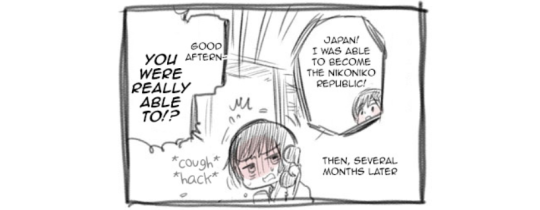
He’s a human who attained micronation status, representing a section of a city in the Fukushima prefecture. 

He had previously told Japan that he planned to become a micronation, but the latter didn’t believe him. 

Japan’s reaction to Niko Niko becoming immortal attests to the fact that this isn’t a typical case of nationhood.

image

How Niko Niko experiences nationhood, such as
having his health and well-being be based on his economic performance and
halting aging all together, is normal. What’s abnormal, or rather, “irregular”
is how Niko Niko was able to attain nationhood.

image

Likewise, Niko Niko
gives up his nationhood and becomes a normal Japanese citizen again. He also
resumes aging and is able to have a son. 

image
image

It’s noted in another strip that in
contrast to Niko Niko, it would be more difficult for a regular nation to
become a human [x] – which is possible in canon, by the way, post on that here [x].

 Sealand:

Sealand is also noted to
be abnormal, regardless of the fact that he’s not officially recognized.

For one thing, his body
(geographic landmass) is small. This causes other nations to have concern over
Sealand’s ambitions to become a formal nation, as it would be too hard on his
body and heart.

image
image
image

Seborga:

Seborga is interesting
because he used to be an independent nation, became a part of Italy, and then
later declared independence again despite still living as an Italian.

image
image

His experience of
nationhood confirms my “organization” argument. Before, Italy used to be composed
of several independent city-states.
Those were the ‘nations’ of the time, given how vastly different they
were and how people organized and identified themselves.

If that’s the case, then
I wouldn’t be surprised to see Genoa still existing in the present, albeit this
not being confirmed in canon. Point is, the Genoan identity and culture are
still prevalent enough today to warrant his existence.

image

Ladonia:

Ladonia is an internet
personification. Notice again that it’s how people organize themselves, not the
officiality of the title the matters in prompting the personification’s
existence.

image
image

Wy and Age:

One last abnormality
about the micronations that differentiates them from traditional [formal]
nations is their age.

Traditional nations are
usually born as babies, with the exception of Germany.

image

Meanwhile, micronations
vary in age.

Ex: Wy emerges as an older child.

image

There’s really no
explanation for this. The micronations are supposed to be strange and irregular
as we’ve seen from the above reactions toward Sealand and Niko Niko.

In sum, while many
things about the micronations are inexplicable, there is a consistent logic to
their existence in that they represent an organization, culture, and
personality of people. Nationhood applies to all personifications – it’s not
the title of the region that matters but instead the title in which citizens
identify themselves.

image
image
image

It’s, uh, complicated. The micronations are both similar and vastly different from ‘regular’ nations. While I’ve touched on this before, there’s lots more that I didn’t and would like to discuss!

Guide on the micronations coming up tonight!

image