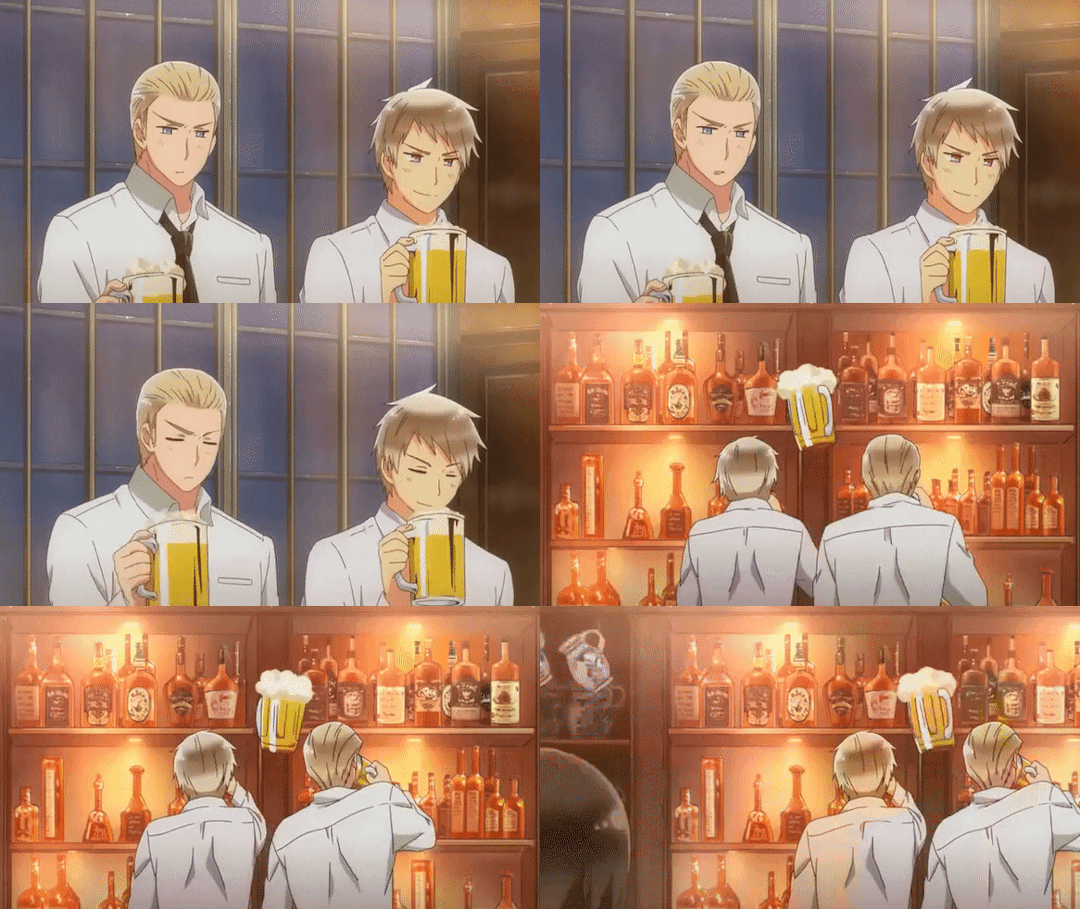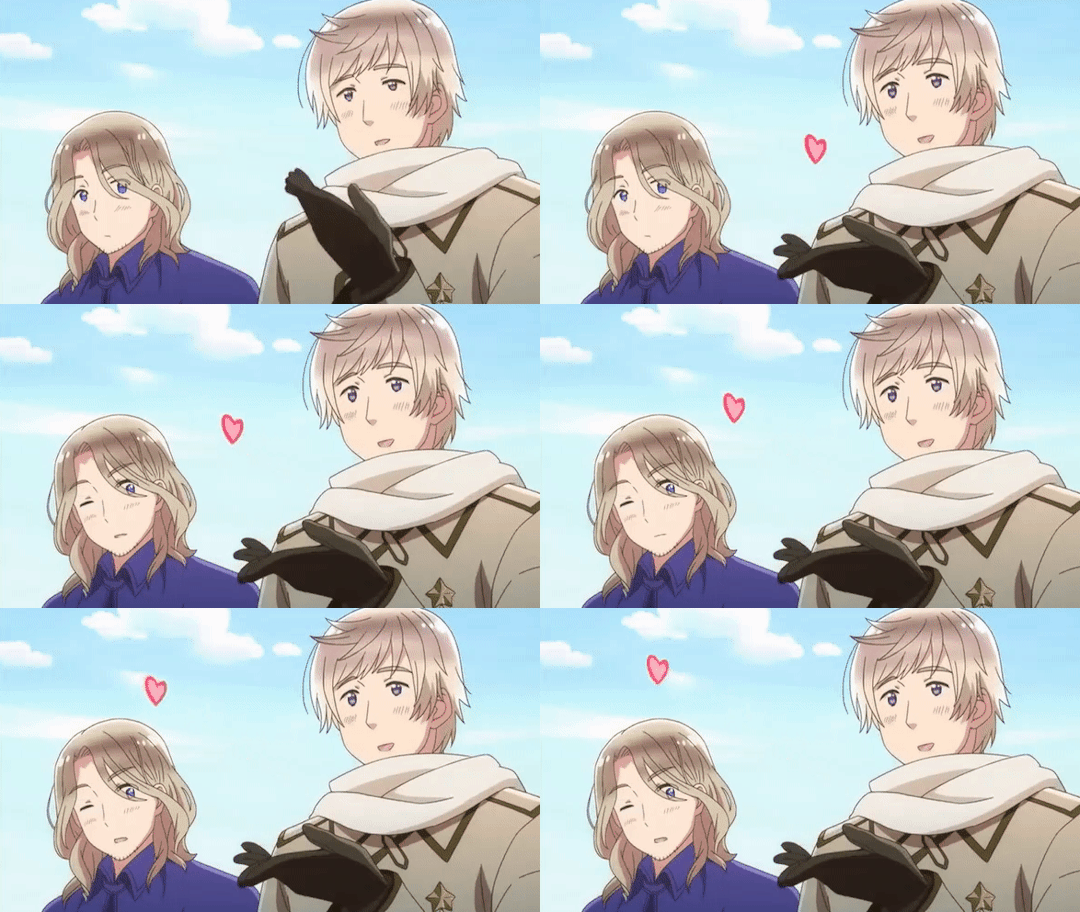
image
image

Counter to the large misconception that Hetalia is racist,
Himaruya’s work goes through great lengths to evoke a sense of familiarity in readers.
Many of us are immigrants or have parents/ grandparents who were immigrants. It’s
a common fact of life, but what I’ve always admired about Hetalia is that there
isn’t an asymmetric power imbalance between the personification and their
citizens. By that, I mean that the personifications experience many of what we
all go through. Our experiences are reflected in their own, allowing for a
greater sense of relatability and stronger affective responses.

That said, let’s go over some examples.

America:

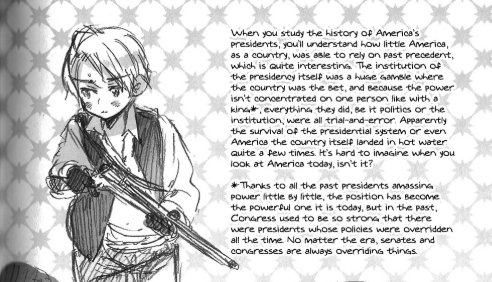
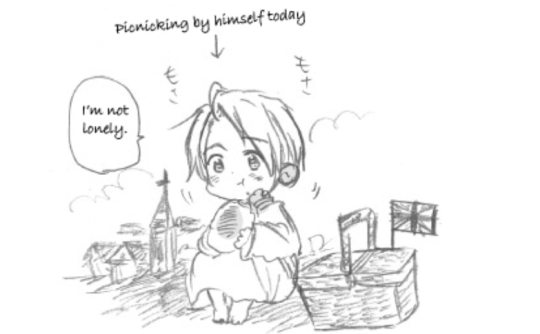
Growing up, America grew accustomed to being left alone for
long periods of time. When it came to the settlement of the Wild West, he could
no longer be a “crybaby.” It’s stated that this experience hardened him.

Source: Hetarchive (Bamboo Thicket, eng trans., Oct 9th, 2010) + Hetarchive, Notes & Etc.
image

Ex: He didn’t have many possessions.

image

Source: Hetarchive, Miscellaneous Extra Book. 

Ex: He would travel on foot for days in order to reach the
polling stations.

Source: Hetascanlations, World Stars 156.

image

The most insight we are given on the impact that this part
of his life had on his personality is when England questions if America mass
produces to compensate for the poverty he experienced as a young child/ adult.

Source: Hetarchive, Christmas Event 2011. 

image

Lithuania:

Lithuania’s immigrant experience stemmed from poverty as
well. Post–WW1, a large percentage of his population left the country to seek
work in America. Lithuania was no exception to this and went to live with
America. There, he did America’s clerical work and basically acted as his personal
assistant.

Source: Hetarchive, Lithuania’s Out-Sourcing pt. 1.

image
image
image

The strips depicting Lithuania’s out-sourcing will always
have a place in my heart, as he and America develop a close friendship. Both
were lonely after losing close friends and partners (i.e., England and Poland).
It was overall a good healing experience for them, but especially for
Lithuania, who had previously lived with Russia.  

image
image

Of most importance is that this arc illustrates how America
was and still continues to be built on the backs of hard-working immigrants who
want nothing but a better life for themselves.

Romano:

Romano’s immigrant experience is probably the most profound
concerning character development.

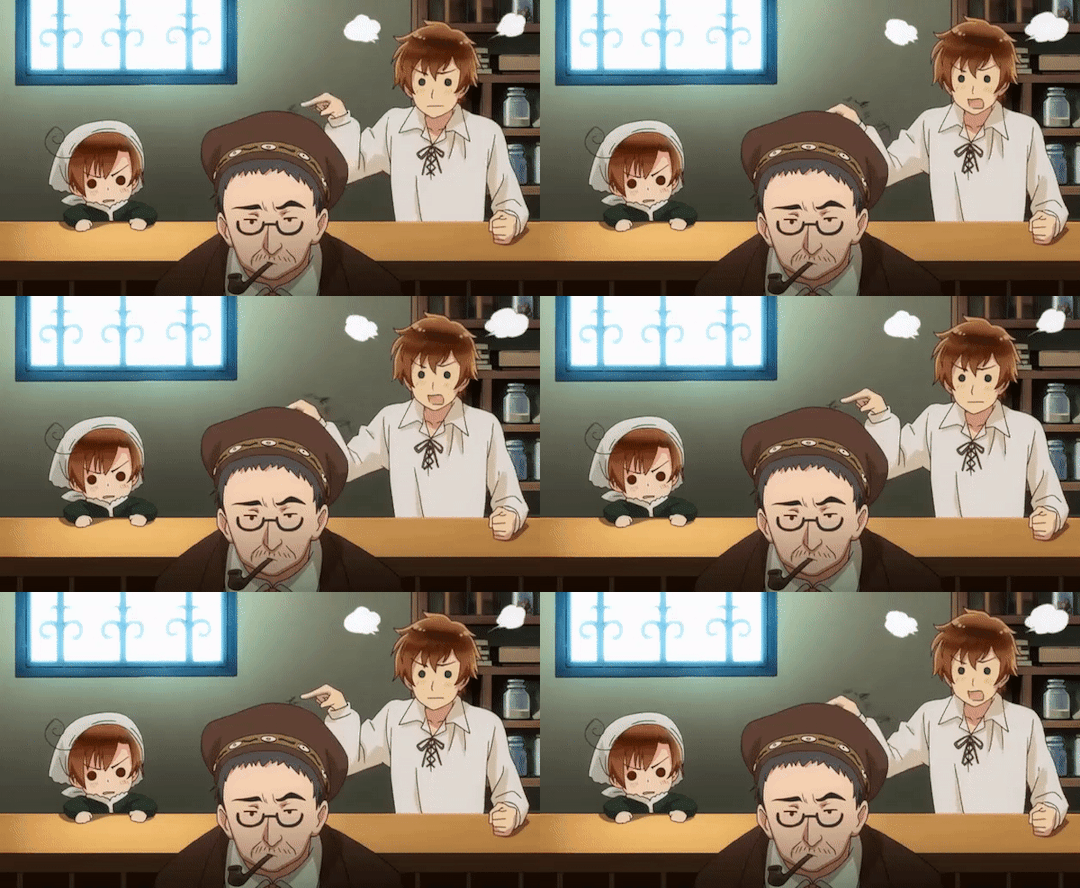
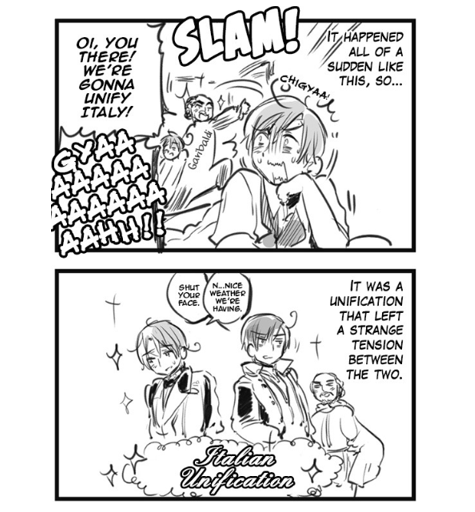
First, some contextualization is needed. Romano had previously
been living with Spain. Just when it’s said that he grew comfortable living
there, he was abruptly reunified with his brother and they were forced to live
together after centuries of minimal contact. It is because of this historical
rift that this same fragmentation is reflected in their personal relations.

Source: Hetascanlations, World Stars Chapter 20.
image


Rather than relying on Veneziano to support him, Romano
decides to seek employment overseas in America during the Second Industrial
Revolution.

Source: Hetascanlations, World Stars 58.

image
image

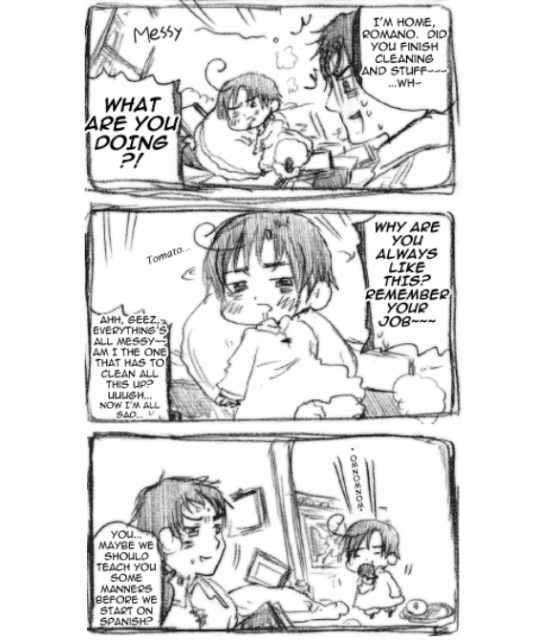
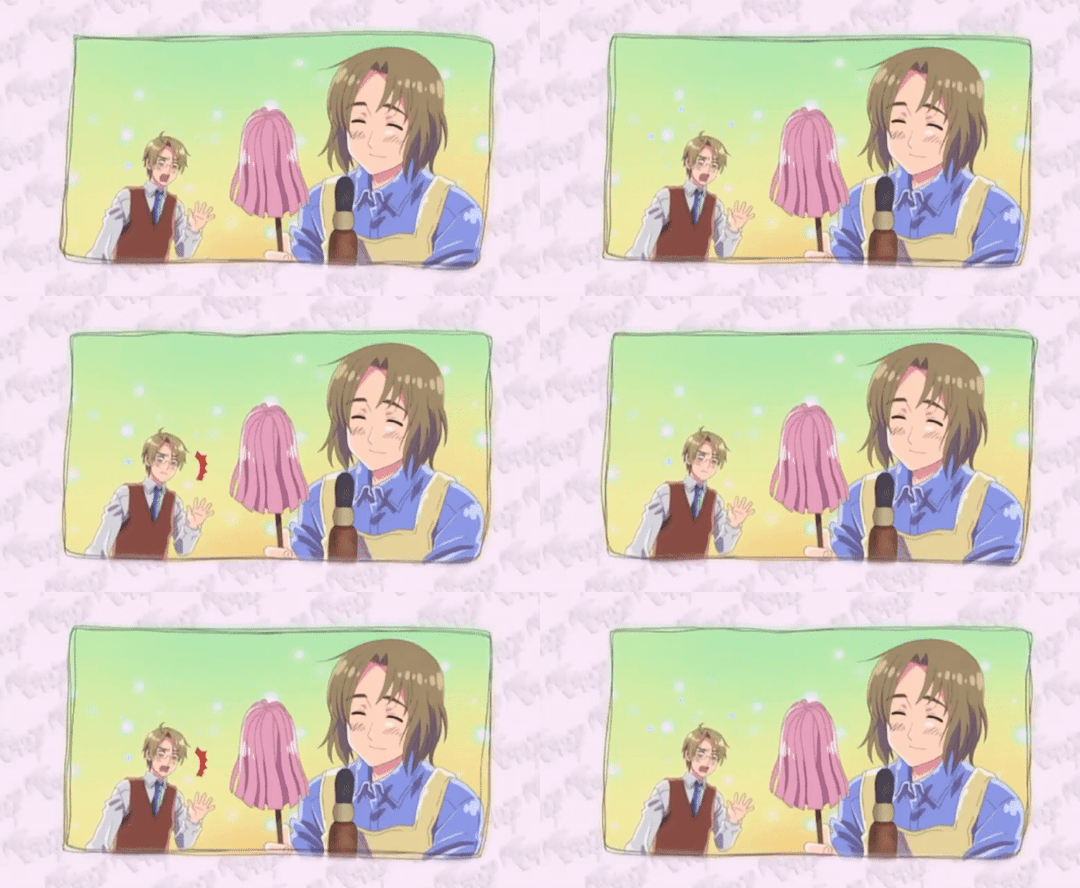
It’s a scary and foreign place to him. He’s on his own and
must navigate things for himself. Not only that, but America immediately puts
him to work in a janitorial position. Keep in mind that Romano was notorious
for not keeping up with chores at Spain’s house.

Source: ibid.

image

To ease and process
his anxiety, Romano relies on the one person who has ever really felt like home:
Spain. Romano’s determination to work sparks surprise in Spain. Again,
Romano was not exactly known for having a good work ethic.

Source: Hetascanlations, World Stars 73.

image
image

This experience of being an immigrant instilled a work ethic
in Romano. He learned to become a hard and diligent worker, albeit only when he
wants to. Still, it’s an improvement! Eventually, he finds a better job
tailored specifically for him and becomes America’s cook.

Source: Hetascanlations, World Stars Chapter 59 & 121. 

image
image

Of most importance is that Romano’s time in America is still
translated and seen in his present-day personality. Being an immigrant profoundly
impacted him in the sense that he learned not only what hard work is but also
the rewards of it. I would also argue that the latent themes of this arc mark
Romano’s progression into adulthood, as he and his brother had just received
their independence.

Source: Hetarchive, Christmas Event 2011.

image

All in all, the source material shows how Hetalia is
anything but xenophobic and racist. Anyone who has read the comics would know
that.

image
image
image

What this post aims to do is chart out Italy and Romano’s
rather…rocky relationship. It’s not something that has warranted a lot of discussion
in the community, so I thought it would be an interesting topic to touch on.

Early Childhood + Ingrained Inferiority:

It’s well-known that Rome devoted more time raising
Veneziano than he did with Romano. As such, Romano has a long and
well-developed hostility towards Veneziano, all of which stems from his own
feelings of inferiority and insecurities.

Sources: Hetarchive, Chibitalia & Volume 6.

image
image

What really cemented this inferiority complex is that after Romano is conquered by Spain, Spain constantly compares Romano to Veneziano and even asks
Austria to trade brothers with him. Romano feels even poorly about himself as a result.

Sources: Boss Spain’s Control of Southern Italy pt. 1 & 2

image
image
image

Thankfully, Spain does learn to value Romano for his own
unique qualities rather than using Veneziano as a measuring rod. This occurs at
the end of the Boss Spain Doesn’t Understand strip.

Another notable characteristic of their relationship is that
they’ve always remained separated from one another. First with Rome and again when they were conquered in the post-Rome era. One point I want to emphasize is
that even though Romano had (and still
has
) a lot of hostility and unresolved feelings towards Veneziano and will
be unequivocally rude and mean to the latter, the two do care about each other.

Ex: They share a heartfelt moment when Spain and Austria
reunite them during a brief visit.

Source: Hetarchive, Comic Diary 6.

image

Forced Unification:
Hastily Repaired Bridge

As mentioned, while the two do care for each other, a
combination of jealous hostility on Romano’s part and a lack of deep rapport
due to long periods of separation prevented them from truly reconciling during
Italian unification.

Rather than a heartfelt scene, they’re suddenly
forced into living with each other. They’re brothers, but what’s awkward is
that they’re very much strangers to one another. 

Source: Hetascanlations, World Stars Chapter 20.

image
image

Not only that, but Romano
refuses to co-operate with and rely on Veneziano during the Second Industrial
Revolution, choosing instead to go overseas to seek employment in America. Notice
again how this emotional rift in their relationship is simultaneously played
out with another physical separation.

Source: Hetascanlations, World Stars Chapter 58. 

image
image

Not only that, but we learn that because of this rigid
unification in tandem to Romano having lived and developed a strong bond with
Spain, he’s closer with Spain than he is with Veneziano.

Source: Hetascanlations, World Stars Chapter 73. 

image

We don’t get much insight as to what happens to them during
WW1, but WW2 is another story.

In a character note, it’s revealed that Romano detests
Germany because he stands as an obstacle to his relationship with Veneziano. 

Source: Volume 2. 

image
image

What’s interesting is that Romano will tell Italy to his face that he doesn’t
want much to do with him and that he doesn’t like him and yet will covertly look
after Veneziano’s well-being without his knowing. And I think that speaks to
their relationship in whole. Romano hasn’t confronted nor addressed his
hostility for Veneziano but secretly cares for him and desires a stronger
relationship.

Source: Hetarchive, Hetare 4: Pact of Steel + Volume 1. 

image
image

Ex: A potential instance of his jealousy towards Germany occurs
when he throws away the pendant that Veneziano had received from the latter.

Source: ibid.

image

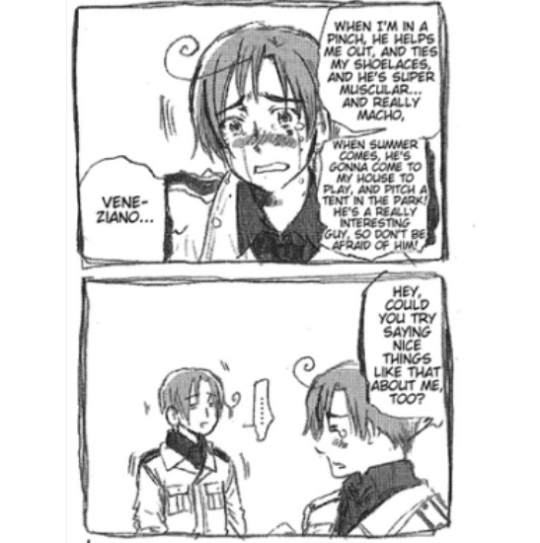
Of course, I shouldn’t neglect to mention that Veneziano isn’t
exactly buddy-buddy with Romano either and even refuses at one point to say
something nice about Romano. Although to be fair, it’s understandable
considering how much Romano berates him.

Source: Volume 1. 

image

What makes things complicated is that Romano is still also
very much self-interested and will look after himself above all else. The scene
where he flees and abandons Italy on the battlefield only for them both to be
captured by England particularly comes to mind.

Source: Hetarchive, the Story of Italy’s Big Brother.

image

Yet, when America occupies Rome and requests that the two
make him a meal, it’s Romano who steps up for the both of them. Veneziano
panics, but Romano remains level-headed, albeit
being verbally hostile.

Source: Hetascanlations, World Stars Chapter 121.

image

Modern-day relations:

Now, I’ve seen a lot of people state that Romano and
Veneziano’s relationship has improved recently, but if I’m to give my honest
opinion, I don’t see it. Nothing significant about their dynamic has dramatically changed. Romano’s
still hostile with Veneziano, refuses to co-operate with him, and insults him.
At the same time, it appears that he doesn’t want Veneziano to leave him
either.

Sources: Hetascanlations, World Stars Chapters 54 & 353 + Hetarchive (Bamboo Thicket, eng trans., Jan 16th, 2015). 

image
image
image

Other instances of this still present fragmentation are
revealed in panels depicting their differences.

Source: Hetascanlations, World Stars Chapter 20. 

image

Although,
there are two panels that offer a lot more hope than previous.

Source: Hetascanlations, World Stars Chapter 19-20.

image
image

That said, this doesn’t mean to say that their relationship can’t
improve and that it won’t ever in the series. All I mean to show is that the
two aren’t super close despite the fact that they’re brothers. There’s a
historical rift in their relationship that has yet to be rectified.

image
image
image

What this post aims to do is cover Japan’s relationship with
other Asian nations. While a tricky subject for good historical reasons, I
think that while he initially had a rough start, Himaruya does a fair job of
balancing a narrative that promotes worldwide peace and reconciliation without
trivializing or obscuring the tragedies of the past.

By that, I mean that while there are many unresolved
historical issues between Japan and other Asian nations, Himaruya is still able
to have the respective personifications get along amicably. They’re not
portrayed as close personally, but they are nonetheless civil and friendly. To
portray them in the former fashion would be insulting, especially given how there
are still tensions regarding how these unresolved historical issues are to be
properly compensated for and addressed. 

Nonetheless, Himaruya is able to work
around this and the narrative of world peace by portraying them as being civil
with each other. He even offers several instances where Japan expresses regret
for his past actions—albeit implicitly.

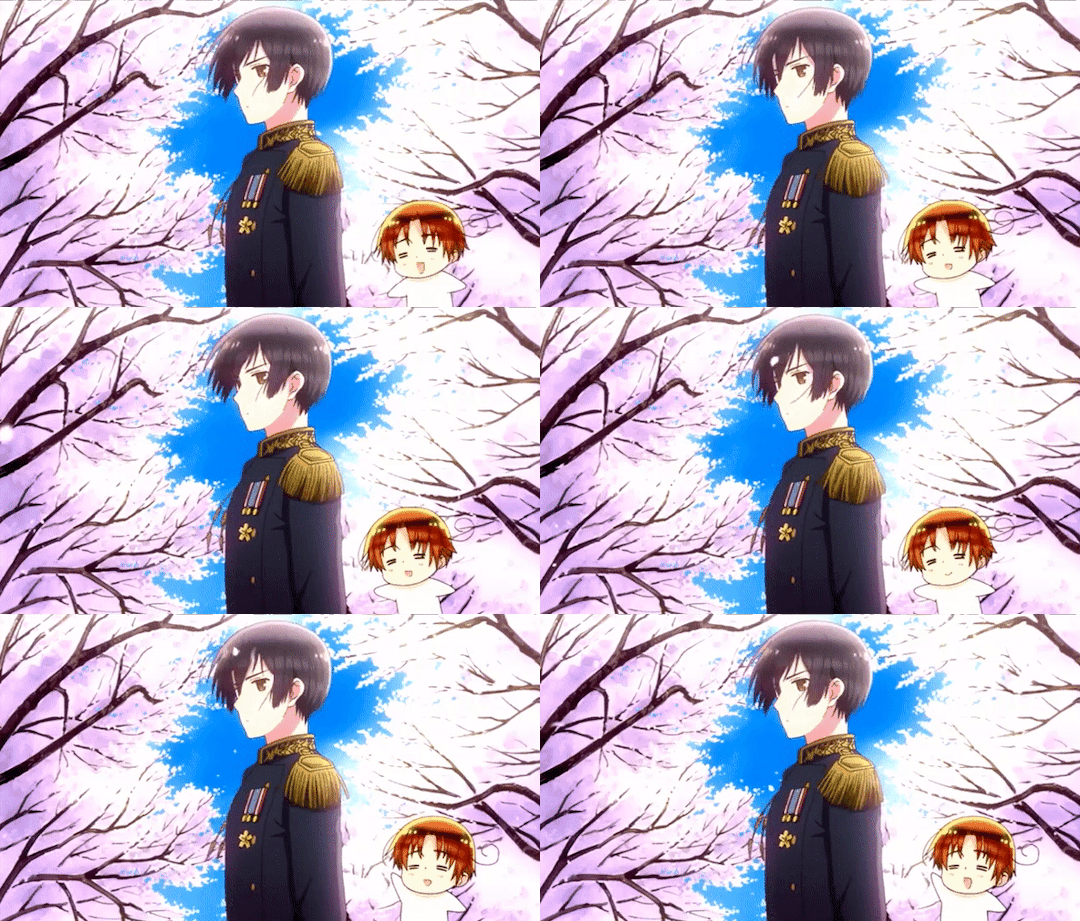
There’s this panel, which alludes to his desire to make
peace in East Asia and achieve reconciliation. I’ve done a longer post on this
here [x], and there’s also a scholarly article that covers the meaning behind this
specific panel in much more detail. Point is, Hetalia doesn’t trivialize or
obscure these dark historical realities but rather it offers hope for the
potential of reconciliation and co-operation as well as the capacity to
overcome grudges.

Article:

Sands, A. T. (2013). Belittling japanese nationalism in hetalia: axis powers. Humanities and Social Sciences Review, 2(3), 125-144.


Source
: Volume 3. 

That said, let’s go over some examples:

China:

There’s the infamous scene where China is betrayed by Japan
during WW2. What I want to place particular stress on is how Japan disconnects
from the situation emotionally—notice how blank his expression is—and asks
China to forgive him.

Source: Hetarchive, The Story about the Early Days of China and Japan.

image
image
image

Chafed and devastated, as he raised Japan and considered him
to be a younger brother, China fears that war has changed Japan and that the
two will never reconnect. Russia reassures him that time will heal their wounds…and
they do.

Source: Hetarchive, The Story about the Early Days of China and Japan.

image
image

It takes a long time, but the two do in fact reconnect. China’s
character song, “Aiyaa 4000 years” expresses China’s longing to look under the
same moon as Japan again (i.e., to reconnect.) China’s signature verbal tick—aru—is scattered throughout the whole song; it’s not until World Stars that
we learn that his aru is symbolic of his hopes, dreams, and romance.

Source: Hetascanlations, World Stars Chapter 43. 

image

In the same World Stars Chapter, we see the two of them
working on improving their diplomatic relations.

image

Another example of their co-operation would be them
designing postcards together.

Source: Hetarchive (Bamboo Thicket, eng trans., Oct 26th, 2011). 

image
image

Again, they may not be as close as they used to be, but they’re
nonetheless on relatively good terms with each other.

image

South Korea:

As mentioned, Himaruya had a rocky start and many lessons to
learn after his characterization of South Korea received a lot of [warranted]
flack.

South Korea claims to hate Japan and will disagree with
anything he says at world meetings, yet he also seems to aspire for Japan’s
approval by mimicking him and showing the latter his creations.

Source: Hetarchive, It’s My First Appearance and All I Get Are Some Scribbles!  + Hetarchive,  Opening of the Meeting at the Center of the World

image
image
image

Unfortunately, that’s the brink of their relationship, since
South Korea’s poorly chosen perverted tendencies have caused Himaruya to
ultimately abandon using the character. Because of this, I can’t comment on any
progression in their relationship. The point I want to emphasize is that they
don’t outright hate each other. Although, South Korea’s grudge is certainly
present in what little interactions that we have.

Taiwan:

Taiwan is the Asian nation whom Japan probably shares the
closest relationship with.

From the inception and early sketches of the series, she is
seen defending Japan, telling China to back off from him.

Source: Hetarchive, Taiwan’s Web Profile.

image

In the present, the two also get along just as well.

Taiwan is very friendly with him.

Ex: She tells his fortune for fun.

Source: Volume 4, Ilha Formosa ~Beautiful Island~

image
image

Ex: She gives him chocolates for Valentine’s day. It’s
hinted that she may even have romantic feelings for him, judging by France and
Italy’s suggestive expressions.

Source: Hetascanlations, World Stars Chapter 42. 

image

Hong Kong:

This relationship is more indirect, but it still tells a
lot. Hong Kong considers China to be his teacher, as they currently reside
together. The fact that Hong Kong finds it suitable and acceptable to ask Japan
for favors is indicative of China having no problem with them interacting.
Although, it is humorous that Hong Kong turns to Japan rather than relying on China to
help purify the air in his country.

Source: Volume 6. 

image

All in all, it’s not so much that Hetalia leaves tragedies
of the past unacknowledged. It’s satirical genre in tandem to its promotion of
world peace limits what it can cover and what stories it can tell. On the other
hand, it doesn’t trivialize or erase these tragedies either. Instead, while
seemingly simple, it’s able to promote narratives of co-operation and civility
in spite of past and current political tensions.

image
image
image

Disclaimer: In
this post, I will not consider nor speculate a Holy Rome = Germany connection.
I’ll only be covering canon material.

Guardian-Sibling
Dyad:

The strength of the two’s relationship begins before Germany’s
birth. Prussia zealously worked towards consolidating the German states into
one sovereign nation. While Germany has plenty of older brothers, Prussia steps
in as his main caretaker.

Source: Hetascanlations, World Stars Chapter 12. 

image

Ex: In the scene depicting Germany’s birth, there’s a clear moment
that demarcates Prussia’s status as the closest elder brother.

image

Germany’s a source of pride and joy for Prussia but also
someone whom he loves deeply. As such, he protected Germany—a then helpless
and inexperienced child—from political enemies.

image

This period of impotence doesn’t last very long, however. Germany
learns the ropes of being a nation very quickly and respectively ages just as
fast. He’s immediately immersed in the world of politics.

Ex: As a young adult, Germany participates in the first
Industrial Revolution. Together with his brother, the two co-engineer several technological
inventions.

Source: Hetascanlations, World Stars Chapter 57.

image

What I particularly want to stress is that while Prussia
loved Germany, he’s very much a regimented and strict person due to his
combative history. In turn, Germany was raised to be cool-headed and to not
disclose his emotions. There’s also the whole Germanic stereotype where they
don’t show their emotions, as revealed with Germania—their ancestor.

Source: Hetarchive (Bamboo Thicket, eng trans., Feb 24th, 2015). 

image

It’s for this reason that I believe Prussia becomes surprised
at the thought of Germany reading romance novels and immediately dismisses it,
referring to the latter as a “battle-crazy guy.” Truth is, Germany was actually an avid reader of romance novels at the time.

It proves my point that the
emotional bonds that they shared was embedded in a war and politics mindset. It’s
a very backwards way of looking at how men aren’t allowed to show their emotions,
or, if they are, it has to be in a manly and comradery-oriented environment. It’s
important to contextualize the fact that this takes place in WWII.

Source: Hetarchive, Buon San Valentino pt. 2 & 3. 

image
image

Ex: The two bond by participating in war missions together.

Source: Volume 6, The Awesome Me’s Biography.

image

One last aspect that I want to highlight before moving onto
other sections is that there’s a significant gap in their relationship post–WWII.

Prussia fell under Russia’s control. If he wanted to
communicate with other nations, he had to write letters, and even those were censored
heavily.

Sources: Hetarchive, Notes & Etc + Hetarchive (Bamboo Thicket, Oct 30th, 2013).

image

We later learn that the two brothers eventually move in
together during German Unification. Hints of their lack of communication reside
in Germany’s surprised and pitying expression at Prussia’s shabby attire.

Source: Hetarchive (Bamboo Thicket, eng trans., Oct 8th 2013).

image

New Wine in Old
Bottles:

…or should I say new blood in old bottles?

The basic idea of this theme is that while Prussia and
Germany may appear to have different personalities, the two
are also very similar.

They both
like beer, they’re both
neat, and they’re both
meticulous researchers and documenters.

Sources: Volume 6, Awesome Me’s Biography + Hetarchive (Bamboo Thicket, eng trans., Dec 23rd, 2014) + Hetascanlations World Stars Chapter 28b.

image
image
image

Passing the Baton:

One last theme revolves around generational inheritance.
Putting aside the reason why Prussia still exists—too many theories on that—the matter of him disappearing was once brought up by a fan. Even though Himaruya
states that he’ll be living with Germany for a while, the possibility of
Prussia disappearing isn’t shot down definitively either.

Source: Hetarchive (Bamboo Thicket, eng trans., Jan 17th 2015). 

image

The main point I want to devote attention to is the mention
of Prussia passing down his knowledge and awesomeness to Germany. How I
interpret this is that it’s Prussia passing on the baton of his nationhood and
legacy to Germany. He raised Germany and now Germany’s the one providing for
him in the post-Soviet era. The roles have reversed. Prussia’s no longer a
nation, whereas Germany wouldn’t have existed without Prussia.

This message becomes more obvious in the “Private Concert”
strip, where Prussia gives Germany a private flute performance. The inclusion
of flashbacks and the ending is of particular relevance here. The strip ends
with Prussia encouraging Germany to take on the flute.

Source: Hetarchive, Private Concert.

image
image

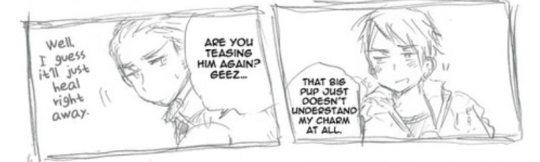
The symbolic meaning surfaces when it’s revealed that
Prussia hasn’t healed from a dog-bite wound, lying to Germany about when he received
it. He claims that it was a recent scrape and given their extraordinary biology,
Germany dismisses it and remarks that the wound will heal right away. It’s
through the dog’s internal dialogue that we learn that Prussia was actually
bitten a week prior—the fact that he hasn’t healed suggests that he’s losing
his nationhood and/or becoming human.

image
image
image

The passing on the baton theme becomes relevant in the sense
that the flute is used as a metaphorical device to represent Germany taking on the
full helm of their legacy. Just like Fritz used the flute to rally the motivation
of German troops (i.e., leading the charge), this scene is Prussia being
cognizant of the fact that he hasn’t led the charge for a long time. 

Source: Hetarchive, Christmas 2011 Event.

image

And who
better and more competent to lead it than Germany?

image
image
image

What this post aims to do is provide an in-depth look at the
progression of Spain and Romano’s relationship over their life courses.

Early Guardianship:

The two got off to a rough start when
Spain conquered South Italy. Romano, who already had trust issues stemming from
the twofold sword of having Rome focus all his attention on rearing Veneziano and
later dying without much warning, has these issues exacerbated by his early
relationship with Spain.

Sources: Hetarchive, Chibitalia & Volume 6. 

image
image

Spain wishes that he had received Veneziano
instead and begs Austria to trade Italy brothers with him. I attribute the
crudeness of this to the fact that it was very early on in the series, but canon
material is canon material; it must be worked with. Of more importance is the parallel of coming second to Veneziano. 

Source: Hetarchive, Boss Spain’s Control of Southern Italy.

image

Essentially, Romano develops an inferiority complex and
feels inadequate in comparison to Veneziano. He can’t cook, he can’t clean, and
he has no manners. I mention this because it acts as a backdrop for Romano’s
initial hostility towards Spain.

Source: Hetarchive, Boss Spain’s Control of Southern Italy pt. 2.

image
image
image

Even as Spain gives him the best care possible, Romano
denies the reality and states otherwise. Being cared for is foreign to him, so
the hostility didn’t just emerge in a vacuum. He’s distrustful and confused. Or
perhaps he’s even testing Spain by lashing out, seeing how much the latter can
handle.

Source: Volume 4. 

image
image

Point is, there’s a degree of skepticism that makes sense
and it would be too simplistic to portray Romano as an entitled brat given what
he experienced in his early childhood.

Ex: Spain resorts to wearing rags and funds a whole new
wardrobe for Romano. Notice how the blush on Romano’s face (embarrassed, surprised
and flattered) betrays his true emotions rather than his hostile remark.

Source: Volume 4.

image

The next strip is particularly important in resolving this
sense of devaluement that Romano felt.

The frustration was mostly felt in how Romano didn’t live up
to Spain’s expectations, as he was held up to a measuring rod that reflected
Veneziano’s qualities. In other words, Romano wasn’t being valued as his own
person by Spain.

It was only until Spain learned to value Romano for his own
unique qualities and positive character traits that the two came to an
understanding.

This occurred when Romano perceived a troop of German
soldiers that Spain had allied with to be enemies. To Spain, Romano’s tantrum is
childish…but that’s because he is a child. In Romano’s world, Spain was in
danger, and he was willing to sacrifice his life for him. That’s why Romano
becomes angry with Spain and throws another fit when he’s reprimanded.

Source: Hetarchive, Boss Spain Doesn’t Understand.

image
image
image

The two take some time to cool off and Spain realizes that
even though Romano perceived the situation incorrectly, he had good intentions.
The message conveyed at the end of this strip– titled Boss Spain Doesn’t Understand–entails Spain learning to step into Romano’s world and understand
his way of viewing things. By doing so, Spain was able to appreciate Romano for
who he is rather than who he’s not.

image
image

In another strip, Romano shows his appreciation for the financial sacrifices Spain made for him, by deciding to sleep with the latter. Of course, it’s very Romano-esque, resulting in Romano taking over Spain’s bed. What’s touching is that Spain understands that Romano is trying to convey his thanks and accepts it as is. 

Source: Boss Spain’s Control of Southern Italy pt 2.

image
image

Late Guardianship:

Although this is a brief and shallowly covered period of
their relationship, we know that the two lived comfortably and peacefully
together.

Spain sees Romano grow up from a young child, to a child,
and to a late teenager.

Source: Hetarchive (Bamboo Thicket, eng trans., Feb 6th, 2015). 

image

There’s even an arc where Spain passes down his medieval
chivalric romance novels to Romano, who goes through a nerdy middle school
phase with them.

Source: Hetascanlations, World Stars Chapter 279. 

image
image

While long-lasting and cordial, the stable environment
Romano had found in Spain’s home ended abruptly upon Italian Unification, where
he was forced to live with his brother after centuries of separation.

Source: Hetascanlations, World Stars Chapter 73. 

image

It’s not so much that this creates a break in Spain and
Romano’s relationship, but as I’ll get into in the next section, it creates a
bit of a grey area for them regarding how they navigate the shift from a
guardian-child relationship to simply being friends.

Post-Guardianship:

Regardless of the fact that their guardian-child relationship
ceased to exist, Spain and Romano still relied on each other. They were and remain
as each other’s support systems.

Ex: When Romano moves to America for work during the Second Industrial
Revolution – a foreign and unfamiliar place–his first thought is to call
Spain.

Spain is still home in his mind, and home brings comfort.
Notice how it’s stated that Romano is closer with Spain than he is with his own
brother ↑

Source: Hetascanlations, World Stars Chapter 73.

image

The irony of their relationship is that even though Spain
has learned to understand Romano – such as seeing through his hostility – he still
remains oblivious at times. In other words, they either click and are on the same
wavelength, or they completely misunderstand each other, echoing the Boss Spain Doesn’t Understand comic.

Source: Hetascanlations, World Stars Chapter 75. 

Either way, the reliance hasn’t gone away.

Ex: Spain takes a drunk Romano home after the Halloween
2013-2014 event.

Source: Hetarchive, Halloween 2013-2014 Event.

image

What’s new in this phase of their relationship, however, is
that Spain can also rely on Romano.

Ex: Romano saves Spain with imports during an economic
crisis. He even faces off against the mafia, whom he’s normally terrified of.

Source: Hetarchive, In just two minutes you can grasp the exterior of the European Economy. 

image
image

That said, I think the “grey area” in Spain and Romano’s
relationship has a lot to do with the fact that they’ve worked away from the
guardian dynamic and yet haven’t exactly defined how they should go about their
friendship.

Source: Volume 5.

image

Although, Spain certainly has become very fond of Romano and
has a habit of stepping over his boundaries…

Sources: Volume 2 & Hetarchive (Bamboo Thicket, eng trans., Dec 5th, 2014 & Nov 6th, 2013).

image
image
image
image
image
image
image

This guide will give a concise rundown of how the nations experience
and participate in wars.

Status:

They’re no different than any other citizen fighting for
their country. In other words, they aren’t given any special treatment.

Ex: There’s a comic gag regarding how terrible it was to be
a Russian soldier.

So much so, that Russia becomes ecstatic when Germany takes
him as a prisoner of war.

Sources: Volume 1. 

image
image
image
image

Ex: During WW2, Germany is said to tolerate his way through
pain every day.

Source: Hetarchive, Hetare 5: Lietuvis. 

image

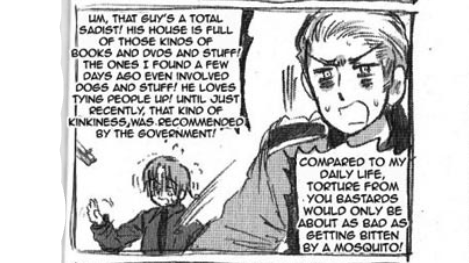
When captured as a prisoner of war himself, he states that
torture is no more than a mosquito bite to him.

Source: Volume 1. 

image

Regarding food, they’re not allocated extra supplies. If
their population is starving, so are they.

Source: Hetascanlations, World Stars Chapter 120. 

image

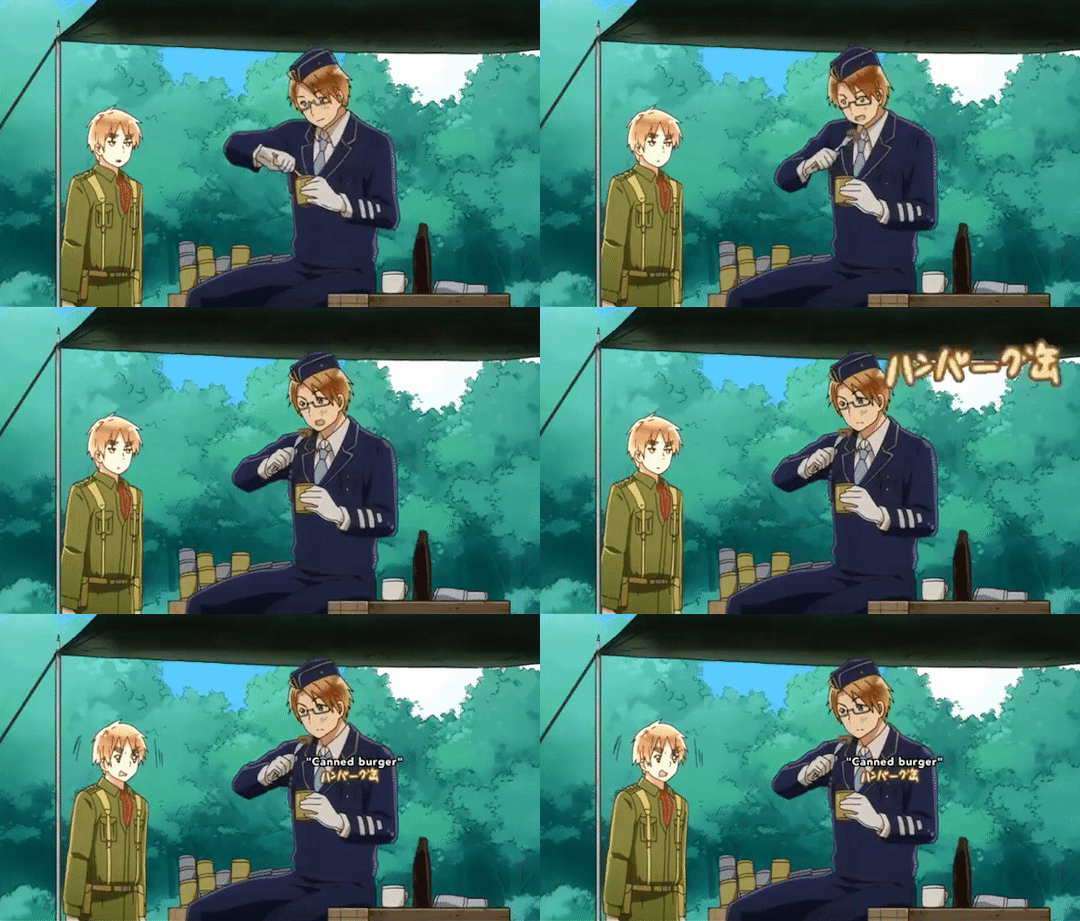
They’re given rations just like any other soldier.

Source: Volume 5, Let’s Eat Military Rations!

image

They fight with their people rather than being fought for.

Source: Volume 4, The Ruler of Scandinavia and the King of Eastern Europe.

image

Post locations:

Nations can serve on the ground, the navy, and
the air.

Sources: Volume 3,  A Battlefield’s Kickoff + Hetarchive, Hetare 3: Nonagression pact + Hetarchive, Germany & Cohabitation.

image
image
image

Missions:

They get missions from their bosses.

Ex: Germany is tasked with annexing Austria.

Source: Hetarchive, The Austrian Anschluss.

image

Ex: Germany and Prussia are asked to infiltrate America’s war
camp.

image
image
image
image

There’s a tendency for people to wave off Russia as a flat
character due to the fact that his ‘craziness’ (for lack of a better word) is
poorly written. This trait dominates the fandom’s perception of him and erases
the larger picture of the reason behind why he acts the way that he does. No, it’s
not a stereotype for Russian people to be emotionally unpredictable and cruel, which
is a big reason why his characterization is often contested. However, Russia’s
mental state was never meant to represent a stereotype. It’s instead a tool
that Himaruya uses to demonstrate the impact that Russia’s volatile and chaotic
history had on him.

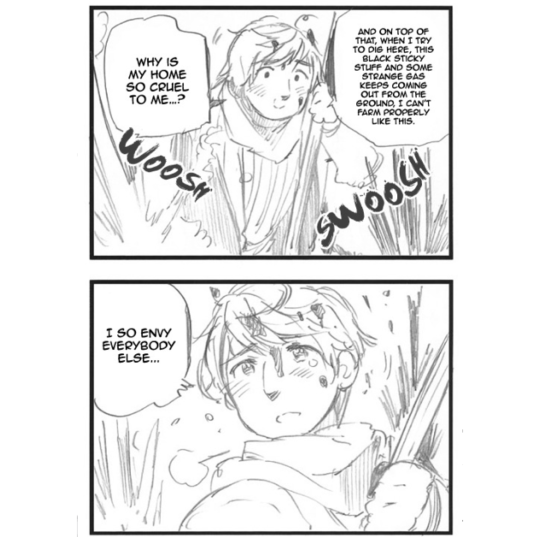
For example, Russia is described as a simple bumpkin type.
While this is supposed to be in reference to his impoverished lifestyle, this
is often misattributed to his personality. 

Note: Russia isn’t treated as an
elite in his nation and is instead treated like an average citizen, not reaping
any of the benefits that the selfish oligarchs in power did.

Source: Volume 2.

image
image

Ex: Russia was
tasked with building a waterway with his people during the Stalinization period…without food and adequate clothing. Notice
the contrast with the person ordering him around, who has food and warm
clothing.

Cruel, isn’t it?

Source: Hetarchive, To Your Heart’s Content, Russia!

image

That said, I’ve covered and contextualized the reasons for Russia’s
“warped sense of reality” in another post [x]. What I specifically want to focus on
here is how World Stars goes the extra mile in developing his character. Yes,
there were a good amount of strips prior that shed considerable insight into Russia’s
mind; however, World Stars really fleshes out these earlier strips.

Let’s go over them.

Economic and Cultural
Revolutions:

We see Russia go through several personal and national developments.

With Peter the Great and his Westernizing reforms, Russia
gains cultural capital and begins mingling with French nobility. He’s tasked
with studying France’s culture. I’ll get into this in more detail soon but
notice how Russia mentions that he’s unable to go home until he gains this
information on France.

Source: Hetascanlations, World Stars Chapter 295,298, & 299.

image
image

During the industrial revolution, he begins as a poor nation
without any attractive resources. This all changes when he discovers oil and
finally begins to catch up to other industrialized nations.

Source:  Hetascanlations, World Stars Chapter 61.

image
image
image

Political Turmoils
and Inconsistency:

Russia is notorious for its dark and bloody history.

Think about how disorienting and traumatizing it would have
been for Russia to experience one chaotic shift in government to another.

World Stars effectively demonstrates the rapidity of these
transitions.

Source: Hetascanlations, World Stars Chapter 61. 

image
image
image

Helplessness + Its
Impacts:

Since personifications are obligated to obey their Heads of
State, they’re inevitably put in a complicated position of inferiority and
subjugation.

Russia’s bosses are the most brutal example of this. The
control they have over them is extensive and abusive, both physically and verbally.

Ex: Russia’s threatened into building a steam engine. Notice
again how he dissociates the moment that he’s threatened. It’s an indication of
trauma.

Source: Hetascanlations, World Stars Chapter 61.

image

Ex: He cryptically comments about vote counts in his
elections, alluding to the fact that they’re fraudulent but also how he can’t
do anything about it.

Source: Hetascanlations, World Stars Chapter 157.

image
image

Ex: He needs to be granted permission to visit other
nations.

Source: Hetascanlations, World Stars Chapter 143.

Isolation and loneliness:

Lastly, we learn that Russia suffers from chronic
loneliness.

In his childhood, a good New Year’s for him was not freezing
to death. Cut to the present, and, while not nearly as traumatic, he’s still
alone. Obviously, this is the result of the abuse he inflicted on the ex-Soviet
nations he invites over to his house. They’re understandably not keen to
see him. 

If anything, this just further elaborates on the idea that the trauma he
experienced has prevented him from maintaining healthy relationships with
others. He’s remained forever as a child because of it and is unaware of the
harm and cruelty he inflicts onto those around him.

Source: Hetascanlations, World Stars Chapter 235 & 236.

image
image

There’s also this chapter, which highlights how Russia would
rather be around shouting nations [during a meeting] than being alone. The unpredictability
and violence of his nation’s history are reflected in his dark comment about
silencing the shouts “as lawfully” as possible should they get too loud.

Source: Hetascanlations, World Stars Chapter 49.

image

With all that in mind, this post doesn’t seek to defend Russia,
nor does it remove him from the cruelty of his actions. Instead, what I hoped to do was prove that his character extends beyond the crazy stereotype. It’s filled with a much deeper meaning than what is conventionally understood.

image
image
image

What this post aims to do is flesh out the “hot tempers”
that are often attributed—uni-dimensionally—to these characters. While Hetalia
is based on stereotypes, the characters’ personalities are still considerably
developed and round. It’s the fan depictions that tend to make them flatter
than what they actually are.

England:

England is probably the easiest character to misinterpret,
especially for those who don’t like him—not to mention that he’s hands
down the most hated and contested among fans.

I’m not here to debate the fact that England can be
incredibly rude. However, it’s important to contextualize and
understand the reasons for this if anyone is to truly appreciate let alone
depict him.

England’s temper comes from a place of extreme sensitivity
and vulnerability.

Ex: His temper became particularly volatile in the aftermath
of the American Revolution. We also learn that he experienced 100 years of
heartbreak. While the connection hasn’t explicitly been made in canon, I think
it’s safe to assume that the latter fact is in reference to the heartbreak that
he experienced in the wake of America’s separation from him.

Source: Hetarchive, 2007 Christmas Event + Hetarchive, Notes & Etc.

image

Ex: Other character notes state that he’s poor at expressing
himself (i.e., he lashes out and rubs others the wrong way). He’s even aware of
the fact that he’s misunderstood but copes with self-deprecating humour.

Source: Hetarchive, Notes & Etc.

Point is, England’s personality is two-sided: he insults and
condescends, only to reel in this scrutiny in and deprecate himself.

Source: Hetascanlations, World Stars Chapter 25.

image
image

Germany:

Germany is notorious for being characterized as someone with
a short temper. While this isn’t in whole inaccurate, as he does have a short
fuse, it ignores the fact that most of his anger stems from confusion and
perplexion at forming meaningful relationships with others. Longer post on that
here [x].

Source: Volume 3, the United States of Hetalia.

image

What I particularly want to emphasize is the problem in
which other characters mistakenly perceive Germany to be angry (a German stereotype). In
other words, he comes off and seems angry.

Source: World Stars Chapter 1. 

image

Ex: Germany asks Italy out for drinks after a training
session, only to be interpreted by Italy as being angry.

Source: Hetarchive, Comic Diary 4. 

image
image

Iceland:

The most forgotten element about Iceland’s personality is
that it’s predicated on a hot and cold spectrum. It’s a clever reference to his
geography, i.e., hot volcanoes/ springs vs freezing weather.

Source: Hetascanlations, Chapter 106 + 114.

image
image

Characterizations lean more towards depicting his hot side
and how ‘annoyed’ he gets when the other Nordics—especially Norway—coddle him.

In reality, it’s revealed that Iceland doesn’t mind this
badgering. In fact, he appreciates it.

Source: Hetarchive, Halloween Event 2014.

image
image

Another example would be how flustered he becomes when he
finds out that the other Nordics had gotten together to host a surprise
birthday party for him.

Source: Hetarchive, Volume 6. 

image
image

Romano:

Romano’s personality is very much along the same lines of
England’s. His hostility is a self-protective mechanism employed in order to hide his sensitivity.

Ex: He’s described as a crybaby and coward.

Source: Volume 2. 

image
image

Ex: When he confronts Germany during WW2, putting on a macho
act, he’s quick to retreat when France appears.

Source: Volume 1. 

image

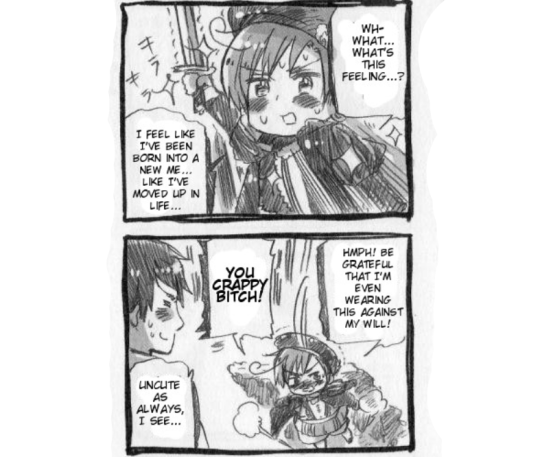
Ex: When they lived together, Romano became fed-up with the
maid work America tasked him with. The comic gag revolves around Romano
attempting to intimidate America with a gangster persona, only to cower and
surrender when America perceives him to be a “bad guy” in need of being brought
to justice.

Source: Hetascanlations, World Stars Chapter 59. 

image
image
image
image
image

While characterizations depicting
Romano as an easily irritated and rude person isn’t in whole inaccurate, it’s
nonetheless one-sided and uncontextualized. By that I mean that this type of
characterization erases the fact that Romano’s incredibly sensitive from a lifetime
full of pestering insecurities and fears. He’s bottled up a lot of these
emotions and lashes out as a result. Likewise, it also erases Romano’s loyalty
in spite of his poor way of expressing it.

Let’s unpack what I mean by this.

For one thing, it’s canon that Romano is an even bigger
crybaby than Veneziano.

Source: Volume 2.

image
image

A lot of this stems from feelings of resentment and
inadequacy that he developed as a child. Rome spent the majority of his time
rearing and caring for Veneziano.

Source: Hetarchive, Chibitalia.

image

Consequently, Romano develops an inferiority complex and
feels inadequate compared to Veneziano.

Source: Boss Spain’s Control of Southern Italy pt 2.

image

What doesn’t help is that Romano placed second again when
invading countries preferred Veneziano over him.

For example, Spain initially wanted to trade Romano for
Veneziano, as Romano’s manners and housekeeping skills weren’t nearly up to
par. 

Source: Hetarchive, Boss Spain’s Control of Southern Italy pt 1.

image
image

It sounds horrible, but we do get a touching scene where Spain eventually reconciles
with Romano, learning to accept and love him for who he is.

Source: Boss Spain Doesn’t Understand.

The two meet each other halfway and develop a strong bond in
which they genuinely enjoy living together.

image
image

That bond is abruptly cut during Italian Unification, where Veneziano
and Romano are forced together after centuries of separation in which they
rarely saw each other.

image
image

Sources: Hetascanlations, World Stars Chapter 20 & 73.

Since Romano still had unresolved feelings towards Veneziano,
the two didn’t exactly get along. As such, Romano opts to move to America
instead to look for work. The immigrant life was a scary and unfamiliar terrain
for Romano to traverse. To cope with this, he calls the first person who’s ever
felt familiar and homely to him: Spain.

Source: Hetascanlations, World Stars Chapter 73.

image

Point is, even though Romano doesn’t show it, he’s very
sensitive and shows it in ways that aren’t the most obvious.

While I initially rubbed this off as trivial, there are
scenes during WW2 that are particularly important in showcasing Romano’s
vulnerability.

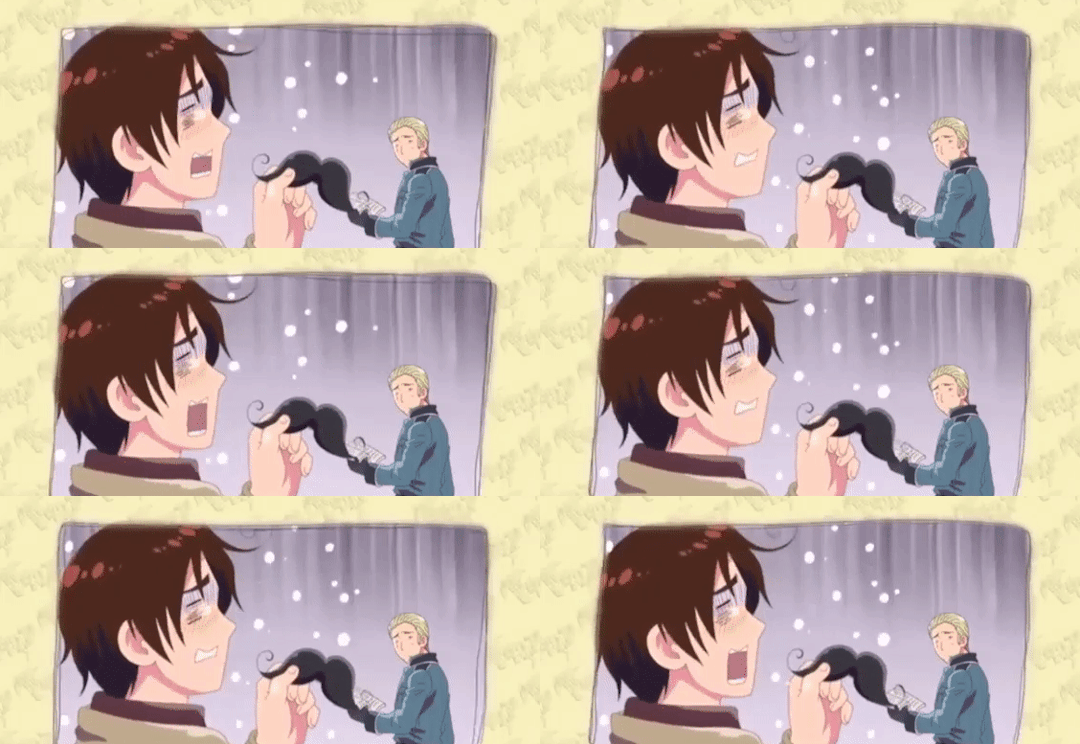
Ex: He cries during the infamous failed mustache incident with Germany.

Source: Volume 1. 

image

Ex: He cries and hides behind Germany from France – note that
this is likely indicative of the fact that Romano is reliving the childhood fear
of being conquered and attacked.

Source: Volume 1. 

image

Other examples of vulnerability would include him being
sensitive about his height and crying into tears of joy when Grandpa Rome
visits him from heaven.

Lastly, it’s also important to recognize that while Romano
may be rude, even to people he cares about, he’s loyal.

Ex: During the immigrant period of his life, he cheered on
America when the latter surpassed England in industrial production.

Source: Hetascanlations, World Stars Chapter 70.

image

Ex: While too shy to do this upfront, Romano looks out for
Veneziano in WW2 by remaining skeptical towards Germany, questioning him about
his intentions.

Source: Volume 1.

image

Ex: Romano tries to save Spain from illness during an
economic recession, which forces him to come into conflict with the mafia, who he’s
normally terrified of.

Source: Hetarchive, In just two minutes you can grasp the exterior of the European economy.

image
image

All in all, it would be unfair to say that Romano’s a prick
without contextualizing this within a broader understanding of him employing a
tough exterior to hide a more sensitive than normal interior.

image
image
image

The purpose of this post is to delineate the fact that
nations that have cultural influences on each other are not biologically
related. While the influencee may adopt traits from the influencer in some
cases, it doesn’t always constitute a biological relation. What’s even more
confusing is that there are specific adopted traits that the nations use to
mark a biological relation.

I know this sounds obscure, but it’ll make sense when I go
through some examples.

Romania and Bulgaria
vs Romano and Veneziano:

A gag with Romania in the series is that he claims that he’s
a descendant of Rome, and, therefore, an Italy brother.

However, even though Rome did, in fact, instill significant
cultural influence in Romania, Romano is quick to reject this claim. He
identifies the presence of a curl as proof of biological lineage from Rome.
Remember that Rome is said to have had many grandchildren and adopted
grandchildren.

Source: Hetascanlations, World Stars Chapter 163 + Hetarchive (Bamboo Thicket, eng trans., October 30th, 2014).

image
image

Later, we see the same rejection occur with Bulgaria, who
has Roman ruins.

Source: Hetarchive (Bamboo Thicket, eng trans., Oct 22nd, 2014).

image
image

England, America,
Finland, and France: (+ more)

As I’ve stated before, England and America are not
biologically related. England is stated to be the fourth and youngest sibling
in his family, consisting of Wales, Northern Ireland, and Scotland.

Source: Hetarchive (Bamboo Thicket, eng trans., Aug 4th 2010).

In the Battle for America, it’s explicitly stated that
England becomes America’s brother. We also learn that because America was a
“melting pot” of several cultures at the time, he inherited certain physical
traits from his colonizers.

Source: Hetarchive, The Battle of America.

image

For example, in the trio’s feud to make America their little
brother, Finland notices that America looks like him.

image
image

The distinction between cultural influence and blood
relation is necessary otherwise it would lead to a slippery slope where all
nations are related to each other. So, unless explicitly confirmed by Himaruya,
nations aren’t related to each other regardless of their histories. Arbitrary
as the biological relations may be, you work with what’s given to you.

Lastly, I’ve seen people comment that there’s a confirmed
biological relation between America and Finland. That’s not the case. Finland says that America has some genes from his people. Remember that America emerged as a personification representing several cultures. The genes are the traits, but because America has so many cultural influences, they don’t consider each other to be blood-related.

The fact that America didn’t identify with Finland as a
family member in the first place is telling of this cultural influence, as well
as the fact that Finland offers to become a father figure for America, who in
the context of the strip had been feeling jealous of kids who get presents from their fathers on Christmas.

Source: Hetarchive, Christmas 2010 Event.

image

France and Canada:

Similar to the situation with England and America, Canada
inherits France’s hair.

Source: Hetascanlations, World Stars Chapter 192.  

image

France, America, Canada, and Seychelles vs England, Hong
Kong, India, Australia, New Zealand, Hutt River, Sealand, and Wy:

We learn that France’s cultural influence is a dominant trait
that prevents America, Canada, and Seychelles from inheriting England’s bushy
brows. Although, interestingly enough, Seychelles had initially been designed
to have one thick eyebrow and one bushy one to represent English and French influence.

Source: Hetarchive, Seychelles profile.

image

Meanwhile, without French influence, Hong Kong, Australia,
New Zealand, Hutt River, Sealand, & Wy inherited the bushy brows.

Source: Hetarchive (Bamboo Thicket, eng trans.,Nov 12th 2013) + Hetascanlations, World Stars Chapter 269.

image
image

Of most importance and what I can’t stress enough is the
example of Hong Kong. It proves, with the most clarity, that cultural influence
does not have a causal relationship with biological relation.

After becoming English territory, Hong Kong’s eyebrows grow
bushy from the resulting English influence on his culture.

Source: Volume 6, A wise man has no specialty.

image
image

It’s said that England put a curse on him to have his eyebrows become so thick, but you also have to remember that England’s eyebrows themselves are cursed. The implications would be that his influence caused the curse to pass on.

Source: Volume 5, Special Booklet.

image

Point is, as far as Himaruya’s concerned with his
characterizations:

Cultural influence ≠ biological relation.

image