Sure, Spain is a lovable character; what with his sunny smile, goofy, weird humour, and cheerful ‘obliviousness.’ However lovable, the Spain depicted above makes him out to be a flat character, one that doesn’t have any flaws.
Flaws make characters interesting, and trust me, Spain is chock-full of flaws. He has a violent temper when tested (he’s also a violent drunk), is able to read the atmosphere and be fully aware of it, and can be pretty spiteful too.
In this strip, Spain recognizes that contrary to what Germany says in terms of guiding the rules of the meeting, it isn’t actually a compromise. I like to interpret this as a small reference to how strict Germany has been when regulating Spain’s economy in the EU.
Spain wasn’t oblivious to his financial situation at all, despite irritating Germany by “singing songs” as the latter helped him out of his property bubble.
This hilarious panel in particular clearly shows Spain’s recognition in needing Germany to help bail him out financially.
On the other hand, there’s a notable spiteful side to him too. America claims that Spain “attacks him in the knees” every time they see each other. Spain can hold grudges; not only that, but for a long time too, as there isn’t much of a reason for Spain to hate America in modern times.
Here’s another example. In the 1990s, at the peak of a financial crisis, Spain lies on his deathbed and suffers from a high fever. His last regret is that he didn’t get to give England and America one last punch.
Spain’s competitive nature can be dangerous too. Here, he puts in a bid to host the Olympics, but loses the privilege to Japan despite having already built a stadium.
Yes, that’s right. That’s caution tape behind him, warning of a potential explosive outburst. I certainly wouldn’t want to piss him off, that’s for sure.
There you have it. Spain isn’t your typical cheery Gary-Stu. He’s a lot more complex than people give him credit for. Let’s stop seeing him as “plain,” yeah?
Let’s jump into the pits of hell, shall we? Nah, I’m just
kidding. I think you guys know by now just how brutal the USSR was not only for
those under Russia’s rule, but also for Russia himself, as he’s always
struggled with chronic loneliness and making ‘friends.’
Political revolts aimed at gaining independence were
supressed through the use of force, dissenters were sent to gulags, and alcoholism
was rampant. That said, it’s no wonder that the Baltic nations were referred to
as the “Trembling Trio.” Anyone in their right mind would be terrified.
Russia, both the nation and personification, ruled with an
iron fist. To gain compliance, he either squeezed shoulders, or in Latvia’s
case, pressed down on the former’s head.
On the other hand,
the psychological damage is the most lasting here. Russia has a warped, child-like
mentality, one where he doesn’t quite understand the consequences or repercussions
of his actions. He uses violence to solve his problems.
When it comes to the damage Russia inflicted, Lithuania and the
cuts on his back immediately comes to mind.
Likewise, we know that Lithuania is still rehabilitating
from his time spent in the USSR.
Surprisingly, what I don’t see people talk about is this notion
of transference. That is, Lithuania has actually adopted some of Russia’s
violent tendencies, albeit unintentionally. You see this play out in chapter 96
of World Stars.
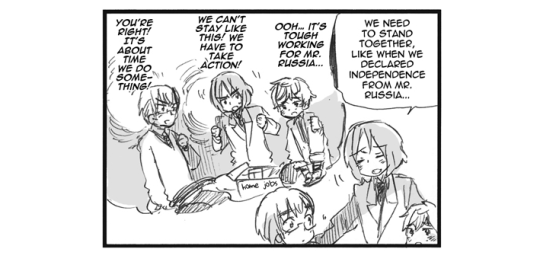
As Estonia gushes about wanting to become a Nordic, Lithuania
urges that they stick together and remain as the Baltic trio, just like they stuck
together when they gained independence from Russia.
Lithuania relives the first memory.Then, he remembers Russia squeezing his shoulders, and, without realizing it, starts squeezing Latvia and Estonia’s shoulders to the point that it causes
them pain.
In my opinion, Lithuania doesn’t just seem to be experiencing
PTSD here. I honestly think he’s learned some of Russia’s violent tendencies,
not consciously, but more as an unconscious psychological consequence of the trauma
he experienced.
Latvia even asks Lithuania if he’s okay, but Lithuania is unresponsive. Just look at Lithuania’s expression; he’s pretty removed from the situation.
It’s these small, brilliant, and dark details that makes
this series enjoyable to read. Hima is so methodical in how he develops and
evolves his characters. In a single strip you see how unfathomably deep Russia
has hurt Lithuania, in more ways than one.
Just like humans, the nations become products of their
environment.
Being one of the world’s largest powers is a huge
responsibility. What made America’s ascension into this position all the more
difficult was that it was quick. After WW2, the Western half of Europe relied on
America to help rebuild their economies and infrastructure. That’s a huge
change from their isolationist and non-interventionist policies from before,
where they didn’t intervene and entangle themselves in foreign affairs.
What you’ll see in the series is that America is often referred
to as a “child” or “brat.” He’s also been judged by the other nations as “immature”
and “spoiled.” How I interpret this is that it stems from his isolation and
lack of interaction with the other nations post-Revolution. When he grew up and
became independent, England wasn’t there to teach him the ropes of politics.
In isolation, America only thought in terms of himself, which
would explain that when he finally did enter the world’s stage, he came off as self-centered.
‘Children’ are inherently egotistical, and it’s only until they mature that they
begin thinking outside of their own little bubble.
For example, he thinks a world map is that of his own
country.
In other words, America simply wasn’t used to putting others
first and lacked experience in socialization. He didn’t know any better. However,
what I’ll be arguing is that once America got used to his position as a leading
power, he was no longer unaware of the repercussions of his actions. He grewup fast.
Indeed, it’s canon that he chooses not to read the atmosphere,
something I believe originates from the negative reactions directed at him by
the other nations.
He’s not oblivious. In fact, it’s all a pretense if you dig
deep enough to find the brief moments in the strips where America reveals his vulnerabilities
and ridden insecurities. Instead of being ignorant, America consciously makes
the decision to ignore things; most often
enough, it’s to avoid criticism.
There’s plenty of hints in the strips to support this too. In
Chapter 23 of World Stars, England tells America that he’s “far too removed from
reality.”
What’s worth questioning is perhaps England doesn’t
realize that America’s cheerfulness and whacky ideas potentially serves as a mask
to hide from his problems. Instead of confronting them, America invents wild
schemes such as aliens or spies as an unhealthy escapist mechanism…a
distraction.
You see this again in Chapter 25, where America presents a
ridiculous Earth-defense plan that involves the use of Power Rangers.
On the other hand, what America pulls off next is childish and selfish, but also a fully conscious and calculated tactic. To intimidate other countries into complying with him, he crushes a bundle of spoons.
This is the move of someone who wants power and knows how to get it. You can also say that this is the behaviour of someone who’s afraid of receiving criticism, and uses force to suppress it.
England’s reaction to this reinforces the idea of America’s
childish behaviour.
That said, England will scold America at every opportunity,
to the point of excess.
In particular, England likes to criticize America’s movies. It happens so much that America has normalized it.
Now, I’m going to take you through two mixed reactions. Here,
America doesn’t seem to be bothered by the fact that England hates his movies,
even going so far as to compliment his own works as a hasty pick-me-up.
In Chapter 34, however, we see the potential negative effects
that England’s put-downs has had on America. To compensate for these criticisms,
America makes parody award shows for the worst of his movies. This a very
different reaction from the first one I mentioned, as here America is openly
recognizing that his movies are not all that good.
At the same time, he’s
also putting up a front by scrambling to make something positive out of
something negative. It would seem that this is how he copes with criticism; by
not addressing it at all.
Lastly, America has been shown to be painfully aware that he’s
not well-liked.
Overall, how I interpret this is that America’s big and
larger than life smiles, grand schemes, and supposed obliviousness is all an
act. It helps him hide from acknowledging how low his self-esteem is. He’s unable to handle criticism from others because it shatters this facade.
Misconception: America is lazy and doesn’t take anything
seriously.
Reality: He’s an extremely diligent worker. He didn’t just
magically become one of the world’s top powers.
Misconception: Russia is a psychopath.
Reality: A psychopath
thinks only in terms of themself, has subdued and withdrawn emotions, is
narcissistic, doesn’t understand the consequences of their actions, is extremely
manipulative, and routinely lies.
Russia, while maintaining a child-like personality and not
being able to understand the consequences of his actions all the time, is an
extremely emotional and sensitive individual. He cares about others and wants to
befriend them, but has trouble healthily expressing this.
Misconception: America and Russia must hate each other,
because, ya know – the Cold War.
Reality: Russia and America get along very well, but like to
tease and make passive jabs at each other.
Misconception: The Italy brothers prefer guys.
Reality: They tend to flirt with girls more, despite the
obvious Spamano and Gerita hints in the strips.
Misconception: The nations are portrayed as dumb.
Reality: They play a key role in the intellectual revolutions
their countries experience. They’re all geniuses (some more than others, arguably), having been shown to pioneer and
invent various technologies.
When you think of Italy, what immediately comes to mind is a
charming, womanizing, and fashionable individual, someone who’s full of smiles,
laughter, silly pranks, and overall joy.
On the other hand, I don’t see Italy’s anxious, flighty, and
insecure side depicted all that much. Italy isn’t always confident and flashy,
as he’s often low on money, but, nevertheless, there are brief moments in the
strips that reveal how truly broken he is on the inside.
This post will go over some of these insecurities, traumas,
and intrapersonal conflicts.
What you’ll see is that several people leaving Italy over
the course of his life has affected and devastated him in more ways than one;
he’s clingy, but is afraid that he’s being a burden; he keeps lots of private
secrets; and, perhaps most important of all, he’s terrified of being alone.
In “Axis Powers Jokes,” Italy lets his anxiety best him and
worries that his contribution in his alliance with Germany isn’t up to par. He
claims that there isn’t any reason for Germany to like him, and is unable to
get any sleep because of this.
Italy’s worry grows, and he crosses over the border into
Switzerland – in the middle of the night, mind you – to confirm whether Germany
likes him or not. When asked, Germany reassures Italy and puts the latter’s
mind at rest. What I want people to pay attention to is this isn’t the first
time Italy’s asked Germany this question.
There
are some real self-esteem issues present in Italy, and as the strip progresses
this becomes even more evident. Immediately after, Italy gets Germany to repeat
his answer again, except this time more clearly. If that wasn’t enough, he then
requests that Germany say this several times over.
Notice now how uncertain and unsure Italy is of himself. He
wants to make sure that he’s liked by the people around him. That way, from his
perspective, they won’t have any reason to leave him.
In Chapter 7-8 of World Stars (the webcomic), Italy gains some
weight, and of course, this rouses him into another fit of panic. Despite
Germany’s reassurances, Italy still worries to the point that Germany has to
pull out a poll which concludes that most people don’t care if a “handsome
Italian man” has a bit of stomach fat.
Italy’s trouble with relationships didn’t start with Holy
Rome, either. Italy and Romano don’t exactly have the greatest brotherly bond.
Albeit complimenting Italy when the former can’t hear him, Romano explicitly
puts down his brother, often enough to cause quite a large rift between them.
There’s also the fact that Romano left Italy during the second Industrial Revolution, just so he wouldn’t have to rely on him. Which
leads me to my next point…
During this same time, England comes to Italy for help on
attaining better designs for his manufactured goods. Italy’s reaction here is
crucial.
It seems that Romano leaving Italy has deeply hurt him, even
if he doesn’t vocalize these feelings. It’s also important to mention that
Italy hasn’t even met Germany at this point, as this time period ends just
before WW1.
With Ancient Rome and
Holy Rome dead and Romano overseas, as well as not having the best relations with Austria and Hungary, Italy likely grew very lonely during this period. He didn’t
really have any support.
That said, there’s a lot more to Italy than reveals the eye.
Misconception #1: Romano swears only using the word
bastard.
Misconception #2: Ugh! The fandom’s got it all wrong! They exaggerate
how much Romano swears!!!
Reality: Romano swears a
lot, but has a very…colorful language.
Let’s go over one Romano-centric strip, shall we?
Final Swear Count: 17
Note: This post
is making the assumption that Germany was reincarnated from Holy Rome. The rest
is all canon material.
All right! In canon, we know that reincarnation is possible.
The most obvious example would be Jeanne d’Arc and her American reincarnation,
Lisa.
What people often forget is that Hima explicitly states that
it’s possible for the nations to be reincarnated too.
In these panels, Hima makes it clear for us what a nation’s
existence and lifespan is like. They can last for really short or really long
periods of time and can be brought back by a sudden memory. More importantly, is
that nations can change their titles and ultimately, their personalities.
Following this logic, this would explain why Holy Rome and
Germany share some personality differences.
Where Germany is more clear-headed, rational,
and organized, Holy Rome is emotional and sensitive, irrational, impulsive, and
disorganized. I think Hima does this on purpose as a pun to contrast how at
first, Holy Rome was a disorganized collection of nation-states and then became more organized after unification and the subsequent formation of Germany.
Just to highlight this, I’ll go over some quick examples. We
see some of Holy Rome’s impulsiveness not only with his obsession and
compulsion in getting Chibitalia to live in his house, but also in his
interactions with other countries.
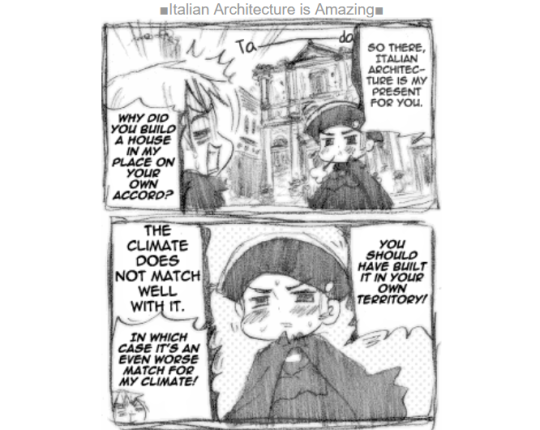
What immediately comes to mind for me is how Holy Rome built
an Italian home in England, without even considering how the architecture
wasn’t designed to endure the harsher English climate.
It would be unprecedented for Germany to pull off something
like that, as he’s always rationalizing and thinking things through enough
times to drive anyone crazy.
You see the organization pun come to life with Germany’s
love for schedules, manuals, and the scientific method. Overall, he’s a much
deeper and rational thinker than Holy Rome.
Further, with unity, comes a stronger sense of national
duty.
On the other hand, due to the fragmentation in his empire,
Holy Rome doesn’t seem to care what happens to it and is more focused on
chasing after Italy. He’s even scolded for neglecting his duties by
Switzerland. Tell me, have you ever seen Germany slack off?
That said, there are more similarities between them than
differences, and Hima sure loves to stress this all throughout the series. They
both share a love for the Italian culture and climate, are flustered easily,
love sweets, own dogs, have Prussia as on older brother, and…
there’s also the obvious fact that they look exactly alike.
Note: This is not
a theory. All I am doing is presenting canon information to help people better understand
the topic at hand.
Despite all the countless evidence explaining why Italy and
Romano remain as separate personifications, it seems as if the entire fandom
has conveniently forgotten about this. Shame on you all for pulling a Germany
and becoming amnesiacs!
Nah, I’m just kidding! But really, the number of strips that
explain why they’re separate personifications is overwhelming if you add them
all together. First, let’s start with the strip that makes this reasoning as plain
as day.
In chapter 20 of World Stars (the web comic), Hima states that the Italy brothers
are separate personifications not just because of regional differences, but
also because of their difficult cultures (which includes different dialects)
and histories.
On example of these differences, Romano has Spanish and some
Arabic influence, whereas Italy Veneziano has German blood in him. This is likely
attributed to how they were continuously conquered and divided by larger
foreign powers (ex: Spain, HRE, the Austro-Hungarian Empire).
Hima was also very careful to differentiate Italian Unification
from German Unification. The Italy brother’s unification process was rushed and
forced. It was artificial and symbolic more than anything else; in reality, it
wasn’t true unity.
Meanwhile, while the other German nations were also separate
personifications, their unity was a much smoother process and established more
solidarity throughout the country. It’s for this reason that only one
personification, Germany, was needed.
You can even tell that Hima was a bit frustrated in having
to explain this all to the readers (again),
as he finishes the scene with these sassy panels:
Honestly, given how many times Hima has stated these
differences and distinctions throughout the series, I would be annoyed too.
After this strip, however, the reasoning for why there are two Italian
personifications is 100% obvious.
You’ll see that Hima has been explaining these differences
right from the very start. Without further ado, let’s go over some of the many examples provided.
Due to Spanish influence, those in the island of Sardinia “still use Spanish.” Although, others have informed me that this influence is only in the dialect and that Sardinians don’t actually speak Spanish.
Here, Hima makes a clear distinction between the cultures,
personalities, and economies of the North and South.
Oops! More Spanish influence on Southern Italy (cuisine).
A small map that reveals what the regions are known for.
North Italy = Arts, Cars, and Tourism
South Italy = Primarily agriculture + has a mafia problem.
Although, it’s important to mention that North Italy has also had things stolen from him by the
mafia. Point is, the mafia is a much more prevalent problem in the Southern
half of the country, especially with kidnappings.
All right, I think I made my point. Both Italy brothers are
here to stay, so you don’t have to worry about one of them fading away any time
soon.
In this strip, Hima touches on the morbid theme of
immortality and how painful it would be to live forever. The strip begins with
a young man dreaming of a childhood memory of a time spent with his
grandfather. There, his grandfather shows him a photo that he took with France
when he was just 18 years old.
After being woken up, we find out that in the present day of
the strip, the young man is working in Paris. When he sees that France hasn’t
aged since the time the photo was taken, he impulsively confronts France and asks
him why this is.
France’s answer, true to his philosophical history, gives a
vague and abstract explanation. Basically, to break it down, he states that the
nation is to be thought of as a ship; the government as the mast; the citizens
as the wind; and the sea as time itself.
If there’s a good wind blowing and the mast is straight,
then the country will keep pushing forward. In other words, as long as the
people (the wind) keep believing in and identifying with the nation and that
the government (the mast) is still functioning properly, then the nation’s
existence and immortality shall continue.
He also states that
the ship can get stranded, which I interpret as the nation losing their
nationhood (immortality); they’re no longer able to push forward having lost
this status via annexation, military occupation, or any other forms of
abolishment.
However, France also comments that if there’s someone to fix
the ship, then you can keep using it forever.
Fix the ship – the
nation – huh? That’s odd, because if you look two panels up again,
there’s a small dialogue bubble that says:
“A wise German said that.”
That’s weird. A wise German…could he be talking about
Prussia? It wouldn’t make sense for the German to be human. Humans don’t have
the first-hand experience of understanding what it’s like to be a nation, so it
would be difficult for them to comment on the process.
There’s also the fact that if you touch on the Germany-Holy
Rome reincarnation theory, it falls directly in line with France’s explanation.
When the Holy Roman Empire dissolved, the separate sovereign German states and
their respective German people still remained. They didn’t just get up and
disappear. It was the state that disappeared, hence the immensely clever title:
“Though I May Depart, You Shall Remain.”
Holy Roman Empire died because he represented the fragmented
and uncoordinated unison of those separate sovereign states. Then, nearly
seventy years later, Prussia united those states to form one sovereign nation –
Germany. Could it be that this example is where France is getting his knowledge
of nationhood from?
Just think about it. Prussia fixed the ship that was German
national identity and united the people into one sovereign nation – Germany.
Before, the Holy Roman Empire’s governance was weak, therefore the mast wasn’t
held up straight. But, with one sole government, the German Confederation
became stronger. It wasn’t the lack of people that was a problem for the Holy
Roman Empire; it was simply a matter of a weakened state.
This is why I believe that Germany was born as a child –
rather than a baby – and already had an existing body. He was resurrected from
his time spent as Holy Rome, and since his people and their history had already
developed, he started from where he had left off before dying. Although, it’s
still a bit wishy-washy why he wouldn’t retain his memories from before…
To wrap things up, it would seem that Prussia fixed the ship
of German identity, united it into one, and then straightened the mast of
governance by centralizing it.
Following this logic, because Prussia united Germany, he was
able to bring back his brother. The people always remained, but with the state
situation stabilized, the personification was able to exist again.
Perhaps this is why France claims that the ship can exist
forever…as long as it’s fixed. The people never left, but the state did.
Note: This is not a theory. I’m simply just presenting canon information to answer a question.
Despite some inconsistencies regarding Prussia’s first
personification, all of them are German. That said, my answer to this question
is no. Prussia may have conquered territory that held indigenous Baltic peoples
(Old Prussians) but again, his starting points are all rooted in German
ancestry.
In “Liechtenstein’s Journal of Swiss Dopiness” we learn that
Prussia began as Margraviate of Brandenburg (1157-1806), which is considered to
be the ancestor of the Kingdom of Prussia. Brandenburg-Prussia was a leading
state in the Holy Roman Empire until its dissolution. It later incorporated the territory of the Teutonic Knights.
However, what I’m more willing to accept as his starting
point is this panel, as we see him depicted more frequently as such in the strips.
It states that Prussia began as St. Mary’s order and then
became the Teutonic knights (1190 – Present). I believe this might be a small
error, as St Mary’s Order is short for “The Order of Brothers of the German
House of Saint Mary in Jerusalem”, which was more commonly known as the
Teutonic Knights.
There’s also the
Monastic State of the Teutonic Knights (or State of the Teutonic Order), which
was an actual state formed by the Teutonic knights (Teutonic Order) in the 13th
century.
What Hima also does is leave how Prussia became Prussia from the Teutonic Knights
open-ended. All this put together only ends up causing a lot of confusion, as
well as a problematic timeline. Either way, the personifications mentioned are
still nonetheless German.
The reason why some people believe Prussia used to be a Baltic is likely
because of the 13th century German invasions of
the original Baltic tribes (Old Prussians) that resided in Prussia. The
Monastic State of the Teutonic knights were then formed to conquer more
territory. Prussia was actually a name taken from the Baltic people originally
living in the region, hence the term Old Prussians
The point to reiterate once again is that Prussia’s stated origins
are all German, not Baltic.
One last thing. It’s not really related, but it’s been
speculated that Prussia once represented Livonia too. I disagree with this
theory. In “Lazy Comic Country” Japan has trouble remembering who Lithuania is,
despite knowing that he’s likely a Baltic.
Japan ponders if Lithuania is Livonia, but in the end, can’t
figure out who he is and decides to use a
more general greeting to avoid any awkwardness.
We also see in “Opening a Country is tough, too”, that
Prussia is one of the few countries that Japan allows into his country during
his recluse period and even signs a treaty with him.
Point is, Japan doesn’t show any lapse or uncertainty in his
memory when he sees Prussia, and if he at least remembers Livonia in the other
strip, then I’m sure he would recognize Prussia as Livonia if he truly was
Livonia – I don’t think he is. Livonia’s likely a separate personification that
has yet to be created.
Either way, given the information provided for in the
strips, I don’t believe that Prussia was a Baltic. He seems to be German
through and through.









 Ellawritesficssometimes