image
image

Before I get into explaining why France is easily one of the
most gripping and enthralling aph characters, I have to point out that the
France I’m discussing is not the France that we saw in the earlier years of
Hetalia (2006-2009/10).

I fully recognize that France’s old characterization was
appalling, offensive, and harmful and condemn it wholeheartedly. On the other
hand, I believe in the potential for creator growth. Said growth is so evidently
seen in how Himaruya has characterized France up to now. Eight plus years of
material is enough to conceptualize a character completely anew.

image

In fact, the France I admire and hold a deep reverence for
is so vastly different from his previous personality that I consider them to be
separate. Again, I would be dishonest if I weren’t to admit that his old
characterization leaves a bitter taste in my mouth. The reason for this is
because of how beautifully his personality has blossomed in the present. Unfortunately,
he’s most known for his former characterization and isn’t given credit for the deep
life questions that he provokes later in the series.

image

What this post will explore is how France acts as the go-to
vessel for giving readers insight into the painful consequences of immortality.
Jokes aside, there are moments where France says something so intricate and
profound that it pulls you into his world and gets you to really think.

His outlook on immortality: 

As stated in more detail in previous posts [x], we learn in the “Though
I may depart, you shall remain” strip that the nations exist because of the belief
of their people [x]. The personification is compared to a ship; the gov’t, a mast;
the people, the wind; and the sea, time itself.

image

Essentially, the metaphor frames how the ship will continue
forward [live] so long as the mast [the gov’t] is strong and functioning and the
wind is blowing [the people still hold a common identity].

image

The consequence of immortality is revealed in how the
nations continuously push forward without having the privilege of enjoying
intimate relationships with others. It’s because they’re immortal that they
detach themselves from close human relations. This way, they’re able to spare
themselves from the hurt of loving someone, only to watch them grow old and
die. 

My favourite theme of this strip is the contrast between the
human outlook on immortality and the immortal outlook on immortality. One of
France’s citizens grows jealous upon realizing that France gets to live forever
but is later reminded by his wife that to live forever would draw more
suffering than it would benefits. Immortality, while seeming to be ideal and
utopic, produces the misfortunes of isolation and loneliness.

image
image

The scene ends with France watching a young family with a
longing gaze. As a country that’s supposed to symbolize love, France is
tantalized by the prospect of bestowing his love [of all kinds] onto others but
knows that if he’s to protect himself, he can never truly do this.

image
image

His outlook on life:

The metaphor of time is likewise seen with Jeanne d’Arc.
France encounters an American tourist named Lisa, who we learn is Jeanne’s
reincarnate.

image

At first, France questions whether God has played a trick on
him.

image

He then realizes that history has paved a kinder path for Jeanne, albeit
it being in another life. It was of his personal belief that those who have been toyed with by history will be reborn into a better life.

image

This tongue-in-cheek approach to confronting how
unfair and brutal history can be is best seen in France’s initial skepticism
and mistrust. At the same time, the scene culminates with France placing trust
and faith in fate, recognizing that while he has no control over it, good still
exists in the world.

image

This is perhaps the most powerful image that Himaruya has
ever created to date. With just one image, he’s captured the throngs of France
surrendering himself and placing trust in the people that will come to define
his history – him [x].

image

Life produces many wounds and scars, but it’s the brave who embrace
these harmful experiences and integrate them into their understanding of self [x].

image

Projection and Reflection:

What you’ll see is that how France presents himself – either
by humour or egotistical remarks – is a mask. Of course, this is to be expected
given that he served as the country of philosophical enlightenment in the late
1700s.

In a quick slip of his teasing and lively façade, France
reveals that he believes children should have carefree upbringings. How I read
into this is that France vies to give children the childhood he never had.
After all, wars, self-interest, and politics robbed him of his [x].

image

Another definitive moment involves him being asked what he’ll
dress up as for Halloween. Never being one to settle for simplicity, France
gives this cryptic answer:

“I’m always disguising myself. The wild beast of the heart
is hidden within this work of art known as me,”
[x]. 

image

Translation: By mastering his looks through good
self-presentation, France has respectively mastered the art of concealing the
bad in his life. Unfortunately, this is to the detriment of not being able to
express and expose his true self to others. Again, notice the theme of
protecting oneself against the hostilities of the external world.

The irony of this is that whereas France is unable to live
his life in a carefree manner and has lost full trust in the world, he
encourages others to live their lives to the fullest; that way, they won’t have
to bear any regrets or emotional burdens [x].

image

In this sense, France’s life
experiences have forced him to be brave and resilient, the pitfalls being that the
constraints of his immortality have also rendered him fearful and hesitant to
strive for a fulfilling existence.

In sum, you can think what you want about how awful France’s
character was in the past. I’m not denying that and never will. But, to
demarcate his character today is something that I’ll always disagree with.
There are many precious moments that France has offered us. Let’s not negate
them.  

image
image
image

[2p Fem France, China and Russia]

Misconception:
The 2ps are canon characters with personalities.

Reality: The 2ps
are alternate character designs with fanmade personalities. While some designs are official, most of them are fanmade.

It’s complicated, but let’s go through it.

The 2ps are alternate character designs made by Himaruya. It’s
a play on how in some video games the same character will come in different colours. That way, several players are able to use them at the same time.

Ex: In Super Smash Brothers, players can choose alternate
colours for the costumes of the character they want to play as.

image

Another colour simply means that the colours were changed.

While they haven’t been given canon personalities, the 2ps
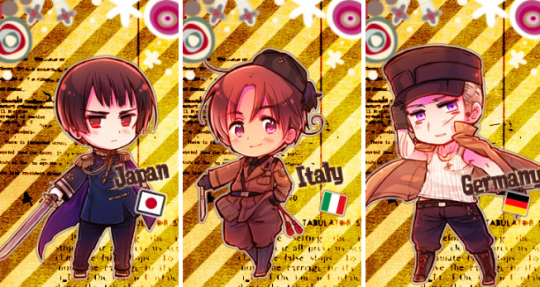
were drawn by Himaruya to look as if they were part of an evil organization [x]. 

Well, I thought I’d give them clothes and coloring that’s a bit different than usual, so I drew them to look more like heels or someone who could run an evil organization.

I like that Italy looks like a bad boy.”

Therefore,
any 2p that is depicted with a personality is completely fanmade.

The Axis are the only original characters in Hetalia to receive
this second colouring [x].

image
image

Although, Poland was once given an alternate blue military
uniform in 2008 [x].

image

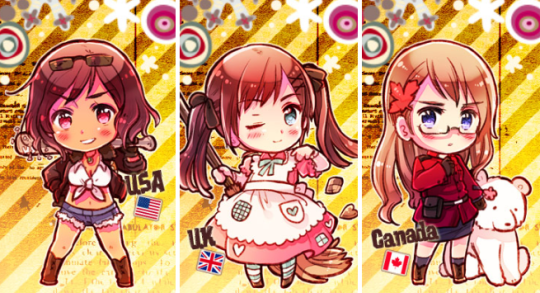
The remaining 2p designs that are most commonly seen are
fanmade. They’re genderbent versions of the “Nyotalia” alternate colour designs
that were posted in 2011 [x].

image
image

On the other hand, in 2013, Himaruya created real 2P designs
for America, Austria, Canada, China, England, France, Netherlands, Russia,
Switzerland, Spain, and Turkey [x].

Notice how their clothing differs slightly.

image
image

According to Hetarchive, it’s left unclear whether these latter draft
designs are for separate characters or if they’re just alternate colours/designs [x].

In sum, some 2ps are official designs while most are not. Likewise, any 2p character with a personality is fanmade. 

image
image

Misconception: Nyotalia isn’t canon.

Reality: The word “Nyotalia” isn’t canon. It’s a fanmade
term. On the other hand, alternate female and male versions of APH characters have
been officially created. They’re character designs, and some of them also have
character notes and personalities.

Himaruya stated on his blog that each nation will have a
reverse male and female counterpart [x].

While designs, the reverse male and female versions are
separate people from their original counterpart. As such, their personalities
are slightly different [x].

Ex: Both female Italies are stronger fighters [x] [x].

image
image

Ex: Female England, Canada, and America [x].

image

Ex: Female Austria and Prussia [x].

image
image

Ex: Male Taiwan [x].

image

Ex: An old version of Portugal’s design – that has since
changed slightly – and his female version [x].

image

Ex: The female nations’ male versions [x]. *not all of them*

image

Ex: The male nations’ female versions [x]. *not all of them*

image
image

It’s important to remember that Himaruya is open to fans
choosing whatever names they please for “nyo” characters [x].

Another thing that confuses people is the female versions’
cameo in volume 4. The premise is that Estonia has a dream where God grants him
his [alleged] fantasy to be surrounded by girls – although this plays out with
the male nations being replaced by their female versions.

The point to differentiate here is that while the female
versions don’t exist in canon, given that they’re separate versions of the
original canon nations, they’re officially designed characters with
personalities that have made an official appearance. Although, this appearance
doesn’t occur in reality. [I know, it’s confusing.]

image

If it helps, Estonia’s reaction to the female nations sets
out the fact that they don’t exist in canon. Nonetheless, they’re canon because
they’re officially designed characters with personalities.

image

Fun facts:

When asked, Himaruya explained that the reason why Estonia
has these strange dream experiences – including the mochi one – is because his
“elite glasses summon strange fellows,” [x].

This is just a speculation, but my best bet as to why there
are far more male nations than there are female ones is because Himaruya has
repeatedly admitted to not being good at drawing girls [x] [x].

image
image
image

This guide will go over
the stereotypes that affect how the Germanic nations are able, or rather, unable
to express their feelings. The steely emotionless stereotype of Germans/
German-speaking countries often prevents the respective nations from being
understood properly. It’s not that they’re incapable of experiencing love or
feeling care and affection. It’s quite the contrary. Instead, they just have a
difficult time showing and communicating how they feel [x].

image

For the purpose of this
post, I’ll only be going over the Germanic nations that are listed in this
strip, as they are what Himaruya characterizes to be of German inheritance and influence.
I recognize that there are many more Germanic countries than this. I’m just
going by what we see portrayed in the manga.

That said, let’s go over
some examples.

Germany: 

The German stereotype of
being emotionally steely and hot-tempered is a complex that Germany is defined
by in the manga.

He’s sweet and
compassionate but is often mistaken to be angry by those around
him [x].

image

Germany also claims to
have trouble smiling. It’s not something that comes naturally to him [x] [x].

image
image

In terms of
relationships, Germany is emotionally withdrawn. This is most seen in Buon
San Valentino [x].

There, the premise of
the arc is that Germany has trouble defining what his relationship with Italy
is.

He first buys a popular
book in Germany titled “Communicating with your partner.” The comic gag
of this is the stereotype that Germans aren’t savvy at reading emotions; they’re
‘emotionless.’ Obviously, this isn’t truly the case. 

image

As Germany reads this
first book, he begins to question whether Italy likes him as a friend or as a
romantic partner. 

When Germany gives
details of his relationship with Italy to Austria, Austria is repulsed due to
the romantic overtones = seeing someone every day, kissing and hugging them,
bathing with them etc. The irony is that Austria later realizes that Germany
was talking about Italy, an anomaly of a person who normally does all these
things.

image
image

Unfortunately, Germany
doesn’t know this, and he forms the conclusion that Italy has romantic feelings
for him. It’s a “misunderstanding.”

Since he’s still clueless about this aspect of human relations, Germany then buys a book that gives dating advice.

image
image

His dismay grows when he remembers that Italy’s a guy [wow!] so of course, his next course of action is to ask Austria if he can practice these newly learned romantic gestures on him.                                         

image
image
image

He later reveals to Austria that he has no previous experience with romantic relationships and that he’s only read romance novels. 

image

The strip culminates in
Germany mistakenly proposing to a very confused Italy.

image

Prussia:

Despite having never
been married, Prussia is the most sensitive and emotionally-expressive Germanic
nation.

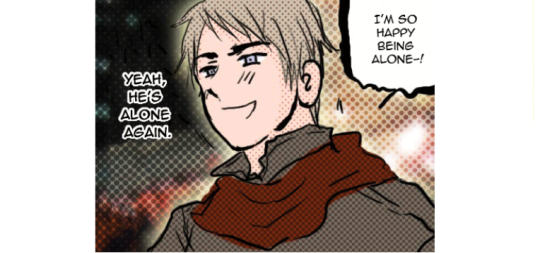
He’s often found crying
and lamenting over the fact that he’s single and “alone.”

Ex: He cries when he
spots Hungary and Austria spending their Christmas together during the 2007 Christmas event [x].

image
image
image

The Germanic stereotype
has more to do with the fact that he’s a poor socializer. 

For example, he’s given a
book on “How to Socialize with People.” He sneezes and claims to be bored with
it [x].

image

Austria:

In direct contrast to
Prussia, as someone who’s been in several marriages, Austria is arguably just as
clueless as the German brothers.

He may have solved his
problems with marriages…

image

…but when it comes to
relationship troubles, he’s read his fair share of manuals and guides too.

Austria had copies of both
books that Germany purchased in Buon San Valentino. Had he have known this
beforehand, he would have lent them to him.

image
image

He becomes flustered
when Hungary reads the dating book and laughs at how inaccurate it is. It would
be to his own embarrassment should he have admitted that he had been an avid
reader of it.

image

On the other hand, in his defense, it’s largely hinted that he’s the one who gave Hungary flowers on Valentine’s Day.

image

Switzerland: 

Switzerland’s similar to
Germany in that he’s an angry-type that’s soft on the inside and well-intentioned.

He shouts at Japan to
give his own opinion, scaring the latter despite the good intentions of this
action. It’s tough love in that he’s trying to get Japan to stand up for himself.

image
image

He cringes and gets
angry for remembering all the fond moments that he had experienced with Austria during
their childhoods. This is sometimes at the expense of ruining the fond moments that
he shares with Lichtenstein [x].

image
image
image

Nonetheless, Switzerland
shooting at Italy in the frilly pajamas that Lichtenstein made for him is
iconic, and you can’t tell me otherwise.

image

Sweden:

Sweden’s slightly
different in that his minimal facial expressions are intimidating to people.

Finland finds Sweden
scary at first… [x]

image

…but later warms up to
him and realizes that Sweden smiles and expresses his happiness subtly [x].

image
image

In reality, he’s also
quite the softie.

He sews smaller
clothes for Finland [x].

image

He acts as a father
figure to Sealand [x].

image

In sum, while the
Germanic nations may come across as hard and steely, they’re easily among some
of the sweetest, most considerate characters in Hetalia.

image
image
image

It’s well-known that England became increasingly bitter and temperamental
post the American Revolutionary War. The grudge resided deep, and he turned to criticizing
America as an outlet for his anger.

What I haven’t seen talked about is that America also held
quite a considerable grudge over this conflict. Instead what I often see is
that America’s portrayed as obliviously cheerful, as if the Revolution didn’t affect
him at all and that he didn’t suffer.

That’s simply not true. America’s more than capable of
holding grudges. What you’ll see, however, is that his grudges aren’t openly
displayed. He doesn’t express his anger directly. He’s either passive-aggressive
and petty, behaviours that are often mistaken as thoughtless rather than tactful
and deliberate.

Ex: America’s grudge over Alamo is revealed when he purposefully
does a poor job of drawing Mexico on a map [x]. 

image

That said, what this post aims to do is prove the emotional
consequences that America bore after his independence – note that this doesn’t
cover their present relations.
I will also debunk the misconception that America
acted selfishly toward England. This is a slippery slope conception that assumes that
America doesn’t/ didn’t care about England, which couldn’t be any farther from the
truth.

America cares about England:

When England falls sick after the Revolution and despite
their volatile political relations, America goes to Canada’s house and demands to
see England. He claims that he’s unable to sleep due to how poorly things ended
and later attempts to force his way into the house. After refusing America
entry and America’s own refusal to leave, Canada is left with no other choice
but to force the door shut [x].

image
image

Once again, the difference between personal and political
relations is highlighted in this strip. Why else would America go to Canada’s
house having just fought against England, his previous guardian, for his
independence?

In an old WW2 strip that was later redrawn by Hima, America
panics when England falls ill and faints [x].

image
image

He cares about what England thinks of him: 

As stated in earlier posts [x] [x], America’s a very insecure
individual. Having spent a long period in isolation, America was left in a
place where he only had to look after himself, hence why he comes off as so egotistical
when he immerses himself in world politics again. It wasn’t that he was
purposefully selfish. He had merely grown accustomed to putting himself first
and the adjustment toward working with others didn’t come naturally.

This is likely why he’s sensitive to criticism. Not only did
he lack validation, but the fact that he presumably hadn’t been criticized very
often contributed to his fragile sense of self-worth.

Ex: In Volume 2, America’s stated
to avoid showing England his movies because of the criticisms they receive.

image
image

Although we later learn that he’s gotten over this fear of
showing England his movies and openly shows and lets the latter criticize them
in present times [x].

image

While America’s political dependence was severed from
England, his emotional dependence arguably still remained.

Ex: On one Valentine’s day, America grumbles after England doesn’t give him any chocolates.

image

He’s later found stuffing his face with a bucket full of
chocolates when England finds him. If anything, this comes off as spiteful to
me.

Translation: England won’t give me chocolates, so I’ll show
him that I don’t need him by eating as many as I can possibly find.

image

If you unpack this further by linking it to a strip in
volume 5, America’s gluttony is a reflection of how empty, lonely, and unfulfilled
he feels.

He consumes and overproduces to fill the emotional gap and
lack of company that he’s historically and personally experienced. Those who
are materialistic tend to be the loneliest and unhappiest people. Humans are
social creatures; they need interaction and stimulation. Those who turn to
material possessions may be stimulated, but it doesn’t last, nor does it
fulfill them.

Ex: England observes that America’s overconsumption and
overproduction may, in fact, stem from how he possessed little belongings when
he advanced settlements in his country. Notice the link with the chocolates too [x].

image
image
image

This is something that I’ve always admired about Himaruya’s characterizations.
He takes historical events, humanizes its psychological effects, and embeds it into the
nation’s personality.

He’s bitter:

As mentioned above, when America’s bitter over a grudge, he’s
often petty about it. On the other hand, just because he expresses his grudges
in a comical way, doesn’t mean that he’s incapable of being emotionally damaged.

Ex: America starts drinking coffee in spite of England [x].

image

In another strip, America is shown to have conflicted and melancholic
feelings about his past with England as he finds items that he had previously
stored away in his storage closet – a symbol for how he’s hidden from his past [x].

image
image
image

We learn that even though America’s finally gained the
courage to confront his past, he still hasn’t gotten over it. His grudge is
subtly there, as Himaruya ends the strip by having America drink coffee.

image

Ex: America practices making friends with whales when he
visits Japan for the first time [x].

image

When England offers to be his friend, America laughs,
refuses, and runs away.

image
image

Ex: When he and England get shipwrecked, the prospect of
them having to share a sleeping bag comes up. America watches England shiver
and deliberately decides not to sleep closer to him [x].

image
image

I’d like to end this by stating that regardless of their
grudges and the mixed feelings they felt after the Revolution, America and England
were still happy to see each other and joke around.

Ex: When he arrives in Africa, America’s happy to see
England.

image

Ex: England’s so worried about America and his reckless
behaviour that he has a nightmare about it.

image

Ex: America jokes with England during a spy mission.

image

In sum, while America’s emotional display can come off as
oblivious and cheerful, it’s a carefully calculated mask that hides his deep-set
resentment and hurt. By declaring his independence, America lost his best
friend and emotional support and vice-versa with England. The consequences of this loss are seen in how
insecure, lonely, and materialistic he is.

image
image
image

I just want to preface this post by stating that Russia isn’t
evil, as stated in his volume 3 character note. Instead, he’s described as “naturally
scary.”

On the other hand,
the spirits, ghosts, and entities that follow Russia may, in fact, be evil.

image

Is Russia Cursed?: 

Yes.

There are several sources that describe and/ or hint at his curse,
his cursing ability, and the cursed beings that follow him.

1)  The
Russo-Japanese war. The Russian Orthodox Church was allegedly able to curse
Japan.

image

Russia’s also able to curse Japan after the fact, once
causing the latter to develop a stomach ache.

image

It’s no wonder that Japan is so opposed to Germany forming
an alliance with Russia during WW2. Notice the supernatural-esque words that Japan
uses to describe Russia: 

“A monster created by fallout from nuclear tests” [x].

image

2)  To get his revenge on America, England intends
to have him sit on the infamous Busby Chair, a chair that’s rumoured to kill
all those who sit on it.

image

Instead, Russia sits on the
chair, only to cause it to explode. Something about his aura appears to be too
overwhelming for the chair to handle.

image

3)   After the failed Busby Chair incident, England
decides to summon a being to “crush America.” Russia appears instead.

image

There are two reasons why I believe Russia may have appeared in the circle. One, Russia fits the description of what England wanted to summon; he’s large, mentally twisted in that he has a warped sense of reality [x], and as the USSR would have been strong enough to crush America. Two, just the fact that Russia’s cursed.

Of critical importance is that not only does Russia admit to
having a grudge on England – likely stemming from their relations during England’s
Splendid Isolation period – but England also retaliates by claiming that the
two settle their grudge with a magic duel. No such duel occurs, but it’s the
fact that Russia’s capable of using [dark] magic that I want to place stress
on.

image

4)   The remaining seven G8 countries mistake Canada’s
presence as something creepy and off. Nonetheless, France’s first thought is
that it may be General Winter, ghosts, or Russia’s old emperors following him.

image

5)   Why does Russia say KolKol?

 This part is theory. It hasn’t been confirmed
in canon.

A fictional tale included in the fourth original chapter of
the webcomic details how the Allied leaders – Roosevelt, Stalin, and Churchill –
reacted when the plane they were on was suddenly attacked by a demon [x]. As the
demon sets out to destroy the plane’s engine, neither Churchill’s nor Roosevelt’s
negotiations were able to stop it.

It’s only when Stalin threatens to throw the devil into a
Kolkhoz – a collective farm, commune – that the demon disappears. The story ends with
this quote:

“At the moment the
devil heard those words,
it flew away, never to be seen again.

From the kolkhoz that even the devil fears.

The reason I mention this story is because,
in the panel above, we see Russia muttering “kolkolkol” in reaction to
Lithuania’s unfavourable remark aimed at his “old-fashioned” uniform.

image

If that’s the case, then perhaps
when Russia mutters “kolkolkol” it’s a form of repelling anything that he doesn’t
like, similar to how a priest repels a devil.

Bonus: Although unmentioned, there’s
also the curse that Rasputin allegedly cast on the Russian royal family before
he died.

What does England have to do with this? 

You’ll notice that throughout the
manga, England is consistently wary and distrustful of Russia.

Ex: During WW2, Russia offers
England some of his tea. England’s immediately skeptical and suspects Russia of putting
something strange in it [x]. 

image

Ex: England calls Russia a psychotic bastard when the latter’s
heart falls out during a meeting. England had initially thought that the heart
wasn’t Russia’s.

image

Ex: England doesn’t hesitate to express his desire to kick
Russia out of the G8.

image

Ex: When he falls asleep during a world meeting, England has
a weird dream and blames it on Russia.

image
image

As mentioned above, the hostility isn’t only one-sided.
Russia doesn’t always get along with England either.

Ex: During the Splendid Isolation strips, England
acknowledges that Russia wants him dead

at that time [x].

image

Ex: In the same strip where England falls asleep during a
meeting, Russia’s solution to wake him up is to hit him with a sickle.

image

Evidence of a demonic presence:

Given the evidence I’ve presented,
my answer is that because England is magical himself, he’s able to sense the
dark presence emanating around Russia. In other words, Russia spooks him.

Ex: England claims that Russia
being depressed is a dangerous omen.

image

Ex: During the 2013-2014 Christmas Event, right
before Russia arrives [with America and Japan], all ghosts, mythical beasts, fairies,
and monsters present feel a dangerous aura [x].

image
image

They later flee to avoid being
taken over by something evil. I don’t think this is a coincidence [x].

image

It’s for this reason that I believe
that Russia is once described as the person that England doesn’t want to meet
in private [x].

image

In the Merry Halloween strip, the
gag is that England and America host an annual competition where the two
attempt to out-scare each other. England brings a fairy friend to scare
America. Meanwhile, America uses Russia. The fact that England’s terrified of
Russia makes sense if you look at it from the perspective that Russia harbors
many dark spirits around him.

image

In sum, it would seem that England
is hostile toward Russia because he’s canonically cursed, can give curses
himself, and has malevolent spirits that follow him.

image
image
image

As stated in “In just 2 minutes, you can grasp the exterior of
the European Economy,” a nation’s health is dependent on two factors – the
stability of their economy and their politics.

This post will examine what happens to a nation when their
political situation lacks stability.

Let’s go through some examples.

America: 

The recent divide between Republicans and Democrats have
been a cause for concern for America’s health. The fighting between the two
political parties is enough for England to comment that the 2016 election must
have been exhausting for America [x].

image
image

America denies this, claiming that his body is strong enough
to handle the infighting.

image

The running gag is that all parties will bond over
how much they hate the new president once the election is over [x]. Point is, it’s
the fact that England’s worried about America’s health – stemming from his
political situation – that’s significant.

image

China: 

China’s rough history of ups and downs, consisting of many rebellions,
conquests, moments of prosperity and unification, and division was a lot for
his physical body to handle. The consequence of these political conflicts is
that he develops aches and pains [x] [x].

image
image
image

England: 

England is notorious for falling ill after/during political
conflicts.

Ex: After the American Revolution [x].

image

Ex: After the Napoleonic Wars [x].

Ex: During WW2 [x].

Germany:

This example is undeniably the most important one.

Remember that nations are representations of their citizens. 

image

They exist because of them. Said body of citizens encompasses all groups within
the population. A German is a German, regardless of their ethnic heritage,
culture, and race.

That’s why I believe that Germany is described to “tolerate
his way through pain” during WW2 [x]. German Jews were still his people regardless of their ostracization and the monstrous atrocities
committed against them. This all had to be felt by Germany.

Not everyone was favourable of the Nazi regime either
(obviously) – the executions of those who spoke out against Hitler, assaults,
raids, and surveillance carried out by the Gestapo created an immense sense of
fear and terror for many Germans. Combine that with air raids. The politics of
this time were far from stable.

image

As always, I must point out that the nations are
subordinates to their bosses and are forced into complying with their orders, often
against their own free will and conscience. Full post on that here [x].

Ex: Germany didn’t want to annex Austria, but was forced to
by his ‘strange’ boss [Hitler]. [x]

image

Ex: He’s screamed at by his boss, and yet, still takes down
notes. [Out of obligation.] [x]

image

Ex: Germany didn’t want to form an alliance with Russia. He
did so out of a sense of duty [x].

image

Ex: While joking, Finland darkly hints at the real
possibility of Hitler being capable enough of imprisoning Germany should he
complain too much about him. It’s more than just “boss troubles” [x].

image
image

Ex: When taken as a prisoner of war, Germany compares torture to a mosquito bite. This is because of the pain he experiences on a daily basis during the war.

With all this in mind, what I want to stress most is that
the nations feel pain for their people in whole, aside from whatever actions
their government decide to take.

image
image
image

Not much is known about
this phenomenon, especially since most of the coverage of these events are
glossed/ skipped over. On the other hand, there are some things that I can potentially
clarify and shed light on.

First, let’s go over
some examples.

America: 

We get a brief – albeit shallow
–depiction of America’s Civil War in chapter 211 of World Stars. No insight is
given, other than the fact that America is visibly distressed [x].

image

Spain: 

We get two strips that
cover Spain’s Civil War.

One involves Romano
getting mad at Spain for not participating in WW2. Romano had fought in the Spanish
Civil War and got shot in the butt during the conflict. Meanwhile, Spain is too
poor to give a significant contribution to the war effort [x].

image

Another strip involves
Romano calling Spain after he and Veneziano were taken as prisoners of war by
England. Spain explains that he can’t bail the two out because he was too busy
making roses. This seems to occur at the end of the Spanish
Civil War [x].

image
image

Russia: 

We get a brief look at
Russia’s title change from Russia to the USSR in this panel here. It’s from one of
the first original webcomics [x].

image
image

Unpacking this information:

It’s a common headcanon
that during civil wars, a separate personification develops. For example, the
US Confederates would have developed their own personification.

While this hasn’t been
shown, rules in canon can potentially support this.

In chapter 1 of World
Stars, it’s stated that personifications can exist for as little as a few days
to several centuries – or millennia if you consider the Ancients, China, Japan,
and Turkey [x].

image

There’s also the
hypothetical example where Canada dreams of Quebec becoming an actual country [x]. What’s important is that the new nation is born after the secession is
legally recognized, thus differentiating the situation from the American Civil
War.

image

Something that’s always
puzzled me about this scene is its ambiguity. When Canada states “anything but
Montreal” it could easily be interpreted as Montreal – as a municipal personification
– evolving to represent Quebec as a nation. Given that states and Japanese
prefectures are personified, it’s not far-fetched for a city to be personified
as well. We just haven’t seen this yet in canon.

On the other hand, we
also know from the above panel that personifications can change their personalities
as a result of a title change. 

In that case, when two gov’ts fight for power in
a civil war, there isn’t a need for a second personification except in the case
where two legitimate states form. The end result is that if a new gov’t assumes
power and changes the name of the country, the personification can undergo a
personality change.

That said, since very little information is known about civil wars in Hetalia, it’s difficult to draw anything conclusive about them. 

image
image
image

The Rules:  

Before, I used to dismiss the idea of time travel in
Hetalia. Looking back, I can see that this limited my understanding of several
bizarre and inexplicable occurrences in the manga.

In a fictional series
where the nations are immortal, being referred to as “strange” and “odd”
beings, it’s honestly not that far-fetched to consider that they’re capable of
time travel.

image
image

This is especially true given the facts that…

1)  Time is experienced differently by the nations.

Ex: Canada spends an entire weekend staring at Kumajiro’s
eyelashes. It passes by without him realizing this [x].

image
image

Ex: If a human were to spend enough time around a nation,
their perception of time would become so warped that they’d go mad.

Ex: Pets don’t go mad when they’re around their nation
owners. Instead, their lifespans increase. Should they separate from the
nation, however, they would become normal pets again and resume aging [x]

2)  Some nations are capable of magic,
fortune-telling, clairvoyance and other supernatural abilities.

Ex: England’s and Romania’s ability to cast spells.

image

Ex: Japan’s powers of clairvoyance and mind-reading [x]– I’ll
get back to this later.

image

Evidence of time travel in Hetalia is either extremely
subtle or so right in your face that it’s easy to overlook.

Could it be that the pets don’t age because the nations are beings that are able to transcend space and time? In other
words, what if time is bent around the nations, which, in turn, causes their
pets not to age?

They’re timeless beings in that they’re immortal. While they
do age, it’s very incremental. They still remain youthful, likely because time
is slowed for them. In that case, the reason that the pets won’t go mad by
being around a nation is that they don’t perceive time the same way that humans
are able to.

Are the nations able to time travel then?

Evidence from the manga suggests that they’re indeed able
to.

Let’s go over some of these examples.

Bizarre and Casual Anachronisms: 

If you factor in time travel, this would explain the sudden
appearance of anachronisms when you least expect it. I used to think that these
were silly comic gags. My opinion has since changed.

Ex: When America pulls out a computer to google where
Germany is in 1942, England isn’t surprised. Instead, he’s able to pinpoint
exactly how far into the future the model is and reprimands America for showing
off.

image

Ex: Why is it that during the 18th century, Japan
appears to be listening to music…with earbuds? [x].

image

Ex: The Roman Emperor Nero is once depicted to be playing an
acoustic guitar.

image

They’re aware that it’s an
anachronism. Perhaps either Rome or Quintillus – another Roman Emperor who’s
canonically able to time travel – brought that there. I’ll get back to
Quintillus in a moment.

Japan’s Powers of Clairvoyance: 

As mentioned above, Japan has been shown to be able to read
minds, see into the future, and establish contact with others without having
ever met them in person before.

Ex: Japan demonstrates his clairvoyant powers during the
Meiji Era. The fourth wall is broken as the scene pans in on
Himaruya scrambling to finish a comic.

image
image

Ex: When Japan first becomes acquainted with the Italy
brothers, they’re put off by how silent and reserved he is. Japan later admits
that he’s not used to speaking out loud with those whom he’s read the minds of [x].

image
image

If anything, this alludes to the fact that Italy and Japan
have technically met before.

Notice the title of the strip too. “A melody that transcends
history and reaches you…”

image
image

Japan’s ESP Contact with Italy + Dream Sequences:

After falling into bed with Holy Rome, Chibitalia has a
strange dream where he encounters a presumably divine being that leads him to –
yes, Japan. This confirms what Japan claims in World Stars. He did, in fact,
read the mind of Italy and communicated with him far before they formed their
alliance in WW2 [x].

image
image
image
image

That’s not it, either.

Italy in adulthood has a ‘unpleasant dream’ of a child that looks
exactly like him pressing to be acknowledged [x] [x].

image
image
image

How I’ve interpreted this before is that it symbolically
represents Italy’s unconscious mind repressing memories from his childhood. Put
another way, he’s refusing to remember – acknowledge – bits of his past.

Taken literally, this could also mean that Italy’s child
self is transcending time and space to get him to remember his past.

Or, what about this scene? Italy encounters his child self, recognizes this, and feels ashamed for
lying about how [not] strong he’s become [x]. 

image
image

Germany also appears to have these strange encounters with chibis.

Ex: In the same strip, a child that looks
exactly like Germany/ Holy Rome presses to be acknowledged as well [x].

image

Ex: Germany’s once shown to be holding up Chibitalia.

“It’s me!”

image

What if this is Chibitalia traveling into the future
to get Germany to remember about his past as Holy Rome? At the same time, it could symbolically represent childhood memory repression. Of course, this is all making the assumption that Germany is, in fact, Holy Rome.

Quintillus:

Most obvious of all is that there’s a real character in the series
who’s physically able to time travel.

The play on Quintillus’ time-traveling abilities is that
because historical records about him are shifty, his timeline leaps back and forth.
Himaruya took this, made it literal, and gave Quintillus time-traveling powers [x].

image
image

Ex: We see Quintillus visit Germany in modern times making
sure that the latter’s research and re-writing of Roman history are accurate [x].

image

With all the evidence I presented, I truly do believe that
the nations are able to time travel. It’s not just limited to their ability to
slow time for those around them. They seem to be able to manipulate it too, being able to disappear on
a whim…

image
image
image
image
image

What this post will explore is
how other nations – to lesser degrees – are able to possess greater physical
strength than the average human. While it’s not necessarily the extreme strength
that we see with America and Russia, the
additional strength gained by nations at different points in history is still
very much present.

The Rules: 

image

As stated by Finland, America and
Russia are super humans, whereas the rest of the other nations aren’t so
different from regular humans in terms of their physiology – aside from the obvious facts
that they’re immortal, don’t age and heal faster. After all, they are referred
to as “strange” and “odd” beings [x]. Some things about them are abnormal. 

image
image

How I’ve interpreted the panel with
Finland before is that the superhuman
phrase is a reference and pun for the Cold War, where America and Russia emerged
as economic and political superpowers.
They were the two most powerful nations during this period.

image

The rules for this are laid out
in the strip titled “In just two minutes you can grasp the exterior of the European
economy.”

There, it states that when a
nation experiences political strife/ economic recessions, their health worsens
and they develop a cold. It would follow, then, that if a nation’s politics are
stable and their economy is performing abundantly well, they become stronger –
literally. 

In this manga, a nation having a cold = something like a recession. By the way, when they’re physically unwell, the nation’s politics or economy is having problems. [x]

That’s why young America
initially gained his super strength. His economy was doing exceptionally well [x].

image
image

As such, this
would also explain why during times where America’s economy is strained and his
political affairs at home aren’t stable, he loses some of this strength and
appears to be weak. (Longer post on that here [x]).

Ex: The Great Depression – one of
the largest economic recessions to date.

image
image

Likewise, as a result of the Soviet
Union gaining steam [and territory], Russia had already acquired super strength
during WW2.

Ex: Russia was able to stop a
tank with his body.

image

The reason that America and
Russia’s strength is so extreme is that their power was globalized. 

Meanwhile,
consistent with the rule above, other nations who gained economic and political
power also got physically stronger, albeit not nearly as strong as Russia or
America given that their influence wasn’t as reaching (e.g., European
superpowers instead of global superpowers).

I should also mention that the English empire was indeed a global superpower; on the other hand, the political sphere hadn’t yet been globalized during their prime (e.g., the UN and global international relations).

That said, let’s go over some of
these examples.

Austria:  

A referenced European superpower
that became weakened during the War of Austrian Succession [x].

Pay attention to the specific
wording as France loots from the defeated Austria.

image
image

Hungary:

When Hungary acts as Austria’s
reinforcement during the War of Austrian Succession, she’s referred to as “freakishly
strong back then” [x]. The back then is especially important, as it proves that the
country’s strength and position reflects itself in the personification’s
physical strength.

image
image
image

France: 

France became strong as a result
of the Napoleonic Conquests [x]

Again, notice how exhausted the enemy
nations are after they finally defeat him [x]

image
image

Bonus Case: Canada

It’s also hinted that super
strength, even when the nation isn’t particularly powerful, can be tapped into
by the personification.

After the American Revolution,
England falls ill. America visits Canada’s house, begging to see England. When
Canada refuses him entry, America attempts to force his way in. In the end,
Canada is able to shut the door on America [x] [x].

image
image
image

It would seem that during moments
of adversity/ stress, an adrenaline instinct kicks in, thereby allowing the
personification to temporarily tap into this super strength. Put another way,
all nations are capable of acquiring super strength if their country is
powerful enough; however, in astringent circumstances, the personification can attain
it nonetheless.

In sum, super strength, albeit in
differing degrees, isn’t something exclusive to America and Russia. As shown in
the strips, other nations have become stronger in reciprocation to their
country’s strength and power.

image