
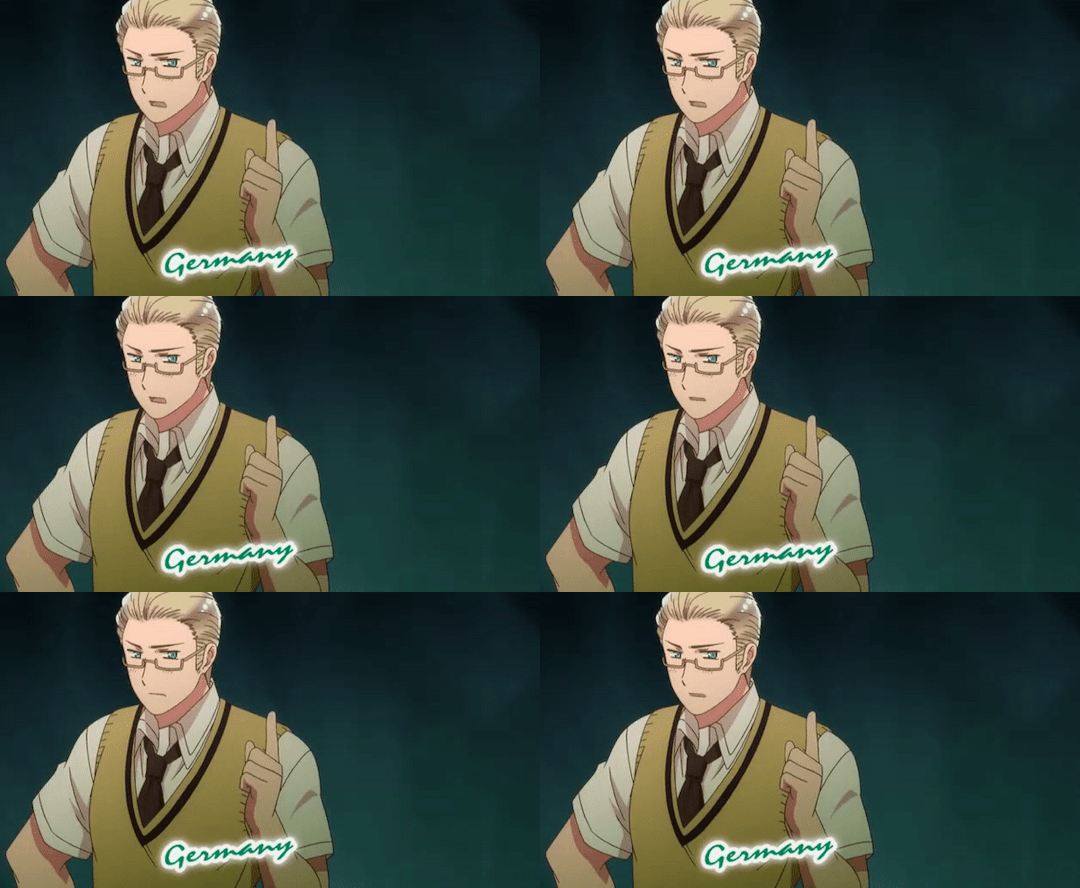
The purpose of this post will be to clarify much of the
confusion that has been generated by changes made in the anime concerning Germany’s
birth.
In the anime, what you’ll see is that the process of Germany’s
birth is depicted as a clear result of the German states huddling [combining]
together to form one state.
Meanwhile, in the manga, the process of Germany’s birth isn’t actually shown – all that’s
revealed is the end result. It’s left vague and open-ended, perhaps for the
purpose of giving Himaruya leeway to later confirm that Holy Rome is, in fact,
Germany.
That said, let’s go over the strips that cover Germany’s
birth.
Chapter 12 of World Stars:
In this chapter, a meeting for all German states is held [x].
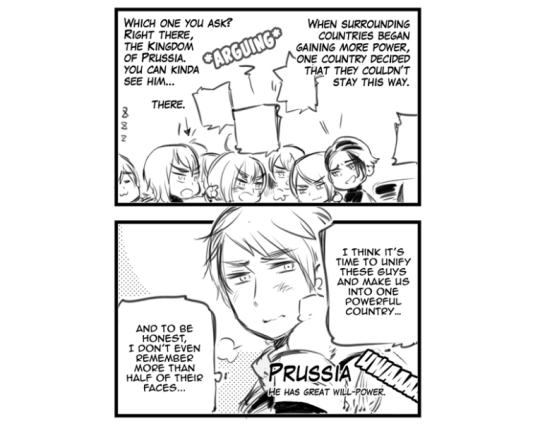
Prussia’s suggestion of merging into one sovereign state is received
well.


Admittedly, before the German states are able to form
Germany, they’re excited about “the birth of their new baby brother.” I’ll get back to this in a minute, hold on.

Austria stops the process and claims that he’ll assume
responsibility over Germany once he’s born.

Prussia kicks out Austria from the German Confederation.

What’s critical is that when Germany is born, the previous
process in which the German states were to huddle together to form him isn’t
shown.
Instead, the strip skips straight to Germany being born.

My explanation:
I’ve done a full post on this [x], but it’s important that I
go over this again before comparing it to other strips.
The reason that I believe the German states aren’t depicted
to be huddling together, only to step back and reveal a new personification –
as shown in the anime – is because the personification already existed.
Holy Rome hid in Prussia’s house after his dissolution
He
didn’t die right away.

On top of that, we know that Holy Rome became sick as a
result of the fragmentation and lack of unity in his empire. This illness only
became worse once he was dissolved.

I
believe the reason that Germany was born as a young child is because he changed titles. The existing body panel is meant to be taken literally in
this sense. The personification was already alive – but not well.
Note: I also recognize that baby nations canonically wear nightgowns. As I’ll reveal below, I believe Germany was wearing a nightgown for an entirely different reason.

As stated in chapter 1 of World Stars, it’s completely
possible for nations to change titles and assume new personalities.

Since your
personality is very much driven by life experiences and memories from them, to have a new
personality inevitably means that you’ve obtained new memories.
Or, in Holy Rome’s case, for him to assume a different personality
as Germany would mean that he’d have to completely forget about his past life. Otherwise,
these past memories would influence his personality.
So, maybe Germany’s an amnesiac Holy Rome then…is there any
evidence of that?
Yes.
In the same strip, Prussia reminding Germany that he can
call him big brother several hundred times can easily be interpreted as him attempting to trigger the newly-born Germany’s memories of being Holy
Rome.

As such, the fact that Germany emerges wearing a nightgown,
as a child, can likewise be interpreted as an amnesiac Holy Rome – who also
conveniently wore a nightgown in his later days – stepping off his deathbed for the first time. In
other words, German Unification fixed Holy Rome’s health, the only problem
being that he’s lost all of his previous memories.
Ex: Holy Rome, sick in bed as Prussia reads him fairy tales.

Ex: An edited comparison of Germany and Holy Rome, both of whom are wearing nightgowns. They also look exactly alike.
Left – Germany, Chapter 12 of World Stars, Right – Holy Rome, Chapter 187 of World Stars.

Lastly, this would explain one German state’s sobbing
reaction to Germany being born.

This is all behind the scenes speculation, but I believe
what happened is that when the German states initially agreed to form into one
country prior to Austria’s interruption, they believed that Holy Rome was dead.
Remember that Holy Rome was hiding in Prussia’s house. That’s why they thought
they would be gaining a new younger brother.
The reason that the process of Germany’s birth was skipped
the second time around is, again, because the personification (Holy Rome) that
represented them already existed.
This panel, then, can be interpreted as one of Germany’s
older brothers realizing that Holy Rome hadn’t in fact died and had been alive the whole time.
Comic Birz Episode 11:
Timeline wise, this was made before World Stars. Nonetheless, here too, the process of Germany’s birth isn’t depicted [x]. All we see is the end result.

Volume 6: The Life of the Great Man, the Awesome Me
This is a redrawn and reprinted version of Comic Birz
Episode 11. It’s especially important because it’s what the anime adapts, as World Stars hadn’t yet come out at the time.
Notice again how the process of Germany’s birth isn’t
depicted. It doesn’t show the German states huddling together.

Bonus: Chapters 20 and 57 of World Stars
I think you already know what I’m getting at here.


The Big Difference: The Anime Depiction
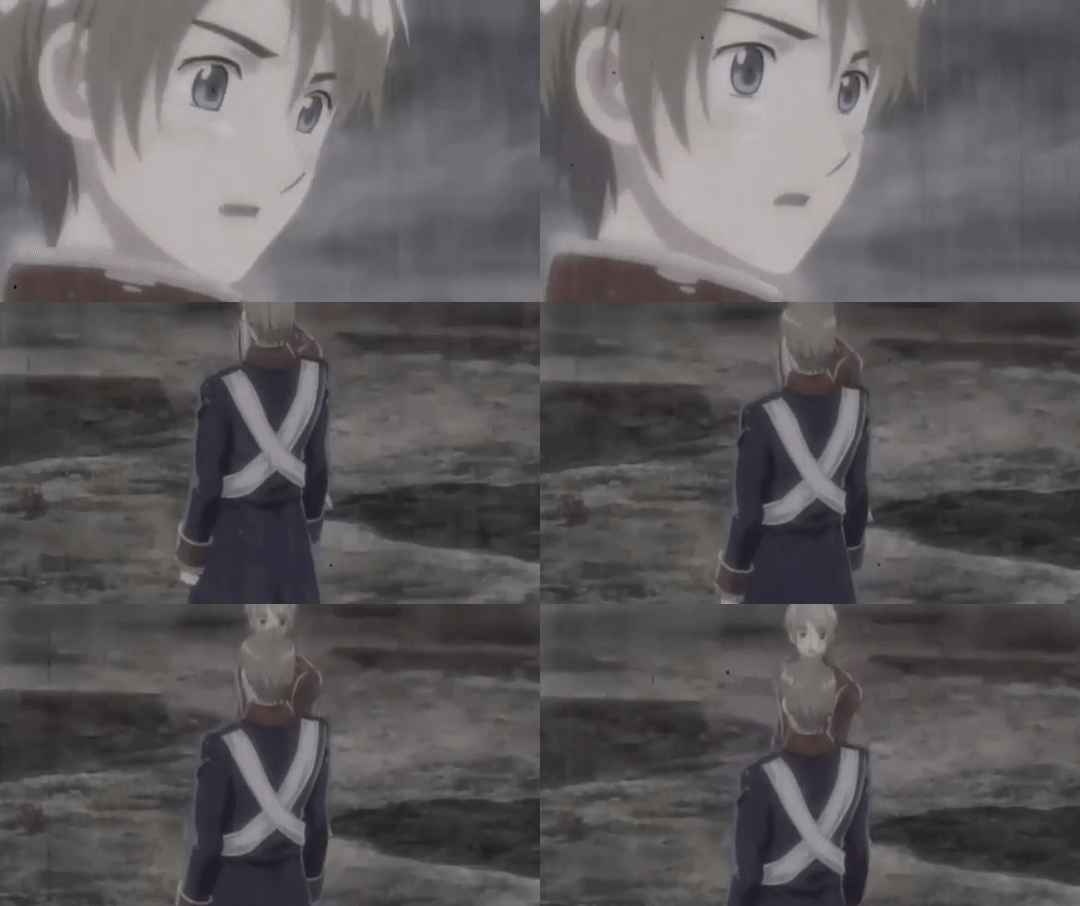
Unlike the strips listed above, Germany’s birth in the anime
is drastically different. It actually shows Germany’s birth process.
Episode 5 of World Twinkle animates this, adopting the strip
from Volume 6.
I cannot stress this enough: The German States huddling
together and later stepping back to reveal a young Germany is not canon.

With all that in mind, I can see how easy it would be to
assume that Holy Rome and Germany are separate persons just by basing opinions off the anime. While the connection between them isn’t confirmed in canon,
however, the manga leaves things far more open-ended.












 Ellawritesficssometimes