Misconception: Latvia’s physical body is young
and small for “no reason.”
I couldn’t
object anymore to this. While it’s not explicitly stated why Latvia is like this,
there are written rules and examples in the manga that provide a suitable
explanation. This is aside from the fact that Latvian people are among some of
the tallest in the world.
Since I
already have a theory on this, I’ll merely put a quick summary here:
For one
thing, we know that a nation’s health is predicated on their political and
economic situation. That is, if their economy is doing bad, or they’re experiencing
political instability, then they’ll develop a cold.
Likewise,
we know from the case examples of America, Canada, Italy, and Romano that
gaining independence causes the nations to age.
A strong
economy, a stable political situation, and political sovereignty are solid
factors in determining the age and size of full-blown nations – not micronations,
who are often anomalies to these rules.
That said,
because Latvia has historically experienced constant political repression and
subordination and lacks a strong economy, his physical body hasn’t aged as much
in comparison to the other nations.
Ex: Russia
pushing down on Latvia’s head is a metaphor for the political repression the
latter experienced at the hands of the former.
Further,
what differentiates Lithuania and Estonia in modern times is that both of them
are doing better off economically than Latvia is, who primarily relies on
agriculture. You also need to account for how Lithuania at one time was a
European superpower.
Ex: Estonia’s obsessed with money, and is good at managing economics.
Even then,
because of the political repression Estonia also experienced, he’s only a little bit
older than Latvia at 17.
Misconception: Because Latvia’s scared of
Russia and is physically weak, he’s just weak.
Latvia’s actually
a genius.
Ex: He
built an entire railroad by himself.
Ex: He
plays solo chess.
Misconception: His physical age means that he
has the mentality of a child
[He’s 15.]
While
Latvia does have a bit of a blabber-mouth –which gets him into trouble with
Russia, admittedly – that’s more of a character quirk than it has to do with his
maturity.
Ex: Latvia
has adopted a mentoring role when it comes to dealing with Sealand.
[He also
drinks a lot of alcohol.]
Misconception: He’s not scared of Russia
anymore
I’ve seen a
tendency for people to get angry when authors characterize the Baltics as being
afraid of Russia. Honestly, it’s accurate, especially given how terrifying their
past in the Soviet Union was and the extent to which they’re still traumatized
by it. (i.e. both Lithuania and Latvia are shown to escape from
reality, and maybeEstonia too with his mochi-inspired dream + other dream fantasies).
The problem would be if you only depict
them this way, and don’t reveal the other aspects of their characters.
In other
words, “Stop making the Baltics weak!!!! They’re not scared of Russia!” is just
as bad as only showing them cowering
in the face of Russia.
Also remember that there was resistance and political
revolts on their part too. Either way, both depictions are biased,
one-dimensional, and don’t give the complexities of their personalities the
credit they deserve…
The title is a bit
provocative in the sense that I mean aside from the obvious reasons of both
world wars. With that out of the way, I’m going to be fair to Holy Rome =
Germany skeptics, and will give an alternative reason as to why France’s hatred
of Germany extends well before 1914.
First, while this
strip is deleted and should not be taken at canon value, it’s still important
in potentially giving us more insight as to what Hima might plan to do should
he portray how the nations react to the news of Holy Rome’s dissolution and
subsequent death (that is, if he ever died. Yes, I’m biased).
Either way, this
demonstrates that France was severely impacted by what happened to Holy Rome,
and for very good reasons considering that it was Napoleon who caused his dissolution.
1) Holy Rome look-alike
Since France grew up
with Holy Rome, having a new nation [Germany] spring-up in his place, looking
exactly like him would be like rubbing salt to the wound. You can see why
France would be hostile to this substitute; a replacement of someone
irreplaceable.
2) Germany is Holy Rome + France’s Guilt
Consider this. You ‘kill’
someone who you view to be a little brother –or well, at the very least, he’s believed to be dead (bias x 2)–only to
have him become a new nation with no memories of the past.
In that case, France’s
initial hatred of Germany (while unfounded) is what we in psychology call a
projective defense mechanism. France is taking the hatred that he feels towards himself for dissolving Holy Rome, and constructs Germany as the
object to be hated.
In other words, to
minimize anxiety over his past, France represses these emotions and inflicts this
hatred onto Germany, who then becomes the focus of said hatred.
Obviously, this hatred
is amplified in the world wars. This, of course wanes over time, as it’s noted
that he no longer hates Germany and that they hang out regularly.
However, what’s
important to note is the substantial degree of hesitancy, nervousness, and
skittishness that France sometimes shows when he’s interacting with Germany.
From an interpretative
standpoint, this could mean that France is still wary of Germany. Or in the
case that Germany’s Holy Rome, France is still left to deal with the
consequences that he caused back in the Napoleonic Wars; that is, Germany’s
estrangement and amnesia from his past as Holy Rome.
This hesitancy is
shown as France secretly backs Germany in an EU meeting. Of course, there’s an economic reason for this too.
Likewise, the
contradictory skittishness and desire to form a strong relationship with
Germany is seen when France offers to let Germany tell him about his troubles, only to plugs his ears and run away.
While this could just
be a joke of him not wanting to deal with EU matters, if you read into it, it could also possibly mean that France is afraid
that Germany might say something indicative of his forgotten past. We’ve
already gotten a few hints of this in other strips (i.e. Prussia not telling
Germany everything about his past, or Germany recalling a memory of Chibitalia
in San Buon Valentino).
Regardless, their
relationship does progress, making significant grounds as they take leading positions in the EU.
Ex: When England
leaves the EU, Germany and France ease each other’s worries and work together.
As the character note
states, they do hang out as well.
Ex: They vacation in Seychelles together.
Lastly, there seems to
be another projective metaphor with regards to France’s desire to strengthen
his relationship with Germany.
Here, France invites
Germany to his house. When Germany arrives, France randomly blurts out that he
thinks school uniforms are “awesome.” He then communicates his desire to share
“complex aesthetics” with Germany.
Immediately, I’m
already seeing hints at an unconscious conflict manifesting itself here…
…which is well
substantiated when you consider how it seems like France is, well, desperately
grasping at any seams that he can use to mend his relationship with Germany. I
mean, when have you ever seen Germany take an interest in fashion?
It’s the topic that’s trivial, not the repressed emotions behind it.
If anything, this can
be taken as France projecting his broken past onto the object of a school
uniform, and in doing so, represent his desire to sew and repare the figurative seams of
his relationship with Germany.
In previous posts, I’ve discussed how more often than not,
the nations are forced to comply with their bosses’ orders, often at the
expense of going against what they think is right. It would follow then, that
there’s a discrepant irony between what the nations represent (their people),
and who they serve (their bosses).
Despite this direct involvement of the gov’t facilitating nation
action, there are many instances where the nations lack very minimal political
power and influence. In other words, you don’t commonly see the nations facilitating
much gov’t action.
One of the prime examples of this would be how powerless
they are to stop corruption. Nonetheless, they still possess a deep awareness and
recognition of these political issues.
Without further ado, let’s go over some examples, shall we?
The Italy Brothers:
The Italy brothers experience a lot of troubles back home.
For one thing, they have the mafia and pick-pocketers who routinely steal from
him.
Italy has his car and phone stolen.
The mafia attempts to steal imports that Romano intends to
send to Spain.
As such, the prevalence of being constantly stolen from and
victimized ultimately motivated Romano to learn how to defend himself against
pick-pocketers.
Lastly, we get an explicit recognition from Italy that the
Italian Parliament suffers from transparency and corruption issues.
America:
America’s involvement in his politics is a tricky puzzle,
all right.
He’s incredibly optimistic about the outcome of his
elections…well, at the very least he leads on the façade of believing that
everyone will get along in the end.
England notes that because of how partisan America’s
citizens are, it divides the country.
America responds by saying that the “powerful enthusiasm” of
his citizens is a good thing…
…to which England counters by deeming America to be blithe
about the political division in his country. Basically, England is saying that
America is cheerfully indifferent about how polarized the Republicans and
Democrats are.
What makes me think that America is putting on a façade is
the fact that when he claims that everyone will get along in the end, the image
he pictures is in stark contrast to his statement. It reveals two beaten-up and
worn-down citizens agreeing on the fact that the President isn’t doing his job
well.
Go back to the first panel where America refers to their political
activism as “lively.” When comparing that statement to the fact that America is
implicitly acknowledging how potentially violent his politics can become, it shows a
reluctance on his part to confront the volatile–both verbal and sometimes
physical i.e. rallies or protests–aspects of his elections.
The “United after all” phrase seems like America is trying
to convince himself that the situation in his country isn’t that bad. It’s also
important to consider that this strip is recent, having come out in 2016.
It doesn’t end here, either. As a result of America’s
dividing politics, England expresses concern for the former’s health– a small
reminder that a nation’s health can be affected by the stability or instability
of their political situation.
Of course, America waves off England’s comment, likely not
wanting to admit that even with his super strength, he can grow weaker just
like any other nation can during dire economic recessions or turbulent socio-political
disputes.
What he says next, however, gives a better hint as to how
involved he is in his politics. It’s quite worrisome.
To surmise, means to accept something as true without possessing
the evidence to confirm it. If that’s the case and America’s merely guessing
what his citizens want, it would mean that he’s not directly involved in the campaigning and gathering of public opinion.
Without a decent grasp of what the polls are like before
voting, perhaps America is relying on media reports and/or word of mouth from
other gov’t officials on who the people are leaning toward. Point is, he doesn’t
seem to be directly involved in the process of actively talking to people
during elections.
This doesn’t mean to say that America is completely removed
from his politics. He hails and takes the privilege of voting very seriously.
What I’m trying to get at is that he might have more of a sideline role with
regards to how active and engaged he is during elections.
Russia:
This one is pretty disturbing and unsuprising, but it still
goes to show how little control a nation has over their gov’t.
Bluntly and with a
troubled look on his face, Russia admits that votes [and people] in his country disappear, and
that he doesn’t even know if all of the votes are counted.
France’s Speculation about Germany:
While this is just a speculation on France’s part, it
nevertheless demonstrates the recognition that nations are capable of taking
part in corrupted schemes. As stated above, however, they don’t always have the
discretion to oppose these gov’t orders.
France suspects
that Germany took part in a conspiracy where he knew that letting Greece into the
EU would cause the European economy to crash.
Germany obviously denies this.
It’s the realized possibility that matters here, not the
actuality of it playing out in real life.
That said, while the nations are often used as puppets by
their leaders, that doesn’t mean that they share a similar mindset. Instead,
when presented with issues like corruption, it causes them to experience reciprocal
internal conflict.
After talking about how nations are affected by illnesses with @ellawritesficssometimes, I decided to write an extensive post to better explain my take on the matter.
Now, as Ella already pointed out, from canon we know for sure that personifications can experience what’s the human equivalent
of an illness in three different situations:
1) Economic recessions
or depressions
2) Political unrest
Rome was shown to be sick when there was some
unrest inside his territory, in spite of the successful external military campaigns.
3) An illness affecting a big part of the population
This is the case of Romano, for example, who as
a child was affected by Huntington’s Chorea. I remember reading the strip but
I couldn’t find it to have a better check, I would just like to note that this
isn’t actually a widespread disease, Huntington’s Chorea is by definition a rare neurodegenerative pathology. It has its highest incidence
among European population, with a peak of 10.85/100.000 in Molise, a region of
South Italy, while it’s extremely rare in Japan (0.5/100.000), so I guess that
this is what Himaruya was talking about.
Either way, it’s canon that personifications can
be affected by illnesses that are characteristic of their population or affect
part of it.
It looks quite straight-forward, doesn’t it?
And then there’s this:
America, who, in front of a sick England and wearing
what looks like his WW2 uniform, doesn’t seem to know what a cold is.
As Ella pointed out, this looks like a
continuity error. It doesn’t make sense for America not to know what a cold is,
as he has already experienced the Great Depression, knows that England was sick
after the Revolutionary War and should have seen some humans getting sick, anyway.
My point is that, while this could likely be a mistake
on Himaruya’s part, there could also be
an explanation.
The most straight-forward explanation could be
that America does know what a cold
is, but he associates it with a human disease, not with personifications, so he’s
merely confused at the use of the term and he’s asking France for
clarifications on this. His confusion might also derive from the fact that he has
never experienced such an illness, as Himaruya seems to imply in a following panel:
Here, Himaruya is talking about wars, but since
this is his explanation for America’s ignorance on the matter, I think that it
applies on broader terms, meaning that America has never had a cold before – or
at least, not such a bad cold that it left him as sick as England was.
This seems to clash with other canon
information we have about the way illnesses affect personifications, but I don’t
think it’s necessarily so.
Now, what I’m proposing is not canon, but it’s
not even merely a headcanon, as it’s an interpretation rooted on canon material.
I am of the opinion that the rules I listed at
the beginning are merely general rules,
but they don’t apply in the same way to every single personification: just like
humans, there is always a factor of individual variability to keep in mind.
The fact that there’s some individual variability
isn’t only a headcanon of mine, either, as we have seen it in other fields, one
of the most glaring examples being a personification’s strength: this is clearly
linked with a nation’s political and economic strength, however it also varies from
personification to personification. For example England, even at the peak of his
power, was never shown to be as physically strong as America – he was even surprised
when he witnessed America’s strength (who at that point, by the way, was only a
colony – for how prosperous his land might have been, he shouldn’t have been that strong unless it was also a
characteristic belonging to him as a person, that later emerged even more with his
status of superpower).
Going back to illnesses, some nations will tend
to suffer more debilitating effects from an economic recession, while others will be affected in a lighter way, for example getting away with some exhaustion
or a slight cold instead of being bedridden, and this depends only on them as
individuals – just like some people might get a fever of 39 degrees for only staying
out in the cold and others never get sick.
Based on the evidence, I would place America at
the second end of the spectrum. Again, it could be a mistake, but it doesn’t have
to be. This is up to interpretation.
Moreover, I’ve also found another small evidence
that might point to America having a stronger constitution than other nations:
Civil wars should be another instance where personifications
get sick, however America looks perfectly fine here – Canada looks worse than he is, and this makes me believe that,
while the general rules are always valid, the single personifications are
affected in different grades.
With this, I’m not trying to say that America doesn’t
get affected at all, but he has probably never experienced anything more than a
slight cold, and being isolated for so long he didn’t know that nations could
be affected differently – hence his confusion at seeing England so sick and the
fact that he didn’t know about it. Once again, his ‘what’s a cold?’ might be referred not in broad terms, but only in correlation
with personifications. This is why I believe that’s it’s not necessarily a mistake.
I really hope that it’s clear now! And don’t hesitate
asking if there’s any question 🙂
Re: Nations, Illnesses and Individual Variability
All right! So, as previously
discussed, the three rules @feyna-v laid out for us are canon. The first two are
explicitly stated in “In just 2 minutes you can
grasp the exterior of the European economy”, whereas the third one
derives from a solid example. I’m not here to dispute that.
However, there are few things
that I would like to point out and go over. Not all of it relates back to
America’s perception of colds either.
1) America not knowing what a cold is may
not be a consistency error:
A) Situating the Context
I think it’s important first
to situate the context under which these panels took place. Like Feyna said,
they take place during WW2 judging by America’s uniform. This comparison in
health happens at a time where America’s industrializing and profiting
immensely, not to mention that the war isn’t taking place on his own soil.
European land, politics, and civilian life was thrown into chaos. Despite
taking part in the war, for their own self-interest mind you, America wasn’t
nearly as affected as France and England were.
The fact that America is
stronger than France and England should be expected, as it falls consistent with
the inverse of the economic strength rule; if the nation’s economy is weak,
then they’re weak too. Wouldn’t it follow that if their economy is stable, that
their health would also be stable? It’s an implied yes.
Likewise, we know that during
the Cold War, America and Russia, as a result of their economic and political dominance
as global superpowers, were equated to superhumans by Finland. Today, America remains as a superpower.
Disclaimer: I’ve noticed that
Feyna and I have different methods of approaching the material :). If
I see a rule, I apply it to all unless an exception in the form of an example
or written statement is provided.
What I’m trying to get at
here is that using the former panel to compare America’s health is biased given
his economic situation.
How I interpret it is that
America’s health is stronger as a result of him not getting involved in
constant conflicts. France’s and England’s wallets are bled dry because they’re
consistently at war with each other or other European nations. As such, they
don’t possess the leisure that America experiences in not having to constantly
finance and handle the costs of these wars.
America “prospers” for a
number of potential reasons: he was previously spared from the costs of
international conflict, he entered the war later, he doesn’t have to suffer
from the loss of public infrastructure, and lastly, he began to industrialize again
after the Great Depression. The European nations also industrialized (in the beginning), but this
waned off dramatically as all resources were channeled into the larger war
effort.
Further, we don’t get to see
much comparisons of America’s health during economic recessions or slumps, save
for the Great Depression. Here, he’s notably weaker in spirits, confidence, and
potentially health. He shivers in the face of the other nations’ anger for recklessly
causing the recession.
Either way, the fact that
America is cowering in the face of the other nations’ fury is not him being his
usual self. When he’s at his peak, even when he’s wrong, he doesn’t seem to be
affected by opinions external to that of his own. This might imply that his
health actually declined during the stock market crash.
Nonetheless, because there’s
such a gap in the timeline, we don’t actually know how affected he was by the
political and economic turmoils following his independence and subsequent
isolation from European affairs.
Following that logic, this is
another reason why I believe that America not knowing what a cold is is a consistency
error. While he may be in better health relative to the the other nations, this
can be attributed to his economy. Isolation granted him a lot of privileges that
the European nations didn’t possess, regardless of the slew of economic slumps
he fell into during this time.
B) America attributes a cold with human
illness
As I just mentioned, we don’t
really know much about America’s health state following his independence. We
get snippets of WW1 where he seems to be fine, and we already know that he’s
doing pretty well off in WW2;after
the recession…still, there’s huge gaps that we have to work with here.
Given the economic-political
strength rule, the nation’s health is impacted by the strength of their economy
and stability of their political affairs. If that’s the case, I find it hard to
believe that America never experienced a cold, given how volatile and
fragmented the nation was at several points in history.
Not only that, but I find it
hard to believe that he experienced a cold and wasn’t able to attribute it as
such. Unfortunately, these gaps in the timeline make it impossible to draw any
solid conclusions.
Although, if I had to guess,
America would have had to have experienced a cold when he was still under
England’s rule. We still don’t know for sure if Hima has made America as an explicit
exception to the rule in how he’s affected by political movements or riots.
There’s also the fact that
while not being allowed to see England when he falls ill after the Revolution, America
still shows concern for how serious England’s condition is. If that’s the case,
then he would have had to have had some understanding of what the symptoms of a
personification-type cold entails. Admittedly, it does seem like he underestimates
the seriousness of the cold at first. Then again, the Revolution was an extremely
serious blow to England, a consequence America likely hadn’t seen before.
2) Physical
Strength Resulting from Economic/Political Strength vs Physical Durability/
Stamina
Feyna brings up an interesting point regarding how England at
the peak of his empire is never shown to be physically strong. However, I disagree.
What needs to be differentiated here in my opinion is the nation’s
stature and stamina and their physical strength resulting from economic and
political stability.
You will have nations like Prussia, who’s shorter in height from
malnutrition, but is nonetheless able to get physically stronger as a result of
his country’s situation. In other words, the rule isn’t exclusive. It may not
be super strength like America’s, but as stated before, other factors hinder
this strength. So yes, there is some degree of individualized
characterizations. My argument is that it’s the same rule applied in uniform culminating into different outcomes.
While England is never explicitly shown to demonstrate immense strength,
it’s not shown that he’s entirely weak either. Instead what you’ll see is that
his physical body is weak in handling conflicts and lacks stamina, but he
nevertheless possesses a considerable amount of strength – it just doesn’t last
for long.
For example, as I’ll get into in the next part of this post,
France gains additional physical strength as a result of Napoleon’s conquests.
In the end, with the help of allies, England musters the strength to defeat
France, but collapses right afterwards. He also demands money as compensation. He’s exhausted from the financial and physical stain the Napoleonic Wars caused him.
I think that can be attributed to how thin and small his
physique is. Simply put, England possesses the strength, but lacks consistent
stamina. It’s also important to mention the fact that we don’t get much strips
covering the peak of his empire following WW1.
3) Physical strength is something all nations can but don’t always
achieve [cont…]
With Prussia, we learn that the reverse of the economic/political
rule is also true. Prussia is told by Frederick I that he needs culture if he’s
to stand with the greater nations in Europe, which just so happens to be France
at the time. Prussia then reluctantly admits that his economy and industries are
faltering, implying that he is becoming weaker.
I’ll be quick, but the running gag of this arc is that Prussia [because of France] associates wealth and “awesome” [aristocratic] clothing with physical strength.
He’s tasked with observing France’s culture, and later becomes the latter’s
pupil. Notice the consistency with the reference to the economy here.
The whole premise is predicated on Prussia becoming a stronger
power in Europe, a status in which he temporarily achieves.
Point is, while France and Prussia associate gaudy clothing as indicators
of strength, Austria is the one to point out the fallacy in this perception.
I do recognize that there’s a military morale at play here too.
Still, taken into the context of how the nations have been conceptualized before,
there’s more to take away from this.
The underlying message is that it was never the clothes, but
rather the economic wealth and political dominance that provided them with
extra strength. The wealth was simply a misatribution of this; it allowed for them to dress themselves lavishly
and feel good… a placebo effect if you will.
(i.e Prussia dressed up aristocratically, convinced himself he
was powerful, and then actually became powerful by initially studying and learning
from France’s culture).
In sum, from France and Prussia, we know that it’s possible for
them to gain additional strength. It would follow, then, that how a nation
gains strength is not quite based on individual variability (as in their
physical body), but rather individual economic and political variability stemming from a uniform rule that allows for this diversity…
4)
Nations suffer differently from economic recessions (yes)
It’s depends on them as individuals (not quite):
I’m basing this answer from what we saw in the Great Depression
strip. Each nation’s health was affected depending on how badly their economy
suffered as a result of the recession.
Hima even went so far as to assign objective numbers to measure this.
It’s not that I don’t agree with Feyna on the fact that America
is overall stronger health-wise in comparison to the other nations. I actually agree,
but I don’t think it’s an individual character trait; I think it’s very much
vested in the function of the economic leisure his political isolation gave him, his influential mass industrial power, and his rise to superpower status following WW2.
He wasn’t strained by conflicts as much (not that he wasn’t at all) as the
other European nations were.
But, given how volatile his domestic politics were, I do believe
he’d would have to been affected by it. Again, we don’t know this for sure,
since the notion of it falls outside the jurisdiction of the strips.
This brings me to my last point:
5) Domestic American conflicts
The rendition that we do get of the American Revolution is too shallow
to draw any conclusions on how America fared during it. We know that he cuts off
ties with Canada, and that England meddled in the whole affair.
Still, I wouldn’t say that America looks perfectly fine in the
panel Feyna provided above either. If you compare his expression from the first
and second panel in the strip, the way he raises his eyebrows and the potential flushing of his face does reveal some
kind of tension or strain.
Either way, this is just me being nitpicky. I would want to see
more coverage of the American Civil War before I would feel comfortable
commenting on America’s health and well-being during the course of the conflict.
Considering how inconsistent America not knowing what a cold is
with regards to the rules listed above, I honestly do think that it was just a
consistency error – it’s a fairly old strip, after all.
England’s character tends to get a lot of criticism, for, well,
how critical he is of America. Don’t get me wrong either. England can be
exceptionally mean. At the same time, however, as I’ve mentioned in previous
posts, he can also be just as sweet, considerate, and thoughtful.
To understand why England tends to take out his frustration onto
America, it’s important to situate this behaviour within the context of the Revolutionary
war, both before and after (duh).
The isolation and constant mocking that came with being the “Black
Sheep of Europe” took a huge hit on England’s self-esteem. Of course, being as
sensitive as he is, he responds with anger and keeps the accompanying feelings
of stress and anxiety to himself.
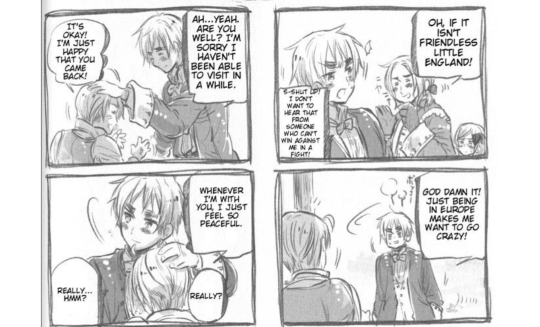
Things were different with America, who functioned as England’s
stress relief. England’s even noted to feel at peace when he’s with America.
This can be attributed to the fact that America’s youth and naivety
led to his unconditional acceptance and love for England. America was the one
person England could feel at home with. While the rest of the world hated
England, America didn’t.
That said, England became dependent on America emotionally. He
didn’t have to worry about being rejected by America…that is until America
began fighting for his independence.
To put it simply, America going against him broke England’s
heart. He felt like he could trust and rely on America to have his back, only to
be betrayed (in his POV) and isolated once more when other European nations sided
against him in America’s favor.
History repeats itself, and England found himself all alone
again.
While subtle, there are significant hints about just how deeply
the Revolution hurt him.
For one thing, it’s said that he’s suffered from 100 years
of heartbreak. Likewise, an even more telling emotional omen of the past is that
in one his character notes, three important pieces of information are given.
1) “His
temper was quite stormy during the decades after America’s independence.”
– Anger is a maladjustive way of
either expressing one’s need for something or acquiring it. In this case, it
could be a reaction to the loneliness he experiences after losing America.
2) “He’s quite bad at expressing
himself. He himself knows that people often misunderstand him, he uses this fact
for self-depreciating jokes.”
– This ties in with how easy it is to see him as an angry
person when he’s actually extremely sensitive.
Taking the latter two bits of information, you can see why Hima then
says this about England:
3) “He could
easily be the most pitiful one in this webcomic.”
In other words, England thinks lowly of himself, cares about
others’ opinions of him, poorly expresses his sadness by acting out in anger,
and yet doesn’t bother to fix these external misconceptions.
Like I said before, America was his best friend, and because
he can’t articulate his feelings well, England went from using America as a stress
ball to a punching bag (this term is used loosely).
For example, England is notorious for being a “scathing”
critic of America’s movies.
Nonetheless, what you’ll also notice is the subtle hints of America knowing that England cares about him.
Here, America –with a noticeably teasing look, as if he understands
more than what he voices– allows England to poke holes in his proposed world
defense plan.
Also pay attention to how England “commends” parts of
America’s plan.
Aside from these faults, the strengths in England’s
character prevail when they’re most needed. Even though any mention of America’s
dependence causes England to get sick, he visits America and celebrates the
occasion with him.
It causes him a lot of pain to do so, but he still commits
to it. Not only that, but he gives America the liberty bell on the 100th
anniversary of his independence, worries over and offers to repair the bell in
1958 despite the offer being turned down by American officials, and gives America
a new one another one hundred years later.
While America is amused by England’s evident embarrassment,
the next panel can easily be interpreted as him crying and laughing from
happiness.
Please note that the anime handles this scene quite differently, as it’s depicted more as in America laughs so hard that he cries.
I think it’s also important to end this by mentioning that
England was also America’s best friend. America is arguably just as lonely as
England.
When he was younger, America was scared to sleep alone. Regardless
if England always fell asleep before he did, America still needed him.
In “We’re Shipwrecked Too”, we get this awkward moment where
both of them consider sleeping closer to each other for warmth, but in the end
choose not to.
The tension here reveals that England isn’t the only one
having trouble working past the difficulties in their relationship.
Nevertheless, we also get moments where America reaches out
to England.
Ex: During a blizzard, he asks England to come and play
video games with him, but is turned down.
As seen in more modern strips, the two of them are slowly working
towards reconciliation and visit each other often. The perfect ideal would be
if they’re able to become best friends
again, not just in their hearts, but openly and expressively without any qualms
of what others might think.
Ever noticed how similar
the Chibitalia and Holy Rome storyline is to Cinderella?
Because I sure have, and
I honestly wouldn’t put this level of trollness past Hima.
Death of [Grand]father + adoption by Evil Stepmother:
When Ancient Rome died,
Chibitalia, as Northern Italy, fell under Austria’s strict rule. There, he was
subjected to rigorous chores and harsh punishments.
Keep in mind that
Austria’s strictness is exaggerated given how old this strip is. Even so, Chibitalia still shares fond moments with Austria.
Evil Step Siblings:
“Big Brothers” France and
Spain ruthlessly fight over Romano and Italy as if they were pieces of pie. Again,
their relationship isn’t only tied down to this, I’m just situating this with
regards to the fairytale.
Cleaning + Mice:
Chibitalia encounters
rats while performing his chores. While they’re not mice specifically, it’s the similar
theme that matters.
Fairy Godmother:
Chibitalia is mistaken as a girl by Holy Rome. While Hungary is aware of Italy’s true gender, she
still has him wear fancy and traditional Hungarian dresses.
In other words, Hungary ‘dresses’
Chibitalia up.
The Prince + the Glass Slipper:
There’s no ball here,
nor is there an imminent stroke of midnight in which the plot has its turning
point. Holy Rome would be the fill-in for the prince but the roles reverse
slightly here.
Nonetheless, the scene in which Holy Rome leaves for war is eerily similar to when Cinderella
forgets her glass slipper.
The glass slipper in
this case would either be the push broom (anime) or the underwear (manga) Chibitalia
gives to Holy Rome as a parting gift.
Holy Rome = Germany disbelievers, look away, because you’re
not going to like this…
The Big Reveal:
It pains me to say it, but after hearing all this, how much
do you want to bet that if Germany is ever revealed to be Holy Rome, it’ll have
to do with him still possessing the underwear or push broom?
Just imagine it. Hima could have possibly been trolling and
leading us on for eleven years about an ending so obvious and overstated in popular culture that it’s gone
completely unnoticed.
Misconception: He was an ungrateful child.
In reality, Romano
didn’t realize how much Spain had sacrificed for him until well into his
adulthood. In that sense, he can be even more oblivious than Spain at times.
Spain and Romano share
a very close relationship. What happens is that Romano often gets irritated with
Spain because they tend to switch from completely understanding one other to
not understanding each other at all.
Remember that when he
moved to America for work, Spain was the first person Romano called. He was in
a scary and unfamiliar environment and was all on his own. The fact that he
calls Spain is most telling of the less expressive but nonetheless strong bond they
share together.
Misconception: Romano’s
lazy
Yes, but not all the time. Romano’s a very competent worker when he puts his mind to it.
The truth is that there’s an evident tension between Romano and Veneziano
as a result of their rushed and sudden unification. They were separated for
centuries with minimal contact, and as such, have had a difficult time
reconciling.
Romano grudgingly moves
to America to sustain himself, as he didn’t want to rely on
Veneziano.
While he does complain
frequently, he’s still an exceptionally hard worker. Here, he’s even shown to
be above paying for shoes. Arguably, he’s the harder worker out of the two brothers. I’ll
get back to this in a moment.
There’s also an
interesting conflict regarding how the two Italy brothers share their workload. Romano wants Veneziano to work in order for him to work too while Veneziano wants Romano to “work properly.”
Likewise, there’s the
problem of North Italy infantilizing Romano and his capacity to work and be productive. He has a tendency to alleviate Romano’s workload, much to the latter’s annoyance.
Misconception: He
hates North Italy.
Not quite – he detests
him “a bit.”
The two don’t share
the greatest relationship. This likely stems from the fact that Romano suffers
from an inferiority complex in comparison to his brother, who was spoiled and
tended to more by their grandfather. Combine that with a rushed unification,
and there’s inevitably going to be some tension between them.
What you’ll see is
that Romano will insult Veneziano face-to-face– admittedly, quite spitefully and
rudely– only to discreetly look after his well-being behind his back.
Misconception: He’s
got an emotionally-strong backbone
Romano’s an even
bigger crybaby than Veneziano. He’s extremely sensitive.
Ex: He’s insecure
about his height.
Hopefully this sheds more light on Romano’s character. He’s not the stiff, rude, and unmotivated jerk that I often see him portrayed as in fanon.
While he can act like this, this isn’t how he always is. There’s a deeply emotional, anxious, caring, motivated, and passionate side of him that also needs to be recognized.
I’ve briefly talked about America’s naivety before, but
given how prevalent it is throughout the series, it deserves its own post.
For one thing, it’s important to define what I mean by
naivety. It’s not so much that America is gullible, as he’s more than capable
of reading the atmosphere, especially if it means getting what he wants.
Instead, this naivety has more to do with how inexperienced and childish
America can be, often without realizing it.
Likewise, I’ve also explained the role that America’s
isolation has played in this childishness. As a result of a lack of interaction
with other nations, America unintentionally comes off as egotistical. He grew
accustomed to only looking after himself, and this way of interacting with the
world stuck with him.
It’s hard for him to think about and put others first. Even
when he calls himself a hero and ‘saves’ others, it’s self-validating. Of
course, this doesn’t mean that he doesn’t have good intentions, because he
does. He’s a giant sweetheart, don’t get me wrong.
On the other hand, like an inexperienced child, America
lacks a balanced understanding between ability and expectancy. He often has
grand, unrealistic plans that involve him taking the lead in saving something
or someone.
That’s what this post will focus on; how, despite possessing
the ability to make calculated decisions, America still holds some pretty naïve
and unpragmatic beliefs on how life works.
All of this equates to the fact that he’s still relatively
childish.
For one thing, in WW2, he thought that a map of his country was a world map. This is possibly a play on the fact that children often think that the world revolves around them.
This childlike imagery appears again as America proposes
unrealistic world defense plans.
On another note, we also see that he’s not great at planning
for the future. Mass production led to inflation and plummets in stocks,
which ultimately resulted in the Great Depression.
However, during WW2, this mass production starts up again.
What’s interesting is that England remarks to himself that America might have
been traumatized during his childhood due to a lack of belongings and experienced poverty whilst
expanding settlements in his nation– it’s hinted that America overcompensates
for this by producing things in bulk.
Regardless of these economic downturns, America is revealed
to have never had a cold before WW2. Remember that nations acquire colds during
recessions. If this is the case, and it’s not just a consistency error, then
being spared from illness up to this point in time would have also influenced
his naive perception of the world.
Lastly, although possessing benign intentions to give
financial aid to smaller developing nations, America doesn’t seem to grasp at
the fact that loans are more economically harmful than good. Once again, this reveals how unrealistic he
is in being able to match his expectations with a likely outcome.
That said, it’s important to realize that America’s childish
naivety and unintentional egocentrism is only one side of his person. He’s
extremely intelligent and is crafty in getting what he wants.
Most of the time, however, he doesn’t have to use wit and instead
resorts to the easier route of relying on physical force. It’s for the latter
reason that I believe his character is often misinterpreted.
First, let’s just establish the fact that for the most part,
the nations are bound by their bosses’ orders.
“They accept their fate as it is and let their bosses order
them around.”
All right, good. Now that that’s out of the way, it’s
important to differentiate between what the nations represent and what they do.
The nations represent their people – they’re cultural personifications.
However, what’s ironic is that because the nations are
subordinated to their leaders, they often act in ways that goes against the best
interests of their people.
Basically, while the nations are personifications that
represent their people, they may not represent them well politically. There’s
an inherent tension between the reason why the nations exist (their people),
and whose interests they serve (their leaders/politicians).
Of course, this doesn’t mean to say that a government can’t
act in the best interest of their people, nor am I trying to justify or
minimize any wrong action taken by a nation as a result of an order given to
them. The point here is that there is an evident power imbalance between a
nation and their boss.
More often than not, the nations don’t have any other choice
but to listen to their boss, aside from the fact of whether the latter’s
intentions are good or bad.
Nonetheless, what I also intend to reveal is how the nations
are still able to exercise a sense of agency and resist their bosses to some
degree. Not only that, but there are times when the nations form a strong and
positive relationship with their boss.
Dictative Relationships:
Russia:
Russia is the epitome of a nation who is forced to comply
with their boss’ orders.
His bosses are “notorious” for making unreasonable demands. It’s
even alluded that they’ve tortured Russia before out of mere boredom.
He was once asked to stop a tank with his own body.
He was also ordered to build a canal in frigid weather
without any food.
Germany:
He’s forced to annex Austria, despite voicing his
unwillingness to do so.
During WW2, Finland talks to Germany about his boss troubles.
He jokes with Germany and says that countries can be imprisoned by their boss
if they complain too much.
This joke takes a dark turn when Finland suggests that
Germany’s boss would actually be capable of doing this.
Private Life:
Now that these more drastic orders have been covered, let’s go
over some of the more trivial aspects of a nation’s life that is controlled by
their boss. Like I said before, the relationship between the two isn’t always oppressive,
but there still remains a clear hierarchy.
England:
England’s banned from alcohol and sweets by his boss, and is
threatened with higher duties and taxes should he consume either of them.
The boss enforces this ban to keep England’s health in check.
Either way, this demonstrates how pervasive and extensive their control is.
Lies + Blind-sidedness:
Sometimes, the nations are kept in the dark about things
too.
America:
After the Roswell New Mexico incident, America is told that
the UFO he saw was nothing more than a weather balloon and that he should
forget that it ever happened.
Likewise, it seems that America is a bit disconnected and naïve
about how his own political system works. The fact that he has to “surmise”
what everyone wants is troubling. The naivety comes with the fact that he
thinks he can find a satisfactory political candidate that pleases everyone.
On the other hand, to surmise means to guess, estimate, or
speculate without having any evidence to confirm the assumption. If anything,
this might mean that he’s not directly involved in gathering public opinion,
but rather that he’s adopted a passive role when elections come around.
It makes me wonder how much he’s permitted to get involved
in the process.
Resistance:
While bound by their bosses’ orders through customary
tradition, there are times when the nations go against them.
Japan:
During the formation of the Anglo-Japanese alliance, Japan apologizes
to England when his boss “went on his own accord.”
Italy:
Italy maintains a boundary with his boss by asserting his right
to keep some of his life private. Admittedly, he does offer to reveal these
stories should his boss treat him to lunch.
Notice the title of this strip too. This confirms the power
differential between boss and nation.
Idolizing Relationships:
Prussia:
Lastly, there are times where the nation forms a lasting
bond with their boss.
Prussia and his relationship with Frederick II “Fritz” is
the best example of this.
Prussia idolized, or rather still idolizes, Fritz to the
point that he still keeps a picture of him on his nightside table.
You’ll also find that when he feels anxious or lonely,
Prussia evokes the memory of Fritz to comfort him. This is seen
in Buon San Valentino.
Bonus: In his character song “Mein Gott!”, Prussia also asks Fritz to watch over him.
In sum…
The nations are often forced to comply with their bosses’
orders, despite being representations of their people. None of this negates or
justifies the fact that they’ve likely been commanded to do unspeakable things.
The bosses’ orders are not always negative in nature, but
they’re still authoritative.
The nations have been shown to exercise discretion and
agency by resisting their bosses.
It’s possible for a nation to form an affectionate
relationship with their boss.
Keep in mind that the rules I’ve come up with here are not
canon. They’re simply just me compiling examples that form a consistent logic.
Overall, I’ve noticed two principle factors that causes the
nations to mature. There are other sub-principles that fall in tandem with
these categories.
1) They need a strong and autonomous economy, which
usually entails having a large population – If the nation is being taxed as a
colony, then they’re not economically autonomous.
2) They need to achieve political autonomy and
sovereignty (independence) – This includes a self-functioning and officially recognized
government.
Let’s go over a few examples.
America:
At a young age, due to an early economic boom, we know that
America gained super strength. However, because his economy and legislatures
were authoritatively controlled by England, he grew weak for some time.
Now, notice how under England’s overbearing rule America’s
economy is strained. Not only that, but he looks considerably younger.
Then, look at him after he begins fighting for his
independence; there’s a notable increase in age between these two panels.
We also see this same growth spurt in volume 3, where
America ages exponentially right before he revolutionizes.
With control over his politics and economy, America was then
able to become an adult.
Admittedly, in the “Cleaning out the Storage” strip, America
admits that he feels like he’s becoming an “old geezer.”
Lithuania responds by telling him that he’s merely “becoming
an adult.”
Put into context, I interpret this as America maturing
mentally, as opposed to physically. From the example above, we know just how
dramatically he aged.
Likewise, what you’ll see in a moment is that America was considered
to be an adult well before the 1930s (around the time when the outsourcing
strips take place).
Canada:
Canada is another good example of this autonomous economy/politics
requirement.
For one thing, he ages far slower than America, remaining as
a young child while the latter grew up at a faster rate. This is likely owed to
America’s larger economy.
That said, this proves the strong role that the total
strength of an economy overall plays
in the nations’ aging process. America and Canada were both under England’s
rule and were subjected to taxes, but because America’s economy [and
population] was larger, he matured more quickly.
The political autonomy rule is realized once Canada becomes
a Dominion (1867). While it’s not complete independence from Britain, it was
enough for Canada to physically mature from a teen to an adult.
Monarchies vs Constitutional Monarchies and Republics:
This is a more tentative example, but I’ve noticed that the
nations possibly could have aged as a result of a changed structure in their
governments.
Before constitutional monarchies or people’s republics, the
government was strictly run by the church and later monarchs, who ruled by
absolute divine right. Basically, the people had no say in their governments.
I mention this because in this strip here, we know that
Austria, France, and Russia are about 17-18 years old during the Seven Years’
war.
We know now that France is 26 and Austria is just a little
younger than Prussia, who’s 20↑
. We still don’t have a confirmed age for Russia
yet.
Nonetheless, the difference between now and then is that
democratic governments today are supposed to derive their power from their people (corruption
and tricky nuances aside, it’s the structure not the pragmatics that matters
here).
Starting in the late 18th century, this new era
of politics and the subsequent provision of constitutional rights might have
lent to stronger senses of national identities, thus causing the nations to
adapt and age in response.
We also know from France that the nations exist and therefore get
their power from their people.
Latvia:
With the following rules above applied, this explains why
Latvia remains so fragile, small, and young despite existing for far longer
than some of the other nations who are physically older than him.
Latvia hasn’t historically experienced consistent political
independence and autonomy, and has been subjected to foreign control for much
of his existence.
His economy is also considerably poor. He lags behind in
industrial developments and remains largely dependent on agriculture.
So, before anyone says that Hima characterizes a nation’s
age for seemingly no reason, try applying these rules. I guarantee you that you’ll
find some sort of economic or political justification.










 Ellawritesficssometimes