image
image

Looking at potential hints at ships is great, but I’d also like to use this forum to explore some of the most wholesome friendships in Hetalia. Today, let’s look at Japan and America. They’re compliments of each other, representing two polar personalities that balance out perfectly to create great comic relief. Among my favourites are the cultural misunderstandings that the two share.

Autobiographical Easter Eggs:

A lot of Japan’s bewildered reactions to America’s culture
is based on the own reactions that Himaruya  experienced himself when he moved to New York.

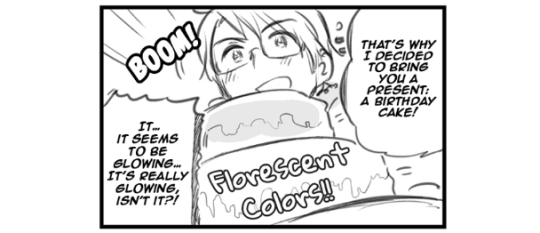
Ex: Japan takes a picture of the brightly coloured cakes in America.
So does Himaruya, who finds the colouring to be weird [x].

image
image
image

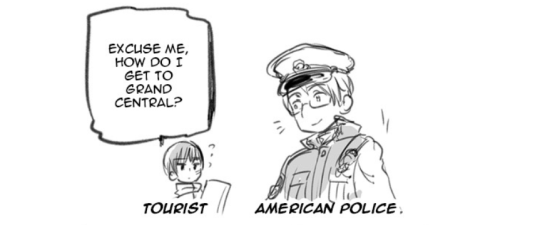
Ex: Through the strips, Himaruya advises Japanese tourists that American
police officers aren’t the best at giving street directions, unlike in Japan
where that’s their main purpose [x].
image
image
image

Where their relationship begins:  

When Japan opens his country to the West during the Meiji
Era, Netherlands warns him that because America is young, he may force himself
in.

image

Despite this, America and Japan hit it off very well. Of
course, this is still exhausting for Japan, who’s both physiologically and chronologically
older.

image
image

One moment that really sets the pace for their relationship
is when America introduces table-turning to Japan. He wants to surprise Japan
into believing that it can answer any question.

image
image

What America didn’t expect was for Japan to reveal his
anxiety over whether he’ll be able to get along with other countries in the
future.

image

The sweetest moment is when America doesn’t hesitate to
reassure Japan of this by moving the table so as to say yes.

image

Since this post covers
their friendship, WW2 will be purposefully glossed over
.

Post-WW2:  

This one panel here has puzzled many people. When America
proposes a ridiculous world defense plan, Japan agrees without any debate.
Switzerland then reprimands Japan for not voicing his own opinion.

If we’re to take this meeting as occurring right after WW2, this
fits with the Japanese-American relations of the time, where the Japanese
government and society were completely restructured. If this were to be
depicted in the manga, Japan would have become a lackey to America during the
American Occupation of Japan.

image

Cultural Differences:

Culture shock or accidental misappropriations between them
make up the flesh and bones of their relationship.

Ex: Japan’s version of horror is far different than America’s [x] [x].

image
image

Ex: Japan is astounded by how large the food portions are in
America. Meanwhile, America is just as astounded by how small the food
proportions are in Japan.

image
image

Ex: Again, Japan likes to take photos of the fluorescent cakes
in America [x].
image
image

Ex: America likes to dance. Japan doesn’t.

image

Ex: America visits Japan on New Year’s day. He
takes it upon himself to study Japanese New Year’s customs, but accidentally
ends up using a wrong reading for “home etiquette.” It comes off as “sword
killing” instead [x].

image
image
image

Visiting:

image

The two visit and spend time with each other pretty often in
the manga.

Ex: Japan moves in with America for some time. America
kindly greets him with a large meal.

image

Ex: Japan invites America to come see the sakura bloom in the
spring.

image

What I also find funny is that there are times where America
becomes too much for Japan to handle.

Ex: Japan runs away when America asks him to sleepover after
watching horror movies. It’s not romantic in context. America’s just a big
fraidy-cat that needs someone there with him [x].

image

Ex: America invites Japan to his Christmas party, only to
leave the tab of said party on Japan. This prompts a good bout of lecturing [x].

image
image
image

Even more interesting is that we get a small snippet that
expresses America’s fears and secret recognition that he’s not well-received by
other nations. Japan is the only one he believes won’t abandon him [x].

image

Ex: America unceremoniously breaks Japan’s window. This
prompts another lecture [x].

He goes there to ask for Japan’s help in successfully scaring England on Halloween. (America and England host an annual competition where the two attempt to out-scare each other).

image

All in all, the relationship that Japan and America share is
definitely a sweet spot in the manga. The two are very close friends, and if
creative inspiration just so happens to dictate it, then yes, they would also
make for a good, well-rounded ship.

image
image
image

Nationhood:  

To understand why micronations and provinces/ states
–aside from the country they’re part of– exist, it’s important to understand
how broadly nationhood is defined in the manga.  Nationhood and the respective immortality it
brings is not exclusively given to formally recognized nations. In fact, the
modern nation today is a fairly recent method of human organization. Humans
used to organize themselves far differently, ranging from city-states, clans,
tribes, empires, kingdoms, etc..

I say this only because the personifications exist
as reflections of their people, regardless of how they organize themselves.
What’s important is that they all share a common identity. As such, nation in
the manga doesn’t strictly apply to the sovereign countries that exist today.

Ex: Prussia and the Knights Templar represented
Catholic Religious Orders.

image
image

As reflections of people located within a specific
geographic region of a larger country, territories, provinces, states, and
prefectures are also personified.

 Ex: In one
post, Hima created a dialogue with several American states. While this is a
hypothetical scenario, as they haven’t been canonically personified, it’s the
possibility of their existence that matters.

image

Ex: China’s provinces are personified.

image

Please note that all examples of intra-state
personifications can be found by searching up the “states and provinces tag” on
the English translation of Hima’s blog, Bamboo Thicket [x].

Put another way, personifications exist because
they represent a culture and a personality. How I interpret personality is that
it’s a reference to evidence/ remnants of the personification’s existence, such
as historical artifacts or architecture.

If no one remembers or cares about the
personification, then their existence is threatened. The same goes for culture.
Without a culture, the personification can’t exist [x]:

“Usually, when the culture or
the country’s personality dies/disappears, the country would gradually
disappear or entrust him/herself to the country that takes over him/her.”

With all this in mind, it should be noted that not
everything about the nations’ existence is logical.

Ex: In the first chapter of world stars, they’re
described as odd and strange beings.

image
image

That said, what this post will explore is the
abnormalities of the micronations’ existence. While not everything can’t be
explained, there is some logic to it that I’d like to run through.

Let’s go through some examples.

The Republic of Niko Niko:  

Niko Niko is easily the most abnormal micronation.
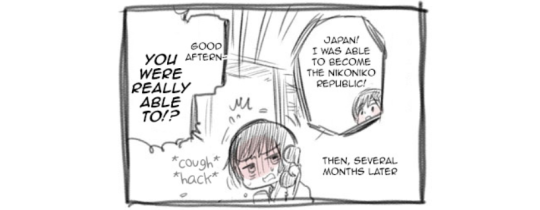
He’s a human who attained micronation status, representing a section of a city in the Fukushima prefecture. 

He had previously told Japan that he planned to become a micronation, but the latter didn’t believe him. 

Japan’s reaction to Niko Niko becoming immortal attests to the fact that this isn’t a typical case of nationhood.

image

How Niko Niko experiences nationhood, such as
having his health and well-being be based on his economic performance and
halting aging all together, is normal. What’s abnormal, or rather, “irregular”
is how Niko Niko was able to attain nationhood.

image

Likewise, Niko Niko
gives up his nationhood and becomes a normal Japanese citizen again. He also
resumes aging and is able to have a son. 

image
image

It’s noted in another strip that in
contrast to Niko Niko, it would be more difficult for a regular nation to
become a human [x] – which is possible in canon, by the way, post on that here [x].

 Sealand:

Sealand is also noted to
be abnormal, regardless of the fact that he’s not officially recognized.

For one thing, his body
(geographic landmass) is small. This causes other nations to have concern over
Sealand’s ambitions to become a formal nation, as it would be too hard on his
body and heart.

image
image
image

Seborga:

Seborga is interesting
because he used to be an independent nation, became a part of Italy, and then
later declared independence again despite still living as an Italian.

image
image

His experience of
nationhood confirms my “organization” argument. Before, Italy used to be composed
of several independent city-states.
Those were the ‘nations’ of the time, given how vastly different they
were and how people organized and identified themselves.

If that’s the case, then
I wouldn’t be surprised to see Genoa still existing in the present, albeit this
not being confirmed in canon. Point is, the Genoan identity and culture are
still prevalent enough today to warrant his existence.

image

Ladonia:

Ladonia is an internet
personification. Notice again that it’s how people organize themselves, not the
officiality of the title the matters in prompting the personification’s
existence.

image
image

Wy and Age:

One last abnormality
about the micronations that differentiates them from traditional [formal]
nations is their age.

Traditional nations are
usually born as babies, with the exception of Germany.

image

Meanwhile, micronations
vary in age.

Ex: Wy emerges as an older child.

image

There’s really no
explanation for this. The micronations are supposed to be strange and irregular
as we’ve seen from the above reactions toward Sealand and Niko Niko.

In sum, while many
things about the micronations are inexplicable, there is a consistent logic to
their existence in that they represent an organization, culture, and
personality of people. Nationhood applies to all personifications – it’s not
the title of the region that matters but instead the title in which citizens
identify themselves.

image
image
image

PART 2

Italy: 

Loneliness–

Ex: During the Second Industrial
Revolution, Italy breaks down crying when England asks him for help, citing
that it had been a long time since someone had last trusted him. At the time,
he had just unified with Romano, so their relations were even rockier than they
are now.

image

Fear of being useless and
unwanted, abandonment–

Ex: When Germany makes an
alliance with Russia, Italy gets anxious and suffers from a nightmare. He imagines that his allies, Germany and Japan, want nothing to do with him.

image
image
image

Ex: He makes Germany reassure
him several times that he’s not hated.

image
image
image
image

Discontentment with looks–

Ex: Italy panics when he gains
weight. Germany has to reassure him by drawing up a poll that confirms that it’s okay for handsome Italian men to have a bit of stomach.

image
image

Ex: He worries that he’s not
macho enough.

image

Prussia:

Fear of being alone + single

Ex: He never married.

image
image

As such, no matter how much he
tries to convince himself that he likes being alone, the fact that he cries
when he sees Austria and Hungary on Christmas proves otherwise.

image
image

Fear of being weak + inferior–

Prussia’s life cycle is full
of peak and weak moments.

When he’s weak, he’s meek and
down in spirits.

image
image

When he has power, he becomes
cocky and will degrade others to make himself feel better.

image
image

Romano: 

Inferiority over being
compared to his brother–

image
image
image

Russia: 

Fear of being alone +
inability to make friends–

Ex: He’s put-off by America’s ability to make friends.

image

Ex: He grows disheartened
when many nations are unable/ choose not to visit him during the New Years’ break. A blizzard plays a part in this too.

image
image
image

Ex: He’ll call anyone his
friend, even General Winter who abuses and attacks him on an annual basis.

image
image
image

Ukraine:

Discontentment over looks

She doesn’t like her big
chest. One strip in Volume 2 is literally titled:

“I Hate my Big Boobs!”

Ex: During the 2013-2014 Halloween
Event, others point out that her costume is too tight and restraining. (It’s to prevent
them from bouncing).

When other nations point this out, she grows uncomfortable and tells them not to mention it.

image

That said, you can’t say that
these characters don’t have their flaws or complexes, hardly any of which that
you see depicted in the anime. So no, Hetalia isn’t simple. The fandom didn’t
make it any deeper than what it already was.

image
image

Misconception:
She’s a ‘Plain Jane.’

Reality: Her
awareness that she’s ‘plain’ and doesn’t stand out in comparison to surrounding
countries is what adds more layers to her character [x]

image

Ex: She tries her
best to stand out.

image

Ex: If anything,
her and Luxembourg realizing how powerless they were 100 years ago makes her personality
more complex. It’s revealed that she was constantly at the mercy of other
nations. Any character that’s vulnerable and has weaknesses, flaws, and
insecurities are far from plain [x]. 

image
image

Misconception:
She’s weak

Reality: She’s endured a lot. Resilience is what makes her strong.

Ex: There was a
period where her and her older brother, Netherlands, had a rocky period in
their relationship. 

Netherlands attempted to unite their kingdoms into one, but
she declared her independence instead. This incident is described as a fight by Netherlands’ bunny [x]. 

image
image

Ex: Her
personality isn’t only a stock sweet-type. She’s also noted to have quite the
temper; she becomes scary when she’s angry.

image

Misconception: She’s fake and ingenuine

Reality: She’s incredibly sweet and supportive.

image

Ex: When Spain buys new clothes for a young Romano at the cost
of wearing rags, Belgium pleads for him to get new clothes too.

image

Ex: She cheers on Romano as he attempts to lift up Spain [x]

image
image

Ex: Because they’re so familiar with each other and regardless
of the fact that she’s a girl, Romano gets nervous and will swear in front of
her [x]. He used to have a crush on her, after all. 

image

Ex: She gets to share rare moments with Netherlands where he
reveals his softer side [x]

image

Bonus Facts:

Her smile is sometimes cat-like, a probable reference to the
annual Cat Festival held in Ypres.

image
image

Given that Hima bases a lot of the physical traits of the
nations on population statistics, Belgium has large breasts [x]. 

She’s very serious about her waffles and will make a sour
face if she eats a foreign recreation of the treat.

image
image

All in all, even though Belgium doesn’t appear very often in
the manga, she still has a unique and distinct personality. Yes, she’s long due
for further character development, but she’s
not plain.

image
image
image
image

It flows
differently for them:   

Of course,
being immortal affects how the nations experience time. They’ve lived for
centuries/ millennia and experience time at a much faster pace. A year, let
alone a decade, for a human is nothing to them.

Ex: Canada once
spent an entire weekend in a trance, staring into Kumajiro’s eyelashes. [x]

image
image

Ex: Because time flows differently for him, by the time America visits his child/ later teen friend Davie again, the latter’s had both children and grandchildren [x].

Interestingly,
the nation’s immortality can also rub off on other beings.

Ex: Pets like
Hanatamago, Pochi, or the Gilbird’s have extended lifespans as a result of
being around their owner nations. Should they separate, they would become
normal pets again. [x]

image

Ex: The
situation with humans is similar, but not quite the same. Unlike pets, humans
have a stronger developmental capacity to perceive time. It’s likely for this
reason that being around a nation for too long would cause them to go mad. The
drastic warping of time would be too much to handle.

image

How the Nations cope with their Immortality:

From what we’ve
seen in the strips, immortality is depicted to be more of a curse than it is a
blessing. There are several instances where nations have expressed regret over
their existence.

Ex: Germania
and Rome, as fallen ex-nations, experience relief over not having to deal with
wars and their leaders.

image
image

Ex: As an
Ancient in his own right, China romanticizes about the past, wishing that the
world was the same as it was 4000 years ago.

image

Ex: Italy
admits that he sometimes gets bored of seeing the same people every day [x]. Also
notice how his boss recognizes that immortality isn’t beneficial in practice,
as Italy’s had to endure countless painful memories and experiences. 

image

Ex: The nations
have gaps in their memories [x]. 

image

While it would
be impossible for them to remember everything, as they’re not perfect immortals
and can get injured and die, the fact that Russia claims that it’s good that
they don’t remember all the bad in their life may allude to an unconscious repression
of memories.

image

Still using
Russia as an example, given how he’s historically been tortured and punished by
his bosses, it’s easy to understand why he wouldn’t want to remember everything.

image
image
image
image
image
image

Misconception:
Japan’s emotionless

Reality: He’s shy,
but far from emotionless.

Due to his hikikomori phase, he became used to
communicating with others by reading their minds – he has clairvoyant powers.

image

Ex: Italy and
Romano initially believe that Japan doesn’t like them because of how contained he
was.

image

Ex: He’s an
introvert that taps into his extrovert side for business. He’s able to smile and
keep up with pleasantries. Like a true introvert, he’s drained after these
interactions.

image

Additionally, Japanese cultural display rules for emotion
are vastly different and more reserved than Western nations.

image

Fun fact: Nowadays, nations that are more reserved
emotionally in public tend to express themselves online in private more,
especially through the use of emojis. The Japanese
have some of the most innovative and creative use of emoticons.

Japan is very active online and has an Instagram account. 

image

He
also has an appreciation for cute things, although he doesn’t realize it. 

image

Ex: When he offers to wash Berlitz, he goes a bit overboard. 

image

Ex: He asks to take a picture of England and America after they put on cat ears.

image
image

Misconception: He’s
weak because he doesn’t voice his own opinions.

Reality: He’s
tactful and is extremely careful with what he says out loud.

image

Ex: Following
WW2, he agrees with what America says, likely because it served to his own
benefit.

image
image

If you think about it, it’s amazing how within a decade
after the dropping of the atomic bombs, the Japanese were able to emerge as an industrial power large enough to compete with the United States.

Japan’s intelligence and resilience should be looked at as a
source of strength. It’s also important to mention that before his defeat, he
had pretty much ruled the Eastern Pacific.

Japan’s not always composed either. It’s said
that because he keeps his opinions to himself, he’ll “explode with 100 years
level” and that caution should be taken when this happens. [x]

Ex: He vehemently
opposes the idea of Germany forming an alliance with Russia during WW2.

image

Misconception: He’s
anti-social.

Reality: He’s extremely social, albeit not overtly.

Ex: He takes great lengths to set aside time to visit his
friends.

image
image
image
image

Ex: Japan has his own way of expressing
his happiness.

image
image

Misconception: He’s
inconsiderate.

Reality: He goes
out of his way to help others. It’s for this reason that he’s probably the most
considerate and sincere APH character.

Ex: He learns Western greetings and attempts to practice
them despite how much it sparks up his anxiety over maintaining his personal
space.

image
image

Ex: He helps England with artistic design during the Second
Industrial Revolution.

image

He also makes sure to praise and commend England for his
efforts, not to mention that these compliments are all genuine.

image
image

Bonus facts:

Due to his old historical chronological age, Japan’s body,
while appearing young on the outside, is actually old with age.

image

He’s a photo-lover.

image
image

Although Italy doesn’t remember this, Japan first
communicated with Italy in his dreams. This is the first time we see Japan’s
clairvoyant powers depicted.

image
image

He works so hard that even Germany worries about him.

image

He’s able to perform cleansing and purification rituals.

image
image

A pretty neat and complicated character, eh?

image
image
image

I think it goes unsaid that how the nations relate to one
another is not only based on their present political relations.

In other words, while they may not be on good terms with
each other, these relations don’t define their relationship in whole. There are
times where nations get along, and there are times where they will fight
frequently and ‘hate’ each other. Point is, the hate doesn’t typically last.

While current relations do cause tensions, their pasts have
the most impact on how they view one another. It would therefore be shallow to
say that if nation A and nation B grew up together, only to go to war centuries
later, that they would unequivocally hate each other and be unable to reconcile.
Relationships don’t work like that, and this is especially the case for
immortals who have lived several lifetimes.

I’ve stressed this in other posts before, but the nations
don’t represent their government. They represent their people – they’re cultural,
not political representations. The irony is that they’re forced to serve their government, which may or may
not represent their peoples’ best interest. [x] [x]

It is for this reason that even in times of war, nations on
opposing sides are shown to be getting along with each other when they’re not
on the battlefield.

Ex: America’s occupation of Rome. He doesn’t treat the Italy
brothers as enemies, but rather friends.

image
image

Ex: England, Russia, and Germany share their military
rations with each other.

image
image

While humans from other nations may bear present grudges
towards each other, this doesn’t always reflect itself in the personification.
It’s important to remember that they’re people themselves, and have had more experiences
that influence their outlook on life.

That said, what this post will set out to demonstrate is
that nations rumoured to canonically hate each other don’t actually. The hatred
isn’t deep-set or genuine. It’s more like a rivalry between someone who constantly
gets on your nerves…someone who you routinely get into arguments with and can
never see eye-to-eye. On the other hand, old war grudges have been shown to heal with time.
Although, some take far longer than
others.

With all that in mind, let’s go over some of the most common
characters that are mistakenly depicted to be in hate-hate relationships. And
yes, while this is intended to be ship neutral, all of these examples can be
used to counter bashes against your ship.

Russia and America:  

While they may have been on thin ice with each other in the Cold
War, their history runs far deeper than that. Unfortunately, we get very
minimal insight into American-Imperial Russia relations. The strips only depict
Russia’s participation in the American Revolution.

image
image

Either way, the two countries don’t hate each other,
regardless of how tense their political relations were and still are. They even
acknowledge this tension as they spend time with each other in the present.
Russia in particular admits to how much America gets on his nerves.

image
image

China and Japan: 

Japan’s betrayal in WW2 caused China to develop a strong
grudge towards him.

image

Nonetheless, in recent strips, we do see China attempting to
reconcile with Japan through diplomacy.

image
image

Hungary and Romania:  

The two are noted to fight like cats and dogs. Each nation
depicts each other in a negative historical light. They may have resented each
other, and still do from time to time. However, it’s not true, long-lasting hatred.

image

Ex: Hungary’s somewhat smug reaction to Romania and Bulgaria fighting with
each other.

image

Regardless, they’re still capable of getting along. 

image

Greece and Turkey: 

The two bicker every time they see each other. 

image

Comic gags
aside, the two still care for each other and are mentioned to be making some grounds
in their relationship.

image

Ex: Turkey’s form of bullying Greece is taking him to a
bathhouse and massaging him.

image

Switzerland and Japan:

Switzerland yells at Japan to be more assertive and voice
his opinion. It has nothing to do with hatred. If anything, it’s an aggressive form of encouragement.

image
image

Veneziano and Romano: 

Romano suffers from an inferiority complex in comparison to
Veneziano, who received most of their grandfather’s attention. As such, he is
often very hostile to Veneziano, referring to him as “stupid little brother”,
or something similar to that depending on his mood.

image

However, this is only done to Veneziano’s face. When he’s
not around, Romano’s been shown on several occasions to look out for Veneziano.

image

America and England:

Short story short, the two have been able to reconcile their
rocky relations in the years following the Revolution. England’s bitter and
scathing nature towards America has softened considerably over the years.

It’s said that England once suffered from one hundred years
of heartbreak, presumably a hint to the American Revolution.[x]

Ex: England still goes to America’s centennial celebrations, despite
how sick it makes him.

image

He also offers to fix a crack in the first liberty bell he
gave to America, and gives him another one for his bicentennial. 

image

Ex: The two are close enough to make fun of each other’s
politics.  

image

America and Canada: 

Canada doesn’t hate America. Instead, he hates America’s
egocentrism and often calls him out for this.

image

France and England:  

While these two are notorious for fighting, having their own
designated preserve to quarrel in…

image

…they can get along with each other just as well too.

Ex: France used to be England’s cook.

image

Ex: England proudly calls on France’s cooking skills again
when he opens a butler café.

image

Ex: A summary of how their relationship’s progressed. 

image

Prussia and Austria:

The two don’t get along with each other.

image

However, that doesn’t stop them from spending Christmas together as ‘family.’ Prussia, of course, initially [teasingly] refuses to accept Austria and Hungary as guests.

image

                                                            …

image

Real Hatred – Prussia and Russia:

Albeit the fact that it’s one sided, Prussia’s hatred of
Russia is deep. It’s probably one of the only case examples where it’s not a
matter of two nations simply not getting along.

Ex: Prussia will cough up blood if Russia touches him.
Either that, or he will lose four eyelashes.

image

With all that in mind, long-lasting hatred between nations
is rare in canon. Similarly, while current political relations may have an
influence on how nations interact with each other, the influence of the past –
on a personal level – is much greater.

image
image

The nations are two-fold representations. By that I mean
that they have a literal body and a figurative body.

Bear with me, things get a bit tricky, but I’ll break it
down to the best of my ability.

Basically, the figurative body is what influences the nation’s
physical body.

The figurative body
is composed of two parts.

1) There’s the geography
of the nation. The landmass is sometimes referred to as their body or house,
despite the real physical one that they possess.

The geography can influence both the physical appearance and
personality of the personification.

Ex: Since Sealand’s geographic body is small, so is his physical
one.

image
image

Ex: Iceland’s contrasting volcanic and freezing temperatures respectively
causes him to have a hot and cold side.

image
image

2)  There’s the personality
of a nation. The personality of a nation (not to be confused with the
personification’s personality) is defined in terms of culture in the manga [x]

If the culture is well-developed
and thriving, then the personification will also thrive and be able to grow; to
age. However, if the culture is repressed, then the personification’s growth
will also be stunted.

The reason I’m outlining this is essentially to show how
geography/climate and historical events are reflected in the personifications’
appearances and personalities. Information on the impact that this has on their
health can be found here [x] [x]

What this post will focus on, however, is why some nations
have scars and either suffer from or are affected with other physical symptoms.

Let’s go over some examples.

Ancient Rome: 

Before dying, Rome was noted to have many wounds and scars –
a physical reflection of the turmoil his people suffered from.

image

Lithuania: 

We know from his time spent in the USSR that Lithuania acquired
several scars on his back. The military repression of several revolts and the
banning of diverse cultural practices in favor of an atheist state very likely
had a role in causing these scars to appear.

image

Latvia: 

Latvia’s case is similar to Lithuania’s. While we don’t know
if he has any scars, we know that Russia pushing down onto his head ultimately
stunted his growth. How I interpret this is that it’s a metaphor for political repression.

image

Put another way, Russian control stunted Latvia’s growth,
which, in turn, was reflected in the personification’s physical body.  

image

China:

It’s hinted that China gained scars after being betrayed by
Japan in WW2. It’s both a literal and symbolic stab to the back.

image
image

Germany: 

Each time America engages in reckless financial activities,
a new wrinkle develops on Germany’s forehead.

image
image

Finland: 

Estonia’s quest to become a Nordic causes Finland’s back to
be itchy whenever he’s talked about.

image

Bonus cases that aren’t so clear…

Russia: 

When he’s not wearing a scarf, Russia is shown to be wearing
bandages around his neck.

image

Netherlands:

An unknown event caused him to develop a scar on his
forehead.

image
image
image

I want to begin by pointing out that I’m simply presenting
canon information. That is, what we’ve seen
about religion in the strips.

Just because one nation follows the dominant religion of their
people doesn’t necessarily mean that they don’t hold their own beliefs or can’t
engage in the religious practices of other groups amongst their citizenry – all
I’m saying is that the latter point hasn’t been demonstrated in the series.

It’s also important to mention that the nations are
stereotypical personifications – they’re not characterized for specificity.

With all that in mind, religion in Hetalia encompasses a
generalized population rule. Similar to how they’re affected by the demographic
statistics of their citizens (e.g., their weight, income, behavioural habits),
the nations have also historically abided by the most dominant religion in
their country.

The Clergy as a ‘Boss’: 

Since the Church used to be the Head of State, they would
have also been the respective personification’s boss.

Ex: We saw this with England, who spent some time on the run
from a Bishop who ordered him to cut his hair.

image

The Personification as a Religious Entity:

Ex: Prussia first emerged as a Catholic religious order.

image

As a reflection of his people and their beliefs, he was
therefore extremely religious.

image

Ex: There’s also Knights Templar, who likewise represented
a Catholic religious order.

image

War:  

The Polish-Swedish wars are a good example of how the
different religious orientations of the two countries are reflected in their personifications.

image
image

Conversion: 

As mentioned above, the nations only follow a religion if it’s
prevalent within their population.

Ex: During the year 1000 [the Christian Millennium Apocalypse),
France and England truly believed that the world was going to end.

France feared going to hell. Because he thought they were both
going to die anyway, England fulfilled France’s last wish and pretended to be
conquered by him (ironic, considering that the Norman Conquest wasn’t that far
in the future).

image

Meanwhile, Hungary who had just converted to Christianity
that year, hadn’t yet acquired the religious beliefs that would have also made
her fearful of the so-called apocalypse.

image

Ex: There’s also this beautiful gem of a scene where Iceland’s
converted to Christianity. Note again how this happens only because his people
are being converted.

image
image

There is a Real God in Canon Verse:

Ex: Despite being a secular state in modern times, France
still believes in God. This is seen in his encounter with Lisa, Jeanne d’Arc’s
reincarnate.

image

Ex: Ancient Rome ties up God so that he’s able to leave Heaven and visit Veneziano.

image
image

Ex: God visits Hungary in her dreams and orders her to hit
France with her frying pan.

image

Ex: God visits Estonia in his dreams and fulfills his
fantasy to be surrounded by girls.

image

Of course, this wouldn’t be a religion-based post without mentioning the Vatican. While he doesn’t have an official design and appearance, Hima does say what his personality would be like should he ever become canon. 

image
image
image
image

Misconception:
Greece and Turkey genuinely hate each other.

Reality: They say
they hate each other, but their actions tell another story. It’s more like
they’ll break out into arguments whenever they see each other, despite being
too prideful to admit that they actually care for one another.

The whole Greece wishing death upon Turkey gimmick is used for
exaggerated comedic purposes.

image

To be as transparent as possible, they do get on each
other’s nerves. A lot.

image

Ex: They’re often compared to cats and dogs.

image
image

Regardless…

This doesn’t stop Turkey from checking in on Greece. He did
play a part in raising him, after all.

image

Ex: They’re noted to be making advances in their
relationship, but still break out into arguments easily. 

image
image

Ex: Greece offers to be stripped naked during the Christmas
2007 event to prevent Turkey from having his mask ripped off by France [don’t
ask]. 

image

That’s not the face of hatred – it’s far from it.

image

When Turkey enters, with his mask taken off nonetheless,
only then does Greece get hostile. 

image

How I see it was that he had no problem
looking out for Turkey as long as Turkey wasn’t there to witness this and later
have something to gloat about.

image

Ex: Turkey’s form
of “bullying” is taking Greece to a bathhouse to bathe him and remedy his stiff
bones. 

image
image

Misconception:
His slow and languid form of speech must mean that he’s unintelligent.

Reality: Greece
is incredibly intelligent. His culture’s philosophies and sciences had and
still have profound influence in how humankind organizes itself today. His
laziness, aside from the Greek stereotype, also stems in part from that fact
that he’s a night person.

image
image

The whole problem started as he joined the Euro zone.Thanks to Greece, Germany had to mobilize all his resources, and he is now fully dependent on him.

Despite this situation, he’s mostly eating good food, sleeping, thinking about philosophy, and is generally happy like usually.”

Misconception: Because he’s so absorbed in his mind, he’s a
recluse.

Reality: He’s one of the most sexually active aph characters
out there.

Ex: He’s very natural and forthcoming about the topic of
sex.

image
image

Ex: It’s hinted that he once slept with Japan, although
Japan dismisses this as a dream.

image

Bonus Facts:

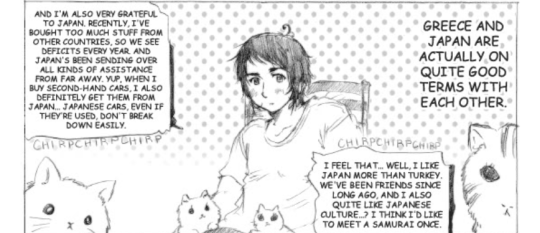
Still on the topic of Japan, Greece shares a very close and
wholesome friendship with him. 

The two have undergone many cultural
exchanges.

image
image

His hobby is excavating his mom’s ruins [Ancient Greece].

image
image

In an EU meeting, he once proposed to get rid of the concept
of debt.

image
image