image
image

Before I go through case examples, I want to go over some
important ground rules pertaining to the subject of economics and how nations are
affected by it.

1) When a personification has a cold or is
physically unwell, they’re having problems with their politics and/or are
experiencing a recession.

image
image

2) An economic recession will impact a nation’s
health differentially depending on their economic standing.

Ex: During the
Great Depression, some nations were more affected than others, as designated by
greater negative signs.

image

3) If the nation itself is poor, so will the
respective personification.

image
image

With all that in mind, just like political independence and
a stable, functioning government, the strength of a nation’s economy is an
equally important factor in influencing the personification’s age. The best way
I can explain this process is that a nation’s age is a result of an amalgamation
of factors.

Some personifications will go through a gigantic growth spurt
in reaction to their country’s own surge in economic prosperity. 

Other
personifications, while lacking official political recognition, are able to age
upon achieving and maintaining economic prosperity through high GDPs.

Lastly,
there are officially recognized nations who remain young as a result of poor and
inconsistent economic growth.

America: 

Of course, I’ll start with the most obvious and well-known
example. America grew up quickly in tandem to his growing economy, despite lacking
independence from England.

“Because he was relatively tolerant of religion forms, America became a melting pot for various cultures, arts and crafts. Soon, he began to grow an industrial prowess and rivaled England himself.”

image

Meanwhile, Canada, who didn’t possess the same
economic strength, aged at a much slower rate than America.

image

The point to differentiate between the two brothers is the
impact that their economies had on their biological ages.

Chinese Autonomous Territories: Macau and Hong Kong 

While they are presently considered to be autonomous territories under a one country-two systems mode of governance and therefore lack full
recognition as nations in themselves, Macau and Hong Kong’s strong industrial
economies allowed for them both to age. 

This lack of official autonomy is depicted by both of them
living in China’s household.

image

Macau: 

Macau was originally Portugal’s underling. He was East Asia’s
centralized and most successful trading port before being superseded by a
younger Hong Kong. 

image

As such, despite being part of Portugal’s house, Macau’s
commercial success was enough to make him an adult.

image
image

That’s all we know, as he’s not given an exact canon age.
Now, he remains as an older brother figure in China’s house. Again, it’s his
economy that primarily contributed to his physical maturity.

Hong Kong:

Hong Kong was little when he became English territory. 

image

Becoming an economically-successful trading port is what contributed to his growth. 

image

However, because he’s not a nation-state in himself,
this would explain why he’s 16-17. If he did become a full-blown nation, the
consistency in this rule would likely have him age again.

Historically, Macau’s a lot older than Hong Kong – this might
offer a plausible explanation for their differences in age.

image

Taiwan:

This one’s a bit tricky and controversial given the testy
disputes regarding China’s claim of sovereignty over a self-governing Taiwan.
Nonetheless, there’s still an economic factor that accounts for the reason why
Taiwan is older in age [as opposed to a small child]. She’s also a strong
industrial power, despite not receiving international recognition.

image

On the other hand, Taiwan was officially recognized as China
in the UN before losing its seat in 1971. This also may have had an impact on
Taiwan’s age, although since none of this is presented in canon, all I can do
is speculate.

Latvia: 

Not only was Latvia historically repressed politically, but
his agricultural economy isn’t doing all that great today either. Both of these
factors account for his young age, regardless of how long he’s existed
chronologically.

image

Moldova:

As one of the poorest countries in Europe, it’s no wonder
that Moldova’s growth has been stunted.

image

In sum, while economic sufficiency and success is only one
of the factors that allow a personification to age, it’s influence has a strong impact.

image
image
image

Now that I’ve gone over some of the factors that cause a nation
to age [x], I think it would be useful to go through each one separately. This
post will focus on how political autonomy and independence allows a nation to
reach adulthood.

Not only that, but what you’ll also see is that they go
through growth spurts right before gaining independence; their status as an
adult is solidified once this independence is gained. In other words, it’s the resistance that first sparks the aging.

It’s also important to mention that
chronologically-speaking, nations will still consider themselves to be older
than others, regardless if one of them became an adult first. There are late bloomers
like the Italy brothers and quick bloomers like America. The best comparison I
can think of is that anything to do with gaining independence is akin to the pubescent
period for a personification.

That said, let’s go through some examples.

America: 

In the following three panels, we see America go through three
developmental changes. In the first stage, he holds a more compliant attitude
towards England and helps him in the French-Indian War. Notice the tag of “Young
America” attached to him.

image

This compliance begins to wane as America was heavily taxed and financially drained by England following his involvement in the war. Notice how he’s a slightly
older child here.

image

Then, when America begins fighting for his independence, he’s clearly gone through another growth spurt. 

image

We also see in the years leading up to his independence – as he becomes even more economically and politically sufficient – that he grows pre-emptively.

image

Lastly, there’s the imagery that Kumajiro uses with dolls to
represent England’s relationship with America and Canada. America is the rowdy
Baby Bear; put another way, it’s like a teenager fighting for freedom from
their parent. Once that freedom is gained, only then will they become an adult.

image

Canada: 

Canada’s growth occurred at a much slower rate than America. He wasn’t an economic powerhouse like the latter.
While he remained as a young child, America appears to be in his pre-teen
phase.

image

In the years following America’s independence, Canada ages,
but he still has the lanky and awkward appearance of a teenager. He hadn’t yet
gained his autonomy yet, the missing factor to the age equation.

image

Here’s Canada after the Battle of Waterloo. 

Pay attention to the roundness of his face.

image

And here’s him during the war of 1812 [right], vs how he
looks in present strips [left]. There’s a notable difference in age. 

image
image

Likewise, we also know that when Canada upgrades to the semi-dependent
status of a Dominion, the autonomy is enough to allow him to reach adulthood.

image

Italy: 

We know that Italy is around the age of a pre-teen during the
Austrian War of Succession. He’s not quite a teenager, or at least not an older
one given how short he is in comparison to Austria.

image

During the Battle of Custoza [whilst raging his third war of
independence], there’s a considerable increase in age. Once again, we see an
example of a nation pre-emptively growing right before they attain independence.

image

Once Italian Unification is complete, there’s no doubt that
Italy has become an adult.

image

Romano:

Romano’s path to adulthood occurred in the exact same manner
and timespan as Veneziano’s did.

He’s around the same age as Veneziano during the Austrian
War of Succession.

image

He’s noted to have stereotypical teenager behaviour in the
years leading up to his independence from Spain.

image

Before independence, he appears to be in his late teen
years.

image

Once unification occurs in the panel I provided above, he’s also clearly an adult.

With all that in mind, it’s important to mention that chronological age is how the nations organize themselves
in terms of perceiving their elders. I know this may come across as obvious,
but it still needs to be said.

Despite becoming an adult later than America did, Romano
still sees himself as older than America and even takes it upon himself to give
him political advice.

image
image
image
image

Misconception: He’s
weak

Reality: Far from
it. The man’s been through a lot, emotionally especially.

Ex: During a heated
argument with America, he’s able to close the door on him. It’s hinted that
Canada may have super strength, but he dismisses this.

image
image

Ex: He’s more
than capable of standing up from himself if necessary. Even a pushover has their limits.

image

Admittedly, he does excuse a lot of Cuba’s hostile behaviour
towards him. It’s only because Cuba mistakes him as America, though.

image

Ex: Canada’s
emotional insecurity can easily be seen as a strength. It takes a lot out of a
person to remain so generous and friendly, despite being historically ignored and
neglected by those close to you.

image

Misconception: He
and America hate each other.

Reality: While
they may have had some extremely rough times together, they’ve done more than
enough to make up for this.

Covering the progress of their relationship in more detail
will require a whole series of posts, but these are the basics.

Despite growing up together, they argued a lot following
America’s independence. Britain acted as the most prominent wedge between them. For some time before, they also couldn’t see eye-to-eye due to profound age differences.

Canada held resentment towards America for being selfish,
reckless, and too imposing.

image

Ex: America
actually pushed for Canada to gain his independence. This didn’t occur until quite a while later, obviously.

image

Ex: When Canada
does get his independence, they reconcile for the better…after having another argument of course. Siblings will be siblings.

image
image

Although, as you’ll
see soon, they still argue over the same things. Canada’s main tooth to pick
with America is his egotism and boisterousness.

Ex: America knows
little about Canada’s pop culture, meanwhile Canada knows everything about his.

image

Nonetheless, the two are still extremely close…

Ex: America helps
Canada figure out his identity. Canada’s multiculturalism [in the strips only,
of course] is inspired by America’s own diversity of cultures and ethnicities.

image

As such, Canada suddenly finds South Korea and China staying
at his place. The East Coast of Canada, especially Vancouver, is where many
East Asians immigrate to.

image

Ex: America is
jealous of Canada’s natural ability to get along with everyone.

image

Ex: The two co-host an online cooking show together. Yes, it’s called “America’s Cooking Channel, but Canada is on there enough times to deserve the title of a co-host.

image

Misconception:
France is his father.

Reality: France temporarily
acted as a big brother figure to Canada before England took hold of his
jurisdiction. As such, this would explain why Canada inherited France’s hair. It’s
mere influence. They’re not blood-related.

image

We’ve already see with Hong Kong how one nation’s influence can impact the
physical/ personality traits of another.

Ex: England’s
influence on Hong Kong’s personality. England also cursed Hong Kong to have
thick eyebrows like him.

image
image

Ex: Seychelles was originally supposed to have one
thick eyebrow and one thin one to represent French and English influences on
her nation’s culture.

image
image

Misconception: Canada’s invisible for no reason.

Reality: There’s
a real historical reason for this. Being a dominion, Canada was often
overshadowed by Britain.

For instance, in WW1, other than the occasional Canadian Red
Ensign flag – which also had a Union Jack on it – Canadian troops fought under
the Union Jack. In return, Britain absorbed much of the credit for the feats
accomplished by Canadian soldiers.

Ex: America thinks that Canada hides in Britain’s shadow. He holds back from saying this out loud.

image

Later, Canada’s shown to recognize this on his own. 

image

Ex: Canada wanted
to sign a treaty with America, however he was too scared to talk to America
directly. He was worried that America wouldn’t be able to see him.

image
image

Bonus Facts:

He cried when Seychelles remembered him as being part of the
G8.

image

He served in the French army at Waterloo.

image

Maple syrup is his fuel.

image

He smoked marijuana.

image

He once yelled at America for three hours straight, pointing
out his faults. America cried afterwards. Predictably, this was quickly fixed with
a burger.

image
image

He aged at a much slower rate than America.

image
image
image
image

They owe their
existence to them. 

Ex: France lays out the rule that as long as the nation
possesses a stable government and a large enough citizenry to identify with
said national identity, the respective personification will remain and continue
to be immortal.

image

This rule is further confirmed in World Stars, where France
explicitly admits that he exists because of his citizens.

image

They openly interact with one another + humans know of their existence. 

image

A common misconception that people often make is that the
nations’ identities are a secret kept from the public and that only their bosses
know about them. That simply isn’t true.

In fact, while some humans are shown to be perplexed by the
nations’ immortality, their overall existence is known to the public.

image
image

Ex: France introduces himself to Lisa, Jeanne d’Arc’s
reincarnate.

image

Ex: Italy flirts with his own citizens.

image

Interestingly, Italy’s also admitted to getting tired of
seeing the same faces of his citizens every day – a consequence of his
immortality. However, he does add to this and claims that seeing
these same faces can also be refreshing.

Point is, on top of their being no knowledge barrier of
their existence, the personifications openly interact with their citizens.

image

The Nations are Citizens Themselves. 

Ex: Romano has his own passport.

image

Ex: Russia isn’t exempt from civilian duties, such as manual labor.

He’s forced to build a waterway alongside his people under
impoverished conditions.

image

He fought alongside his people in both world wars (as well
as any other personification), and endured the same notoriously terrible living
conditions that his soldiers were exposed to.

image

Ex: Coinciding with the last example, the nations serve in
their military. Here, America is tasked with tightening security among his
troops after Germany and Prussia successfully infiltrated them.

image

Population Demographics Affect the Nation’s Personality Traits, Behaviours, Habits, and Physiology:

Given that this is a series predicated on stereotypes, this
isn’t all that surprising.

Ex: China has a video game addiction resulting from this
becoming a rising problem among Chinese youth.

image

Ex: Germany strictly adheres to the directions of his GPS.
Hima drew this from a news story of a Bavarian who caused an accident by
following GPS directions.

image
image

Ex: Post WW1, several Lithuanians immigrated to America to
outsource their labor so that they could send money back home. As such,
Lithuania lived with America during this time.

image

The same thing happened with Romano. He went to live with America
during the first Industrial Revolution –a direct effect of his own people
migrating there for work.

image
image

Ex: As a result of his shifting cuisine (i.e. Indian and
Chinese influences), England is beginning to learn how to cook.

image
image
image

Ex: A nation’s obesity rate likewise impacts the weight of
the personification.

image
image
image
image

Misconception: He’s
lazy and unmotivated

Reality: He’s extremely
strict, neat, and places great importance in his appearance. Nonetheless, on
occasion, he has been shown to grow bored easily when faced with the prospect of
work.

Ex: He trained America and his military during the American
Revolution.

image

Ex: He keeps his clothes spick and span.

image

Ex: He gets bored and sneezes when he’s given a book on how
to socialize with people. 

image

Misconception: He’s
full of himself, so he doesn’t need anyone.

Reality: He’s
painfully lonely.

Ex: He never
married.

image
image

As such, he’s brought to tears when he sees Austria and
Hungary as a couple on Christmas.

image
image

He unconvincingly rationalizes to himself that he’s happy to
be alone.

image
image

This is repeated in his character song Mein Gott!, where he claims
that “Being alone is too much fun.”

Ex:
He misses Frederick II, and hasn’t found someone to fulfill this strong [but nonetheless implicit] desire for companionship.

It’s even said that he grows
depressed at the mere mention of Fritz. Ironic considering that he has a picture
of him on his nightstand.

image

Notice how Prussia also calls
on Fritz during Valentine’s Day, and once again attempts to convince himself
that he’s happy to be single.

image
image

Misconception: He’s overly-confident.

Reality:
Prussia’s narcissistic, but this stems from being extremely insecure about
himself.

He’s always trying to gain
power for self-reassuring purposes. This reassurance acts to discount his
insecurities over being weak. His use of the word awesome, then, is more
defensive and reparative than it is an exercise of confidence.

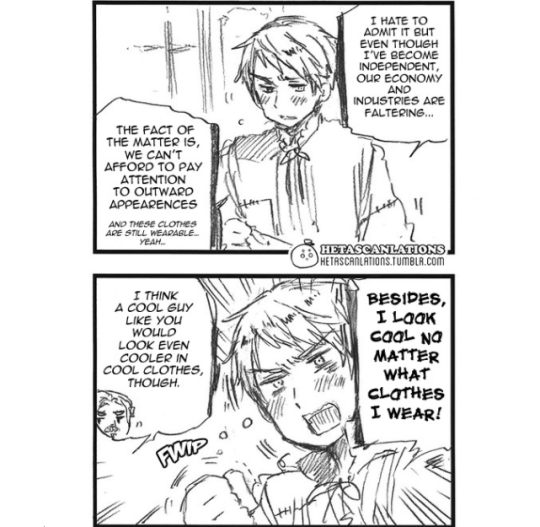
Ex: He associates fancy
clothes with strength + brags to bolster and reinforce confidence within himself.

image

Before his country grew in
strength, notice how he falsely tries to convince himself that his clothes are
still cool, despite them being worn down. The important difference is that he
doesn’t make use of the word awesome. This a time where his confidence and
morale is low. Awesome for him is equated with strength.

image

Bonus Facts:

He’s noted to feel like an enclave as opposed to an actual
nation.

He’s an incredible older brother:

Ex:
He reads Fairy Tales to a dying Holy Rome, and is revealed to be heartbroken
after the Napoleonic Wars.

image
image

Ex: He immediately
steps in to protect young Germany when he’s born.

image

Ex: He’s very supportive
and encouraging of Germany, despite teasing him a lot.

image

To be honest, given all this, I find it redundant for
Prussia to refer to himself as awesome.  

image