image
image

The following post aims
to give a concise breakdown of America and Lithuania’s relationship. Since the
material can be used for both shipping and friendship purposes, I’ve tagged
things accordingly. In analyzing their relationship, I’ve sorted it into three
main themes. Let’s go over them.

Structure:

An overarching theme of
their relationship is structure and the previous lack thereof. Lithuania moved
in with America post–WW1 for employment purposes as his country was
experiencing an economic recession.

Source: Hetarchive, Lithuania’s Outsource pt. 1

image
image

Nonetheless, it’s
important to understand where the two were coming from emotionally prior to the
move.

America was living on
his own, having just recently come out of isolation. He still wasn’t on good
terms with England and hadn’t coped with the feelings of grief and bitterness
that accompanied his declaration of independence.

Point is, America was
lonely.

Ex: During an overseas visit
to Japan for trading purposes, America attempts to befriend a whale. He also
declines England’s offer—who was able to read into America’s covert
loneliness—of friendship. Note that this takes place a little bit before, during the Meiji era of Japan.

Source: Hetarchive, Black Ships Have Come.

image
image
image

Lithuania had it a lot tougher. His empire with Poland had been annexed, culminating in him being
forcefully torn from Poland by Russia. In Russia’s home, Lithuania was likewise
forced into servitude. We also learn that in between the world wars, where he
had briefly gained independence from Russia, Lithuania had accumulated several
scars on his back from the abuse he underwent at the hands of the former.

Sources: Hetarchive, Hetare 4: Pact of Steel + Hetarchive, While You Were Gone.

image
image
image

In light of the turmoil America and Lithuania both experienced, the personal and positive experience of living with someone gave structure to lives that had for too long revolved around the chaos of
politics.

This brings me to my
next theme.

Companionship:

The two became best
friends when they lived with each other. Both experienced the loss of a partner
(America, England, and Lithuania, Poland), so to find a friend in these times
was crucial for them in establishing a sense of normalcy in their lives.

For once, work didn’t
take priority and they were able to relax, enjoy each other’s presence, and essentially become best friends.

Lithuania cooked for
America and basically organized his whole life as he took up a clerical/ assistant position.

Source: Hetarchive, Lithuania’s Out-sourcing pt 1. 

image

Other peak examples of
their friendship would include:

America’s pets taking a
liking to Lithuania and competing for his attention.

image

Lithuania sleeping with
America, since the latter was too scared to sleep alone having just watched a
horror film.

image

Source: Ibid + Hetarchive, Lithuania’s Out-sourcing pt 2.

Coping & Respite:

Lastly, the two’s
friendship was very much a healing experience.

America’s home provided
Lithuania with the sanctity of a healthy, stable, and safe environment—the polar
opposite of Russia’s home. He also felt comfortable enough to confide in America about his separation from Poland.

Source: Hetarchive, Lithuania’s out-sourcing pt. 1 + pt. 2.

image
image
image

Similarly, Lithuania
helped America cope with his separation from England.

Ex: When Lithuania first
moves in with America, we learn that America drinks coffee in spite of his
grudge towards England.

Source: Hetarchive, Lithuania’s out-sourcing pt. 1.

image

This grudge is touched
on again in the Cleaning out the Storage strip, where we learn that America had
shoved away items that reminded him of England (e.g., toy soldiers, a gun from
the revolution, and a suit that England gave him).

The strip involves
America cleaning out the closet—a metaphor for airing out his past and making
peace with it—and reliving his life with England as his parent figure.

Source: Hetarchive, Cleaning out the Storage.

image
image
image

After he’s finished
cleaning, Lithuania is perceptive enough to offer America coffee and the two serenely
enjoy the drink in America’s backyard. The nature is particularly important
because it shows how grounded and calm America has become as he decides to open
up to Lithuania.

The fact that America
drinks coffee too is symbolic in itself, as it shows that while his grudge and
spite are still present, there’s the hope and prospect that things will get
better as he matures. Essentially, Lithuania has become the familiar shoulder
for America to lean on.

image
image
image

In sum, while short-lived
and ending on the sad note where America became too poor to be able to host Lithuania
(following the Great Depression), the two shared a relationship that was full
of genuinity and sentiment.

The sadness on America’s
face as Lithuania is torn away from him says it all; it’s an arc in the manga
that I’ll always appreciate and have a soft spot for.  

Source: Hetarchive, Lithuania’s Out-sourcing pt. 3. 

image
image
image
image

The following post aims to give a concise breakdown of
Lithuania and Poland’s relationship. Since the material can be used for both
shipping and friendship purposes, I’ve tagged things accordingly. In analyzing
their relationship, I’ve sorted it into three main themes. Let’s go over them.

Balanced Imbalance

A core theme of Poland and Lithuania’s relationship is that
the inequality (for lack of a better word) of their dynamic is what balances them out so well. In other
words, while Poland may weld most of the power in their relationship, it’s this
imbalance that makes it both strong and palpable.

Poland is known for being extremely shy
and anxious towards strangers. He felt this way before meeting Lithuania—to the
point that he was crying and begging for the event not to go forward. However, during their first encounter he became strangely receptive to Lithuania.

Source: Volume 3, The First Time the Poland Rule Was Used.

image
image
image

We later learn from an observer that Poland joked around
more with Lithuania than he had previously.

Source: Volume 3, the Legend of the Iron Wolf

image

The power imbalance mostly has to do with how Poland treated
Lithuania. He perceived himself to be the lord and Lithuania, the lackey.

Source: ibid.

image

Other instances of this would include:

Ex: Poland not listening to Lithuania as the latter recites
folklore to him.

Source: Ibid. 

image

Ex: Poland had a tendency to slack off in his duties.

Source: Volume 3, Tannenberg – The Aftermath

image

Nonetheless, the two functioned very efficiently.

Ex: They fought together.

Source: 

Volume 3, The Ruler of Scandinavia and The King of Eastern Europe.

image

Ex: They traded together.

Source: Volume 4, At Netherlands’

image

What you’ll see in later sections is that regardless of
these idiosyncrasies in their relationship, the two made a lasting and inseparable
impression on each other.

Divorce vs Nostalgic
Obligation

This theme involves their forced divorce and the subsequent
end of their empire.

Lithuania was forcefully torn away from Poland. As he begs
for Poland to help him, Poland watches and points out how funny Lithuania’s
face looks. While I attribute the crudeness to the fact that this strip was
created in 2006 and that Himaruya’s characterizations weren’t as sophisticated then as they are now, it’s still material I have to work with.

image

Source: Hetarchive, Main Storyline Chapter 4

This bitter divorce created a lot of resentment in
Lithuania, who became Russia’s servant in the aftermath.

However, a counter for Poland’s behaviour comes later in the
“While you were gone strip,” where he sees the abuse and torture that
Lithuania was subjected to in Russia’s home. In
that case, perhaps Poland didn’t realize the grave implications of what it
would mean to be under Russia’s rule.

Source: Hetarchive, While you were gone.

image

We then learn in a character note that Lithuania was so damaged that he was rehabilitating with Poland during this time (i.e.,
the years between WW1 and WW2). The note
also goes on to mention that although Lithuania may be dragged around by
Poland, he seems to be enjoying himself.

Source: Volume 2

image
image

Lithuania’s resentment is revealed in two instances:

1)     
He feels like he’s in paradise when he moves to
America and lives in the latter’s home in exchange for work, citing how living
with Poland wasn’t exactly the most pleasant option.

Source: Hetarchive, Lithuania’s Out-Sourcing pt. 1.

image

2)     
After being invaded by Russia once more,
Lithuania hears of Russia’s plans to invade Poland. He goes through a series of
conflicted of emotions and flashbacks, calling Poland a bastard for letting
Russia capture him in the past. Regardless, he still has it in his heart to
warn Poland and worry about the latter’s well-being.

The nostalgic obligation, then, pertains to how Lithuania
and Poland’s past, grey and muddled as it may be, still makes them feel a sense
of obligation and duty to look after each other.

Source: Hetarchive, Main Storyline Chapter 4. 

image
image
image

Restoration and
Reconciliation

Although touched on in the last theme, the two haven’t let
the past get in the way of their relationship.

Ex: Poland stands
up for Lithuania and protects him from Russia during a world meeting.

Source: Volume 1, Meeting of the World.

image
image

Ex: Lithuania
doesn’t attend meetings for the Choral Club (in the Gakuen AU) because he’s too
busy showing Poland around.

Source: Hetarchive (Bamboo Thicket, eng trans., July 10, 2011)

image

In sum, whereas political and personal relationships are concerned,
Lithuania and Poland’s has been able to triumph through many obstacles. Their dynamic
has proven to contain considerable resilience as they continue to be life-long
friends.

image
image
image
image

Note: This post
can be taken as both a friendship and shipping post, so I’ll tag it
accordingly. I say shipping in the sense that this material would be useful tools
to incorporate into characterizations should anyone wish to write this pairing
more in tandem to canon.

A trend I’ve noticed in the fandom is that many people are
quick to dismiss the possibility of Japan and England sharing a good
relationship. I suspect that the anime’s portrayal of them in WW2 has a lot to
do with this conception. That said, what I seek to prove is that their
relationship—more specifically friendship because that’s what it is—extends before WW2. The two are and were actually very close allies.

That said, I’ve organized their relationship into three main
themes. All themes are linked to one another and contain substantive parallels
between their characters.

Loss of a Brother
Figure:

Both England and Japan experienced the pain of losing a
brother figure. Japan lost China, who raised him, and England lost America, who
he raised. While Japan’s historical isolation extends into the time where he
and China were still personally involved with each other, there is nonetheless the
unique parallel that both countries have experienced personal isolation.

Ex: China
developed a grudge after Japan betrayed him in WW2. Please note that the grudge
has since eroded away in the present.

Source: Hetarchive, The Story About the Early Days of China and Japan.

image

England and America both experienced a substantial loss and
tear in their personal relationship following the Revolution. This has also
since been rectified in the present.

Ex: America drank coffee in spite of his grudge over the
Revolution.

Source: Hetarchive, Lithuania’s Out-sourcing Series pt. 1

image

Ex: England dreams about raising America, an echo of his
latent and longing desire to live in the past again.

Source: Volume 3, England Dreaming of Long Days Passed.

image

Loneliness and Isolation:

Of course, the two didn’t just experience personal
isolation. They’re both known for their political isolation.

Ex: England,
being geographically isolated from continental Europe, became ostracized from other European nations.

Source: Volume 3, England Dreaming of Long Days Passed.

image

Ex: Japan grew
accustomed to telepathically communicating with other beings. In fact, he grew
so accustomed to it that when he first met Italy, he wasn’t in the habit of
speaking verbally [x]. 

Obviously, this isn’t overlooking the Westernization he
experienced during and after the Meiji era. The point is that his previous
isolation impacted his communication patterns.

image

Ex: In fact,
several strips in the series depicts Japan being overwhelmed upon opening his
country.

Source: Volume 4, Netherlands and Isolationist Japan. 

image

The neat tie between the two characters is that Himaruya
dedicates an entire strip to the two of them forming the Anglo-Japanese
alliance. The title of said strip is pretty self-evident as to how their
isolation impacted them:

“The Anglo-Japanese Alliance Between Two Lonely People.“

image

Lastly, there is also this comic gag that depicts their neko
versions overcoming their isolation by sharing a kitty box [x]. 

image
image

Cultural Sharing:

A last theme coursing through their relationship is the open
dialogue between their cultures. In other words, the two have a history of
sharing their cultures.

Ex: England enlists Japan’s help in teaching him how to make
better industrial design [x].

image

Ex: Japan adds his own spin to a traditional Christmas card and
England reciprocates the favour [x]. 

image
image

Ex: England hosts Japan at his café and aims to give the
latter an authentic English experience of the space [x]. 

image
image

Overall, England and Japan share a very gentle and generous
relationship, overlooked as it may be in light of other relationships that tend
to be underscored in fanon.

image
image
image

The following post will examine Denmark and Norway’s
relationship. It serves to summarize their dynamic, which, while complicated,
is still nonetheless a friendship. For those wishing to characterize them in a
romantic relationship, these strips will also be useful tools to incorporate into
your works.

I’ve organized their relationship into three themes: Childhood
Nostalgia, Rocky Waters, and Nexus of Inseparability.

image

Childhood Nostalgia:

The first theme is particularly important because it sets
the framework for how the two associate with each other. Because they were
childhood friends, Denmark believes that Norway still thinks of him as his best
friend [x]

Meanwhile, in the same character note section, Norway is
noted to “somberly pick on Denmark” despite the latter not noticing this [x]. In
other words, Denmark isn’t aware of Norway’s quips or criticisms, while it’s
left unspecified how Norway truly feels about Denmark. What I’ll show soon is
that Norway does care about Denmark but is also easily agitated by him,
remaining externally aloof in their interactions.

Overall, a panel that bests captures their dynamic is this
one. The prompt is what they would be like as
elementary students. Of particular importance is that they’re closely depicted
together [x]. There’s a reason for that…

image

Rocky Waters:

image

This theme is in reference to how the sea has been used as a
metaphor for time in the series. Historically, Denmark and Norway have had
several ups and downs in their relationship (e.g., fighting against each other,
fighting with each other, and being separated by force).

As mentioned above, the two were childhood friends.

One thing that fans don’t often mention is that Himaruya’s acknowledged
that his depiction of Denmark and Norway’s union gives off the “impression that
Norway is completely disinterested in Denmark.” Not only that, but he goes on
to mention that the two were in actuality working together very well at that time [x]

Ex: They fought together side by side [x]. 

image

He also makes note of Norway’s oppression leading up to
their separation and how the two drifted apart afterwards. Denmark even went so far as to throw a
tantrum and send a letter that cut his ties with Norway when he had heard about
the latter’s new union with Sweden.

Ex: This panel depicts their mutual poor relations in the
aftermath of their separation [x]. 

image

On the topic of Norway’s oppression and the poverty/
turmoils he experienced under their union, it’s important to recognize
that Denmark was initially unaware of this.

Ex: He cries when he realizes the delipidated living
conditions Norway experienced because of him. In this strip, Denmark had
originally been tasked with increasing taxes onto the Norwegian population but
was unable to follow through with it [x]. 

image
image

Ex: He becomes distressed when a naval blockade prevents him
from reaching Norway [x]. 

image

Lastly, even though Norway may come off as indifferent and
make several jabs at Denmark, he still expresses concern for him. It’s not that
he doesn’t care at all. What confuses a lot of people is that Norway will act
indifferently one moment and then express concern for Denmark in the same
scene.

Ex: Norway tells Denmark not to worry about him. He then reassures
him by admitting that he knows Denmark was trying his best despite his
impoverished circumstances [x]. 

image

Ex: Denmark doesn’t want to look uncool in front of Norway
and engages in a fight with Sweden that he knows he’s going to lose. Norway
makes a few remarks about Denmark’s well-being but is waved off as a worrywart.
It’s only after Denmark is defeated that Norway goes back to the trope of
remaining indifferent…which brings me to my next point [x]. 

image
image

Nexus of Inseparability:

The most resounding theme of their relationship is that the
two are inexplicably bound to each other, regardless of how many ups and downs
they’ve experienced.

What I haven’t seen anyone point out is that while one of
Norway’s hobbies is to “gently poke fun” at Denmark (vol 4), this stems from a Norwegian
stereotype.

image

Although Norway is perturbed by the fact that Denmark thinks
they’re best friends, he’s resigned to it. He isn’t exactly the type of person
to say something as explicit as that, which is why the phrase “competent
partner” was probably used [x].

image

Make no mistake either. Denmark irritates Norway, but the
two always end up together.

Ex: Iceland chides Norway for being contrary to  Denmark, as it’s completely
ineffective. Denmark is described as a person who ignores unkindness, so Norway’s
jabs go right over his head [x]. 

image

As is the same for anyone who wants to depict the Nordics,
Himaruya touches on how historical tensions between them have been replaced by
cooperation and closeness in the present [x]. 

Conclusion:

All in all, it would be a misnomer to claim that Denmark and
Norway hate each other or that it would be impossible to depict them in a romantic
relationship. Just be mindful that they’re not buddies like Denmark sees them
and that they have a complicated personal dynamic stemming from their history together.

image

image
image

Looking at potential hints at ships is great, but I’d also like to use this forum to explore some of the most wholesome friendships in Hetalia. Today, let’s look at Japan and America. They’re compliments of each other, representing two polar personalities that balance out perfectly to create great comic relief. Among my favourites are the cultural misunderstandings that the two share.

Autobiographical Easter Eggs:

A lot of Japan’s bewildered reactions to America’s culture
is based on the own reactions that Himaruya  experienced himself when he moved to New York.

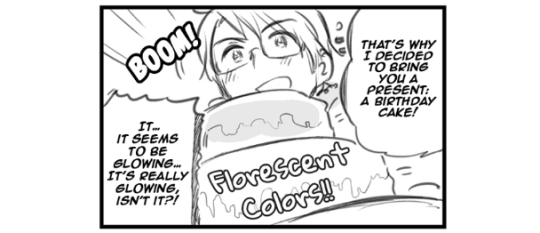
Ex: Japan takes a picture of the brightly coloured cakes in America.
So does Himaruya, who finds the colouring to be weird [x].

image
image
image

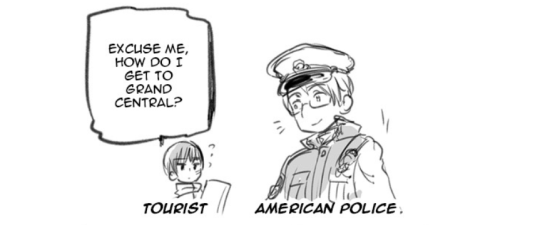
Ex: Through the strips, Himaruya advises Japanese tourists that American
police officers aren’t the best at giving street directions, unlike in Japan
where that’s their main purpose [x].

image
image
image

Where their relationship begins:  

When Japan opens his country to the West during the Meiji
Era, Netherlands warns him that because America is young, he may force himself
in.

image

Despite this, America and Japan hit it off very well. Of
course, this is still exhausting for Japan, who’s both physiologically and chronologically
older.

image
image

One moment that really sets the pace for their relationship
is when America introduces table-turning to Japan. He wants to surprise Japan
into believing that it can answer any question.

image
image

What America didn’t expect was for Japan to reveal his
anxiety over whether he’ll be able to get along with other countries in the
future.

image

The sweetest moment is when America doesn’t hesitate to
reassure Japan of this by moving the table so as to say yes.

image

Since this post covers
their friendship, WW2 will be purposefully glossed over
.

Post-WW2:  

This one panel here has puzzled many people. When America
proposes a ridiculous world defense plan, Japan agrees without any debate.
Switzerland then reprimands Japan for not voicing his own opinion.

If we’re to take this meeting as occurring right after WW2, this
fits with the Japanese-American relations of the time, where the Japanese
government and society were completely restructured. If this were to be
depicted in the manga, Japan would have become a lackey to America during the
American Occupation of Japan.

image

Cultural Differences:

Culture shock or accidental misappropriations between them
make up the flesh and bones of their relationship.

Ex: Japan’s version of horror is far different than America’s [x] [x].

image
image

Ex: Japan is astounded by how large the food portions are in
America. Meanwhile, America is just as astounded by how small the food
proportions are in Japan.

image
image

Ex: Again, Japan likes to take photos of the fluorescent cakes
in America [x].

image
image

Ex: America likes to dance. Japan doesn’t.

image

Ex: America visits Japan on New Year’s day. He
takes it upon himself to study Japanese New Year’s customs, but accidentally
ends up using a wrong reading for “home etiquette.” It comes off as “sword
killing” instead [x].

image
image
image

Visiting:

image

The two visit and spend time with each other pretty often in
the manga.

Ex: Japan moves in with America for some time. America
kindly greets him with a large meal.

image

Ex: Japan invites America to come see the sakura bloom in the
spring.

image

What I also find funny is that there are times where America
becomes too much for Japan to handle.

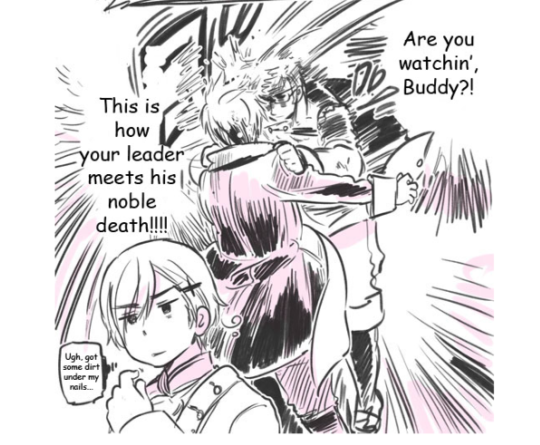
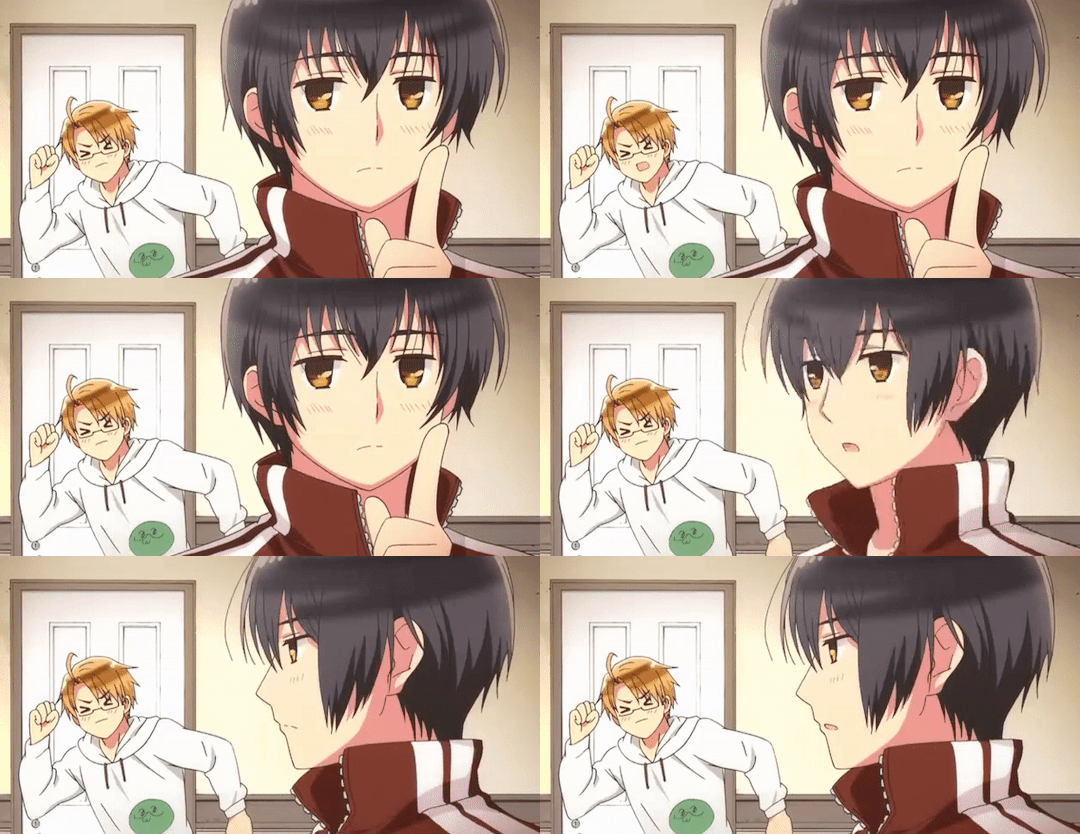
Ex: Japan runs away when America asks him to sleepover after
watching horror movies. It’s not romantic in context. America’s just a big
fraidy-cat that needs someone there with him [x].

image

Ex: America invites Japan to his Christmas party, only to
leave the tab of said party on Japan. This prompts a good bout of lecturing [x].

image
image
image

Even more interesting is that we get a small snippet that
expresses America’s fears and secret recognition that he’s not well-received by
other nations. Japan is the only one he believes won’t abandon him [x].

image

Ex: America unceremoniously breaks Japan’s window. This
prompts another lecture [x].

He goes there to ask for Japan’s help in successfully scaring England on Halloween. (America and England host an annual competition where the two attempt to out-scare each other).

image

All in all, the relationship that Japan and America share is
definitely a sweet spot in the manga. The two are very close friends, and if
creative inspiration just so happens to dictate it, then yes, they would also
make for a good, well-rounded ship.

image