

By now, you should realize how damn clever and intricate
Hima’s characterization is. It’s honestly mind blowing to me how chapters and
strips spaced out years apart from
each other are nonetheless effortlessly bridged together to form a logical connection.
On a similar note, you see a lot of similarities and
respective foreshadowing between Holy Rome and Germany. It’s uncanny how they
will say literally the exact same things, like a mimic or relic of the past in
Germany’s case.
As designated by the
title, this post will focus on how fairy tales are used to hint at Germany’s
infamously known, but unconfirmed connection to Holy Rome.

In chapter 187 of World Stars, we learn that Holy Rome hasn’t
died, even though he should have given that he’d already been dissolved at said
time. Still, his end is near as he lays on his death bed.
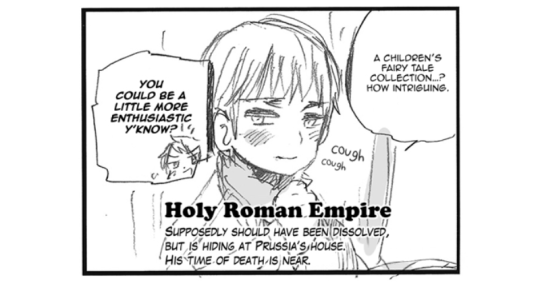
A “heartbroken” Prussia takes to
consoling Holy Rome by reading the latter Brothers Grimm fairy tales.

Notice how Prussia is not only grief-stricken,
but he’s also in partial denial. He refuses to accept that he’ll have to be a subordinate
to France and adopt French manners of propriety.
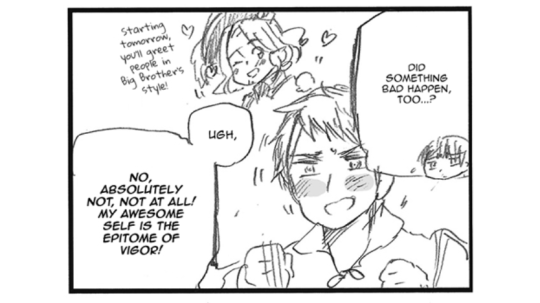
Meanwhile, even while on the verge of death, Holy Rome is
the more logical of the two. He has no problem in skeptically pointing out the
plot holes in the stories Prussia fabricates. (The original tales contained too
much eroticism, so Prussia had to take a bit a liberty when recounting them to
Holy Rome).

Regardless, what’s important to emphasize is the motif of
fairy tales – which will come up again later – as well as Holy Rome’s use of
concrete logic.
In Chapter 222 of World Stars, as Italy talks about feline
nonsense, Germany responds by saying: “Isn’t that a little too fairy tale like?”

I’m sorry, but I really do think that Hima did this on
purpose. Germany’s skepticism eerily echoes that of Holy Rome. Also, when have
you ever heard of a fairy tale that involves cats?
That one piece of
dialogue, trivial as it might seem on its own, serves as a key link to chapters
which would otherwise be completely unrelated.
 Ellawritesficssometimes