Pretty bad considering they had a quarrel preserve specifically constructed for them.
Let me just preface this by
clearing up the most common misconception about Russia; that is, he’s evil. In
canon, it’s the complete opposite. Russia is explicitly described as “not evil”,
albeit being “naturally scary.” Obviously, being scary in appearance and
possessing an evil mind are two entirely different things.
In the same character note,
it goes on to say that Russia thinks that Vodka and General Winter are his
friends. What’s more, everyone that he meets he thinks are his friends.
Strange, considering that aside from protecting Russia from invading nations,
General Winter attacks and torments Russia himself.
It’s this warped
understanding of reality and interpersonal relationships that I’ll be discussing
over the course of this post. To do that, we need to understand the core
influence of Russia’s childhood on his present person today.
In doing so, this will give
insight into the reasons why Russia wrongly sees violence as an answer; why he comes
off as cold; and why, despite having good intentions to make friends, he does
anything but.
To put it simply, Russia’s
childhood was brutal. For the most part, he spent his winters alone with little
help and no shelter. This strip darkly alludes to the fact that he grew
accustomed to freezing to death.
On top of that, Russia grew
up in oppressive circumstances. One example of this would be how he was
subjected to Tatar Rule (the Golden Horde).
In “The Yoke of Tatar”,
Lithuania first meets Russia and warns the latter that he’ll “freeze to death”
if he stays outside for too long. Of course, from the example above, we know
that Russia has already died this way several times before.
Here, Russia fantasizes about
becoming a bigger country and tells Lithuania that they’ll become friends one
day. Now, pay attention to what Russia says when Lithuania offers for them to
become friends in the present moment.
“We don’t have enough power.”
To me, that seems like a child with a twisted conception of what a healthy
relationship entails. Power in a relationship is what Russia’s been taught,
it’s all he knows.
He’s picked up on the
authority that the Tatars hold over him, and therefore applies it to how he
interacts with others. Put another way, the ruled strives to be the ruler.
This cycle of unhealthy
learned behaviour is also demonstrated in chapter 194 of World Stars. There,
Russia dismantles England’s naval brigade during the American Revolution. When
confronted about it, Russia’s response is so naturally oblivious that it
appears to have been internalized.
He’s literally equated power
with the ability to do whatever you want. Once again, you see how the influence
of his childhood factors in here. What Russia observed as a child is now being
repeated by himself.
Likewise, it’s not as if
Russia’s history has given him a break from suffering either. The damage only
keeps accumulating.
In the Bloody Sunday strip,
Russia’s brought to tears as he laments about how all his hard work to improve
his country has backfired, resulting in his people hating him.
Even darker is that at the end
the strip, it’s hinted that he’s been tasked with quelling the civil unrest.
Russia also hasn’t had any
mercy spared to him regarding his bosses. While we don’t get too much
information about them, what little that we do is heartbreaking.
When Russia is taken as a
prisoner of war in WW2 by Germany, he erupts with happiness and claims that
he’s in heaven. Out of everything, the most important comment is how he
mentions that he doesn’t have to deal with his boss.
Further, when he’s later
forced to build a railway by Stalin, Russia snaps. By snap, I mean that he
begins to fantasize about warm weather and loses all touch with reality.
This distance from/
misperceived reality is also to be taken into account regarding how Russia
doesn’t understand the consequences of his actions. He grew up with violence,
so violence is the only way he sees fit to solve his problems.
One example of this would be
when England’s caught sleeping at a meeting, and Russia offers to wake up
England by hitting him with a sickle. China’s comment, “violence is not the
answer!”, is the most telling indication of Russia’s troubled neuroses.
Another example of this
inability to recognize the consequences of his violent actions is when Russia
snaps Latvia’s neck in an attempt to get him to stop trembling.
That said, I would like to
end this by citing a favourite psychologist of mine, Karen Horney. She believed
that the “basic evil” (this is used loosely) in the world is parental
indifference, neglect, and hostility towards children.
While Russia may have had
Ukraine and Belarus, they weren’t around all the time. Centuries of oppressive
leaders, bloodshed, and isolation has taken a massive toll on Russia. What
Horney also said was that parents who exercised this basic evil of indifference
were incapable of treating their children with warmth and compassion as a
result of their own troubled childhoods.
Isn’t that what you see with
Russia? It’s not that he doesn’t want to be warm and compassionate towards
others, because he does. He wants nothing more than to make friends and help
ease his chronic loneliness.
The problem is
that he doesn’t know how.
“If you put your ear to a seashell, you can hear the ocean.”
America: *presses his ear to England’s chest*
England: What the hell are you doing?
America: Shh! I’m trying to hear the person who broke
your heart and made you so bitter.
I wouldn’t apply any labels, just to be fair, but Italy has
been shown on several occasions to like both guys and girls.
Buon San Valentino is a good example of this.
Germany, having already been perplexed by his relationship
with Italy, has his confusion increase tenfold when Italy gives him roses on
Valentine’s Day. It’s noted that in Germany, roses are a confession of love.
Germany then asks Italy if he ever had a first love or girl
or two that he likes. [This is just his attempt to figure out what Italy’s
feelings are towards him].
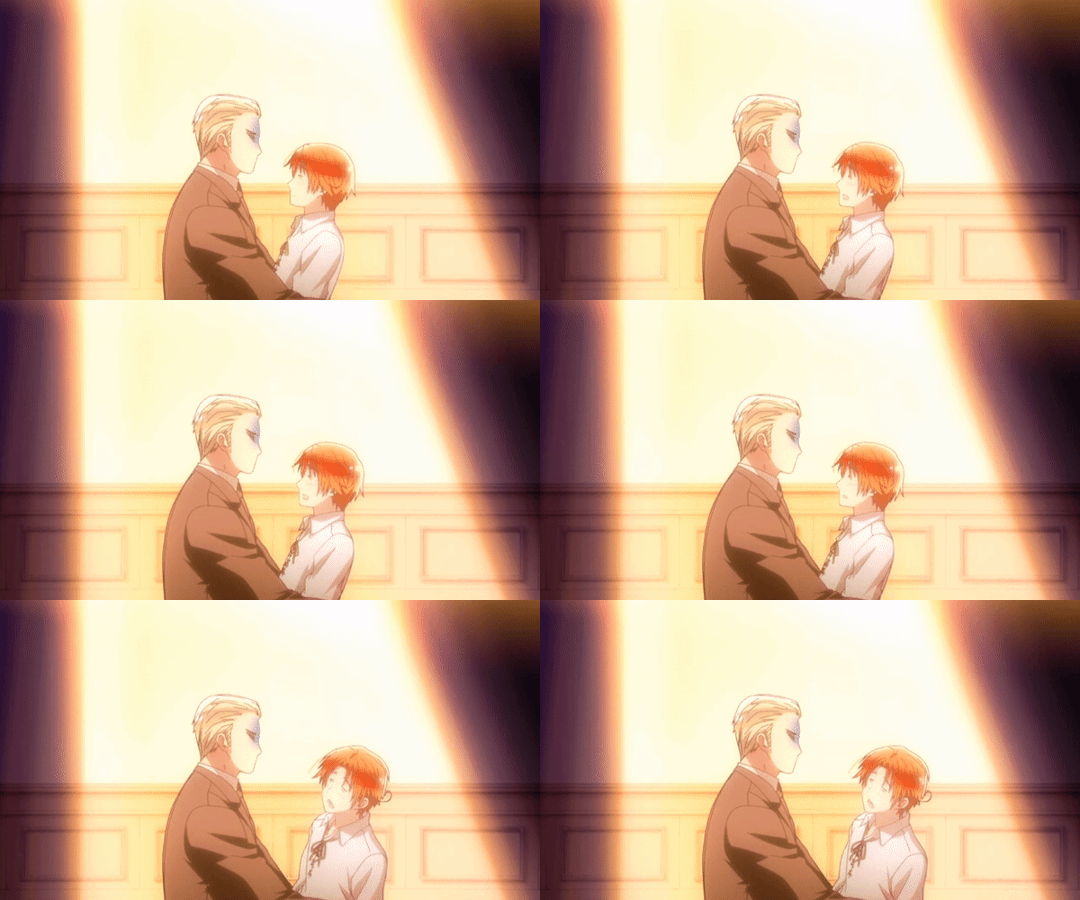
Italy responds by saying that his first love was a boy –
likely a reference to Holy Rome.
Why I don’t think HRE and Germany are exactly the same person
Since @ellawritesficssometimes asked me to elaborate, here I go. I’m no major in Hetalia or anything but this little guy has always been my favorite characer in Hetalia, even when I really disliked Chibitalia, and I want to share my thoughts on him.
So, first of all, Holy Roman Empire and Germany are really different as ‘countries’. Germany is an unified state despite all differences, Holy Roman Empire was more a pact between german states that never sticked and while originally it included a lot of other countries they started falling apart with time. Poor Holy Roman Empire started dying around 1500 and from the way he acted when he said goodbye to Italy I think he was pretty aware of his impending dissolution.
And another thing I suspect, due to the strip in which we see the german states fighting is that he made it back, to some degree, but he avoided Italy or decided to stay in a completely different place: the HRE Hungary is holding up is the teen we see later in the comigs where Prussia reads him the Grimm comics, not the super small child he was earlier.
I know this doesn’t add much to my Hre=/=Germany discussion but I still feel like pointing it out. Anyway, going back to the main topic: while they share a lot of territory, Holy Roman Empire had more than Germany inside him- like Austria, Switzerland, the whole Czech Republic and ridicolous amounts of the Netherlands, Italy and Belgium. Germany is just… Germany. And it’s compact and strong. They share the same territories, yes, but they’re different things.
Now, let’s alk about the points I see around the most:
But Germany and HRE look exactly like each other!
Who else also look really similar, used to share the same territories, have ridicolous similarities and have common history, traditions and culture? The Italian brothers and their grandfather, especially Romano and his grandfather as seen here (A post from @grandparomeaskblog / @mezzogiornovargas.). Even Prussia and Germany are shown to have strong similarities in some strips so I wouldn’t really base myself on how someone looks like considering family members can look alike on occasion.
Also, I DO admit there’s an high chance the empty shell of HRE was used as empty body for Germany but that doesn’t make them the ‘same’ person.
Thanks go to @ask-useless-german for basically being my german history teacher.
Germany is Holy Roman Empire, he just lost his memories.
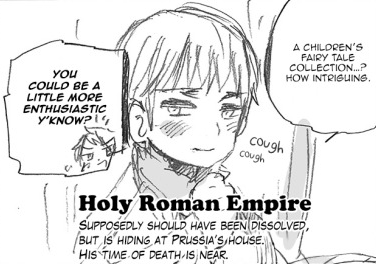
I could buy this if we didn’t have two specific things.This strip in which it’s clearly said the time of his death is close, which implies that he will die soon, he’s not just going to be sick for a while and then return full force-
And the one where they say Germany “already had an exising body” when he was born. I does imply that Holy’s body was recycled but we’re clearly talking about one being dead and the other being born. If anyting it feels like Germany is the legacy of HRE and the one who succeeded where the other failed.
Obligatory Gerita comment here
Feliciano remembers Holy Roman Empire and he still seems to feel something for him as seen in the famous Valentine episode. The only time he blushes is when he mentions his first love was a boy and he has a somehow melancholic face while talking about it.
Italy didn’t forget his first love and he seems to actively ignore when other countries flirt with him (he’s seen being nice to liechtenstein and other girls, sure, but he only flirts with human ladies.). So far we’ve seen him turn down Spain, Prussia’s advance and even Germany’s (the episode ends with Himaruya stating ‘it took them a week to fix the misunderstanding meaning they probably had a good talk about what happened and agreed to be just friends since we don’t see them in any kind of relationship in modern times, if anything it’s Germany who’s still slightly crushing on him), but we do see him blush mentioning Holy- it does feel like he’s still trying to move on. I think that if Holy Roman Empire was Germany Italy would be the first one to notice.
On a more historical note: Italy and Prussia were extremely close during that century so I find relatively strange how Feliciano apparently ‘never met’ Germany during his youth and they only started interacting round WWI- I mean, they’re still countries, they’re supposed to interact and Feliciano had a great relationship with Prussia. I do wonder if he knew Holy’s body had been ‘used’ and that’s why he tried to postpone their meeting as far as he could. Buuuuut that’s just me fangirling. And while I don’t really ship Ludwig with Feliciano IF it’s going to happen I’d rather see Feliciano fall in love with Germany because it’s Germany, not because “oh, look, it’s my long lost love I guess I should be with him”)
This is literally touching the tip of an iceberg since I have a lot of things to add but they’re mostly based on Feliciano’s interactions with Germany, how we italians were hisorically tied to Austria and HRE and this post is probably already a bit too long? I’m sorry if it’s a bit messy, I still struggle a bit with the language and I’m not used to write this kind of things either but this is a very short version of why I tend to consider Germany and HRE two separate entities.
In any case I’d love to discuss more with you.That being said I’m more than open for debate since as far as we go the whole thing is still a big question mark! 😀
Re: Germany is Holy Rome
Note: Germany = Holy Rome isn’t confirmed in canon. I’m merely presenting evidence in support of it.
Okay, before I start, I want
to mention that a lot of the points you brought up have already been explained
in the manga. That said, these rules do have a consistent logic to them. I
think what needs to be recognized here is that while Hetalia may be based on
history, it’s still fictional. What I mean by this is that you can’t apply
technical historical facts to explain a fictional occurrence, such as
reincarnation.
If the fictional rules are provided, then they should be adhered
to while also recognizing the wider backdrop of loose historical influence.
Different Territories, Different Personifications Argument:
The manga provides the
possibility for personifications to adopt new titles “names” and lands. So
while Holy Rome and Germany may differ geographically, it doesn’t negate the
fact that the nations’ borders and land space change all the time.
This
rule of adopting new names (titles) is established in chapter 1 of World Stars.
Likewise, Prussia has long
been established as a character whose geographical representation keeps changing.
He evolved from St. Mary’s Order, to the Teutonic Knights, and eventually to
Prussia. Presumably, he represents East Germany now
In sum, it is 100% canon for
the nations to have the land they represent change. As such, they can acquire
new names.
Memories:
You are correct in saying
that Germany and Holy Rome are not technically the same person, and yet they are. Germany is Holy Rome, except
he doesn’t possess the latter’s memories. That would explain why they have
personality differences.
Again, chapter 1 of World
Stars clearly states that nations can change their personalities out of
nowhere. Personalities are derived from lived experiences, which result in the
formation of memories. That’s why if someone lost previous memories, they would
be a completely different person; if they don’t retain these old experiences,
then it has no impact on who they are as a person.
I’ll get back to the evidence
of Germany’s amnesia in just a little bit.
Why Holy Rome Still Existed After Dissolution:
I’m dreadfully repeating
myself, but I have to refer to Chapter 1 of World Stars again. It states that
they can be called back by a sudden memory…
..but whose memory?
The first answer for this can
be found in “It’s a Treasure Box of Countries”, which outlines 2 outcomes that
can happen once a nation dies.
1) “If the culture of
the country’s personality dies/disappears, the country [personification] will
gradually disappear or entrust him/herself to the country [another
personification] that takes over him her.”
2)There are also cases that
him/her is not a country but continues to live leisurely as a representative of
the region.
Since this strip outlines
exactly what happens to a nation after their culture/personality dies, your
empty shell theory has no canon support.
Anyways, the first case
appears to explain why Holy Rome hasn’t died yet in chapter 187 of World Stars.
While he may have been dissolved, German culture and identity never waned.
It’s for this reason that the
vague statement of “his time of death is near” is used. At the time of the
strip, it was uncertain whether other national identities/ personalities would
eventually develop to replace Holy Rome.
On the same note, it’s human
belief in the nations that allow them to exist. Here, France lays out ground
rules regarding how a nation’s immortality is maintained.
1) They need a strong
and stable government (which Holy Rome didn’t have, admittedly)
2) A body of citizens (which Holy Rome had.
Regardless of how many individual states he consisted of, they were all united
by the German language).
Existing Holy Rome Body Theory + (non) Teenage Holy Rome:
With all that in mind, I
don’t think Holy Rome ever died if I’m to be perfectly honest. Here’s why.
First, the appearance of Holy
Rome in the 2011 Christmas Event strip does not appear to be a teenager at all.
Look at how small he is. Even when he’s in Hungary’s arms, he’s smaller than a
teenager. Popular opinion is what deemed him as a teenager here, nothing else.
Also consider how small Hungary is herself.
Like you said, the age
between the Holy Rome in the 2011 strip and the Holy Rome from chapter 187 is
consistent. The only difference in opinion that I have is that I see them both
as a middle point between childhood and adolescence, whereas you see them both as teenagers. I disagree.
Also notice how the Holy Rome
from chapter 187 appears to be the same age as the ‘just-born’ Germany from
chapter 12.
What’s more, they’re wearing
the same nightgown, aside from the obvious fact that all the other nations
first appeared in similar dress.
Germany is stated to be born
a few years older than the other nations because he already had an existing
body. But, what if we take that literally?
Holy Rome was on his deathbed
and was notably weak and ridden with illness. Nonetheless, we know from the
evidence listed above that it’s still possible for him to exist even after
dissolution given that people still believe and identify with him.
Now, tie that in with the
fact that nations can adopt new personalities and titles. If Holy Rome still
existed, only to become Germany, it’s very well possible that adopting a new
title caused him to lose all previous memories of being Holy Rome. A quick little
reminder again that your personality is very much driven by lived experience.
Evidence of Germany’s Amnesia:
There’s a ton of strips that
point towards this, but I’ll only cover the most obvious ones.
Right from birth, Prussia
takes to reminding Germany that it’s okay to refer to him as an older brother
close to five hundred times.
The excessiveness of this
makes it seem like Prussia is attempting to jog Germany’s memory, only to fail
in doing so.
There’s also some very old
and very strange strips which involve a child Holy Rome vying to be
acknowledged. Taken symbolically, this can be understood as Germany’s childhood
memories attempting to puncture through into his conscious mind.
Italy too has a childhood
version of himself pressing to be acknowledged, which could mean the same
thing. He could be choosing not to acknowledge that Germany is Holy Rome, but
still remembers him as seen in Buon San Valentino.
What else would Germany have
to acknowledge other than his own past? Not to mention that Prussia is known to
have lied to Germany about his past before.
Why else would he do that
other than to avoid having Germany remember the trauma Holy Rome experienced?
It’s a common psychological reaction to repress childhood memories that cause you to feel discomfort.
Or what about Germany’s first
interaction with Lithuania? This is supposed to be the first time they’re
meeting together, and yet Lithuania expresses relief at the fact that Germany
doesn’t remember him.
How could Germany remember
Lithuania if he hasn’t met him before? It doesn’t add up. What does add up is
if Germany doesn’t have access to the memories where he did meet Lithuania…as Holy
Rome.
Alternatively, you posed the
question about why Italy and Germany didn’t meet before WW1. It’s always possible
for bosses to meet with each other without needing the personifications
present.
The most obvious example that
Germany is suffering from amnesia is in Buon San Valentino. Repressed memories
resurface during times of stress and conflict. After getting embarrassed at
improperly proposing to Italy, notice how Germany freezes.
The scene then pans inwards,
delving into the flurry of confusing emotions he experiences. Why is it that
the strip ends with images of Chibitalia? Look at the fuzziness of them too.
Doesn’t it seem like Germany’s
only then starting to access Holy Rome’s memories, memories that had been
repressed into his unconscious mind?
Similarities among Germania, Holy Rome, and Germany:
I think another issue here is a
misinterpretation of the family tree. Holy Rome and Germany are both noted to
descend from Germania. The problem is that there’s inconsistencies regarding
their relation to him [Germania]. For example, both are referred to as sons of
Germania, while Holy Rome is once listed as Germania’s grandson.
What I’m here to debunk is “Germania and Germany look alike, which means that Holy Rome and
Germany can’t be connected.”
Germania hasn’t been reincarnated.
He’s been shown to exist separately in heaven, and even visits Earth with
Ancient Rome at one point.
Touching on the same topic, there’s a clear distinction
between being descended and related to a personification and being influenced
culturally and historically.
For example – Italy and Romano are related to and descend
from Ancient Rome, whereas while Romania may have been influenced by Ancient
Rome, he doesn’t descend from him.
Overall, there needs to be a balance between fiction and
history with Hetalia. If a fictional explanation is given, then history can
simply be used to complement, rather than override canon.
Considering how much evidence there is linking Holy Rome to
Germany (foreshadowing, themes, motifs, similar phrases of dialogue), I truly do
believe that they’re the same person. But, that’s just my opinion 🙂





 Ellawritesficssometimes
