While I can’t really speak for the other nations, as it’s not
made explicit, this does happen with Iceland. He just wakes up and
automatically knows he’s different.
With Greece and Egypt, they both refer to Ancient Greece and
Ancient Egypt as their mothers, but I’m still skeptical on whether they were
actually born in the traditional way.
When Iceland is born, he instinctively senses Norway as his
older brother. Maybe that’s what happened with Greece and Egypt too. They woke
up and automatically knew who their mothers were.
Note: I made a timeline error, as pointed out
by @feyna-v. Thank you! Please disregard the last few posts. It was a
silly mistake on my part. Thank you!
It’s not clear when exactly
Italy goes through the later stages of puberty, but unless there’s an
inconsistency in the timeline, it appears that it occurs before the Austrian
Wars of Succession. Once Italy voice drops, Austria and Hungary buy him male
clothing to wear.
In the Maria Theresa series, Italy is
shown to be wearing boy’s clothes. He’s also shorter than his adult height,
which means that he hasn’t matured in full yet.
Later, as he begins fighting for his independence from Austria,
you see that Italy has grown up, or has at least come very close to it.
The same thing happens with Romano too. Before he leaves Spain’s house, he’s matured significantly.
That said, Italy went through puberty some time before the Austrian Wars of Succession, and aged into an adult as he got closer to his independence.
“Do you really think … that it is weakness that yields to temptation?
I tell you that there are terrible temptations that it requires strength, strength and courage to yield to.”
-Oscar Wilde, An Ideal Husband
Sure, Spain is a lovable character; what with his sunny smile, goofy, weird humour, and cheerful ‘obliviousness.’ However lovable, the Spain depicted above makes him out to be a flat character, one that doesn’t have any flaws.
Flaws make characters interesting, and trust me, Spain is chock-full of flaws. He has a violent temper when tested (he’s also a violent drunk), is able to read the atmosphere and be fully aware of it, and can be pretty spiteful too.
In this strip, Spain recognizes that contrary to what Germany says in terms of guiding the rules of the meeting, it isn’t actually a compromise. I like to interpret this as a small reference to how strict Germany has been when regulating Spain’s economy in the EU.
Spain wasn’t oblivious to his financial situation at all, despite irritating Germany by “singing songs” as the latter helped him out of his property bubble.
This hilarious panel in particular clearly shows Spain’s recognition in needing Germany to help bail him out financially.
On the other hand, there’s a notable spiteful side to him too. America claims that Spain “attacks him in the knees” every time they see each other. Spain can hold grudges; not only that, but for a long time too, as there isn’t much of a reason for Spain to hate America in modern times.
Here’s another example. In the 1990s, at the peak of a financial crisis, Spain lies on his deathbed and suffers from a high fever. His last regret is that he didn’t get to give England and America one last punch.
Spain’s competitive nature can be dangerous too. Here, he puts in a bid to host the Olympics, but loses the privilege to Japan despite having already built a stadium.
Yes, that’s right. That’s caution tape behind him, warning of a potential explosive outburst. I certainly wouldn’t want to piss him off, that’s for sure.
There you have it. Spain isn’t your typical cheery Gary-Stu. He’s a lot more complex than people give him credit for. Let’s stop seeing him as “plain,” yeah?
Note: I made a timeline error, as pointed out
by @feyna-v. Thank you! Please disregard the last few posts. It was a
silly mistake on my part. Thank you!
It’s not clear when exactly
Italy goes through the later stages of puberty, but unless there’s an
inconsistency in the timeline, it appears that it occurs before the Austrian
Wars of Succession. Once Italy voice drops, Austria and Hungary buy him male
clothing to wear.
In the Maria Theresa series, Italy is
shown to be wearing boy’s clothes. He’s also shorter than his adult height,
which means that he hasn’t matured in full yet.
Later, as he begins fighting for his independence from Austria,
you see that Italy has grown up, or has at least come very close to it.
The same thing happens with Romano too. Before he leaves Spain’s house, he’s matured significantly.
That said, Italy went through puberty some time before the Austrian Wars of Succession, and aged into an adult as he got closer to his independence.
Thank you! I don’t have any theories directly revolving around Spain, but I can definitely flesh out his character and reveal some of the other, less-known sides to him.
Spain’s not as oblivious as most people think, nor is he always happy. He actually has a pretty violent temper, and is extremely competitive.
Post coming up soon!
Let’s jump into the pits of hell, shall we? Nah, I’m just
kidding. I think you guys know by now just how brutal the USSR was not only for
those under Russia’s rule, but also for Russia himself, as he’s always
struggled with chronic loneliness and making ‘friends.’
Political revolts aimed at gaining independence were
supressed through the use of force, dissenters were sent to gulags, and alcoholism
was rampant. That said, it’s no wonder that the Baltic nations were referred to
as the “Trembling Trio.” Anyone in their right mind would be terrified.
Russia, both the nation and personification, ruled with an
iron fist. To gain compliance, he either squeezed shoulders, or in Latvia’s
case, pressed down on the former’s head.
On the other hand,
the psychological damage is the most lasting here. Russia has a warped, child-like
mentality, one where he doesn’t quite understand the consequences or repercussions
of his actions. He uses violence to solve his problems.
When it comes to the damage Russia inflicted, Lithuania and the
cuts on his back immediately comes to mind.
Likewise, we know that Lithuania is still rehabilitating
from his time spent in the USSR.
Surprisingly, what I don’t see people talk about is this notion
of transference. That is, Lithuania has actually adopted some of Russia’s
violent tendencies, albeit unintentionally. You see this play out in chapter 96
of World Stars.
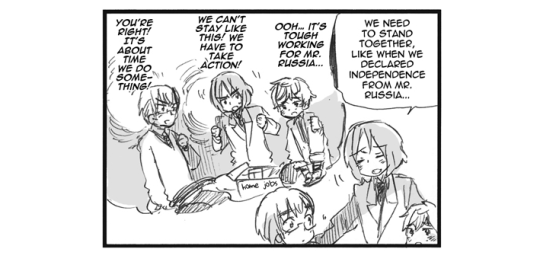
As Estonia gushes about wanting to become a Nordic, Lithuania
urges that they stick together and remain as the Baltic trio, just like they stuck
together when they gained independence from Russia.
Lithuania relives the first memory.Then, he remembers Russia squeezing his shoulders, and, without realizing it, starts squeezing Latvia and Estonia’s shoulders to the point that it causes
them pain.
In my opinion, Lithuania doesn’t just seem to be experiencing
PTSD here. I honestly think he’s learned some of Russia’s violent tendencies,
not consciously, but more as an unconscious psychological consequence of the trauma
he experienced.
Latvia even asks Lithuania if he’s okay, but Lithuania is unresponsive. Just look at Lithuania’s expression; he’s pretty removed from the situation.
It’s these small, brilliant, and dark details that makes
this series enjoyable to read. Hima is so methodical in how he develops and
evolves his characters. In a single strip you see how unfathomably deep Russia
has hurt Lithuania, in more ways than one.
Just like humans, the nations become products of their
environment.
How the nations do friendship:
Constant cycle of “Oh my god!
You look great! We should totally form an alliance,” until one of them gets
pissed off and declares war on the other.




 Ellawritesficssometimes