I can’t speak for everyone, but generally a lot people
assume that political relations define personal relationships, when that hasn’t
been the case in the series [x].
It’s a weird concept to grasp if you’re just coming into the
fandom and haven’t read the manga, so I wouldn’t be so quick to fault them.
I’ve done a post on his inaccurate perception of reality [x].
Mischaracterization post on Russia coming up tonight!
Oh wow! If only they
actually looked into the series too.
Don’t get me wrong
either. I’m not saying that Hetalia didn’t have its fair share of problems,
because it did. The shock perverted humour used in it was blatantly wrong.
If you want a real-life
comparison, it’s very similar to the whole Guardians of the Galaxy and James Gunn
situation. Those tweets were incredibly offensive and cringey, and anyone in
their right mind wouldn’t condone them.
Nonetheless, the
actors in the show were able to recognize that the humour of these ‘jokes’ were
made in poor taste, that they were used for shock value, and that Gunn himself
even owned up and apologized for them prior to the whole scandal. While the
tweets themselves weren’t condoned, they had the common sense to acknowledge
that Gunn wasn’t being serious about these jokes and that they were
unreflective of his true character.
Philip DeFranco on
YouTube did an excellent job of presenting both sides of the story if anyone’s
interested in drawing these comparisons. The only thing that disappoints me is that Himaruya merely deleted the content and didn’t choose to comment on it.
What this post will explore is how America’s character consists
of several binaries. In other words, his personality is predicated on contradictions.
Let’s go over them.
Child vs Adult:
What you’ll notice is that even though America fought for
his independence and vied to be recognized as self-efficient, he’s still
equated to that of a child [x].
He’ll also often swing back and forth between a “I need you/
go away, I don’t need you” complex when interacting with England, who served as
his primary mentor/ parent figure.
Ex: He rejects England’s offer to become his friend in the
strips depicting Japan’s Westernization period [x].
vs
Ex: In a volume 2 character note, England and Japan are
listed as America’s only friends. Remember
that this character note isn’t applicable to modern times; it’s dated.
Ex: America arrives at the African Warfront in WW2 and
ignores England’s advice, only to be overwhelmed and defeated by Germany [x].
vs
Ex: Following his independence, America attempts to force
himself into Canada’s home after learning that England fell ill as a result of
the conflict [x].
While he may be an adult, America doesn’t always have an
accurate grasp of how the world really works.
Ex: He comes up with childish world defense plans that any
competent person (let alone adult) would realize is not realistic (let alone
possible) [x]
vs
Ex: He successfully invests himself in the massive economic growth
experienced in his country during the second industrial revolution [x].
Reading the
Atmosphere vs Choosing not to:
The underlying comic gag is that America’s unable to read
the atmosphere [x].
Yet, in one of his character notes, it’s revealed that he
purposefully chooses not to read the atmosphere [x].
There are times where America will act purposefully
oblivious and there are times where he’s completely aware of what he’s doing.
What confuses people is that the latter occasion often involves him appearing
oblivious to hide his motives.
Ex: Not long after Russia switched sides in WW2, America
runs his mouth and refers to him as a “bad guy.” Note again, how childish this
perception of the world is.
However, when Russia confronts America and threatens him for
this comment, America seems to read the situation and feigns cluelessness to
avoid further conflict. You could also very easily read this as America being petty
the whole time and wanting to take a jab at Russia’s character.
Ex: America receives a one-way ticket to Siberia from Russia for his birthday. He ‘obliviously’ thanks Russia for the gift, not
wanting to give the latter the benefit of a reaction and promises to use it as
a tissue if he gets a cold…and then proceeds to do so [x].
Lastly, there’s the comic gag that America’s sense of
geography is egocentric in nature.
Ex: In one strip, he’s reprimanded for using a map of his
country as a substitute for a world map.
Vs
Ex: He deliberately omits Mexico from a map he constructed
because of his grudge over Alamo [x].
Point
is, he’s not dumb.
Hero vs Achilles Complex:
This one is fairly simple.
Basically, America’s infamous for being the “hero” of the series [x].
He’s strong yet also very
insecure of himself [x].
He’s insecure about his
weight and doesn’t realize that he’s not overweight at all (you’ll notice that the character note contradicts the strips following it). In fact, he’s just
muscular [x].
Ex: In this strip, he’s
shown to be aware of the fact that he wasn’t viewed very favourably by other
nations [x].
Hero vs Me Complex:
This one is a bit tricky.
There’s no doubt that
America cares about his friends and will go out of his way to make them happy
(e.g., gifts, hosting them) [x].
On the other hand, Himaruya
has to work with the global stereotype that historically American foreign
policy has mostly been of self-interest—a great power that has exerted
pressure to get what it wants.
What I really want to
stress is that much of America’s egocentrism isn’t on purpose. Longer
post on that here [x].
It’s also important to
recognize that the nations have two selves: the personal and the political.
They act differently according to their environment, whether it’s a world meeting
or a casual outing. They shouldn’t be confused as the same thing.
Still, there are times
where America will deliberately attempt to intimidate other nations into
complying with him. Like a child, he lives in his own world and isn’t receptive
to other opinions.
Ex: Canada gets fed up with
post-colonial America, berating the latter for being too domineering, bossy,
and selfish [x],
Ex: He claims to want to
work together with other nations. Moments later, he states that opposing
opinions won’t be tolerated.
Ex: He snaps bundled spoons
as an intimidation tactic to prevent other nations from disagreeing with him [x].
In sum, this post shouldn’t
be taken as an excuse to hop on the bandwagon to point out how flawed America
is. It’s quite the opposite. Be mindful that Hetalia’s whole premise is satirical
stereotypes; it doesn’t hurt to have a sense of humour either. His contradictions
and flaws are what make him funny and relatable.
The Hetalia Fandom in a Nutshell
Thank you very much! But…
Taken directly from the beginning of any of my posts that include Freud…
“Note: This theory will make use of Freudian theory. While I recognize that Freud’s ideas do not bear much contemporary relevance, that shouldn’t take away from the fact that many of his concepts (e.g., erogenous zones, childhood memory repression, catharsis) are nonetheless employed by Hima in the series. The purpose of this post is to give some insight into the psychologies of the characters.”
+
Not to mention that Austria is characterized as a stingy perfectionist, which is the exact description of Freud’s anal-retentive personality type. Freud was Austrian, so it makes sense.
A few more points:
– Freud is often misconceptualized as only coming up with the psychosexual stages, when in reality he did a lot of dreamwork and hypnosis studies too. He’s not sex-crazed either. The libido isn’t just about sex; it’s your entire life force.
– Freud’s work may not be scientific and testable, but there’s a reason why his theories are still used today. Many neo-Freudians and feminist neo-Freudians have tweaked his work and have abandoned his male-centric concepts. He was observing a sexist society at the time, so no duh that his concepts are going to be sexist in nature!
– Point is, the core of his ideas is still valued because there is something useful to them. It may not be measurable, but his studies do come from observational data that he collected during his practice. There are problems in perspective; however, Freud is still very much relevant today because of modern Freudians who have adjusted his theories and therapeutic methods.
– His therapy strategies and models are still taught and practiced. Ex: I’m in Criminology, and I learned his whole model. While the Cognitive-Behavioural model is the most popular therapy applied in the criminal justice system, some psychologists still practice aspects of Freudian theory, not to mention that the concepts of transference and counter-transference are widely accepted in the clinical field.
– You’d be surprised by how accurate some of his concepts are even if they can’t be substantiated by ‘empirical data’. His cocaine addiction is often used to discredit him, but that still shouldn’t negate his contributions.
Lastly…
– I don’t only use Freud. I’ve used Karen Horney and Attachment theory too. I believe that like Freud, Attachment theory was actually used in Himaruya’s characterizations. Karen Horney is just a theorist whose lens I use to analyze the characters for fun.
No worries. Thanks for the correction. Here’s the link [x].
“ Netherlands is a tall, muscular guy who’s in super good shape!
After all, he beat up Spain, who was in control of him during Spain’s golden age.
And he likes young women (too young?) and also thinks some shady drugs are okay, so he’s kind of a punk in that way. ”
Several points again:
– The trivia facts translated from that source [x] are separate from the 2007 Christmas event. They’re two different sources even though they both came out in 2007. That’s why there are differences in the information given (e.g., the xenophobic bit). Himaruya’s character notes are often repetitive, and he’s infamous for re-using old material (e.g., redrawing and reprinting old strips).
– The trivia facts were posted to Himaruya’s blog and were not part of the 2007 Christmas event. These posts were deleted from Himaruya’s blog, so there is no primary source for them, just the translation.
– The translator is the founder of Hetarchive [x]. They even mention that they were unfavourable of the deleted character notes but were impartial and translated them anyway. The lolicon bit was edited out in the Hetarchive article probably because it was recognized that even though this was at one point canon, it’s thankfully no longer relevant nor canon. The initial translator’s note mentions this too.
– My old notes also recorded this fact as once being included in Netherland’s initial Hetarchive article. Here’s proof that it was, in fact, included in the profile [x].
As mentioned in previous posts, for the most part, America is characterized as someone who’s young, inexperienced, and naïve.
Like you said, he does genuinely think that he’s helping “the little guys” while the pragmatic outcomes of said policies aren’t as clean-cut [x].
On the other hand, he is aware that he’ll stand to benefit from helping others too.
The point to reiterate is that he doesn’t seem to be conscious of the negative consequences of his actions until after the fact. He’s impulsive (e.g., the Great Depression and African Warfront strips), and a lot of this is reflective of how American foreign policy has historically been like.
As I’ve mentioned before, the rhetoric says one thing—which is what the population and America the personification believes is its aim—and the outcome is reflective of the true motives of those in office.
The basic premise is that America’s character is predicated on opposites. Sometimes the hypocrisy is used for comical effect, and sometimes it’s used to reveal character flaws and underlying complexes.
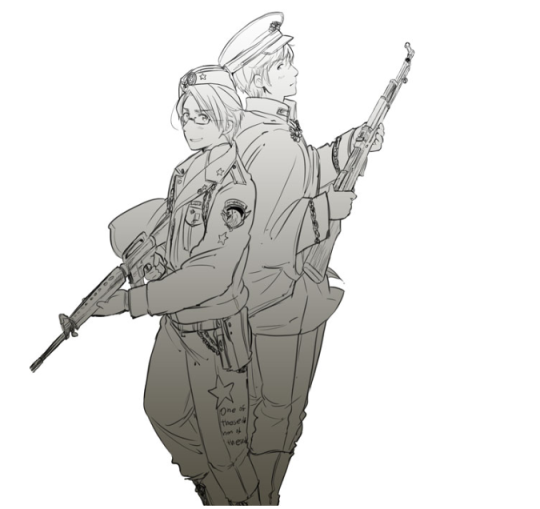


 Ellawritesficssometimes