

What this post intends to do is use Horney’s theory of
personality to analyze why Germany’s strive for perfection and productivity
comes at the cost of compromising his true self and confidence.
Tyranny of the Shoulds:
The tyranny of the shoulds is a term that Horney coined to
explain the occurrence in which someone’s idealized self-image replaces their genuine
self-confidence. What the person strives to be and appears to others acts as
their confidence, whereas they don’t feel confident in who they truly are,
ultimately forcing them to continually put up the former front of
superficiality. An extreme form of this would be the person developing feelings
of shame and disgrace toward their real self.
Put another way, the real self (who you are) is replaced by
how one should be. For example:
“One should always be productive.”
“One should always be punctual.”
“One should never give up.”
“One should be in control of one’s feelings.”
“One should schedule one’s day to maximize utmost
efficiency.”
Sound familiar? It should, because these are the shoulds
Germany is ruled by.
This neurotic compulsion to strive to be someone you’re not
eventually leads to the person internalizing this ideal, albeit unrealistic,
sense of self. The consequence of surrendering your real self compromises the
person’s chances of achieving personal growth and happiness. They’re never
happy with themselves and only focus
on how they present themselves to others.

How does this relate to Germany?
In Germany’s case, he puts up a front of competence, order,
and productivity. He shoulders a lot of pressure to hold up the EU and has
internalized this responsibility to look after other member-states [x].


His work self has become his primary identity…his master
status.
Of course, this doesn’t mean that he’s incapable of unwinding. He’s very favourable of vacations [x].

Nonetheless, there’s no doubt that he’s a workaholic [x].

Ex: Several character notes identity him as bearing an
overly serious and compulsive personality type.
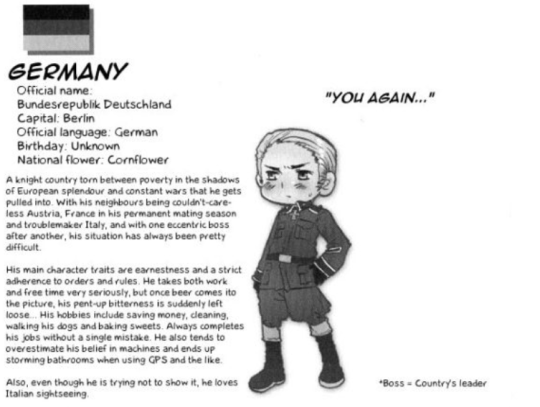
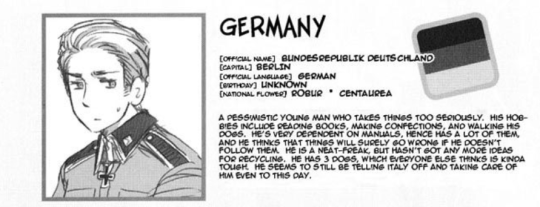

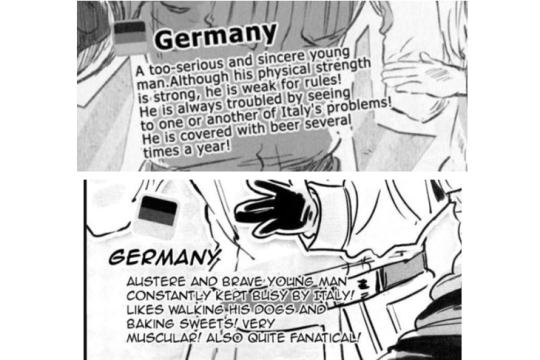
Ex: He has a whole character song dedicated to schedules, punctuality,
and routine. Public appearances are an indication of self-worth to him [x] [x]

Consequences:
Because Germany identifies with his work self, he’s
internalized repressing his emotions to the point that when he does experience
them (e.g., embarrassment, happiness), he becomes incompetent and lacks
confidence in himself.
Ex: He’s not used to being praised for his abilities outside
of work life. In this case, he doesn’t know how to react when Italy commends
him for his drawing skills [x].

Ex: He’s well-known for his inability to smile [x].


Ex: When it comes to interpersonal life, Germany is clueless
and has to rely on manuals (e.g., dating advice, teaching him how to smile). He
doesn’t need manuals for matters like business or economics due to familiarity
and experience, but when it comes to socializing he sheds this cloak of
competence and becomes dysfunctional without them [x].

There are also instances where Germany’s work self overrides
others’ impression of him, even when he attempts to be personal and social.
Ex: His first character note in World Stars [x].

Ex: Italy mistakes him as being angry [x].


In sum, I’d like to end this with a passage from his
character song “Einsamkeit” that best exemplifies how his work self has
compromised who he truly is. He’s essentially alienated himself despite frequently being surrounded by other nations for his work [x].

The side of him that likes romance novels, dogs, and confectionary is completely overlooked.
I’m always said to be scowling,
But my smiling face hasn’t been erased
You may think I’m frightening,
But it’s only because I’m straining to laugh
Strong Eisamkeit (Loneliness)





 Ellawritesficssometimes