Probably Fem Russia.
Can you just imagine how awesome it would have been if Russia was actually a girl in canon? I think Himaruya missed big on the potential for toying at the whole “Mother Russia” endonym.

Probably Fem Russia.
Can you just imagine how awesome it would have been if Russia was actually a girl in canon? I think Himaruya missed big on the potential for toying at the whole “Mother Russia” endonym.

Honestly, I’m only doing this post because it’s the question I’m often asked about. On the other hand, I’d like to point out that the answer to this is googleable!
I try to be patient and understand that not everyone reads the manga, but…Hetarchive has generously made all this information very accessible.
Anyways, guide on the alternate male and female versions of the nations coming up tonight!

Thank you! Although, I have mixed feelings and don’t really
have a firm stance on this matter. Correct names can be found on Hetarchive.
They’ve graciously catalogued everything, and it’s a google search away.
For one thing, Himaruya admits to having a “questionable
naming sense” and encourages fans to name characters however they wish [x]. The
human names actually came from Hima’s deleted yahoo blog, but they haven’t
really been touched on since. Occasionally, he’ll give suggestions for some
countries’ names. Overall, the subject isn’t something definitive. Some people
don’t even consider the human names Himaruya provided to be canon.
Another thing that Hetarchive has helpfully informed readers
of is that the original human names were written in Katakana, which means that
fans have made “suppositions” on the
correct spelling. There’s no real officiality in the spelling of the names [x].
That said, what I’ve seen fans get angry about is, like you
mentioned, how names like “Tolys” are anglicized. Thing is, this isn’t
something that exclusively happens in English.
Names get changed in order to adapt and make things more
understandable for the respective reading or speaking audience. I suppose I’m
just perplexed when people get riled up only
because of the anglicization without realizing how common this practice is
across all languages.
Ex: The German name Ludwig is Louis in French: The French name Jeanne is Joan in English. You see this
with country names too. Germany is Germany in English, Deutschland in German, Doitsu
in Japanese, and Allemagne in French. That’s just how it is.
While I respect and appreciate those who do strive for
cultural accuracy, I also understand your point in why certain names have
become popularized in fanon; they’re easy to recognize and read. Not to mention
the wonky status of the name’s officiality and that Himaruya’s not opposed to
letting people choose their names. Personally, 2/3 of my name has been anglicized.
It doesn’t bother me, but for some people it does, and there’s no avoiding
that.


This guide will go over
the stereotypes that affect how the Germanic nations are able, or rather, unable
to express their feelings. The steely emotionless stereotype of Germans/
German-speaking countries often prevents the respective nations from being
understood properly. It’s not that they’re incapable of experiencing love or
feeling care and affection. It’s quite the contrary. Instead, they just have a
difficult time showing and communicating how they feel [x].

For the purpose of this
post, I’ll only be going over the Germanic nations that are listed in this
strip, as they are what Himaruya characterizes to be of German inheritance and influence.
I recognize that there are many more Germanic countries than this. I’m just
going by what we see portrayed in the manga.
That said, let’s go over
some examples.
The German stereotype of
being emotionally steely and hot-tempered is a complex that Germany is defined
by in the manga.
He’s sweet and
compassionate but is often mistaken to be angry by those around
him [x].

Germany also claims to
have trouble smiling. It’s not something that comes naturally to him [x] [x].


In terms of
relationships, Germany is emotionally withdrawn. This is most seen in Buon
San Valentino [x].
There, the premise of
the arc is that Germany has trouble defining what his relationship with Italy
is.
He first buys a popular
book in Germany titled “Communicating with your partner.” The comic gag
of this is the stereotype that Germans aren’t savvy at reading emotions; they’re
‘emotionless.’ Obviously, this isn’t truly the case.

As Germany reads this
first book, he begins to question whether Italy likes him as a friend or as a
romantic partner.
When Germany gives
details of his relationship with Italy to Austria, Austria is repulsed due to
the romantic overtones = seeing someone every day, kissing and hugging them,
bathing with them etc. The irony is that Austria later realizes that Germany
was talking about Italy, an anomaly of a person who normally does all these
things.


Unfortunately, Germany
doesn’t know this, and he forms the conclusion that Italy has romantic feelings
for him. It’s a “misunderstanding.”
Since he’s still clueless about this aspect of human relations, Germany then buys a book that gives dating advice.


His dismay grows when he remembers that Italy’s a guy [wow!] so of course, his next course of action is to ask Austria if he can practice these newly learned romantic gestures on him.


He later reveals to Austria that he has no previous experience with romantic relationships and that he’s only read romance novels.

The strip culminates in
Germany mistakenly proposing to a very confused Italy.

Despite having never
been married, Prussia is the most sensitive and emotionally-expressive Germanic
nation.
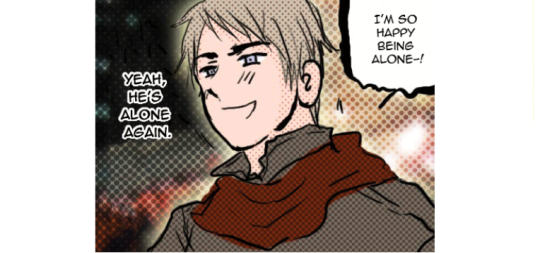
He’s often found crying
and lamenting over the fact that he’s single and “alone.”
Ex: He cries when he
spots Hungary and Austria spending their Christmas together during the 2007 Christmas event [x].


The Germanic stereotype
has more to do with the fact that he’s a poor socializer.
For example, he’s given a
book on “How to Socialize with People.” He sneezes and claims to be bored with
it [x].

In direct contrast to
Prussia, as someone who’s been in several marriages, Austria is arguably just as
clueless as the German brothers.
He may have solved his
problems with marriages…

…but when it comes to
relationship troubles, he’s read his fair share of manuals and guides too.
Austria had copies of both
books that Germany purchased in Buon San Valentino. Had he have known this
beforehand, he would have lent them to him.


He becomes flustered
when Hungary reads the dating book and laughs at how inaccurate it is. It would
be to his own embarrassment should he have admitted that he had been an avid
reader of it.

On the other hand, in his defense, it’s largely hinted that he’s the one who gave Hungary flowers on Valentine’s Day.

Switzerland’s similar to
Germany in that he’s an angry-type that’s soft on the inside and well-intentioned.
He shouts at Japan to
give his own opinion, scaring the latter despite the good intentions of this
action. It’s tough love in that he’s trying to get Japan to stand up for himself.


He cringes and gets
angry for remembering all the fond moments that he had experienced with Austria during
their childhoods. This is sometimes at the expense of ruining the fond moments that
he shares with Lichtenstein [x].


Nonetheless, Switzerland
shooting at Italy in the frilly pajamas that Lichtenstein made for him is
iconic, and you can’t tell me otherwise.

Sweden’s slightly
different in that his minimal facial expressions are intimidating to people.
Finland finds Sweden
scary at first… [x]

…but later warms up to
him and realizes that Sweden smiles and expresses his happiness subtly [x].


In reality, he’s also
quite the softie.
He sews smaller
clothes for Finland [x].

He acts as a father
figure to Sealand [x].

In sum, while the
Germanic nations may come across as hard and steely, they’re easily among some
of the sweetest, most considerate characters in Hetalia.


Yes, but it’s indirect [x].

[You’re so polite omg
bless you]
Yes, both Austria and
Prussia share similar issues, likely because of the steely stereotype that’s often applied to the German people. I think this
is the post you’re talking about [x].
And for sure! I’ll put together a quick guide
on this tonight!


Misconception: He’s
an anxious person without a backbone.
Reality: He’s an
anxious person with an exceptionally strong backbone.
Lithuania used to be a world superpower. While he’s quiet
and introverted – like the other two Baltic countries – the fierce warrior
aspect of his personality hasn’t quite left him.
The most common piece of information that is used to
characterize him is that he “tends to think too much, which gets him depressed
and a stomach ache,” [x].
Ex: In his volume
3 character note, he’s described as a “serious young man with a strong body.”

Ex: In Italy’s
Chest Test series, Italy is surprised at how tough and muscular Lithuania is [x].

Ex: He loves
martial arts [x].

Ex: During the
Battle of Tannenberg, we learn from Finland that Lithuania is a “sharp” person.
In other words, he’s not someone to be underestimated on the
battlefield.
Prussia does exactly this, and it doesn’t turn out very well for
him. He actually hides from Poland and Lithuania after the battle, although he later
becomes a lackey to Poland.


Misconception: He’s
a sweet, pushover type.
Reality: He’s a
sweet, pushover type that has admirable moments of defiance. Lithuania isn’t only
defined by the above [partial] misconception. Even though he’s often bossed around and
later plays servitude to Russia, he’s still able to exercise his own agency.
Ex: The common
mistake is to only conceive him as someone who is introverted and good-natured.
He’s also a big brother type [x].
Ex: In addition,
he’s also noted to be bossed around frequently in Volume 5 – keep in mind that this
strip occurs during the Soviet Era.

Nonetheless, Lithuania’s seriousness and “strong perseverance”
is something that has consistently prevailed in him, no matter how dire the
circumstance.
Ex: Despite being pressured, Lithuania refused to convert to
Catholicism and holds defiance toward Prussia over this [x].

Ex: In strips that presumably take place during the Soviet Era
– as the setting is in Russia’s house – Lithuania’s old defiance for Prussia is
still alive and well. He gives him a “cold stare” and asks Prussia to leave him
alone [x].

Despite admitting to not liking him, Lithuania’s still civil
toward Prussia and gives him advice on living in Russia’s house [x].

Ex: It was
Lithuania who rallied the other Baltics to declare their independence from the USSR [x].

Misconception: He and Poland don’t have good relations
anymore.
Reality: He has some issues with Poland, stemming from their
past, but for the most part the two of them still share a good relationship in
the present.

Ex: Lithuania pulled a lot of the weight during their
union.

Ex: The fact that Poland laughed in his face as Russia
dragged him away during their forced separation didn’t sit well with Lithuania.
He holds clear bitter feelings about it [x].


Ex: On the other hand, Lithuania still cares about Poland
and tries to warn the latter of Russia’s intentions to partition him once again
in WW2.

Ex: While Lithuania is “dragged” around by Poland, he’s stated to still “enjoy himself” as this happens. My understanding
of this is that even though Lithuania does a lot of things for Poland, he doesn’t
mind the company [x].

On a similar note, in the World Academy AU, Lithuania is too
busy to attend the Choral Club’s meetings because he’s doing favors for Poland [x].
While he may be a pushover, I don’t think Lithuania would be doing this if he
didn’t care about Poland.


Misconception: He hates Russia.
Reality: He doesn’t have great relations with Russia, but he’s
civil.
Obviously, they’re not ‘friends-friends’ due to their past
together; however, it’s not pure hatred either.
Ex: He received many
scars during his time spent under Russian control.

Ex: He’s noted to be rehabilitating with Poland in the
post-Soviet era.

Ex: It’s alluded that Lithuania may suffer from PTSD. As he
recalls declaring his independence, he also remembers that Russia used to
squeeze his shoulders – a metaphor for political pressure. Without realizing it,
he begins squeezing Estonia’s and Latvia’s shoulders. It’s hard enough to cause
them pain [x].

Ex: Upon gaining independence, he was eager to get rid of
any belongings that were associated with Russia [x].

Ex: When asked if he considered Russia a friend, Lithuania
doesn’t “want anything in particular” and yet realizes that it’s probably
better to placate Russia. Of course, this is to be expected. The transition
toward a healthier relationship with Russia will take a long time for the ex-Soviet
countries to achieve. There’s also the fact that Russia’s sanity is unpredictable.

On the other hand, they still attend events together, so it’s
not as if the possibility of friendship – or at least acquaintanceship – isn’t
something on the horizon [x].

Bonus Facts:
Following WW1, Lithuania lived with America. This is done to
represent the Lithuanians who out-sourced themselves during this time.
Lithuania is later taken back by Russia once the Great
Depression hits [x].

America’s pets were very fond of Lithuania.

He has a crush on Belarus. On their first date, which predictably
didn’t last all that long (three minutes!), Belarus breaks his fingers [x].

In sum, as sweet, meek, and good-natured as Lithuania is, he’s definitely not someone to be underestimated. He’s an amazing, well-fleshed out character that is far more than the nervous wreck he’s commonly portrayed as.


There are too many of them!
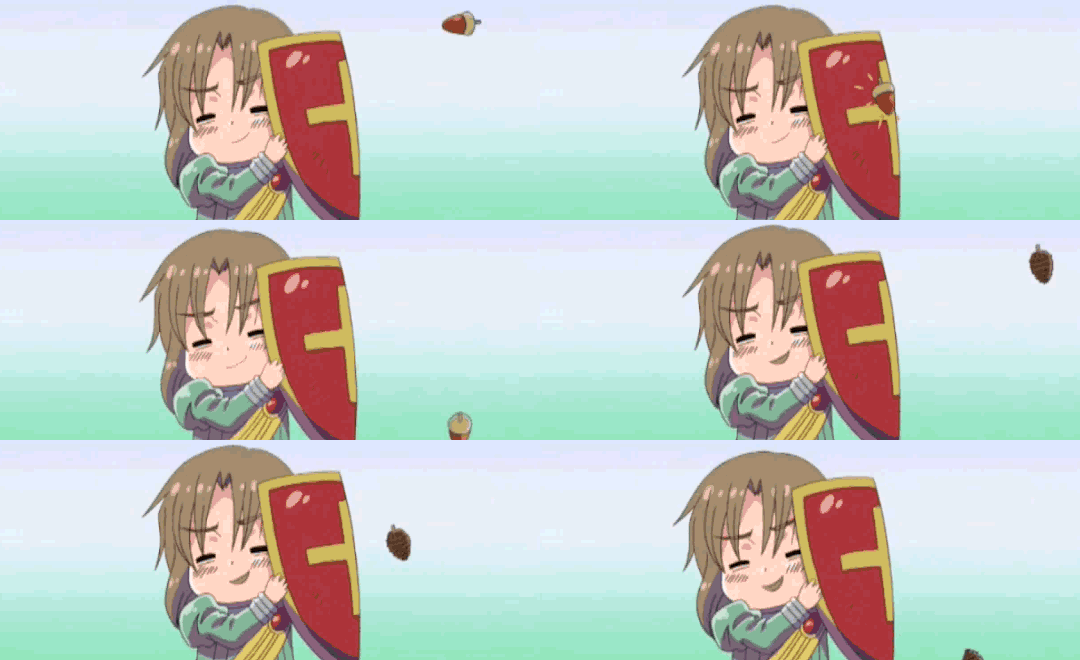
But, Lithuania’s dub actor’s “I’ve gotta a shield muthafucka” is definitely in my top five [x].
 Ellawritesficssometimes