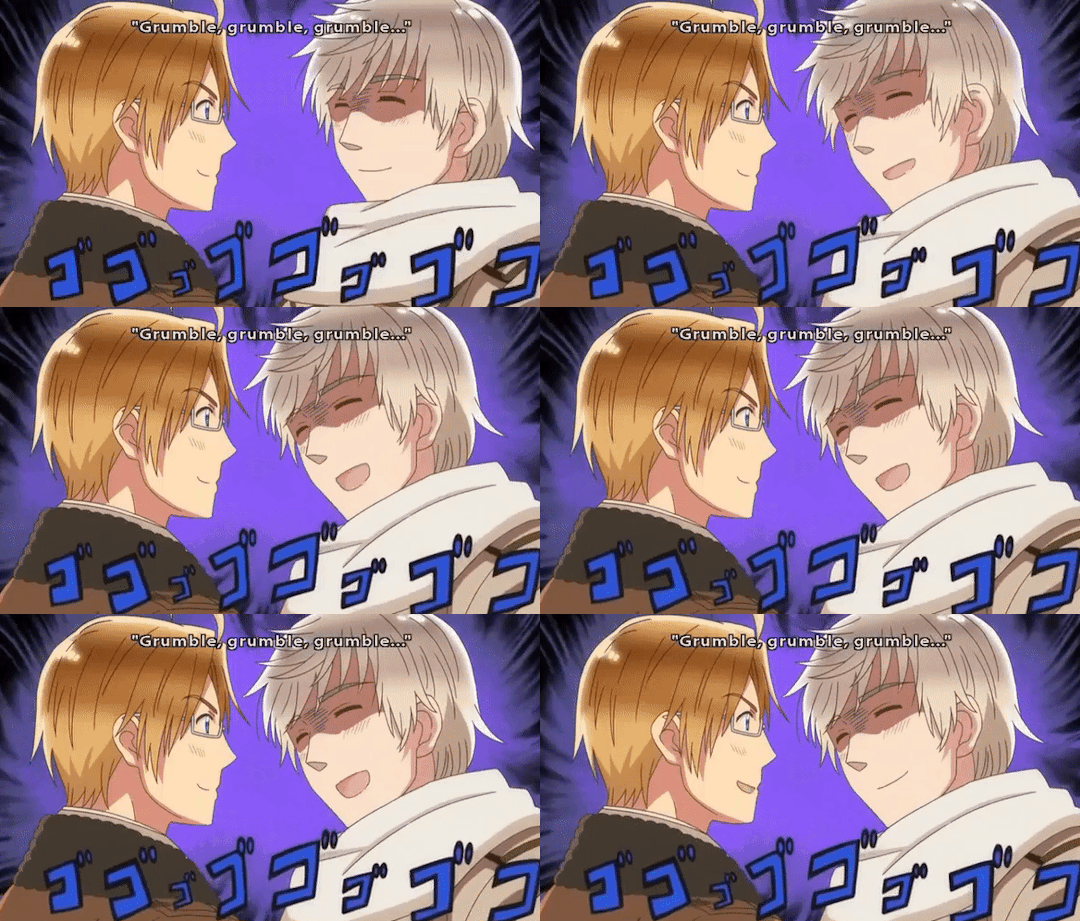
“Wow! You can see into the future?!”
Japan: Yes. What
would you like me to predict?
“Tell us who you’re going to be best friends with!”

Japan: Hmmm…

Japan: …

“What’d you see?”
Japan:

“Wow! You can see into the future?!”
Japan: Yes. What
would you like me to predict?
“Tell us who you’re going to be best friends with!”
Japan: Hmmm…
Japan: …
“What’d you see?”
Japan:
Yes and no.
As mentioned, the colony system in the manga doesn’t have the colonizing nation live with their colony 100% of the time. Instead, the colonizer visits the colony in the latter’s home.
Ex: England visits America at his home. Long gaps of time pass between each visit.

Ex: In his character song “Absolutely Invincible British Gentleman”, England mentions that he has holiday homes – presumably in India and Hong Kong given the lyrics.
“Curry, Chinese cuisine, my holiday houses’ meals.” [x].
What you’ll see is that the word “home” is also used generically to refer to a piece of land/ territory/ settlement. It’s just like how nations will refer to their entire country as their house.
(e.g., “My house [country] has the best food!”)
Another example would be Finland and Sweden’s colonization of America. They make a settlement [home] in America, only to have it taken from them by Holland. In this case, the strip is making a reference to New Sweden, otherwise known as Delaware [x].


In an earlier post, I talked about the fact that whether or
not Romania has magical abilities is left unclear due to contradictory pieces
of information.
Ex: He’s part of the Magic Club in the World Academy AU.

Ex: A later character note in chapter 163 of World Stars
leaves his capacity for magic – not to be confused with fortune-telling –
open-ended [x].

Recently, however, chapter 354 of World Stars confirms his
ability to perform magic [x].


I finally think that I’ve made some sense out of this! The theory is way out there, bordering on science-fiction, but I really do think that I have something here!
Let’s just say that it has to do with the bending of space and time 😉
Post coming up tonight!

Q: Is there any other information that talks about the nations
as being super humans?
A:
Summary: I asserted that a nation’s super strength is a play on the
fact that they’ve obtained the status of being an economic and political
superpower. As such, if the nation loses superpower status, they therefore also
lose the additional strength they gained.
Back to the question: Yes! One of Poland’s character profiles talks about how he
used to be a super nation before losing this status [x].

“Was a super nation that controlled Middle and Eastern Europe with his partner Lithuania during the Middle Ages. Due to the decadence and corruption of the royalty, he lost his status as a super nation and was often split apart (partitioned), and yet keeps reviving himself as though he were a phoenix.”
Q: Yesss fall of the Berlin Wall strip please @hima. How do you
think it would go with your historical and hetalia knowledge? Do you believe
Prussia was kept away from Germany and it would be them reuniting?
A: Based on what we’ve seen in the manga, I don’t think they’d be
kept apart. Instead, I believe that they’d get brief catch-ups here and there
before they actually united and moved into the same house again. It’s not really so much like how it played out historically, where families where kept apart for decades.
The reason I say this is because when a nation is
ruled over/ conquered/ becomes a subordinate to another nation, the ruling
nation takes over their political affairs and attends world meetings for them.
The subordinate nation can still attend these meetings, but only as servants.
They don’t get to speak on their own behalf.
Ex: We’ve seen the Baltic States act as
servants when Russia forms an alliance with Germany during WW2 [x]. They still attend the meeting.

Ex: Prussia is shown on multiple occasions to be working among other Soviet States and is also noted to have worked unprofitable jobs for Russia
post WW2 [x] [x].

Ex: When the two brothers do unite, Germany is
evidently disturbed by how shabby Prussia’s appearance is [x]. Some time had likely passed since they had last seen each other here.


It’s not that they wouldn’t see each other at
all, just likely not often.
Q: Can we appreciate how Hungary’s annoyed/scary face is the
same as Germany’s? I always saw them as a kind of mother son figures, distant
ones but still mother son.
A: I can see it, but Hungary’s angry face more closely resembles
England’s. It’s the demon eyes!


You’re not wrong on that last part. Hungary’s
described as a big sister-figure.
“Opposite of her appearance, she is a gallant girl who used to be a nomad. She’s a lovely older sister-type whom you can rely on if you call for her.”
“In the old days, a real tomboy who chased horses on the plains! Today, a lovely big sister, however, get her angry and she’s awwwfully scary!”
She also appears to be close with Germany, as
she refers to him as “sweetie.”

Q: [On the topic of
how all APH characters are interesting and likable].
I agree! Every time I think I have a few top
favourites, I end up thinking of all the characters. For a fact, the Nordics
are my favourite (even though there are a few missing) because I live in that
area, and can connect more with them. Plus there are the Soviet trio who are my
top, as well, cuz of my Slavic culture. Oh, but then there are the Romantics…
and it keeps going until I’ve listed everyone xD. I wish Hima made more for the
African and Islamic countries, my friends are from there.
A: I’m glad to see that others feel
this way 😀 From what I’ve understood, and while he does make historical
errors, Himaruya does a ton of reading, studying, and even traveling before he
depicts a country. For example, he gives several history book recommendations.
I think that has a large part to do with why some nations haven’t been created
yet.
Q: What is the historical reasoning for
Hungary’s characterization as gender confused when she was a kid? Did it
represent some aspect of her history or culture or was it just something hima
thought would give depth to her character?
A: Not 100% sure, but I’m leaning more towards
depth. Hima even acknowledges that female characters are rare in Hetalia [x],
although I’m not quite sure why that is. Part of it might have to do with the
fact that he’s admitted to having trouble drawing girls [x].
Q: just a by the by: the reason why china’s provinces have
their own personifications may stem from the fact that most provinces have
their own local dialect that’s unique to their place only, as well as very
distinctive local cultures (they all identify as Chinese, but also with their
own province). Someone from Beijing would be completely different from someone
who’s from Hunan who would be different from someone in Guangdong. It’s
different from the states in the US in that way.
A: Thanks for sharing this useful information!
The War of 1812 – a full
depiction, not what we got in World Stars.
India’s independence from England and the proceeding anti-colonialism movement.
Greece, as the origin of democracy, reacting to Papadopoulos’ military dictatorship.
Hungary removing her border fence with Austria + the Fall of
the Berlin Wall.

What this post will explore is
how other nations – to lesser degrees – are able to possess greater physical
strength than the average human. While it’s not necessarily the extreme strength
that we see with America and Russia, the
additional strength gained by nations at different points in history is still
very much present.

As stated by Finland, America and
Russia are super humans, whereas the rest of the other nations aren’t so
different from regular humans in terms of their physiology – aside from the obvious facts
that they’re immortal, don’t age and heal faster. After all, they are referred
to as “strange” and “odd” beings [x]. Some things about them are abnormal.


How I’ve interpreted the panel with
Finland before is that the superhuman
phrase is a reference and pun for the Cold War, where America and Russia emerged
as economic and political superpowers.
They were the two most powerful nations during this period.

The rules for this are laid out
in the strip titled “In just two minutes you can grasp the exterior of the European
economy.”
There, it states that when a
nation experiences political strife/ economic recessions, their health worsens
and they develop a cold. It would follow, then, that if a nation’s politics are
stable and their economy is performing abundantly well, they become stronger –
literally.
“In this manga, a nation having a cold = something like a recession. By the way, when they’re physically unwell, the nation’s politics or economy is having problems.” [x]
That’s why young America
initially gained his super strength. His economy was doing exceptionally well [x].


As such, this
would also explain why during times where America’s economy is strained and his
political affairs at home aren’t stable, he loses some of this strength and
appears to be weak. (Longer post on that here [x]).
Ex: The Great Depression – one of
the largest economic recessions to date.


Likewise, as a result of the Soviet
Union gaining steam [and territory], Russia had already acquired super strength
during WW2.
Ex: Russia was able to stop a
tank with his body.

The reason that America and
Russia’s strength is so extreme is that their power was globalized.
Meanwhile,
consistent with the rule above, other nations who gained economic and political
power also got physically stronger, albeit not nearly as strong as Russia or
America given that their influence wasn’t as reaching (e.g., European
superpowers instead of global superpowers).
I should also mention that the English empire was indeed a global superpower; on the other hand, the political sphere hadn’t yet been globalized during their prime (e.g., the UN and global international relations).
That said, let’s go over some of
these examples.
A referenced European superpower
that became weakened during the War of Austrian Succession [x].
Pay attention to the specific
wording as France loots from the defeated Austria.


When Hungary acts as Austria’s
reinforcement during the War of Austrian Succession, she’s referred to as “freakishly
strong back then” [x]. The back then is especially important, as it proves that the
country’s strength and position reflects itself in the personification’s
physical strength.


France became strong as a result
of the Napoleonic Conquests [x].
Again, notice how exhausted the enemy
nations are after they finally defeat him [x].


It’s also hinted that super
strength, even when the nation isn’t particularly powerful, can be tapped into
by the personification.
After the American Revolution,
England falls ill. America visits Canada’s house, begging to see England. When
Canada refuses him entry, America attempts to force his way in. In the end,
Canada is able to shut the door on America [x] [x].


It would seem that during moments
of adversity/ stress, an adrenaline instinct kicks in, thereby allowing the
personification to temporarily tap into this super strength. Put another way,
all nations are capable of acquiring super strength if their country is
powerful enough; however, in astringent circumstances, the personification can attain
it nonetheless.
In sum, super strength, albeit in
differing degrees, isn’t something exclusive to America and Russia. As shown in
the strips, other nations have become stronger in reciprocation to their
country’s strength and power.

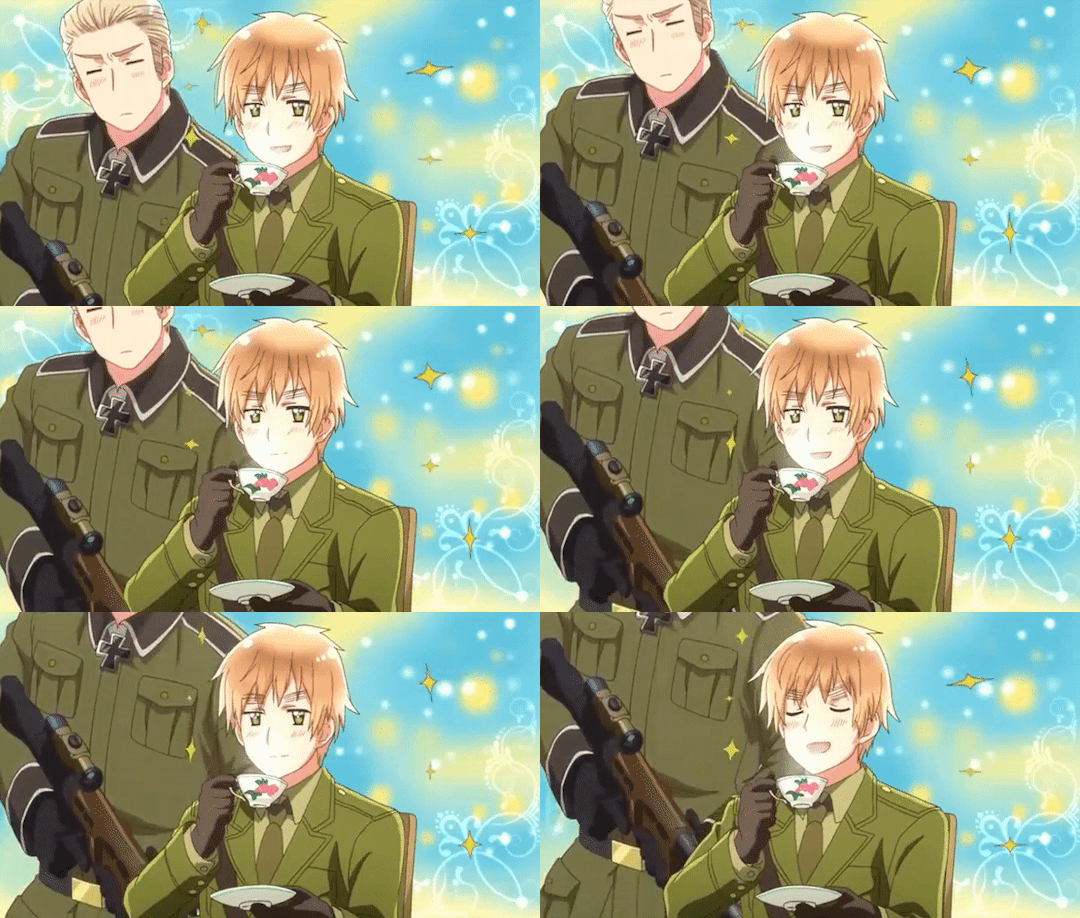
England [to America]: Relax, you yank. Germany’s not anywhere near here.
Germany:
You’ve been hit by
You’ve been struck by
My smooth arsenal
No. What happens is that America chooses China to attack the
axis so that he can assess China’s feats. How I interpret this is that America
is covertly analyzing China’s strength and possibly feels threatened by him.


Oh, I love the humour! There’s several fourth wall breaks
and anachronisms, but my favourite has to be the fact that Himaruya literally
titled a strip “Fuck you.” [x].

 Ellawritesficssometimes