Germany: It’s finally time to come to terms with my sexuality.
Also Germany:

Germany: It’s finally time to come to terms with my sexuality.
Also Germany:
I’m currently working on a mega post that compares literally every example of the parallels between them (e.g., dialogue, expressions, replicated scenes).
For now, this is what I find to be the most interesting.
We know that pets in canon live longer if they’re around a nation, as the latter’s immortality rubs off on them, right? [x]
Well, doesn’t Holy Rome’s dog look a lot like Berlitz?


VS


I don’t recall Wy being involved. I think this is the strip
you’re talking about [x].
Australia did ‘research’ on Japanese people. This entails
watching a clip from Naruto – a joke, obviously.



Note: This is a
guide. It’s not meant to cover an exhaustive list of all relevant examples in the manga. If I did that, this post could
easily be a novel.
Before I get into the direct blood relations of the
characters, this guide aims to chart out and differentiate between the different
types of relationships that we see in the manga.
Biological siblings, obviously, means that the nations in question
are blood-related.
Ex: America and Canada.

Ex: Greece and Egypt and their moms, Ancient Greece and
Ancient Egypt.


The best example of a biological relation is that of Norway and
Iceland’s.
Iceland had no native people. Since it was Norwegians alone
who first settled on the island, the two are directly related [x].
Iceland innately senses Norway when he’s first born.
Norway
also senses Iceland.


Likewise, DNA testing – in this case, a land excavation – is
done to confirm their biological relation.


Now, let’s do a comparison.
When America’s born, he doesn’t sense a biological brother
among the countries colonizing him. The reason for this is that he’s referred
to as an ingredient, meaning that not only were there native tribes living on
the land he represented but that America existed as a mix of several European
cultures [x].
The point to differentiate here is that America doesn’t have
a direct biological relation to these colonizing countries due to the large
volume of them.
Instead, what you’ll see is that the colonizing countries
fight over assuming the role/ title of being America’s big brother, or
onii-chan.


Continuing from America’s example, after he chooses England
over France, he asks England if he can refer to him as onii-chan – ‘Big Brother.’
As stated in the translator’s note, onii-chan can be used as
an expression of adoration and endearment. Put another way, ‘big brother’ here
has an entirely different cultural connotation. It’s a brother-figure relationship
and isn’t meant to be taken literally.


Not to mention the fact that England initially rejects the
label of onii-chan, claiming that “just ‘England’ is fine.’” The reason England
is hesitant to accept the label stems from the horrible relationship he has
with his own older brothers.


France is another example where the term Big Brother is used affectionately.
Ex: He claims to be the Big Brother of the world.

Ex: He’s described as a Big Brother-type.

Ex: The first thing that he does when he meets Lisa, Jeanne
d’Arc’s reincarnate, is introduce himself as Big Brother.

Ex: The reason that Italy refers to France as Big Brother is simply because they grew up in Rome’s house together for some time.


This title of endearment is confirmed in one of Hima’s blog
posts, where he clarifies that Italy and Monaco both call – as in refer – to France as Big Brother [x].
More examples of France’s use of the title ‘Big Brother’ can
be found here [x].
One last example of this is that of Netherlands, Belgium,
and Luxembourg.
Netherlands and Belgium are biological siblings. Meanwhile,
Luxembourg refers to Netherlands, France, Spain, and Belgium as Big Brother and Big Sister respectively [x].
While the translation is noted to be rough, the distinction
is nonetheless made very clear.

A full post on this can be found here [x].
All that needs to be known is that when two nations
willingly unite – not to be confused with being conquered/ annexed – the personifications
involved are considered to be married.
Austria is notorious for this, being noted to have solved
all his problems in the past through marriage (e.g., the Austro-Swiss
partnership, The Hapsburg Monarchy, the Austro-Hungarian Empire).

In the manga, sharing similar ancestors doesn’t make the
nations involved biologically related. In this case, I’m talking about cultural
influence.
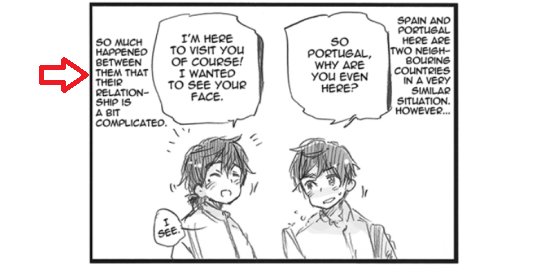
Ex: Spain and Portugal. (Chapters 77-79 of World Stars).
Both are noted to share a similar ancestry. As such,
Seychelles can’t tell which one is Portugal when she has a letter to deliver to
him.


Given the context in which the topic of their physical resemblance and relationship is discussed, if they were siblings, France would have attributed the reason for their likeness to this. He doesn’t.
Not once is a relation ever confirmed except for the fact that they’re neighbors.
Point is, it’s the similar ancestry that causes them to look alike.
+

+

Ex: Romania and the Italy Brothers [x].
While Romania may have inherited much of Rome’s culture, he’s
not related to the Italy brothers.


This brings me to my next point.
While cultural influence often affects the physical
and personality traits of nations, it doesn’t make them biologically related.
Ex: Seychelles was originally designed to have one thick
eyebrow and one thin one to represent French and English influence.

Ex: As an amalgamation of several cultures, America
resembles bits of Finland, France, and England.

Ex: France’s influence prevents America, Canada, and
Seychelles from inheriting England’s bushy eyebrows [x].

Ex: Young Canada inherits France’s hair due to his
influence. This is before England had assumed control over him.

When a country is conquered and their conqueror is on the
same continent, the conquered personification lives with the conquering personification.
Ex: France, Holy Rome, and Chibitalia living in Rome’s house (panel used above).
Ex: Chibitalia and Hungary living in Holy Rome’s house. Despite the rough start, they become so close that they refer to each other as family.


Ex: Romano, Netherlands, and Belgium living in Spain’s house.
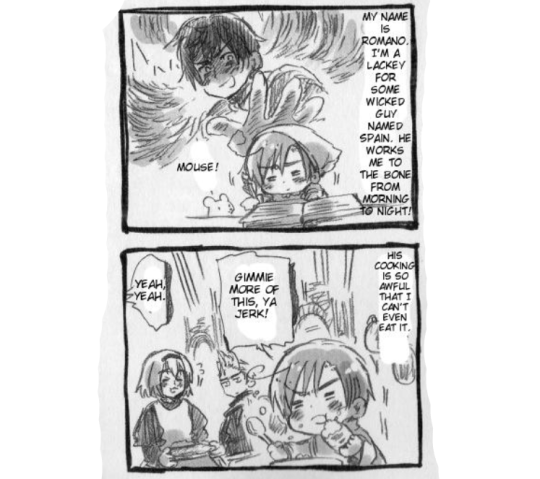
In modern times, we still see this occur, albeit it’s a bit
different.
The Chinese provinces +
Macau and Hong Kong (under a one country two systems principle) all
live in China’s household.


*Note – I made up the labels of house and household system
to better clarify and more easily distinguish between the two different living circumstances.
In canon, ‘House’ and ‘Household’ are terms used loosely and interchangeably in the translations.
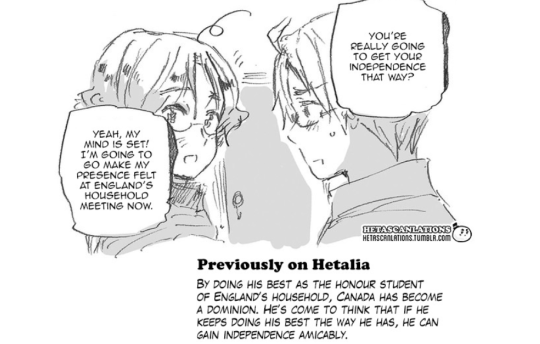
The household system is separate from the house system in
that because the colonies are on separate continents, they’re part of a
household. In other words, they’re together and considered to be a unit despite
not living with the ruling nation.
Ex: England visits America, but America doesn’t live with
him in England.

Ex: England hosts a household meeting, requiring the colonies to travel [x]. (America is already independent here, by the way. He’s not part of the household.)
Ex: Likewise, England has holiday houses in Hong Kong and
India, as alluded to in one of his character songs [x].
“
Curry, Chinese cuisine, my holiday houses’ meals.”
Ex: Hong Kong, who used to live with China and referred to him
in a more intimate way [x], changed after he became an English colony.
When he becomes Chinese territory again, he refers to China
as teacher/ Mr., seeing him more as a mentor.


What I want to stress here is how fluid interpersonal relationships
between nations are in Hetalia. They’ve lived for centuries; how they view and
interact with each other changes with time. Their relationships – aside from
biological relations – aren’t as static as human patterns of organization.

*on the phone*
America: Happy Father’s Day!
England: Wow, I’m impressed! This was really thoughtful of
you.
America: Dang, wrong number…I meant to call France.
England: *calls France*

The comic gag is that it’s attributed to French and English influence.


Sure! Before I get into a post strictly focusing on relations, I think it’s necessary to go over the types of relationships that we see in the series.
Guide coming up tonight!


I couldn’t disagree more.
These are just a few examples. Of course, I’ll
go into them in more detail later.
Magyar raised her just to be like him, which is why she uses
a more male language.

She has a complex over settling down, having previously
represented an equestrian hunting tribe, and has fears about her fighting
skills getting rusty [x]

Despite this, she’s described as “probably the manliest
person in the comic.”


She kicks ass.

Belgium’s ‘plainness’, as in she doesn’t stand out much in
comparison to surrounding countries, is what makes her more complex.
Any insecurity, weakness, or flaw adds depth to a character’s
personality.

As one of the most neurotic and incomprehensible APH character
to unpack, she’s the antithesis of plain.
She breaks Lithuania’s fingers during a date [x]. It lasted three minutes.

Her obsession with Russia became so strong that she forgot
her own language.

This lady packs a strong punch in the world of business and gambling [x].


It was also just recently revealed that she fears losing her
nationhood. Remember that personifications represent their citizens and only exist
because of them.
As such, since most people in Monaco’s country are tourists
(transients) she doesn’t have many citizens to call her own. It’s the tourists
who create the need for her existence.


The threat she faces is that if criminal
activity keeps increasing in her country, tourism rates will decline.

All in all, to say that the female nations are plain is
unwarranted. Even though some of them could definitely use more fleshing out,
they still have distinct personalities, quirks, insecurities, and weaknesses.
I think it’s important to recognize that it’s the quality of
their characters that matters most here; not the quantity of what we see.

Person: *insults me*
Me: Alrighty then.

Person: *insults my friend*
Me:

Totally! That’s what I love about Hetalia.
The personifications can temporarily hate each other on a
personal level and yet be aligned due to politics.
Or, they can be political enemies and still view each other with
positive regard on a personal level.
Or, they can dislike each other on both a political and
personal level and yet still be allies.
Just to give an example of what you mentioned, we see this
with Austria, Russia, and France during the Seven Years’ War.


+

+


 Ellawritesficssometimes