Prussia: Why do you keep telling people I’m dead?
Germany: If you’re dead, then you don’t have to pay taxes and we save money.
Prussia:

Prussia: Why do you keep telling people I’m dead?
Germany: If you’re dead, then you don’t have to pay taxes and we save money.
Prussia:
[On the topic of
Romano referring to Veneziano as stupid/ idiot little brother]
While that may be the
case for most siblings, Romano doesn’t use insults to show his affection. I
know it’s nice to imagine Romano and Veneziano to be like that, but from what
we’ve seen in the manga, they just don’t have that type of relationship dynamic.
You work from what’s
seen in the strips, not what you interpret a character to be like – especially if
canon has already proven the contrary.
If anything, Romano uses actions, regardless
of the insults that fly out of his mouth, to show his affection.
Ex: He’s still calling
Spain an asshole or bastard as he sends imports to help with the Spanish
economic recession.

On the other hand,
with Veneziano, Romano doesn’t ever use insults to refer to the latter in an
affectionate way. They don’t have a good face-to-face relationship, and there’s
a ton of hostility and resentment on Romano’s side of things. In this case,
Romano’s insults do in fact have to do with inferiority.
The suddenness of
their unification is noted to have caused a tension between them.

Romano is also noted
to detest North Italy “a bit.”

As such, he has a much
better relationship with Spain than he does with Veneziano.

Romano’s inferiority
complex is most seen when he uses insults to undermine Veneziano’s accomplishments.
Ex: Veneziano’s
engineering feats during the Industrial Revolution.


It’s like this in
present strips too. The complex hasn’t gone away.
In the Annoy Romano
series, one of the prompts is to be surrounded by Veneziano, his mochi, and his
nekotalia counterpart.

Similarly, Romano
hates to be referred to as Italy’s older brother, as it lacks individual
differentiation.

Again, his insults toward
Veneziano don’t possess any affection to them. Romano refuses to work with Veneziano.

To put things more into perspective, Romano’s hostility of Veneziano is bad enough for Rome to visit him in his dreams, chiding him for this.

Of course, this doesn’t
mean that Romano doesn’t care about Veneziano either. He’s just not direct with
it.
Ex: He looks after Veneziano during WW2, regardless if he degrades him while doing it.

Like I said, they lack a solid face-to-face relationship.

Q: If
the UN has a personification does that mean the EU also has a personification
or is it not significant enough to have one? Another question is that why do
you think certain countries haven’t been given a personification in the hetalia
series, countries like aph Indonesia and Hawaii, is there a reason for this or
is it just a creative choice by the creator?
A: The EU does not have a personification.
There’s no real reason for this. It doesn’t have anything to do with
significance.
As for creating other characters, Hima typically cites that he
wants to travel to the country in question before he personifies them.
Q: How
much does France like anime?
A: A
significant amount considering that it’s so popular among his people.
Characteristics of the population are often reflected in the personification’s
attitude, behaviour, habits, and overall personality.
Ex: He’s
involved in a debate over anime voice actors with Japan, Taiwan, Vietnam, and Thailand.


Q: Any
theory of why France has some perverted tendencies? I know that he just likes
to show affection to others, but sometimes it goes too far.
Q: Why does France strip people, like that’s a pretty recurring
theme from the napoleon strips he was shown to have the thing stripping people from their clothes
and during the Christmas event of 2007 he stripped a bunch of nations naked.
A: It
did go too far. The old characterization of France is pretty awful. However,
the sexualized humour of it is not what people think. It’s honestly just bizarre,
but it does have a logic to it.
France’s stripping of people doesn’t have to do with a French
stereotype of sexuality from my understanding. It’s a historical representation
of how France picked and reaped at leftover territories after European conflicts…
a scavenger if you will. A good idiom in relation to this would be stripping something to the bone.
Just like France stripped Austria for winnings after the War of
Austrian Succession, this was likewise translated into how he interacted with
other nations – by stripping them. [x]


Hopefully, this makes sense, yes?
Q: Do
you think that England has some “big brother” trauma?
A: 100% he does.
Ex: England tears up when he’s faced with the prospect of
becoming America’s guardian. At first, he actually hesitated in accepting the ‘big
brother’ label because of how poorly he was treated by his own older brothers. [x]

The bad memories of his older brothers’ treatment of him that England doesn’t even accept the label of ‘big brother’ at first when he assumes responsibility for America.


Also…

Q: Are
the nations’ homes and/or things provided by the state or they work and earn
money themselves to pay for their own stuff?
A: It’s not clear whether the state provides anything for them.
All we know is that the nations work for their bosses and that the wealth of
the country is reflected in how much money the nation has (e.g., GDP).
Ex: France’s wallet is empty as a result of his economy’s poor performance. [x]

The personification is a physiological embodiment of their nation. Each city/ landmark is reflected in one part of their body.
That’s why, when France ‘rubs’ Italy’s chest during an economic recession, he’s looking for territory to leech money off.

Do you see what I mean by bizarre logic?

Yikes! This is still something that I haven’t quite understood, but I’ll do my best to piece together what we do know! While I have touched on what Germany possibly remembers, with a topic like this, it’s necessary to tie it back again.
Post coming up tonight!

Q: What I really want to know is why people ship Canada and
Netherlands,,, I’m not judging it, it looks quite cute but I don’t??
Understand???? Could you help out?
A: It’s a historically-based ship. During WW2, the Dutch Royal Family fled to Canada. When Princess Margriet was born, they declared the maternity to be Dutch territory so that she would retain her Dutch citizenship. Every year as thanks, the Dutch government sends close to a million tulips, and in return, Ottawa hosts a tulip festival every year. I’ll make sure to take some pictures since I live there.
Q: Hey, sorry to bother you, but do you have any information on
Ireland, Scotland, or Wales? I know they’re not official characters yet, but is
there anything on them?
A: You’re not bothering me! However, I’m not an information blog. If you’d like access to information, there’s an English translation of Hima’s blog, Bamboo Thicket. It’s an excellent resource if you’re looking for facts about specific characters.
Scotland and Ireland are undesigned characters but do have some character notes [x]
England is the son of four siblings, which includes North Ireland, Scotland, and Wales. He also doubles as the UK in representing them [x]
Q: For characters like Iceland, Latvia, Lichtenstein, Estonia
, micronations and other young/ teen characters ;do you think they live by
themselves or with a physically older nation and would they go to school or no?
A: The only school that all nations attend is the World Academy. It’s like a mini AU within the series. [x] Nations only live with each other if they lack independence.
Q: England is my least favourite Hetalia character. Enlighten
me and change my opinion, I don’t want to be the only tea-hating heathen in the
fandom!
A: I’ve done a lot of posts about this 😉 [x] [x] [x] [x]
You’re not a heathen, by the way. Everyone’s entitled to their opinion.
Q: It looks like Romano is getting over his inferiority complex
in recent years, in Liechtenstein strip he certainly is confident even when
Veneziano points out their grandpa’s inheritance to both of them.
A: I’m not so sure about that. Romano still consistently refers to Veneziano in a demeaning manner. He needs to stop calling Veneziano “stupid/ idiot little brother” if he’s to truly get over his inferiority complex.


What this post will explore is the impact of England’s
parenting style on America. There is no good and bad here. All I aim to do is
give reason and meaning to the problematic behaviour and relationships that are
depicted in the series. The characterization is done for a specific purpose;
what I seek to do is bring several parallels to light to prove this.
One of psychologist Karen Horney’s theories explored how
problematic parent-child relationships often result in the child developing
neuroses (mental health complications), such as anxiety or depression.
However, rather than assert all the blame on the parent, she
went on to explain how parents who have been reared in an environment void of
love, care, and affection are typically incapable of raising their kids in any other
manner.
Put another way, parents pass on their neuroses to their
children. You can’t expect someone to consistently provide the care, warmth, and love that
they’ve never experienced and learned themselves. On the other end of the
spectrum, these problematic parent-child-relationships and parenting techniques
are learned and repeated through generation-to-generation. It’s a cyclical
process, that, unless consciously recognized, results in all sorts of emotional
trauma.
Of course, this doesn’t mean that the parents can’t provide this warmth or affection.

What Horney believed to be the Basic Evil of these problematic parenting styles is Parental Indifference, which can also
include a hostile or rejecting attitude of the parents toward the child. This
parental indifference can cause the child to develop feelings of Basic Anxiety or Basic Hostility – both of which, if not attended to, can lead to mental
health issues.
For the purposes of this post, I only need to focus on Basic
Anxiety. Basic Anxiety occurs when the child develops feelings of loneliness
and helplessness in a world that they perceive to be hostile and dangerous.
That said, what I’ll now analyze is how England’s own
upbringing and resulting mental health issues from it were passed down to
America.
Let’s tie this back to the strips.
England’s isolated upbringing as the Black Sheep of Europe
leads him to unconsciously replicate this isolation in how he raises America.

Since he grew up alone, he doesn’t see a problem in leaving America for long
periods of time. He even admits to America that this is what he had to go
through as a child.
Thing is, while this is normal to England, it’s obviously
an abnormal parenting practice.

The point to stress here is that England is repeating
the problematic parenting styles of his older brothers, who played no part in
raising him. They would send him hexes or drive him away with arrows if he
got too close for their liking.
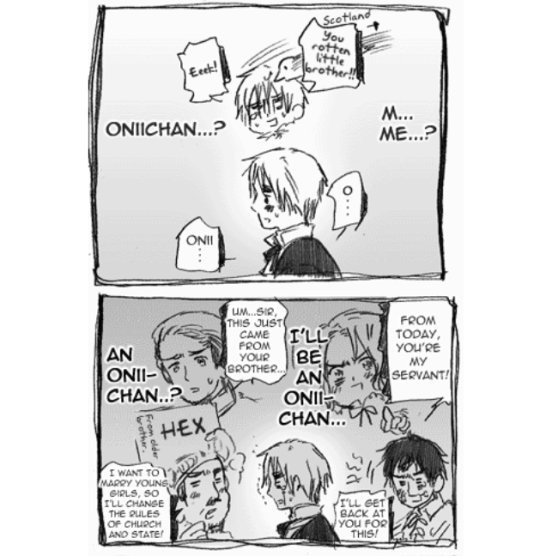
The parallels of loneliness and helplessness are quite
clear.
Ex: England feels
isolated in Europe, often a result of his hostile attitude toward other nations.

Ex: He feels
helpless when he realizes that everyone has turned against him during the
American Revolution.


The loneliness is most prevalent when England pokes into
America’s business, wanting to bridge the gap in their relationship, but being
too prideful and hostile to get anywhere with this.
Ex: He visits
America to “check up” on Lithuania, who was living with America at the time.

America also fears being alone and experiences feelings of
helplessness. This childhood fear still persists.

Ex: America pokes
his nose into other nations’ business to the detriment of damaging his
relationships with them. As such, he fears being alone and desperately clings
on to the few he’s able to maintain a good relationship with (e.g., Japan).


Both feel a compulsion to be the #1 at everything. As I’ll
get into in a moment, this likely stems from low feelings of self-worth and
poor self-esteem. What you’ll also see is that England especially hates coming second
to America.
Ex: England training to become physically stronger.
The
strip this is taken from is titled “England’s plan to be the strongest.”
Hmmm…

Ex: America mass producing and becoming a dominant economic power.

His dethronement of England in becoming the world’s #1
industrial power is not taken well by the latter.

Constantly being ostracized and insulted by other nations
has had a devastating impact on how England views himself.

America also struggles with self-esteem issues, although it
mostly has to do with his weight.
Ex: He refuses to
accept the number on the scale and claims that it’s broken.

Both cope with the stresses and difficulties of daily life
by hiding in their imaginations.
Ex: America’s
go-to safety mechanism is imagining superheroes to solve his problems.

Notice how England calls out how unrealistic America’s
reality is.

Of course, this is hypocritical given that England escapes
into the world of fantasy and magic when he’s feeling lonely or stressed.

Overall, what I find interesting and would highly recommend that
others look into is how similar England and America experience themselves and
their problems. Personality-wise, they couldn’t be any more different;
mentally, however, they’re quite alike.

America: Just admit it. We all know you like McDonald’s.
England: Why I never.
Also England:


Oh yeah, definitely. I could do that.
England’s parenting messed up America beyond belief. However, what some of Horney’s theories set out to do is explain that parents who haven’t experienced a loving childhood are often incapable of raising their own children in a loving manner.
In fact, what you’ll see is that a lot of the neuroses of the parent (e.g., anxiety, depression, other mental health issues/ complexes) are passed onto their children.
Post coming up tonight!


 Ellawritesficssometimes