Trying to motivate yourself to finish an assignment like…
*opens word document*

*opens word document*
I believe this has more symbolic meaning and shouldn’t be taken literally, but Japan’s “Excuse Me, I’m Sorry” character song has some very… powerful lyrics.
I believe it has to do with how he accepts being Westernized again after WW2, as he mentions the Meiji Era. I also think he’s referring to the American occupation of his country, pertaining to his innate fears of losing his sense of self [culture].
“ Cherry trees, maple trees
The meaning of the seasons
My straight black hair
will be blond by tomorrow ”
…
“
I really really like Western cooking
I can’t deny the Meiji Era
Excuse me, I am sorry
I love everything new
I really really like what’s fashionable
The minority can’t control me
Excuse me, I am sorry ”


I’ll
preface this by saying that I know Prussia is East Germany. On the other hand,
we don’t have any strips that concretely refer to Prussia as East Germany.
That said, until Prussia is either referred to
as East Germany or labelled as such, by rules of canon, he technically isn’t
East Germany. Yes, I know this is a bit confusing since his wiki page states
that he’s East Germany… I’ll get back to that in a moment.
Essentially,
the purpose of this post will be to illustrate how we know that Prussia is East
Germany; it just hasn’t been confirmed with a direct reference.
Some people
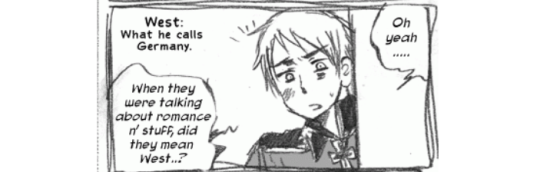
claim that Prussia is East Germany because he refers to Germany as West. This
is incorrect because we see Prussia referring to Germany with this nickname
well before WW2 ended. The nickname likely has to do with geographic proximity, as Prussian
territory is located in the East of the country.
Yes.
Ex: We’ve seen
Holy Rome exist well after his dissolution.
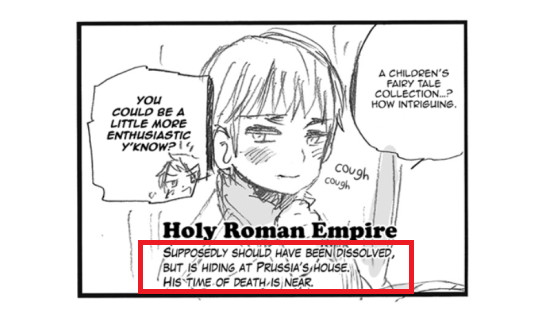
“Usually, when the culture or the country’s personality
dies/disappears, the country would gradually disappear or entrust him/herself
to the country that takes over him/her.” [x]
In other
words, the personification’s existence is personality-based. This personality
is based on how strong their people’s culture is. Even after dissolution, if
the culture doesn’t die right away, the personification will still have a
reason to be. Basically, the path to death is gradual.
The second
part of this rule is what is of particular interest to me. It’s an option where
death isn’t required, regardless if the culture is gone or not.
“… or
entrust him/herself to the country that takes over him/her.”
In the
present day, Prussia mentions that he’s no longer afraid
of Russia because Germany is strong enough to protect him. Of course, this is making
the obvious assumption and conclusion that he’s East Germany.

Lastly,
another reason that could account for Prussia still being alive is that
personifications who have lost their culture can still live on as
representatives of their region.
“There are also cases that
him/her is not a country but continues to live leisurely as a representative of
a region.”
How I see
this is that the personifications become active in politics. In that case, this
would explain why we see Prussia still attending world meetings.
Ex: He
attends an EU meeting. [x]

Character
notes state that he fell under Russia’s control and was stuck working unprofitable
jobs for him [x]
Ex: Russia’s
political indoctrination of Prussia.

Ex: Prussia
working alongside the other Soviet countries.

Ex: In the
Christmas 2010 strips, Prussia reveals his deep hatred of Russia. He’ll puke if
Russia touches him. If not, he’ll lose four eyelashes – this is likely a
reference to the Allied-controlled zones that divided Germany into four post-WW2.

Ex: When
asked why Prussia’s alone so often, Hima answered that he’s in an enclave of a pitiful state. [x]

“An
enclave is a territory, or a part of a territory, that is entirely surrounded
by the territory of one other state.”
If that’s the case then this would translate into Prussia
being amalgamated into/surrounded by Germany. Take note of this mention of weakness, because I’ll be bringing it up again soon.
[…despite it not being confirmed.]
There are
several hints of the East-West divide that still lingers in the country.

Ex: In
terms of infrastructure, the East is on average poorer than other regions of
the country.

Ex: During
the same EU meeting from the example I listed above, Prussia talks about Ostalgie
and uniting the wall in [his and Germany’s] hearts. *Ostalgie is nostalgic
feelings for East German life and culture.
“We have to get rid of the “wall in our
hearts,” so that the country can get better and the progress will be
naturally more effective! When the Ostalgie level gets higher, Russia
imposes himself on my big brother.”
An obvious
reference to German Unification. No doubt.
Ex: When
the two brothers are finally unified, Prussia comes to Germany wearing old clothes.
Of more importance is the car he arrives in. It has an uncanny appearance to
a Trabant, an East German car.

As seen in
one of the examples above, Prussia relies on Germany to protect him from
Russia since the latter is strong.
We also
know that Prussia doesn’t heal as fast as a typical nation would. This doesn’t
mean that he’s dying, given that personifications can still live on without
culture, but it does mean that he’s weaker than he used to be.
Ex: He’s
bitten by Germany’s dog. A full week passes, and his wound still hasn’t healed. What’s even more troubling is that Prussia lies to Germany about how long he’s had the wound for.


Prussia’s always been reluctant to admit to
weakness, so I wouldn’t say that this is all too surprising…
Friends: We’re going out tonight. You should actually come this time.
Me:

From what I
understand, yes.
Russia (the
personification) represented the USSR at world meetings.
Ex: The Baltics either stayed at Russia’s house or
acted as servants when Russia attended world meetings on their behalf. [x]

Ex: Bulgaria stopped attending the World Academy while he was under Turkish rule and didn’t come back until he was independent
again. [x]

The same
thing occurred with Romania too.


Briefly put, we know that Prussia is East Germany, but he hasn’t been formally introduced or referred to as such.
On the wiki page, they cite “Germany is playing an impossible game” as the strip where Prussia’s status as East Germany is confirmed. It pretty much is [it refers to German Unification], but again, it’s not explicit. Technically, it’s not confirmed then, as I’ll elaborate on later.
I actually disagree with how this was done. No matter how obvious something is, I’m of the mindset that things shouldn’t be accepted as canon until it is explicitly stated as such. Most East Germany references have to do with German Unification or Prussia working for Russia, however, no labels are given…
Guide on what we know about Prussia’s extremely probable status as East Germany coming up tonight!


Anon 1: I didn’t forget that Germany’s states are personified. An example post is not purposed to provide
a full list of every case in the manga/ web comic. That’s why I provided
sources for people to search the “states and provinces” tag if they wanted a
more complete list of all state personifications.
However, since we’re on
that note, if anyone wants examples of German state personifications, several of
them are mentioned in the “Cleaning Prussia-san” game [x]. Saxony makes a few
formal appearances in the webcomic (e.g., one panel in the Maria Theresa Arc).
Hesse is the one with
the most formal appearances (e.g, 2011 Christmas strips, volume 5).
Lastly, since the states
aren’t actually personified in canon, that last part of your ask is a headcanon
(I just don’t want anyone to confuse this). But, yes, I’m often perplexed by
the whole ‘top secret’ trope. This is also the case for me in AUs where the nations
are kept as a secret from the public, when we know in canon that humans are aware of their existence.
Anon 2: I suppose, but there are
times where they are both referred to as Italy in conjunction. It’s an inconsistency I’ve noticed in the series.
Like you said, Romano is
referred to as Italy in Lithuania’s outsourcing pt. 3.

However, they’re both
seen representing Italy [in general] at a world meeting in an incompleted strip. (not canon,
just used for demonstrative purposes).

Likewise, what I find
odd is that when they’re given EU profiles, Veneziano is referred to as Italy,
meanwhile Romano is specified as South Italy. [x]


Either way, there’s no
real reason provided in canon to account for this, so I just accept it how it
is.


Q: If there are two
Italies, how come Veneziano is referred to as Italy and Romano isn’t?
A: There’s no
real reason given. It’s just how it is.
The other nations generically refer to Veneziano as Italy, and
Romano as “Italy’s older brother” – Romano gets pissed off at this since he
resents being stuck in Veneziano’s shadow.

Nonetheless, BOTH are Italy.


Q: What did Chibitalia represent? Did anything
change?
A: Nothing’s changed in what he represents. Veneziano has always represented the north of the country, and Romano, the south.

The only difference
then is that Italy was fragmented into several small city-states after the
Roman Empire fell. The country wasn’t as
consolidated.

By this, I mean that each city-state was diverse and different
enough to be considered as a nation in its own right. Veneziano and Romano were
the collective personifications of these states. Similarly, their names are
each likely references to Venice and Rome, city-states that were thriving with
culture at the time.
Veneziano refers to his half of the country as his house, meaning
that when city-states under his jurisdiction were conquered, he would also be
conquered.

This is seen when Milan gets thrown into a war between
France and Prussia. When Milan gets taken over by Spain, it’s Veneziano who’s
captured. Again, he represents the collective of these northern city-states.
“This is how the War of Austrian succession looked like. Basically, everybody just bullying Austria. At one point, Northern Italy (Milan) got caught in a war between between France and Prussia, not noticing Spain surrounding him from the South until he got kidnapped.” [x]

The same thing goes for Romano.
He was once conquered as Naples by France [parts of Veneziano were also conquered here].


Q: Would APH Genoa still be alive today?
A: It’s difficult to say since we don’t see him in the
present, so I can only speculate.

However, I would guess that it’s possible for a variety of
reasons.
1) Personifications are personality-based. These personalities
are based on how strong the culture(s) of a collective organization of people are [x]. Since
Italians are so diverse and tend to identify themselves regionally, it’s
possible that while Genoa is no longer a city-state, he can still be a
personification of Genoan culture.
2) It’s stated that when the culture dies and the personification
loses their nationhood, they either die or become a representative of the
region. In other words, he could be active in politics. [x]
3) This one is more unclear and open-ended, but it’s
still substantiated in canon. We’ve seen personifications that technically
should be dead still existing well past their date of dissolution.
Ex: Holy Rome.

If that’s the case, then Genoa could still exist, either because his culture is still there, or for no explicit reason. Nationhood is often very flimsy and loosely defined in the
series.
You also have to factor in the existence of the micronations, where
even Hima states that the reasons that founded their existence are “amazing” – as in no concrete rules
apply to them. It also has to do with the bizarre reasons regarding how they formed in real life. [x]
It’s likewise important to mention that real nations are often just as perplexed by the existence of micronations.

In sum, it’s possible for Genoa to still be alive if you use
the canon rules I provided; however, it’s not canon.
Q: Is State-talia
real or OC?
State-talia is real. You can find notes on states and
provinces if you search the tag in the English translation of Hima’s blog
(Bamboo Thicket)
Tag: states and provinces
Ex: China’s provinces are personified.

Ex: Japan’s prefectures [blog only] and feudal clans/territories are
personified [make appearances in the manga]
Interestingly, these feudal clans/territories still exist during Japan’s Westernization phase. Again, the rules of nationhood are loose, and personifications don’t always die and fade out right away.
Sometimes it takes a while before they die, and other times they won’t die at all.

Osaka, a previous feudal domain, later evolved to become a prefecture from the Meiji era
– present.

Ex: America’s states are not personified, but Hima does
provide a hypothetical description of what they would be like in their relation
to America [x]. There’s also a brief dialogue between some states.

Notice how America refers to his country as his house in the
case that his states were personified. It’s the same exact situation with North
Italy. Point is, there’s a consistent rule here.
Given that Genoa is personified, it would be possible for the city-states in each Italies’ house to be personified as well.

*end of the semester*
Normal person: I’m going to keep all my notes so I can look
back at them one day 🙂
Me: Can’t relate.


 Ellawritesficssometimes