

Canada, honey, I know you have emotional issues, but what the fuck.
Canada, honey, I know you have emotional issues, but what the fuck.

England hands down. He has the immune system of a fruit fly.


These are all excellent questions!
Although Pearl Harbour isn’t covered, there is documentation of the nations getting scars from wars and political repression.
As for natural disasters? While they haven’t been shown to get scars from them, the nations’ personalities are sometimes based on their climate and geography. Iceland is a good example of that. He has a “hot side” of his personality to account for volcanic eruptions/hot springs.
Guide coming up tonight!


Before I start, it’s important to go over and situate a few
things. The nations’ immortality is more of a curse than it is a blessing.
They’ve experienced countless wars, plagues, political strife, and have even
died, only to be regenerated.
Now, unlike humans who have been blindsided with the rough
backhand of fate, the nations are forced to relive these pains over and over
again. It would be enough to drive a normal person mad.
In other words, their immortality was a prison that kept them
locked into a systemic cycle of bloodshed. What adds to this prison imagery is
that they’re obligated to listen to their bosses and fight in wars that they don’t
necessarily want to participate in.

Nowadays, this prison more has to do with loneliness. They
still follow their bosses’ orders, but the restrictions on their freedom are
not nearly as pervasive.
Ex: England’s sweet and alcohol intake is regulated by his
boss.

Regardless, Germania and Ancient Rome best exemplify how
their freedom was gained not by their immortality, but rather, the loss of it.
They were “liberated” from their bosses and war upon dying.

France is another good example of this. He gives better
insight into how heartless history can be in tossing peoples’ lives around. When
he first sees Lisa, Jeanne d’Arc’s reincarnate, he believed that God was
playing a cruel trick on him. On its own, this already proves how betrayed and
hurt France felt after her death.

Nonetheless, France still keeps his faith and believes that
humans who have had rough past lives will be reborn into happier ones. He
doesn’t have this privilege.

The purpose of this post will be to illustrate how the
nations’ immortality has historically caused them to live through many
traumatic events. It would follow, then, that being reared in such unhealthy
environments would cause some of them to develop PTSD.
In fact, there is a mounting pile of canon evidence that
depicts the nations having discomforting flashbacks, severe anxiety, and
nightmares. That said, let’s go over some examples.
When his settlers moved inland, America didn’t have many
belongings to his name. England ponders why America produces things in mass and
comes to the realization that America’s overconsumption of goods likely stems
from this impoverished period of his life.

Note the use of the word traumatized.


Lithuania has a flashback to when he and the other Baltic
States declared their independence from the USSR. He then experiences another
flashback, where Russia squeezes his shoulder – it’s used as a metaphor to
represent political repression.

Lithuania is so immersed in this second flashback that he
begins squeezing Estonia’s and Latvia’s shoulders without realizing it.

One of his character notes also mentions that he’s been rebilitating after his time spent in the USSR.

England doubts his capacity to care for young America. The
stress of this new responsibility causes him to have a flashback of his older
brothers sending him hexes.

It’s noted that England once suffered from 100 years of heartbreak, presumably a reference to the American Revolution.
This is a theory of mine, as it isn’t confirmed in canon, but given that England coughs up blood and gets ill on the fourth of July, I think that it is meant to symbolize how he still hasn’t recovered emotionally from America’s independence. In other words, each year, England’s heart is both literally and figuratively ripped open on the inside.

While this example is a more subtle depiction of trauma, it’s
not surprising.
Although this isn’t covered in the strips, following WW2, Japan
would have become America’s underling. As such, the atrocities committed by the
atomic bombs would have made him visibly more compliant to America’s demands,
regardless if he agreed or not.
This is seen in a world meeting where Japan unanimously agrees
with America’s ridiculous global warming plan. Switzerland even calls out Japan
for not voicing his true opinion.

Switzerland’s mercenary past still haunts him. Lichtenstein
perceptively reads into this as she asks him why they’re working to boost her income through tourism.

Italy’s perhaps one of the most anxiety-ridden characters in
the series.
Ex: He worries that Germany hates him and has nightmares
about this. His greatest fear is being left behind to fend for himself.

This insecurity leads him to make Germany reaffirm to him several times that he’s not actually hated.


Ex: Italy has nightmares where a childhood version of himself
presses to be acknowledged.

The dream ends with Italy screaming and refusing to
acknowledge the child. To me, and as I’ve theorized in the past, I read this as
Italy repressing parts of his childhood to minimize and forget about the trauma
that he experienced. The child is merely a representation of his unconscious
mind.

Germany also has a childhood version of himself pressing to
be acknowledged. Of course, this is running on the assumption that he’s
actually Holy Rome and has forgotten about his childhood.

Similarly, he’s once depicted to be holding Chibitalia,
looking visibly confused.
“It’s me.”

Again, how I see this is that perhaps Germany is repressing
aspects of his childhood. In that case, Chibitalia is an unconscious
representation of these memories attempting to pierce through to his conscious
mind.
All in all, given how long the nations have lived, it’s not
novel to assume that they’re still traumatized by things that have happened to
them in the past.
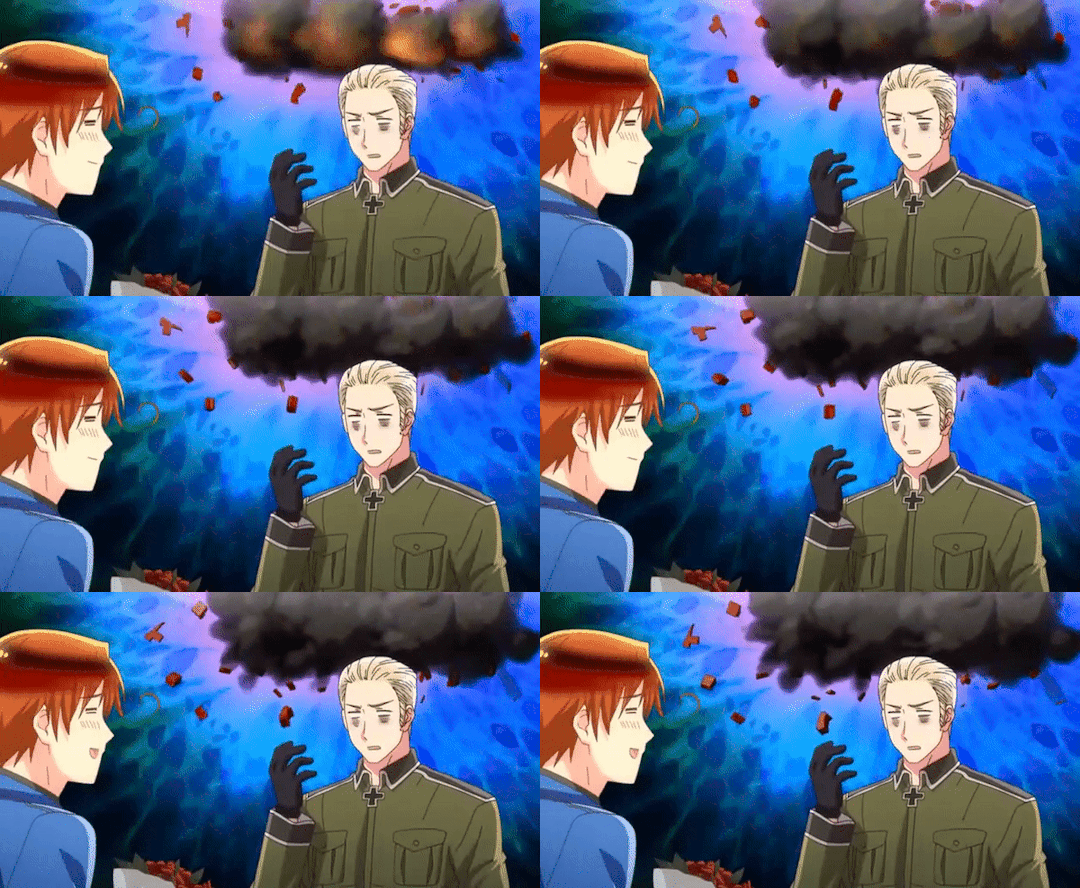
*is swamped in work*
Parent: No excuses. You’re going to have to make time for it.
Me: YoU’RE RigHT. Let me just –

In the version I’ve accessed via Hetascanlations, the Vatican is mentioned, but the character near the line of dialogue isn’t tagged as such.

Unless that was a mistake, I don’t think it was intended to be him.
There’s also the fact that in the context of the strip, we see an unknown American stand in as a spokesperson for his people’s attitude towards Christmas.

It would follow, then, that the character above acts more as a mouthpiece for residents of Vatican City, which would make sense given that there’s another clergy member placed right above him (below here
↓
).

Usually when characters are first introduced in canon, they’ll have an official title underneath them. Like this…

I also double-checked on Bamboo Thicket before I made that post to see if there were any illustrations made of the Vatican. I didn’t find any in the tags.
Unless the Japanese print version of World Stars is slightly different regarding illustrations (I wouldn’t know, but I know that strips are often redrawn), the online English version merely translates the chapters that Hima’s posted.
In that case, if you could provide a sourced image that would be helpful.


I’ve answered this indirectly in other writings, but as a
subject that repeatedly comes up in the manga, it deserves its own post.
This is one thing that I’ve always been careful with, given
that labels like Stockholme Syndrome are loosely thrown around in the fandom.
Thing is, the underling situation doesn’t quite fit the medical definition of
SS. It’s certainly not a healthy
situation, though, and I have no problem clearing that up in the future. Point
is, it doesn’t do any good to attribute serious conditions like that, especially
since these exaggerations result in gross misrepresentations of the characters.
PTSD, on the other hand, is something that the nations have
canonically been shown to have real symptoms of, right to the nail of the medical
definition.
Post coming up tonight.

[laughs in England.]


That’s the point, though! A lot of serial killers’ motives aren’t irrational if you step outside of conventional morals. They’ve either had a misjustice done to them or they believe that they’re above justice (i.e. narcissism and a lack of empathy).
Not all of the characters in the AU will be like that, but their motives for killing will always have reason to it.
I’m working on a directory, but it’s been delayed because I’m in the middle of exams right now. For now, you can search up ‘psych-talia’, ‘mysteries of hetalia’, ‘shipping series’, serial kill-talia,’ ‘guide’, and ‘characterization in hetalia’ in the tags. I’ve tagged them accordingly underneath each post 🙂
Side note: I’m also really sorry for how bad I’ve been for keeping up with my ask box. I have 400+ requests now. Sometimes I get opinion questions that take me time to muster over. People say “quick question” but it’s not lol. I want to answer them to the best of my ability and really commit to it.
Other times, I get questions that while I don’t personally find them controversial, it steps into waters that I’m not keen on treading on in this blog. I can’t always anticipate how people are going to react. I do mention this in my ask guidelines too…
That said, if you want to discuss topics like that, I would prefer that you PM me. Just know that I see and treasure all asks. Your engagement and kind words are immensely appreciated.
 Ellawritesficssometimes