Honey, my love, my poor naïve soul… the old comic strips
used to be nothing but fanservice.
Allow
me to introduce you to the 2007 Christmas Event:
*Mochi is used for censoring purposes*
People often find it perplexing that America can’t see ghosts
or magical creatures, and assert that this is done for seemingly no reason. It’s
quite the contrary. There’s an underlying rule in the manga that’s been used
and consistently drawn on:
That is, whether it’s ghosts, aliens, or magical creatures,
the nation’s ability to see/ believe in them depends on if their citizens
strongly believe in them. In other words, superstitions of the supernatural and
unknown need to be part of the nation’s popular belief system if the respective
personification is also able to believe in them.
I say believe mostly
because as you’ll see soon, sometimes a nation will see an unknown being, and
yet not recognize or acknowledge its existence. For the most part,
however, the nation simply won’t be able to see the being.
The reason listed that explains why America can’t see and
believe in ghosts is because 23% of his people either believe in their
existence or have had an encounter with them. Again, this ability is predicated
around citizen belief.
I can’t attest for the exact figures of this statistic. Point is, this is what Hima cited, and it is thus included into the reasoning
behind America’s skepticism of the supernatural. Of course, this rule doesn’t
mean that these beings don’t exist. It just affects whether the nation will be
able to see them.
Notably, this approximate statistic has since changed. [I’ll
get back to this in a moment.]
Likewise, because Americans strongly believe in the existence
of UFOs, America can see and interact with Tony.
Meanwhile, although England can see Tony, since his people
don’t believe in extra-terrestrial life as strongly, he’s skeptical of the
alien and doesn’t truly believe in it. [x]
Quickly, it’s important to go over some supernatural ground
rules specifically pertaining to America.
On Halloween, the one day of the year where Americans
temporarily, albeit strongly, believe in the existence of the supernatural,
America’s able to see ghosts and other unknown creatures.
England is noted to be able to make anyone who visits his
country see ghosts/spirits; America is the only exception to
this rule. [x]
When accused of seeing illusions by America, England claims that
America can’t see the unicorn because he’s too impure.
Funny, considering that England gives America a
unicorn to celebrate his bicentennial despite knowing full well that the latter can’t see it….yet.
What I’m about to present indicates a considerable shift
in America’s “ghost and monster culture”, whereby it’s strongly hinted that he’ll
soon be able to see ghosts, spirits, and any other magical creatures rather than
just aliens.
Please note that ghost and monster culture are terms that
Hima’s coined in describing a nation’s folklore and superstitional culture.
It’s not like this shift is impossible either. We’ve already
seen with Japan how he’s able to forget and subsequently re-remember the existence of
youkai spirits as a result of his own people forgetting about and later
believing in them again.
For example, in the Meiji era, Japan lost his ability to see
them with respect to his people forgetting about their existence. On the other
hand, because England’s monster culture remained prevalent, he was able to see the spirits (i.e the Tengu and Kappa).
However, later in WW2, when Japan and Italy are taking a
bath in a hot spring, we learn that Japan’s regained his ability to see his
nation’s magical creatures.
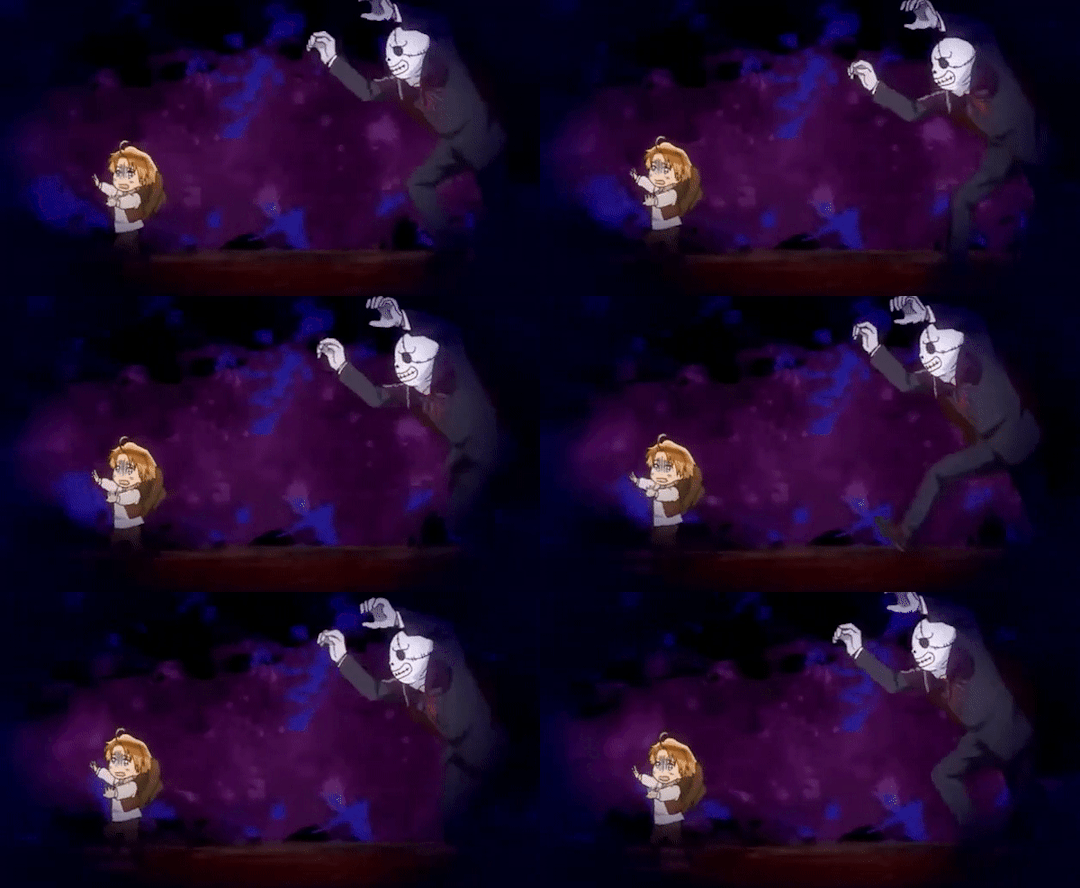
The same thing happens with America.
While he initially can’t see and doesn’t believe in ghosts,
he’s still terrified of them.
The fact that he doesn’t believe in them becomes woefully
obvious when a ghost literally taps America on the shoulder and introduces
himself. America doesn’t notice the ghost and instead seems to attribute the poke
on the shoulder to the false feeling of being touched or watched given that he’s
watching a horror movie while this all happens.
It’s only until World Stars where we begin to see a possible
shift in America’s ghost culture.
America visits England in Chapter 290. What I want to place
particular emphasis on is that America admits to his increasing interest in
fantasy movies. If we follow the rule from above, this would mean that his citizens
have taken up an interest in the genre/ supernatural belief, and this interest
is thus reflected in America’s own interests. Movies genres are a reflection of popular culture, after all.
This scene in particular substantiates this claim.
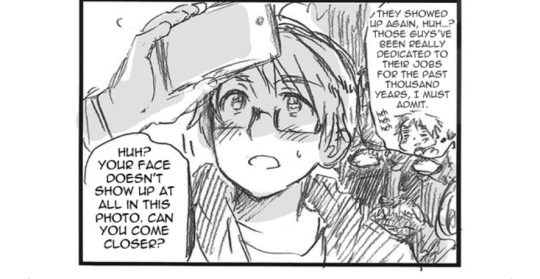
The two take a tour of a haunted citadel. America mistakes ghosts
for current staff members. [They had worked there when they were alive.]
He takes a picture of the ghosts, only to realize that they
don’t show up in the photo. More importantly is the fact that America was actually able
to see the ghosts.
Even if America wasn’t able to make the connection and
realize what they were, it would seem that his newfound interest in fantasy means
that his ghost and monster culture are shifting.
If that’s the case, then we could very well see an America
that’s able to see supernatural creatures in future strips.
Me: It’s just the doctor’s office, don’t be scared.
I can sure try! Psst. I’ll add a bit of a bonus by touching on his inability to see magical creatures too.
Post coming up tonight!
I think
it’s become obvious by now that almost every single nation embodies a good balance
between likeable and dislikeable traits. As such, it’s important to lay out
some essential characteristics if we’re to understand who England is as a
person, his motivations, his faults, and his highpoints.
While
England can be invariably cruel and pessimistic – especially towards America–
this stems from a latent insecurity that he keeps within himself. He pre-emptively
spites others to protect himself from the rejection he’s historically
experienced. In modern strips, his temper has calmed considerably, and this
spitefulness has transformed more into sarcastic banter and blunt teasing.
Nonetheless,
what this post will account for is why England’s loneliness caused him to have
such a volatile temperament, not to mention poor relationships with others.
The
following character notes are of utmost importance in preventing England’s
personality from being misinterpreted. [x]
He’s quite bad
at expressing himself. He himself knows that people often misunderstand him, he
uses this fact for self-depreciating jokes.
He could easily
be the most pitiful one in this webcomic.
His temper was
quite stormy during the decades after America’s independence.
Put
another way: England’s historical isolation caused him to develop a poor sense
of self-worth. To compensate for this, he worked hard to improve his nation and
external image of himself. Meanwhile, the insecurity remained even as he
emerged as a world superpower. Because he was so used to being teased and
berated, England treated others in a similar manner, only for this to work to
his own detriment.
Arrogance
and boastfulness quickly got the best of him. He fell hard and even deeper into
isolation after the American Revolution. His violent temper towards America is
a manifestation of his strong fear of rejection. What you’ll see is that
England is deeply considerate of others and wants to befriend them, but
unfortunately closes up and defensively makes scathing remarks to protect his
fragile self-image.
With all
that said, let’s tie this back to the strips and go through some examples.
We know
that having America as a ward helped ease England’s temper. He even admits
to this.
What’s
important to point out here is that this was during a time when America was
England’s primary ally.
England escaped the alienating
atmosphere of Europe by visiting America. America’s unconditional love was England’s security blanket.
This
security blanket was lost after the Revolution, thus explaining why England’s
temper explodes in the following years. He was all alone again.
England wants to be friends with America, but has trouble overcoming his loneliness. His crippling fear of rejection is often the cause.
In fact,
England can be quite shy at times. If anything, it proves how skeptical he is
to open himself up to others, let alone make the effort to get them to see him
for who he really is.
He embarrassedly
offers to be America’s friend when he realizes that the latter doesn’t have
any, only to defensively fall back on anger when America rejects him.
It’s a cruel
cycle of desiring to be close to another person, opening himself up, and either
1) rudely spiting them, inciting rejection or 2) politely engaging them as a ‘gentleman’,
only for this to incite rejection as well.
His anger
is a shell – it’s a tough habit to break, even though he woefully recognizes
how problematic it is in impacting how others perceive him.
The fact
that he doesn’t expect positive reactions from others is chiefly illustrated with how embarrassed he gets when he does receive praise.
Nonetheless,
England keeps trying to mend things with America to the extent that these efforts are excessively nosy.
He’s
skeptical that Lithuania will be treated well in America’s house, and takes it
upon himself to visit them. Curiosity is a form of caring, however skewed and
counterproductive as it may be.
Point is,
England’s covertly reaching out to America here, likely because he knows
firsthand what it’s like to be directly rejected by the latter. It’s the next
best thing he can do.
As
touched on above, it’s not just America that England’s isolated from. He’s not
referred to as the Black Sheep of Europe for nothing, after all.
During
the Splendid Isolation Period, and having experienced many political rejections
as a result of tensions with Russia, he desperately tries to convince himself
that being alone isn’t all that bad.
Eventually,
he’s able to successfully form an alliance with Japan. Of particular emphasis is
the strip’s title:
“The anglo-Japanese alliance between two lonely people.”
I really don’t think it can get more explicit than that.
Further,
this alienation among the other nations is a repetitive theme in the series.
England’s often left out of excursions and activities.
One
example that best demonstrates this is when Italy, Germany, and Japan take it
upon themselves to interview other nations about their Christmas traditions.
The whole strip entails England hiding in the background, fidgeting nervously
as he waits to be interviewed, only to be forgotten about.
Interestingly,
it’s Japan who remembers to interview England at the last minute. The two share
an implicit, but undeniably deep understanding of each other.
Another
way that England compensates for his loneliness is by turning to the
supernatural – his fairie friends. America thinks he’s crazy, but what he doesn’t
realize is that England likely summons these friends to mitigate his
loneliness, and therefore prevent himself from going mad.
The
imagery of a child-like imagination is later used to describe England’s love of
and desire to live in a world entirely made up of fantasy. He lives in his mind
because it’s safe. Similarly, he talks to his [real] fairie friends because he knows
that they’re safe too; they won’t ever reject him.
I’ve
brought this up before, but I think this is a good note to end on. During the
Anglo-Japanese alliance arc, which focuses on the subject of loneliness, why is
it that England is given the Kappa’s Miracle Cure?
It’s a
medicine said to cure any illness…
…but what
illness is there to cure if you’re an immortal being that will automatically
recover from illness anyway?
It seems
to me that the cure was intended for something less tangible, yet just as hard
to cure:
Heartsickness
and accompanying feelings of loneliness.
The fact that despite all that they’ve gone through, they’ve evolved to the point where they’re able to flat out roast each other…in a teasing manner of course.






 Ellawritesficssometimes