image
image

Misconception: He’s
emotionless.

Reality: He’s
expressive through non-expressiveness.

image

Ex: A smile for
him isn’t expressed as obviously as it is for some of the other characters.
Still, that doesn’t negate the fact that he has feelings. I mean really now.

image

Misconception: He’s
humourless.

Reality: He has
an implicitly “evil” and “mischievous” side. In other words, he’s often
playful, albeit subtly.

image

Ex: He’s the one
to come up with France’s punishment after the 2007 April Fools’ Event. This entails
getting France to praise everything about England’s culture for a whole day.

image
image

Ex: When at war
with each other, he was glad to have a legitimate reason to punch Denmark.

image

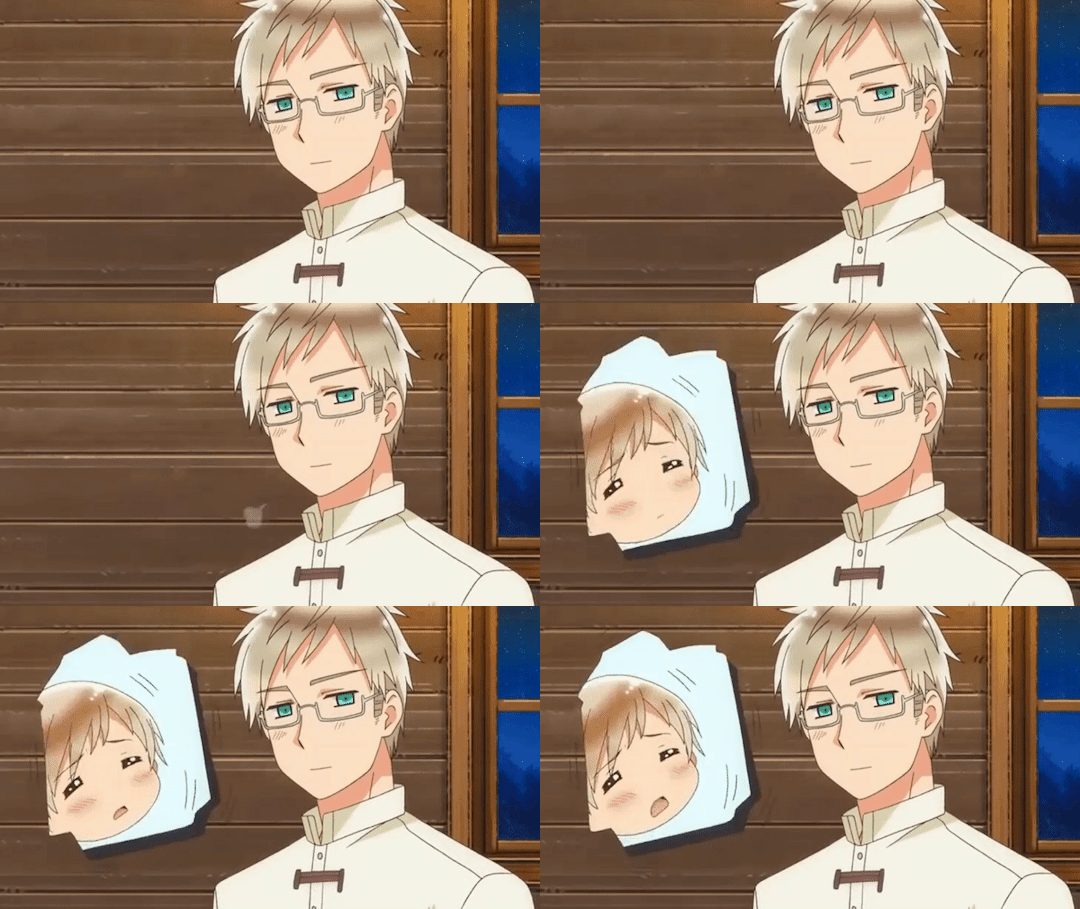
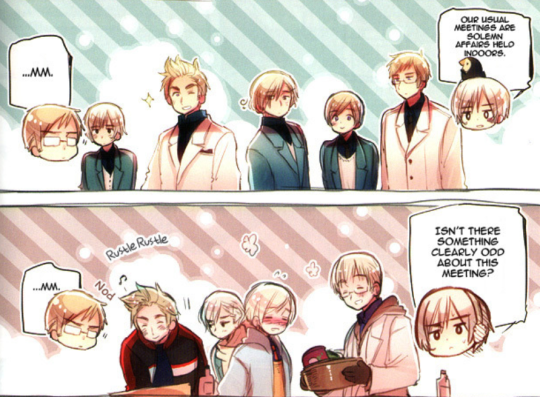
Ex: He goes along
with the Nordics’ plan to host a secret birthday party for Iceland. 
image

Again, the
humour is subtle as he wordlessly teases Iceland and makes light out of the
latter’s confusion over them meeting outside.

image

Misconception: He’s
intimidating inside and out.

Reality: His
external appearance is intimidating, but he’s tender and sweet on the inside.

Ex: During the
stereotypical café arc, Sweden’s customer is initially terrified of him.
Nonetheless, Sweden gives away the meal for free.

image

Ex: He acts as a
parent to Sealand.

image

Ex: Ladonia
refers to him [and the other Nordics] as an Uncle.

image
image

Ex: He’s good at sewing + uses this skill to adjust smaller clothes for Finland.

image

Misconception:
SuFin is canon.

Reality: Sweden
has confirmed feelings for Finland, but Finland doesn’t reciprocate.

In a lost 2007 blog post, Hima confirmed that Sweden has
homosexual feelings for Finland and only acts this way towards Finland. [That’s
literally what the translation says].

Ex: Finland has
repeatedly denied being Sweden’s “wife.”

image

Nonetheless, the two do share a close relationship, enough for Finland to refer to Sweden as “Swe.”

Ex: The two spend
their New Years’ Eve together in 2009.

image

Ex: This one-sidedness
is seen as early as when they were first colonizing America. Finland spots
America in the wild, and Sweden proposes the option of them having kids.

image

Bonus facts:

It’s left unclear as to whether Sweden can see magical
creatures.

image

He and Denmark used to hate each other, but have recently
calmed down in their temperaments. Of course, this is to be expected from their present welfare
and collectively-oriented nations.

Regardless, the two still tease each other in
the present time. 

image

[Denmark and Finland are imitating Sweden here.]

image

All in all, a somewhat mysterious, yet thoroughly entertaining character.

image
image
image

Misconception: He’s
lazy and unmotivated

Reality: He’s extremely
strict, neat, and places great importance in his appearance. Nonetheless, on
occasion, he has been shown to grow bored easily when faced with the prospect of
work.

Ex: He trained America and his military during the American
Revolution.

image

Ex: He keeps his clothes spick and span.

image

Ex: He gets bored and sneezes when he’s given a book on how
to socialize with people. 

image

Misconception: He’s
full of himself, so he doesn’t need anyone.

Reality: He’s
painfully lonely.

Ex: He never
married.

image
image

As such, he’s brought to tears when he sees Austria and
Hungary as a couple on Christmas.

image
image

He unconvincingly rationalizes to himself that he’s happy to
be alone.

image
image

This is repeated in his character song Mein Gott!, where he claims
that “Being alone is too much fun.”

Ex:
He misses Frederick II, and hasn’t found someone to fulfill this strong [but nonetheless implicit] desire for companionship.

It’s even said that he grows
depressed at the mere mention of Fritz. Ironic considering that he has a picture
of him on his nightstand.

image

Notice how Prussia also calls
on Fritz during Valentine’s Day, and once again attempts to convince himself
that he’s happy to be single.

image
image

Misconception: He’s overly-confident.

Reality:
Prussia’s narcissistic, but this stems from being extremely insecure about
himself.

He’s always trying to gain
power for self-reassuring purposes. This reassurance acts to discount his
insecurities over being weak. His use of the word awesome, then, is more
defensive and reparative than it is an exercise of confidence.

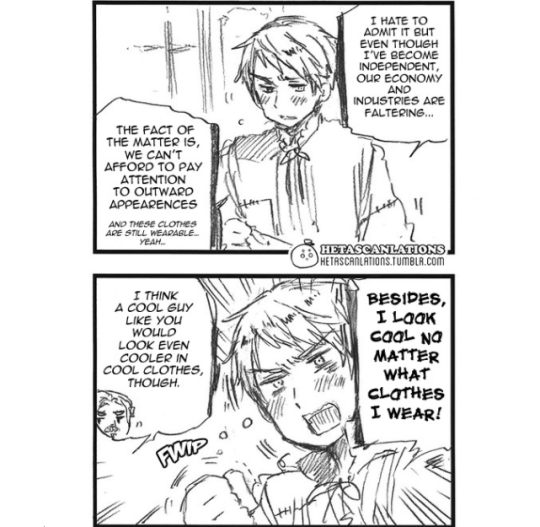
Ex: He associates fancy
clothes with strength + brags to bolster and reinforce confidence within himself.

image

Before his country grew in
strength, notice how he falsely tries to convince himself that his clothes are
still cool, despite them being worn down. The important difference is that he
doesn’t make use of the word awesome. This a time where his confidence and
morale is low. Awesome for him is equated with strength.

image

Bonus Facts:

He’s noted to feel like an enclave as opposed to an actual
nation.

He’s an incredible older brother:

Ex:
He reads Fairy Tales to a dying Holy Rome, and is revealed to be heartbroken
after the Napoleonic Wars.

image
image

Ex: He immediately
steps in to protect young Germany when he’s born.

image

Ex: He’s very supportive
and encouraging of Germany, despite teasing him a lot.

image

To be honest, given all this, I find it redundant for
Prussia to refer to himself as awesome.  

image
image
image

Misconception: China
hates Japan

Reality: While he
does hold against a grudge against Japan for betraying him in WW2, he’s deeply
affected by it.

We all know the scene. Japan stabs China – literally and
figuratively – in the back. You’d think this would generate hatred on
China’s part…

image
image
image

…but this couldn’t be anymore true.

China raised Japan. He was there with him through everything.
He protected Japan from other nations, like Mongolia, only to receive nothing
for it.

image

In other words, China’s heart was broken. A telling scene in
which this is confirmed is when China drinks away his sorrows and breaks down
into tears as he recounts what Japan has become.

image

Unfortunately, we are not provided with much insight on how
Japan and China fare in modern times, as we don’t get many moments where they
exclusively interact with each other.

Misconception: China
is weak

Reality: He
possesses immense strength, but because of his age he lacks stamina.

Ex: This strip
illustrates America’s perception of China’s innate strength and/or capacity for
it.

image

Despite this, however, because he’s lived for so long, China’s
physical body has aged and weakened. This is an exception to the rule of a nation’s
political and economic situation affecting their physical strength.

The physiology is more applicable to how they lead their
daily lives.

Ex: He’s referred to as a grandpa in modern times, and tires easily.

image

Ex: In another modern
strip, he’s affected by his population’s growing obesity rate and subsequently
gains weight despite his efforts to circumvent this.

This can be taken as another demonstrative impact of his
physiology age given that older people also have trouble shedding weight.

It’s still important to note that he’s nonetheless referred
to as a powerhouse [for obvious political and economic reasons.]

image

Accurate Conception:
China is likely an Ancient.

He’s lived for approximately 4000 years. Given that Quintillus, a Roman emperor, was once
seen to be holding a baby China, I would say that this pretty much confirms his
status as an Ancient.

This is aside from the fact that Quintillus can time travel
– the timelines correspond without the need for him to do so. Point is, this is a more concrete example of how old China is.

image

Misconception: China’s
rude and stand-offish.

While he can be petty and complain like a disgruntled old
man in comparison to some of the younger nations, China is probably one of the most
wholesome characters in the series.

Ex: He acts as a
mentor to Taiwan, Macau, and Hong Kong. The latter two live with him. 

image
image

Ex: When Hong
Kong wants to leave China’s house, China begs for him to stay and promises to
stop cleaning Hong Kong’s room so often.

image

Bonus Facts:

He doesn’t like to lose.

image

He believes in fortune + luck and is able to see ‘monsters.’
Monster culture is just another way of Hima naming a nation’s ability to see magical
creatures.

Ex: He compiles an index of monsters. While it does contain
regular creatures, it also bears real monsters.

image
image

Not to mention that the other nations expressed fear towards
China in “Hetalia of the Dead” as they believe that he’s fully capable of summoning
dark spirits.

image

Amazing character, right?

image
image

Misconception: Latvia’s physical body is young
and small for “no reason.”

I couldn’t
object anymore to this. While it’s not explicitly stated why Latvia is like this,
there are written rules and examples in the manga that provide a suitable
explanation. This is aside from the fact that Latvian people are among some of
the tallest in the world.

Since I
already have a theory on this, I’ll merely put a quick summary here:

For one
thing, we know that a nation’s health is predicated on their political and
economic situation. That is, if their economy is doing bad, or they’re experiencing
political instability, then they’ll develop a cold.

Likewise,
we know from the case examples of America, Canada, Italy, and Romano that
gaining independence causes the nations to age.

A strong
economy, a stable political situation, and political sovereignty are solid
factors in determining the age and size of full-blown nations – not micronations,
who are often anomalies to these rules.

That said,
because Latvia has historically experienced constant political repression and
subordination and lacks a strong economy, his physical body hasn’t aged as much
in comparison to the other nations.

image

Ex: Russia
pushing down on Latvia’s head is a metaphor for the political repression the
latter experienced at the hands of the former.

image

Further,
what differentiates Lithuania and Estonia in modern times is that both of them
are doing better off economically than Latvia is, who primarily relies on
agriculture. You also need to account for how Lithuania at one time was a
European superpower.

Ex: Estonia’s obsessed with money, and is good at managing economics.

Even then,
because of the political repression Estonia also experienced, he’s only a little bit
older than Latvia at 17.

image
image

Misconception: Because Latvia’s scared of
Russia and is physically weak, he’s just weak.

Latvia’s actually
a genius.

Ex: He
built an entire railroad by himself.

image

Ex: He
plays solo chess.

image

Misconception: His physical age means that he
has the mentality of a child

[He’s 15.]

While
Latvia does have a bit of a blabber-mouth –which gets him into trouble with
Russia, admittedly – that’s more of a character quirk than it has to do with his
maturity.

Ex: Latvia
has adopted a mentoring role when it comes to dealing with Sealand.

image

[He also
drinks a lot of alcohol.]

Misconception: He’s not scared of Russia
anymore

I’ve seen a
tendency for people to get angry when authors characterize the Baltics as being
afraid of Russia. Honestly, it’s accurate, especially given how terrifying their
past in the Soviet Union was and the extent to which they’re still traumatized
by it. (i.e. both Lithuania and Latvia are shown to escape from
reality, and maybe Estonia
too with his mochi-inspired dream + other dream fantasies).

The problem would be if you only depict
them this way, and don’t reveal the other aspects of their characters.

image
image

In other
words, “Stop making the Baltics weak!!!! They’re not scared of Russia!” is just
as bad as only showing them cowering
in the face of Russia.

Also remember that there was resistance and political
revolts on their part too. Either way, both depictions are biased,
one-dimensional, and don’t give the complexities of their personalities the
credit they deserve…

image
image
image
image

Misconception: He was an ungrateful child.

In reality, Romano
didn’t realize how much Spain had sacrificed for him until well into his
adulthood. In that sense, he can be even more oblivious than Spain at times.

image

Ex: Spain spent money
on improving Romano’s wardrobe, despite wearing rags himself.

image
image

Misconception: He
hates Spain.

Spain and Romano share
a very close relationship. What happens is that Romano often gets irritated with
Spain because they tend to switch from completely understanding one other to
not understanding each other at all.

Remember that when he
moved to America for work, Spain was the first person Romano called. He was in
a scary and unfamiliar environment and was all on his own. The fact that he
calls Spain is most telling of the less expressive but nonetheless strong bond they
share together.

image

Misconception: Romano’s
lazy

Yes, but not all the time. Romano’s a very competent worker when he puts his mind to it.

The truth is that there’s an evident tension between Romano and Veneziano
as a result of their rushed and sudden unification. They were separated for
centuries with minimal contact, and as such, have had a difficult time
reconciling.

Romano grudgingly moves
to America to sustain himself, as he didn’t want to rely on
Veneziano.

image
image

While he does complain
frequently, he’s still an exceptionally hard worker. Here, he’s even shown to
be above paying for shoes. Arguably, he’s the harder worker out of the two brothers. I’ll
get back to this in a moment.

image

There’s also an
interesting conflict regarding how the two Italy brothers share their workload. Romano wants Veneziano to work in order for him to work too while Veneziano wants Romano to “work properly.”

image

Likewise, there’s the
problem of North Italy infantilizing Romano and his capacity to work and be productive. He has a tendency to alleviate Romano’s workload, much to the latter’s annoyance.

image

Misconception: He
hates North Italy.

Not quite – he detests
him “a bit.”

image

The two don’t share
the greatest relationship. This likely stems from the fact that Romano suffers
from an inferiority complex in comparison to his brother, who was spoiled and
tended to more by their grandfather. Combine that with a rushed unification,
and there’s inevitably going to be some tension between them.

image

What you’ll see is
that Romano will insult Veneziano face-to-face– admittedly, quite spitefully and
rudely– only to discreetly look after his well-being behind his back.

image

Misconception: He’s
got an emotionally-strong backbone

Romano’s an even
bigger crybaby than Veneziano. He’s extremely sensitive.

Ex: He’s insecure
about his height.

image

Hopefully this sheds more light on Romano’s character. He’s not the stiff, rude, and unmotivated jerk that I often see him portrayed as in fanon.

While he can act like this, this isn’t how he always is. There’s a deeply emotional, anxious, caring, motivated, and passionate side of him that also needs to be recognized.

image