Note: This theory
makes the assumption that Holy Rome is Germany. It also makes the assumption that Prussia evolved
to adopt the title of East Germany. I will also be talking about specific
evidence in this post. For more detail and evidence regarding my thoughts about
the Holy Rome = Germany connection, here’s a slew of previous posts for that. It
includes things like memory repression, faked rebirth, the role of culture in
nationhood, and other similar goodies.
As I re-read the material, I’ve noticed something
odd that could account for the reason that Germany hasn’t come to the conclusion
– at least overtly – that he’s Holy Rome.
That is, there’s a significant gap in his relationship with
Prussia.
We know that post-WW2, Prussia ended up under Russia’s
control, working unprofitable jobs.
Source: Hetarchive, Notes & Etc.
We also know that Russia heavily censored Prussia’s communications
with other nations during the Soviet Era.
Source: Hetarchive (Bamboo Thicket, eng trans., Oct 30th 2013).
Ex: A letter that
Prussia sent to Austria was heavily censored by Russia.
If that’s the case, it would be likely that the two had very
little communication with each other outside of meetings. Even then, we know
that Russia attended meetings on the Baltic trio’s behalf, so that’s another
factor to consider if the same rule were to apply to Prussia as East Germany.
More importantly, this gap in communication is demonstrated
in more subtle ways too.
Ex: After the fall
of the Berlin Wall, Germany is surprised to find how tattered and rugged
Prussia’s appearance is (note the presumable East German car model Prussia uses).
Source: Hetarchive (Bamboo Thicket, eng trans., Oct 8th 2013).
Ex: Prussia also
talks about Ostalgie (a combined word illustrating nostalgia for East German life)
in another strip. Point is, it highlights that the brothers lived separately for several decades.
Source: Hetarchive, Germany’s Playing an Impossible Game.
“’We have to get rid of the “wall in out hearts,” so that the country can get better and the progress will be naturally more effective! When the Ostalgie level gets higher, Russia imposes himself on my big brother.”
Child of the Past:
Working off the section above, we also know that there’s a
lot of murky waters when it comes to how the series discusses Germany’s past.
For one thing, we know that Prussia has lied about stories
of his own past and that Germany took them at a face value. This scene in the
Christmas 2011 event makes us question whether Prussia may have lied about
aspects of Germany’s past as well.
Ex: Prussia’s account of Germany’s history starts from the
formation of modern-day Germany. He doesn’t delve past that, which is
questionable.
Source: Hetarchive, Christmas Event 2011.
We also know from hints in Buon San Valentino that Germany
may be suffering from memory loss. The basic gist of the scene is that Germany
gets so overwhelmed that he blacks out. The scene then pans in on his brain and
the next panels illustrate fuzzy images of Chibitalia as if Germany is
recalling a lost memory.
Source: Hetarchive, Buon San Valentino pt 3.
Another instance where Himaruya potentially plays with the
idea of Germany and memory loss is this panel here. It seemingly depicts him
having a fuzzy dream. What’s interesting is that this looks very similar to
what his other birth scenes look like.
Source: Hetarchive (Bamboo Thicket, April 15th, 2011).
vs
Source: Volume 6 + Hetascanlations, World Stars Chapter 12.
The reason I bring up these examples is that if Germany
truly is an amnesiac Holy Rome, then at the time that Buon San Valentino took
place (WW2), he was consciously like a child compared to other personifications
who’ve lived for centuries and millennia.
Perhaps it’s for this reason that Prussia didn’t want to
tell Germany about his forgotten past, because it would be too soon and
traumatic to bring up.
Now factor in the gap and lack of communication between
Prussia and Germany post-WW2.
The question I’m asking and want people to think about: Is
it that Prussia still sees Germany as a child and hasn’t felt it necessary to
tell him these secrets? There’s also the fact that because it’s such a
personal, familial matter, other nations haven’t bothered to intrude and tell
Germany this themselves.
Not a passive
spectator:
Lastly, I just want to end on the note that Germany isn’t a passive
spectator in this equation.
While he’s quick to denounce anything that isn’t scientific –
e.g., discounting ghosts, such as Quintillus, a Roman emperor – I think at some
level Germany knows that not everything lines up.
Source: Hetascanlations, World Stars Chapter 41.
What if he’s interested in looking at Roman history because
he wants to know his roots?
Source: Hetarchive (Bamboo Thicket, October 20th, 2014).
Or could it be that he wants to know more about Rome and how
he died and studies Roman history as an indirect way of approaching this?
Source: Hetarchive, Together with Grandpa Rome.
Notice how uncomfortable and unsure Germany looks.
This RARELY happens.
If there was another Holy Rome personification that died,
shouldn’t they be in heaven too…like Rome? Could it be that Germany is second-guessing
his status and realizes that just like how Prussia, Austria, and Hungary (to
name a few) have been able to adopt new titles regarding what they represent, the same thing occurred with him?
Source: Hetascanlations, World Stars Chapter 1.
Or how about the undeniable fact that they look exactly
alike?
Source: Hetascanlations. Edited photo, from left to right; Germany World Stars Chapter 12 + Holy Rome World Stars chapter 187.
In previous posts, I’ve touched on the notion that pets in
Hetalia often function as a mouthpiece for their respective nation. Put another
way, while they are separate physical beings, symbolically they serve to
represent the psyches of their owners (i.e., their thoughts, feelings, and
emotions) [x].
Thus far, I’ve picked up on three consistent themes.
1)
They tell the nation something they need to hear.
2)
They speak what the nation doesn’t dare to say
out loud.
3) In conjunction to #2, they often reveal what the nation is
feeling.
That said, let’s tie this back to the strips.
America:
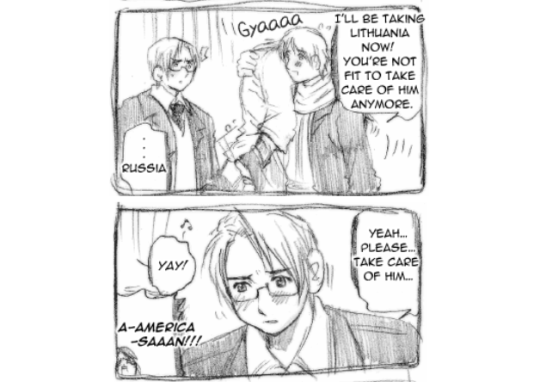
The best example where America’s pets mirror his feelings is
their fondness of Lithuania.
America becomes disheartened when he can’t afford for Lithuania
to live with him anymore [x].
However, in earlier strips, we learn that America’s pets
hold a similar affection for Lithuania [x].
Canada:
Before, I’ve speculated that Kumajiro represents Canada’s
psyche.
The focal point of Canada’s characterization is his struggle
to form a stable and memorable identity and overcome his invisibility. As such,
neither Canada nor Kumajiro getting each other’s names correctly figuratively reflects
how Canada still hasn’t figured out who he is.
Hence, Kumajiro’s infamous “Who are you?” catchphrase has another
level of depth to it [x]. He’s not just asking Canada who he is [as in his name]
but also who Canada stands to represent as a person and a nation. His identity and
self-concept is something that he continues to negotiate and work his way
around.
Some other examples would be…
Canada is too shy to ask England to have lunch with him.
Kumajiro then reassures Canada that it’s okay to be more demanding and urges
him to speak up for what he wants.
In the aftermath of the American Revolution, England diverts
most of his attention toward America. Kumajiro uses stuffed animals to convey Canada’s feelings. The puppet story depicts how Canada feels
neglected and excluded [x].
“I think the well-behaved baby bear should be loved more,
but what do you think, whoever you are over there?”
England:
England becomes dismayed after watching a fantasy movie and
laments over his desire to live in such a world. His magical friends don’t hesitate
to give him a required dose of reality [x].
Iceland:
Mr. Puffin acts as both a mentor and mouthpiece for Iceland.
He’s able to see right through Iceland and recognize what he’s truly
feeling. In this case, he’s aware of how lonely Iceland is [x].
On the other hand, when he first meets baby Iceland, he comforts
him. At the time, Iceland was still figuring out his existence and questioned
why ‘no other guys like him’ existed. Mr. Puffin assures him that other
nations do exist, just in far geographic proximity [x].
He also teaches Iceland knowledge about the world from his
travels [x].
Note: This post will explore the mystery behind why Russia
covers his neck. This isn’t a theory, as I use facts to come up with a
speculation that, while probable, hasn’t been substantiated in canon. I find it
very important to distinguish between facts, theories, headcanons, and
opinions.
What’s the deal with Russia’s heart?:
I know, I know. This
post is about Russia’s neck, but I have to do some backtracking first.
All right. In canon, it’s normal for Russia’s heart to
spontaneously burst out from his chest.
In earlier posts, I’ve speculated that
this acts as a metaphor for how Russia’s conception of love has been equated
with violence.
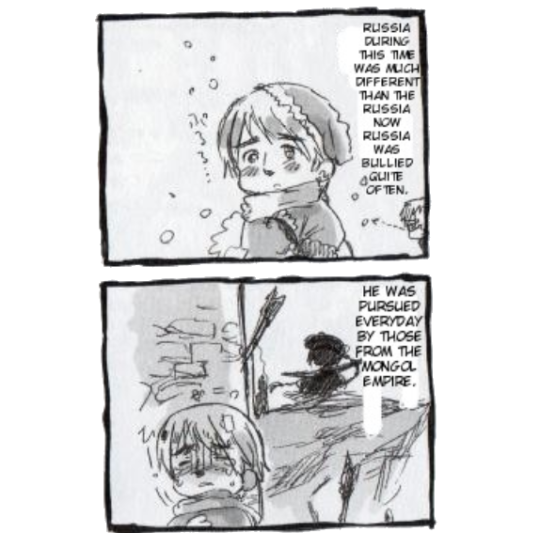
He grew up being routinely conquered and chased after.
Not
only that, but General Winter – who acted as Russia’s de facto parent figure
due to the protection he provided the latter with – also attacked [abused]
Russia on an annual basis [x].
As such, what Russia
grew to understand as love and friendship became irreparably warped.
Ex: He thinks that anyone he meets is his friend. This
includes General Winter, his abuser.
Ex: He uses violence as a solution to his problems. He’s
normalized it [x].
In conjunction with the first reason, I also believe that
Russia’s heart falling out so violently symbolizes being cut up from the inside.
Since the personification’s body is a physical representation of their nation’s
landmass, this would relate to the act of partitioning and being partitioned. The
heart and soul of a nation are tarnished upon being conquered.
Ex: Russia’s hobby during WW2 is partitioning Poland [x].
Ex: When he exerts political pressure on Japan, notice how
Russia sends a heart. Again, I interpret this as another example where Russia
has conflated love and violence [aggression], confusing the two of them.
Russia’s Neck:
As many others in the fandom have pointed out, there is a mystery
surrounding why Russia takes great lengths to cover his neck, most notably with
his scarf. It’s not just his neck, but I’ll get back to that in a moment.
Originally, the scarf was a gift given to him by Ukraine.
While she wanted him to keep warm, she also did this to get him to make Kiev
successful in return.
On the other hand, the scarf has taken on a much darker
meaning in Russia’s adulthood.
Ex: In Italy’s Chest Test Series, instead of his usual
scarf, Russia’s wearing bandages around his neck [x].
Ex: In the History Copy Book, there’s a strange panel with
an angle that reveals Russia wearing a single bandage around his neck [x].
What I haven’t seen people mention is that it’s not just his
neck that Russia tries to cover.
1) He’s often spotted clutching his chest, an
action that I believe is done to prevent his heart from falling out.
2) Russia takes great lengths to cover his chest
too [x] [x].
Putting this all together:
The answer I have that possibly explains all this isn’t
grandiose or complicated. It’s simply medical. I think that by covering up his
chest and neck, Russia’s concealing the physiological effects of heart failure.
The heart failure here is his heart falling out.
Conditions like Congestive Heart Failure occur when the
heart is unable to pump enough blood to give your body the sufficient oxygen it
needs. A symptom of this failure in the right side of the heart can cause
bulging tube-like veins to appear on the right side of the neck – jugular vein
distention.
If that’s the case, then no wonder Russia wants to cover up
his neck. Not to mention that he would without a doubt have massive scars and
damaged unhealed tissue from his heart popping in and out like a revolving door.
There’s a profound lack of clarity when it comes to Germany’s
knowledge of the past, including his own. That said, let’s go over a brief
run-down of what we know that he knows.
Knowledge of his
Past/ Ancestors + Fabrications:
Prussia is the one that tells Germany all about his past.
What makes lots of people, including me, believe that Prussia is hiding Germany’s
unconfirmed past as Holy Rome is that the stories he tells Germany are
inaccurate. He’s an unreliable story-teller.
In this case, the stories have to do with Prussia’s own past, as he lies about how “cool” or “rugged” he used to be. Germany’s understanding of what Prussia used to be is very different from reality.
Regardless, Japan is the one who gives us the best insight on this, as
he’s able to pick up on the fact that Germany believes everything that he’s
told about the past.
On the other hand, what’s strange is in another strip where
Prussia begins telling Germany about his past, Germany is completely
uninterested. He’s more focused on chores than he is on his own genealogy.
There is no explicit discussion of Germany’s relation to
Germania either. It mostly focuses on his older brothers – the German states.
However, despite the inconsistencies in Germania’s relation
to Germany, recent strips claim that Germany is his son. Again, what I find
strange is that Germany doesn’t inquire about his past far enough to at least
know about Germania.
He knows about Rome and even encounters the latter when he
visits down from Heaven and yet there’s no interaction/ discussion of Germania.
I’m of the mindset that Hima’s left things unclear and
undetailed on purpose. That way, he has more leeway to work with if he wants to
confirm in later chapters that Germany is, in fact, Holy Rome. Please remember
that this is all theory, none of this is confirmed.
Research:
Despite all this, Germany has been shown on several
occasions to possess knowledge about the past, full of holes and vague as it
may be when we do see this depicted.
He does a lot of research for someone that seems to be
uninterested in his past.
Ex: He has a deep interest in Roman culture and history.
Ex: He’s conducted research in fixing historical records of Ancient Rome to make the narratives more accurate.
Ex: He once referenced the Dancing Conference, which occurred
right after the Napoleonic Wars. The point to emphasize here is that Holy Rome
was dissolved because of Napoleon.
If he has knowledge
about this figure, it inevitably means that he’s aware of the Holy Roman
Empire (duh). Likewise, historically, he would have to given what the Third Reich was
predicated on reviving…
Lastly, what’s interesting is that despite his knowledge of
Roman History, Germany doesn’t know much about Italy’s past.
Ex: He does his initial research in finding out that Italy
is a descendant of Rome.
However, in modern strips, he’s surprised to find out that
Chibitalia was able to ward off the Ottoman Empire on his own. He’s so used to
seeing Italy as a ‘hetare’ that he can’t imagine him in any other way.
Has Germany Recovered Memories of His Past?
There are two theories that I have in making the assumption
that a) Germany is an amnesiac Holy Rome, and b) he’s gaining his memories.
One position I take is that Germany has already recovered
his memories of Holy Rome but refuses to acknowledge the past and doesn’t tell
anyone about this. This would explain his lack of interest when Prussia brings
up their past. He already knows but doesn’t want to confront it.
This is well substantiated given that Germany has a strong
belief in data, and doesn’t believe in the supernatural. Even though Holy Rome
didn’t die right after dissolution, the fact that he didn’t is unexplainable.
Germany is of a scientific mindset and would therefore
probably ride it off. It’s not something he would accept. The surprise at
Chibitalia’s strength in earlier panels is simply because Holy Rome never got
to see Italy be that strong.
The other position I take is that Germany is just beginning
to recover his memories of Holy Rome, having previously repressed them from
before to guard against being re-traumatized.
Ex: In Buon San Valentino, Germany’s stress causes him to
blackout. During this panic episode, fuzzy images of Chibitalia appear, almost
as if they were semi-inaccessible memories.
Ex: Germany is once depicted to be holding Chibitalia.
Take note of the question mark and the phrase “it’s me”.
To me, this seems like
Chibitalia is an unconscious aspect of Germany’s mind trying to pierce his conscious memory.
Ex: There’s also the strange occurrence where a child that
looks exactly like Holy Rome/ Germany is pressing to be ‘acknowledged.’ From a
psychological lens, this would be interpreted as repressed memories of Germany’s
childhood trying to reach his conscious mind.
Ex: Germany’s love for Italian culture and life can be seen
as him unconsciously remembering how much Holy Rome wanted to have Chibitalia
be part of his house.
However you want to see it, you have to admit that the
amount of questions left unanswered with regards to Germany’s past is done for
a reason. We just don’t know why exactly that is just yet.
I’ll
preface this by saying that I know Prussia is East Germany. On the other hand,
we don’t have any strips that concretely refer to Prussia as East Germany.
That said, until Prussia is either referred to
as East Germany or labelled as such, by rules of canon, he technically isn’t
East Germany. Yes, I know this is a bit confusing since his wiki page states
that he’s East Germany… I’ll get back to that in a moment.
Essentially,
the purpose of this post will be to illustrate how we know that Prussia is East
Germany; it just hasn’t been confirmed with a direct reference.
Opening Misconception:
Some people
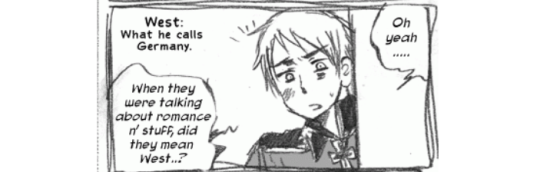
claim that Prussia is East Germany because he refers to Germany as West. This
is incorrect because we see Prussia referring to Germany with this nickname
well before WW2 ended. The nickname likely has to do with geographic proximity, as Prussian
territory is located in the East of the country.
Is it possible for a personification to exist after dissolution?:
Yes.
Ex: We’ve seen
Holy Rome exist well after his dissolution.
“Usually, when the culture or the country’s personality
dies/disappears, the country would gradually disappear or entrust him/herself
to the country that takes over him/her.” [x]
In other
words, the personification’s existence is personality-based. This personality
is based on how strong their people’s culture is. Even after dissolution, if
the culture doesn’t die right away, the personification will still have a
reason to be. Basically, the path to death is gradual.
The second
part of this rule is what is of particular interest to me. It’s an option where
death isn’t required, regardless if the culture is gone or not.
“… or
entrust him/herself to the country that takes over him/her.”
In the
present day, Prussia mentions that he’s no longer afraid
of Russia because Germany is strong enough to protect him. Of course, this is making
the obvious assumption and conclusion that he’s East Germany.
Lastly,
another reason that could account for Prussia still being alive is that
personifications who have lost their culture can still live on as
representatives of their region.
“There are also cases that
him/her is not a country but continues to live leisurely as a representative of
a region.”
How I see
this is that the personifications become active in politics. In that case, this
would explain why we see Prussia still attending world meetings.
Character
notes state that he fell under Russia’s control and was stuck working unprofitable
jobs for him [x]
Ex: Russia’s
political indoctrination of Prussia.
Ex: Prussia
working alongside the other Soviet countries.
Ex: In the
Christmas 2010 strips, Prussia reveals his deep hatred of Russia. He’ll puke if
Russia touches him. If not, he’ll lose four eyelashes – this is likely a
reference to the Allied-controlled zones that divided Germany into four post-WW2.
Ex: When
asked why Prussia’s alone so often, Hima answered that he’s in an enclave of a pitiful state. [x]
“An
enclave is a territory, or a part of a territory, that is entirely surrounded
by the territory of one other state.”
If that’s the case then this would translate into Prussia
being amalgamated into/surrounded by Germany. Take note of this mention of weakness, because I’ll be bringing it up again soon.
Why we know he’s East Germany…
[…despite it not being confirmed.]
There are
several hints of the East-West divide that still lingers in the country.
Ex: In
terms of infrastructure, the East is on average poorer than other regions of
the country.
Ex: During
the same EU meeting from the example I listed above, Prussia talks about Ostalgie
and uniting the wall in [his and Germany’s] hearts. *Ostalgie is nostalgic
feelings for East German life and culture.
“We have to get rid of the “wall in our
hearts,” so that the country can get better and the progress will be
naturally more effective! When the Ostalgie level gets higher, Russia
imposes himself on my big brother.”
An obvious
reference to German Unification. No doubt.
Ex: When
the two brothers are finally unified, Prussia comes to Germany wearing old clothes.
Of more importance is the car he arrives in. It has an uncanny appearance to
a Trabant, an East German car.
He’s grown weak:
As seen in
one of the examples above, Prussia relies on Germany to protect him from
Russia since the latter is strong.
We also
know that Prussia doesn’t heal as fast as a typical nation would. This doesn’t
mean that he’s dying, given that personifications can still live on without
culture, but it does mean that he’s weaker than he used to be.
Ex: He’s
bitten by Germany’s dog. A full week passes, and his wound still hasn’t healed. What’s even more troubling is that Prussia lies to Germany about how long he’s had the wound for.
Prussia’s always been reluctant to admit to
weakness, so I wouldn’t say that this is all too surprising…
I’ll start this by doing a brief summary of what I’ve already theorized on the topic before adding my recent addition to it.
Prussia and Fritz’s flute playing, along with the motif of
marching forward and national consolidation in a military context, also bears
extreme significance when you connect it to some of the underlying themes
running through Germany and Prussia’s current relationship.
The flute is symbolically important in that it’s often
depicted as an instrument used by the Gods. It’s used to channel their voices.
For instance, Ancient Egyptians believed that it channeled the voice of Isis,
the Goddess of life and magic. She was also known for her healing spells, those
of which cured the sick and brought the dead back to life.
In Greek mythology the flute is associated with Pan, God of
the wild. He is also associated with the shepherd, whose primary duty is to
tend to their flock of sheep by bringing them together.
Now, the flute was first used by Fritz in a marching song
intended to instill a sense of consolidation and strength among his troops.
Taken symbolically, Fritz, as the shepherd, used the flute to bring his flock of
troops together.
I’ve also theorized before that Prussia, who adored Fritz
and therefore likely adopted the flute-playing from the latter, also took on the
role of the shepherd when he united the flock of fragmented German
states to form one sovereign nation – the German Confederation. It was a
military march that culminated in unification.
With that said, this theory will be making the assertion
that Prussia has chosen his next successor to undertake the role of the
shepherd – Germany.
The strip “Private Flute Concert” is essential to this
theory in that it gives us some of the biggest hints of connections
between Germany and Holy Rome. Evidence of this symbolic divine reference can be found
when Prussia talks about the “sacred journey of the flute.”
As designated by the title, Prussia gives Germany a private
flute concert.
Notice how as Prussia plays, he has a flashback to another private concert he had… with his little brother no less.
There, a sick
and bed-ridden Holy Rome expresses surprise at Prussia’s ability to play the
instrument. What’s important here is that Holy Rome refers to Prussia as a “war-maniac.”
The connection surfaces once Prussia halts playing and removes himself from the flashback. Germany expresses surprise at Prussia’s ability to
play, and Prussia echoes his previous conversation with Holy Rome by likewise referring
to himself as a “war-maniac” in his defense of this ability.
So, why is it that I think Germany is the next shepherd to
be?
For one thing, in another chapter that echoes Prussia’s
flashback, Prussia reads Grimm Fairy Tales to a dying Holy Rome.
Another connection emerges when you notice that one of the
illustrators was named Ludwig Grimm, who also
just so happened to play the flute. Once again, notice the flute’s herding
properties; in this case, Ludwig Grimm’s flute causes a flock of pigeons to come
together.
Perhaps this is why Germany’s human name is Ludwig. What if
it was Prussia who gave it to him, either as a tribute to his predecessor, or as a tribute to his forgotten past? [I lean more towards the latter]
While Holy Rome himself was not good at drawing and was more erratic and impulsive in temperament, we know that
Germany has a more structured and composed personality. He would therefore be more adamant
on practicing and perfecting this skill. Here, he’s shown to have considerable artistic competency when
he draws Italy.
That said, it’s also important to mention that this personality
difference between Holy Rome and Germany is accounted for and justified in
chapter 1 of World Stars. When a personification gains a new title, it’s
possible for them to acquire a new personality.
Since Holy Rome is seen to exist well after his
dissolution, it’s not farfetched to assume that he never actually died. A
theory on that [here]. In fact, given how much evidence there is that Germany
is suffering from amnesia [theory here], these two arcs seem to form yet another
connection whereby Hima’s implying at the possibility of him being Holy Rome.
All right. With all that said, let’s tie this together.
Prussia is no more in modern times, and so is East Germany, albeit formally. [It’s heavily and painfully obvious that he’s East Germany, but I have yet to
see him explicitly be referred to as this].
Here’s one example of how obvious, yet indirect the hints of Prussia being East Germany are:
“We have to get rid of the “wall in our hearts”, so that the country can get better and the progress will be naturally more effective!
When the Ostalgie level gets higher, Russia imposes himself on my big brother. [ T/N: Ostalgie is a combination of Ost (East) and Nostalgie] ”
Nonetheless, in the same concert strip, we also know that Prussia doesn’t
heal as fast as he should after being bitten by Germany’s dog. On top of that, he lies to Germany about when he acquired the injury. It would follow,
then, that perhaps Prussia’s immortality is waning.
However, this shouldn’t cause us any panic, since we know that
it’s possible for personifications to live on and become state representatives
after losing their nationhood:
“Usually, when the culture or the country’s personality dies/disappears, the country would gradually disappear or entrust him/herself to the country that takes over him/her.
There are also cases that him/her is not a country but continues to live leisurely as a representative of a region.”
[Source: It’s a treasure box of countries.]
It’s these particular panels that are of interest to
me.
That’s right. Prussia’s pushing for Germany to take up
playing the flute. Situating this in its symbolic context, doesn’t it seem that
Prussia is asking for Germany to heal his newfound mortal weakness?
The country was consolidated by a march that Prussia led. Now that the country is consolidated again after the fall of the
Berlin Wall, his reason of being [a personification] is no more.
It’s Germany who now leads the figurative march in running
their country. There’s also the fact that Germany has a character song titled “Vorwärts Marsch!”Translation: Forward March!
If Germany’s marching forward
in running an already consolidated nation, he leaves Prussia behind. There’s
not much use for the latter now.
How I interpret this is that
by giving Germany the flute, Prussia is recognizing that 1) his time has
passed or 2) he’s relying on Germany to help fix/heal his broken immortality.
Prussia gave life to Germany, but what about vice-versa?
Ever notice
how in the strips there’s slivers here and there that make mention of Japan’s clairvoyance
abilities?
What I find
to be pretty fascinating is that this lesser-known side of Japan has subsequently
been built on from way early in the series. Not only that, but you can still
find hints of it in the more recent strips.
What is clairvoyance?
Basically, clairvoyance
is ESP (extra-sensory perception). The context here has more to do with mind-reading
and being able to establish mental contact with the other nations.
In the
Meiji Era, despite the fact that his people’s belief in the supernatural was
declining as a result of Westernization–hence the loss of his ability to see youkai and kappa spirits–interest in the occult and clairvoyance was still very
much a thing.
It would
follow, then, that Japan’s clairvoyance abilities were still able to be tapped
into.
Bonus
points to Hima for having Japan break the fourth wall and read his mind.
That said,
there’s substantial hints that Japan had been using these mind-reading powers well
before he had made contact with the West, spanning into his time spent in
isolation.
The most
concrete example of this is when Chibitalia has a strange dream that involves
him encountering some kind of divine being.
Chibitalia
is then led by the being to Japan. Note that this takes place well before the
two ‘first’ meet to form the Tripartite pact in WW2.
We get further
confirmation that Japan has secretly been reading the minds of the other nations
in Chapter 16 of World Stars. There, Italy expresses confusion at how little
Japan speaks. Japan is quick to ease this concern.
Essentially,
Japan has gotten so used to mentally communicating with those whom he reads the
minds of that he’s forgotten how to speak.
Now, this
gets even more interesting when you consider the potential this ability has in
being used as a plot device. It could reveal a whole lot of secrets about what
some of the other nations are hiding.
I would especially
be interested to see if we can get a little more insight into Italy’s thoughts/
feelings on his childhood, since he hardly ever acknowledges it during adulthood.
The
problem, however, is that the one time we get to see what Japan reads from
Italy’s mind– admittedly, with mind-reading binoculars that he invented– he
doesn’t believe what he sees.
I honestly
don’t blame him, though. That’s not the Italy we’re used to seeing, so it would
be hard to imagine him as anything else.
Still, the
more I think about it, the more I wonder:
Regardless
if Japan doesn’t believe what he’s read from Italy’s mind, doesn’t it seem highly
plausible that he’s come across Italy’s childhood memories before?
If so, has
he indirectly found out what really happened to Holy Rome?
It’s nice to think about, but given how
considerate of a person Japan is, if he did know, I don’t think he would be one to reveal
this secret.
Italy:
Is able to see Japanese arcana/ youkai/ spirits.
Encounters a divine being in a dream + meets Japan as a child in said dream.
It’s hinted that he summoned Finland
when the Allies and Axis got shipwrecked. Obviously, there was no communicative
technology available at the time.
Japan:
Has powers of clairvoyance.
Made contact with Italy in the latter’s
dreams well before they had first ‘met.’ (see above).
Created mind-reading
technology
As a result of his people not
believing in the supernatural as much after contact with the West, he loses his
ability to see youkai/ kappa spirits.
However, in modern strips it’s hinted
that his people’s belief in the supernatural has returned. It would follow that
he believes in them too, as he cleanses spirits and holds many superstitions.
Russia:
It’s hinted that he may have demons
haunting him/ some kind of tangible (not mythical) curse.
Ex: England’s fairies and magical friends
leave the moment Russia arrives at the 2013-2014 Halloween Event. They feel a “dangerous aura.”
England:
Can see
and communicate with ghosts, fairies, and any other magical creatures.
Can perform magic.
Has the
ability to make anyone but America see and believe in ghosts and spirits when they visit his place.
America:
Can only
see magical fairies/ unknown beings on Halloween.
Norway:
Can see
and communicate with magical beings.
Uses
his cross clip to communicate with a troll.
Iceland:
Can also see
Norway’s magical friends, but refuses to acknowledge this ability.
Romania:
Does fortune-telling.
His ability to
perform magic is left open-ended here…
…but since he’s in
the magic club, whose other member (England) does perform actual magic, I’d confidently assume that he’s also able to.
China:
Holds a
lot of superstitions + believes in fortune and good luck
It’s
hinted that he can summon supernatural beings/ spirits.
The other
nations believe that China has prediction powers and can defeat monsters.
He is
shown to go searching for monsters at one point, filling out a “monster index.”
Taiwan:
Does
fortune-telling + doesn’t believe in bad luck.
Note: This theory will make use of Freudian theory. While I
recognize that Freud’s ideas do not bear much contemporary relevance, that
shouldn’t take away from the fact that many of his concepts (i.e erogenous
zones, childhood memory repression, catharsis) are nonetheless employed by Hima
in the series. The purpose of this post is to give some insight into the
psychologies of the characters.
Comic Diary 3…an old strip
that’s very easily forgotten despite how crucial it is in allowing us to get a
good understanding of what Italy may or may not remember from his childhood.
In Italy’s dream, he conjures a lost child that looks exactly
like Chibitalia. When encountered by an unknown man, the child asks to be taken
to a person with a face exactly like them.
The pair go up to Italy. What the unknown man says
next is crucial.
“I have a lost child here.”
The scene then takes a disturbing turn for the worse as the
child eerily repeats “Please acknowledge me” over and over again. Even more important
is that Italy refuses to acknowledge the child.
Freud had a profound interest in dreams, as they act as a
pathway in gaining access into the unconscious mind of the patient. Your
unconscious mind is where your deepest desires, worries, and insecurities lurk;
you’re not aware of them. If a memory is traumatic enough, especially in
childhood, then they too can be pushed into your unconscious mind so that
you’re unaware of/ unable to remember them.
In the context of dreams,
this is where your unconscious has the free reign to express itself. What you
experience in your dreams has both a literal and a symbolic meaning. It’s the
symbolic meaning of dreams that psychologists look at. Basically, your
unconscious paints the dream in a way that something irrelevant – such as an
ordinary everyday object – could represent a repressed conflict, vulnerability,
or unpleasant trauma that is plaguing your mind.
Manifest Content is the
literal element of the dream. It’s what you see and experience. For example, in
this case, it would be Italy encountering a child that looks just like him and
reacting fearfully towards it.
The Latent Content is the
symbolic element; the underlying meaning. It’s the unconscious aspect of the dream that is masked by
the seemingly normal manifest content. Because these aspects are a representation
of unconscious conflicts, when brought to the conscious level they can cause us
to experience discomfort.
What I want to focus on is the latent content of Italy’s dream.
The lost child could be symbolic of ltaly’s lost childhood. Likewise, it can
also act as a lost childhood memory that Italy has repressed and refuses to
acknowledge.
The trauma of losing Holy
Rome could have motivated Italy to actively forget about that part of his
childhood. It would follow, then, that Italy’s childhood self appearing in the
dream is the presence of an unconscious conflict and repressed memory, thus
causing him to respond fearfully.
On the same note, it’s not
impossible for the nations to have limited memories, let alone forget bad
experiences. Russia can surely testify to that.
That said, while Italy may have repressed some of his childhood
memories, we know from Buon San Valentino that he hasn’t repressed all of them
as he at least admits that his first love was a boy.
Perhaps this vagueness of
statement means that Italy’s memory about Holy Rome is muddled… that he knows
just enough, and yet, not enough to cause
him to remember and relive the pain of losing his first love.
Why I don’t think HRE and Germany are exactly the same person
Since @ellawritesficssometimes asked me to elaborate, here I go. I’m no major in Hetalia or anything but this little guy has always been my favorite characer in Hetalia, even when I really disliked Chibitalia, and I want to share my thoughts on him.
So, first of all, Holy Roman Empire and Germany are really different as ‘countries’. Germany is an unified state despite all differences, Holy Roman Empire was more a pact between german states that never sticked and while originally it included a lot of other countries they started falling apart with time. Poor Holy Roman Empire started dying around 1500 and from the way he acted when he said goodbye to Italy I think he was pretty aware of his impending dissolution.
And another thing I suspect, due to the strip in which we see the german states fighting is that he made it back, to some degree, but he avoided Italy or decided to stay in a completely different place: the HRE Hungary is holding up is the teen we see later in the comigs where Prussia reads him the Grimm comics, not the super small child he was earlier.
I know this doesn’t add much to my Hre=/=Germany discussion but I still feel like pointing it out. Anyway, going back to the main topic: while they share a lot of territory, Holy Roman Empire had more than Germany inside him- like Austria, Switzerland, the whole Czech Republic and ridicolous amounts of the Netherlands, Italy and Belgium. Germany is just… Germany. And it’s compact and strong. They share the same territories, yes, but they’re different things.
Now, let’s alk about the points I see around the most:
But Germany and HRE look exactly like each other!
Who else also look really similar, used to share the same territories, have ridicolous similarities and have common history, traditions and culture? The Italian brothers and their grandfather, especially Romano and his grandfather as seen here (A post from @grandparomeaskblog / @mezzogiornovargas.). Even Prussia and Germany are shown to have strong similarities in some strips so I wouldn’t really base myself on how someone looks like considering family members can look alike on occasion.
Also, I DO admit there’s an high chance the empty shell of HRE was used as empty body for Germany but that doesn’t make them the ‘same’ person.
Thanks go to @ask-useless-german for basically being my german history teacher.
Germany is Holy Roman Empire, he just lost his memories.
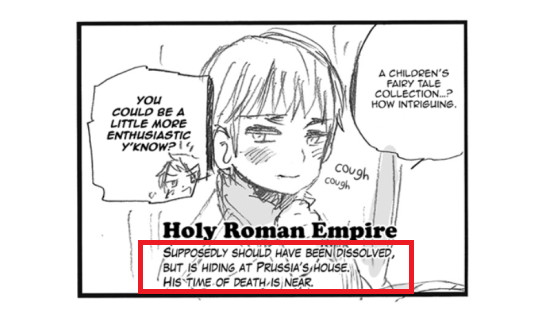
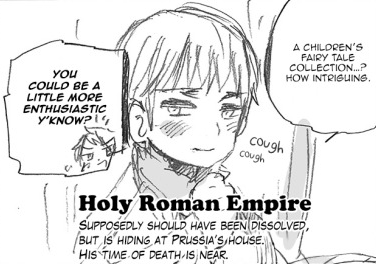
I could buy this if we didn’t have two specific things.This strip in which it’s clearly said the time of his death is close, which implies that he will die soon, he’s not just going to be sick for a while and then return full force-
And the one where they say Germany “already had an exising body” when he was born. I does imply that Holy’s body was recycled but we’re clearly talking about one being dead and the other being born. If anyting it feels like Germany is the legacy of HRE and the one who succeeded where the other failed.
Obligatory Gerita comment here
Feliciano remembers Holy Roman Empire and he still seems to feel something for him as seen in the famous Valentine episode. The only time he blushes is when he mentions his first love was a boy and he has a somehow melancholic face while talking about it.
Italy didn’t forget his first love and he seems to actively ignore when other countries flirt with him (he’s seen being nice to liechtenstein and other girls, sure, but he only flirts with human ladies.). So far we’ve seen him turn down Spain, Prussia’s advance and even Germany’s (the episode ends with Himaruya stating ‘it took them a week to fix the misunderstanding meaning they probably had a good talk about what happened and agreed to be just friends since we don’t see them in any kind of relationship in modern times, if anything it’s Germany who’s still slightly crushing on him), but we do see him blush mentioning Holy- it does feel like he’s still trying to move on. I think that if Holy Roman Empire was Germany Italy would be the first one to notice.
On a more historical note: Italy and Prussia were extremely close during that century so I find relatively strange how Feliciano apparently ‘never met’ Germany during his youth and they only started interacting round WWI- I mean, they’re still countries, they’re supposed to interact and Feliciano had a great relationship with Prussia. I do wonder if he knew Holy’s body had been ‘used’ and that’s why he tried to postpone their meeting as far as he could. Buuuuut that’s just me fangirling. And while I don’t really ship Ludwig with Feliciano IF it’s going to happen I’d rather see Feliciano fall in love with Germany because it’s Germany, not because “oh, look, it’s my long lost love I guess I should be with him”)
This is literally touching the tip of an iceberg since I have a lot of things to add but they’re mostly based on Feliciano’s interactions with Germany, how we italians were hisorically tied to Austria and HRE and this post is probably already a bit too long? I’m sorry if it’s a bit messy, I still struggle a bit with the language and I’m not used to write this kind of things either but this is a very short version of why I tend to consider Germany and HRE two separate entities.
In any case I’d love to discuss more with you.That being said I’m more than open for debate since as far as we go the whole thing is still a big question mark! 😀
Re: Germany is Holy Rome
Note: Germany = Holy Rome isn’t confirmed in canon. I’m merely presenting evidence in support of it.
Okay, before I start, I want
to mention that a lot of the points you brought up have already been explained
in the manga. That said, these rules do have a consistent logic to them. I
think what needs to be recognized here is that while Hetalia may be based on
history, it’s still fictional. What I mean by this is that you can’t apply
technical historical facts to explain a fictional occurrence, such as
reincarnation.
If the fictional rules are provided, then they should be adhered
to while also recognizing the wider backdrop of loose historical influence.
Different Territories, Different Personifications Argument:
The manga provides the
possibility for personifications to adopt new titles “names” and lands. So
while Holy Rome and Germany may differ geographically, it doesn’t negate the
fact that the nations’ borders and land space change all the time.
This
rule of adopting new names (titles) is established in chapter 1 of World Stars.
Likewise, Prussia has long
been established as a character whose geographical representation keeps changing.
He evolved from St. Mary’s Order, to the Teutonic Knights, and eventually to
Prussia. Presumably, he represents East Germany now
In sum, it is 100% canon for
the nations to have the land they represent change. As such, they can acquire
new names.
Memories:
You are correct in saying
that Germany and Holy Rome are not technically the same person, and yet they are. Germany is Holy Rome, except
he doesn’t possess the latter’s memories. That would explain why they have
personality differences.
Again, chapter 1 of World
Stars clearly states that nations can change their personalities out of
nowhere. Personalities are derived from lived experiences, which result in the
formation of memories. That’s why if someone lost previous memories, they would
be a completely different person; if they don’t retain these old experiences,
then it has no impact on who they are as a person.
I’ll get back to the evidence
of Germany’s amnesia in just a little bit.
Why Holy Rome Still Existed After Dissolution:
I’m dreadfully repeating
myself, but I have to refer to Chapter 1 of World Stars again. It states that
they can be called back by a sudden memory…
..but whose memory?
The first answer for this can
be found in “It’s a Treasure Box of Countries”, which outlines 2 outcomes that
can happen once a nation dies.
1) “If the culture of
the country’s personality dies/disappears, the country [personification] will
gradually disappear or entrust him/herself to the country [another
personification] that takes over him her.”
2)There are also cases that
him/her is not a country but continues to live leisurely as a representative of
the region.
Since this strip outlines
exactly what happens to a nation after their culture/personality dies, your
empty shell theory has no canon support.
Anyways, the first case
appears to explain why Holy Rome hasn’t died yet in chapter 187 of World Stars.
While he may have been dissolved, German culture and identity never waned.
It’s for this reason that the
vague statement of “his time of death is near” is used. At the time of the
strip, it was uncertain whether other national identities/ personalities would
eventually develop to replace Holy Rome.
On the same note, it’s human
belief in the nations that allow them to exist. Here, France lays out ground
rules regarding how a nation’s immortality is maintained.
1) They need a strong
and stable government (which Holy Rome didn’t have, admittedly)
2) A body of citizens (which Holy Rome had.
Regardless of how many individual states he consisted of, they were all united
by the German language).
Existing Holy Rome Body Theory + (non) Teenage Holy Rome:
With all that in mind, I
don’t think Holy Rome ever died if I’m to be perfectly honest. Here’s why.
First, the appearance of Holy
Rome in the 2011 Christmas Event strip does not appear to be a teenager at all.
Look at how small he is. Even when he’s in Hungary’s arms, he’s smaller than a
teenager. Popular opinion is what deemed him as a teenager here, nothing else.
Also consider how small Hungary is herself.
Like you said, the age
between the Holy Rome in the 2011 strip and the Holy Rome from chapter 187 is
consistent. The only difference in opinion that I have is that I see them both
as a middle point between childhood and adolescence, whereas you see them both as teenagers. I disagree.
Also notice how the Holy Rome
from chapter 187 appears to be the same age as the ‘just-born’ Germany from
chapter 12.
What’s more, they’re wearing
the same nightgown, aside from the obvious fact that all the other nations
first appeared in similar dress.
Germany is stated to be born
a few years older than the other nations because he already had an existing
body. But, what if we take that literally?
Holy Rome was on his deathbed
and was notably weak and ridden with illness. Nonetheless, we know from the
evidence listed above that it’s still possible for him to exist even after
dissolution given that people still believe and identify with him.
Now, tie that in with the
fact that nations can adopt new personalities and titles. If Holy Rome still
existed, only to become Germany, it’s very well possible that adopting a new
title caused him to lose all previous memories of being Holy Rome. A quick little
reminder again that your personality is very much driven by lived experience.
Evidence of Germany’s Amnesia:
There’s a ton of strips that
point towards this, but I’ll only cover the most obvious ones.
Right from birth, Prussia
takes to reminding Germany that it’s okay to refer to him as an older brother
close to five hundred times.
The excessiveness of this
makes it seem like Prussia is attempting to jog Germany’s memory, only to fail
in doing so.
There’s also some very old
and very strange strips which involve a child Holy Rome vying to be
acknowledged. Taken symbolically, this can be understood as Germany’s childhood
memories attempting to puncture through into his conscious mind.
Italy too has a childhood
version of himself pressing to be acknowledged, which could mean the same
thing. He could be choosing not to acknowledge that Germany is Holy Rome, but
still remembers him as seen in Buon San Valentino.
What else would Germany have
to acknowledge other than his own past? Not to mention that Prussia is known to
have lied to Germany about his past before.
Why else would he do that
other than to avoid having Germany remember the trauma Holy Rome experienced?
It’s a common psychological reaction to repress childhood memories that cause you to feel discomfort.
Or what about Germany’s first
interaction with Lithuania? This is supposed to be the first time they’re
meeting together, and yet Lithuania expresses relief at the fact that Germany
doesn’t remember him.
How could Germany remember
Lithuania if he hasn’t met him before? It doesn’t add up. What does add up is
if Germany doesn’t have access to the memories where he did meet Lithuania…as Holy
Rome.
Alternatively, you posed the
question about why Italy and Germany didn’t meet before WW1. It’s always possible
for bosses to meet with each other without needing the personifications
present.
The most obvious example that
Germany is suffering from amnesia is in Buon San Valentino. Repressed memories
resurface during times of stress and conflict. After getting embarrassed at
improperly proposing to Italy, notice how Germany freezes.
The scene then pans inwards,
delving into the flurry of confusing emotions he experiences. Why is it that
the strip ends with images of Chibitalia? Look at the fuzziness of them too.
Doesn’t it seem like Germany’s
only then starting to access Holy Rome’s memories, memories that had been
repressed into his unconscious mind?
Similarities among Germania, Holy Rome, and Germany:
I think another issue here is a
misinterpretation of the family tree. Holy Rome and Germany are both noted to
descend from Germania. The problem is that there’s inconsistencies regarding
their relation to him [Germania]. For example, both are referred to as sons of
Germania, while Holy Rome is once listed as Germania’s grandson.
What I’m here to debunk is “Germania and Germany look alike, which means that Holy Rome and
Germany can’t be connected.”
Germania hasn’t been reincarnated.
He’s been shown to exist separately in heaven, and even visits Earth with
Ancient Rome at one point.
Touching on the same topic, there’s a clear distinction
between being descended and related to a personification and being influenced
culturally and historically.
For example – Italy and Romano are related to and descend
from Ancient Rome, whereas while Romania may have been influenced by Ancient
Rome, he doesn’t descend from him.
Overall, there needs to be a balance between fiction and
history with Hetalia. If a fictional explanation is given, then history can
simply be used to complement, rather than override canon.
Considering how much evidence there is linking Holy Rome to
Germany (foreshadowing, themes, motifs, similar phrases of dialogue), I truly do
believe that they’re the same person. But, that’s just my opinion 🙂


















 Ellawritesficssometimes
