Chapter 1 of World Stars is crucial in establishing the
rules of nationhood.
The strip outlines how personifications can live for a few
days or several centuries, can disappear unexpectedly, can change their names
and personalities, and if they’ve died, a single person’s memory has the
potential to bring them back.
It would follow, then, that this strip also opens the
possibility for reincarnation/ resurrection.
Either way, sounds pretty simple, right?
That’s how it’s supposed to be.
What’s frustrating is that there’s a massive hint in this
strip that’s so simple, it’s pretty much gone unnoticed. Knowing Hima, he 100%
did this on purpose – just to troll with us.
The answer that, yes,
Germany is in fact Holy Rome has already been revealed, albeit not explicitly. At least, in my opinion.
Now, I want you to look at the first panel again. It says: “They
can live for a few days or for several centuries.”
Okay. Take note of how the being in this panel has an
inverse form.
The one who’s upright has a similar hairstyle to Holy Rome (and Germany). Still, we see Holy Rome with his hair down more.
Meanwhile, let’s flip this image.
Boom. It’s the military hat that gives Germany away.
There’s also the cloak worn by the being on top that could be a reference to Holy Rome.
Take what you want from this, but for Hima to possibly include Germany and Holy Rome
in a strip where they’re literally mirror images of each other pretty much confirms
to me that Germany was reincarnated from Holy Rome.
If that’s the case, then Holy Rome kept his promise and
eventually came back to Italy.
Happy Valentine’s Day~!
We know that Prussia’s been diligently recording diary
entries ever since his birth, taking note of his moments of “awesomeness.”
We also know that the nations’ memories aren’t limitless, as
they don’t remember everything.
Now, what would you say if I told you that Prussia’s diaries
are purposed to prevent him from forgetting his past lives?
Roughly speaking, he started out as St. Maria’s order,
became the Teutonic Knights, somehow evolved into Prussia, and is now
presumably – and obviously – East Germany.
But, there’s one particular strip that hints at and makes me
believe that the nations lose their memories from past personifications.
If it’s possible for them to adopt new personalities upon
acquiring a new title or land, then wouldn’t it follow that they also lose all
memories from their past personifications?
Your personality is very much grounded in your interactions
and experiences in the world, so to possess a new one would imply that you have
new experiences to shape who you are. It would also imply that your old
experiences have had little impact on your character; either they’re discarded
or repressed from your conscious memory.
Here’s where things get cryptic. Assuming that Holy Rome is
Germany’s past personification, this means that Hima has an active motif of
memories present, one that covertly threads the German brothers’ storylines together.
On one hand, you have Prussia, brother #1, who records
memories from previous personifications to maintain and keep his “awesome”
sense of self consistent.
On the other hand, you have Germany, brother #2, who has
possibly had a past life, but is unable to recall it.
By now, you should realize how damn clever and intricate
Hima’s characterization is. It’s honestly mind blowing to me how chapters and
strips spaced out years apart from
each other are nonetheless effortlessly bridged together to form a logical connection.
On a similar note, you see a lot of similarities and
respective foreshadowing between Holy Rome and Germany. It’s uncanny how they
will say literally the exact same things, like a mimic or relic of the past in
Germany’s case.
As designated by the
title, this post will focus on how fairy tales are used to hint at Germany’s
infamously known, but unconfirmed connection to Holy Rome.
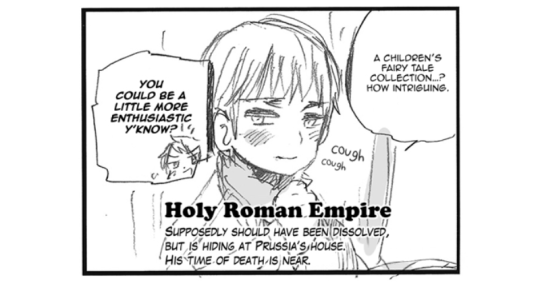
In chapter 187 of World Stars, we learn that Holy Rome hasn’t
died, even though he should have given that he’d already been dissolved at said
time. Still, his end is near as he lays on his death bed.
A “heartbroken” Prussia takes to
consoling Holy Rome by reading the latter Brothers Grimm fairy tales.
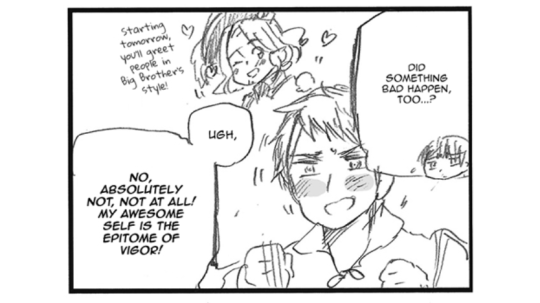
Notice how Prussia is not only grief-stricken,
but he’s also in partial denial. He refuses to accept that he’ll have to be a subordinate
to France and adopt French manners of propriety.
Meanwhile, even while on the verge of death, Holy Rome is
the more logical of the two. He has no problem in skeptically pointing out the
plot holes in the stories Prussia fabricates. (The original tales contained too
much eroticism, so Prussia had to take a bit a liberty when recounting them to
Holy Rome).
Regardless, what’s important to emphasize is the motif of
fairy tales – which will come up again later – as well as Holy Rome’s use of
concrete logic.
In Chapter 222 of World Stars, as Italy talks about feline
nonsense, Germany responds by saying: “Isn’t that a little too fairy tale like?”
I’m sorry, but I really do think that Hima did this on
purpose. Germany’s skepticism eerily echoes that of Holy Rome. Also, when have
you ever heard of a fairy tale that involves cats?
That one piece of
dialogue, trivial as it might seem on its own, serves as a key link to chapters
which would otherwise be completely unrelated.
The answer to the above question, if there aren’t any
inconsistencies with the timeline, is unbelievably fast. So fast in fact that
Germany completely dethrones America’s path to maturity. America goes from a
toddler, to a young child, a young adolescent, and only becomes an adult after
he achieves full independence.
Meanwhile, Germany goes from a young child to an adolescent/
young adult within one year.
No, I’m not kidding. The strips covering both Industrial
Revolutions testify to this claim.
The first Industrial Revolution took place in England in the
late 1800s (approximately 1760) and lasted up until around 1870.
The Second
Industrial Revolution had less to do with the textile industries and more to do
with machinery and steel. That’s where Germany comes in.
At the start of the second Industrial Revolution, Germany
hadn’t unified and therefore lacked behind in the industrial developments that
neighboring countries experienced.
After unification
(1871), this changed, and Germany became heavily involved in the machining
industry. Notice this panel here. Germany is immediately put to work…right
after being born.
That’s not the type of work a child would be capable of
doing, let me tell you.
Germany’s awkward mannerisms as he and Prussia converse with
England makes me believe that he’s a teenager here. He’s still new to the
world, and hasn’t quite figured out how to navigate it.
Here Germany is again, modifying English machinery.
Throughout these strips, Germany is not once shown to be a
child. His aged appearance combined with the phrase “after the unification”, as
well as the panel illustrating him instantly being put to work, hints at a
dramatic and unparalleled growth spurt in contrast with the other nations.
Now, think about this in terms of how relationally-impaired
and awkward Germany is with others. He never got to experience a proper
childhood. In the field of psychology, childhood is crucial; it’s where you
acquire and develop proper socialization skills.
If this is all true, then Germany never had a childhood. Well,
maybe.
He could always be
Holy Rome, but what’s important to reiterate here is that if Germany is Holy Rome, then he’s shown little signs
of remembering this childhood…
I know this might sound like a radical thing to say, but
honestly, after reviewing the strips, there’s enough evidence that points
towards the fact that… yes, Holy Rome never truly
died.
Before I start, let’s just get a few disclaimers out of the
way. Otherwise, this theory won’t work.
There’s a deleted comic where France tells Italy that Holy Rome
is dead. Note the word deleted. As such, the strip should not be taken for
canon value.
Next, there’s also the fact that people have said that Holy Rome
is given a teenage appearance in one of the requests Hima completed for the Christmas
2011 event. If this were true, then there would be a notable inconsistency
regarding his other appearances.
However, to me, this hardly seems to be the case. Holy Rome
doesn’t look like a teenager at all here. He still very much looks like a
child, judging by his height and his size when Hungary carries him in her arms.
It’s important that I mention this, because Holy Rome’s appearance in the 2011
strip is consistent with his appearance in World Stars.
With that out of the way, let’s get to the good stuff. In
chapter 187 of World Stars, we find out that even though he’s been dissolved
and should have died already, Holy Rome is very much alive and is hiding away
in Prussia’s house. He’s still very sick though, as “death is near.”
Since Holy Rome’s so weak, a “heartbroken” Prussia reads him
fairytales, likely to distract the former from the fact that he’s dying.
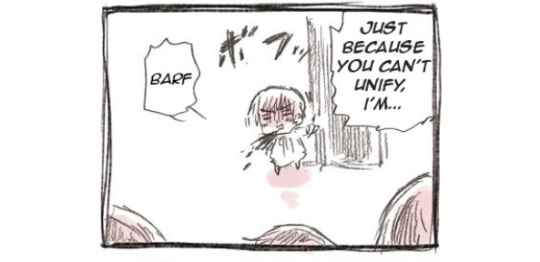
Moving forward a bit, we know that it was Prussia who led
the German Unification movement. He would have every reason to, as we’ve seen
from the Christmas strip how negatively a lack of unity among the German states
affected Holy Rome’s health.
If Holy Rome hadn’t died at this point, which I’m assuming
to be the case, then it would be in Prussia’s best interest to unify the states
and form a stronger country in order to save his younger brother.
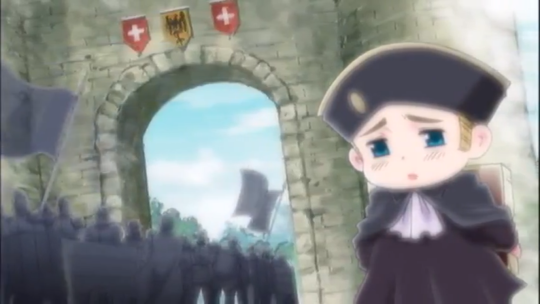
This strip takes us to just before the unification process. Pay
attention to the language used by the German states here. “New Country” and “New
brother.”
It seems like they might not be aware of the fact that Holy
Rome is still alive. Being nations themselves, they would know that it’s
possible for personifications to adopt new titles. But, judging by the words
they use, they believe him to be dead. Because of this, the possibility of Holy
Rome adopting a new title wouldn’t have even crossed their minds.
It seems that only
Prussia knew about Holy Rome still being alive…whenever that strip took place
as it’s not entirely clear. (It’s sometime after the first publication of the Brothers Grimm Fairytales.)
Anyways, before the German Confederation is able to form, Austria, also
thinking that they’re about to form a new country, insists that he will be the one to raise the newborn Germany.
Yadda yadda, Prussia and Austria go to war, skip forward, and now we’re at
Germany’s actual birth (???).
This is so important and I cannot stress it enough. There’s
a massive difference in how the anime portrays Germany’s birth versus how the strips
do.
In the anime, it makes it seem like the German states huddle
together, only to have Germany emerge once they’re finished unifying.
The strips, which I’ll be using as the basis for this
theory, depicts an entirely different reality. When Germany’s born for real, it
doesn’t show the German states huddled together. Instead, it only shows a young
Germany being helped up and/or greeted.
He’s wearing a nightgown…exactly like the one Holy Rome was
wearing in chapter 187.
Yes, I’m aware that the nations are born in nightgowns,
but there’s multiple ways of interpreting this. The nightgown/birth motif is definitely
there, but…
Look at the one German nation holding Germany’s hand. He’s
crying. Now, put this into perspective. How would you feel if you thought your
little brother was dead, only to find out that he’s been alive all this time?
Maybe I’m biased, but Germany being helped up as well as
wearing the nightgown seems as if he’s standing for the first time after being
bed-ridden with illness for who knows how long. There’s also the fact that his
age is consistent with the Holy Romes from the Christmas event and chapter 187.
Which brings me to my next point. At the end of the chapter,
it states that Germany wasn’t born as a baby because he already had an existing
body.
We all know Hima and how much he loves to make puns. What if
“existing body” literally means an existing
body. Holy Rome adopted the title of the German Confederation and became a
stronger nation, but never actually died.
The German identity never died either, despite a lack of
formal unification. Maybe that’s why Holy Rome still managed to exist,
regardless of how physically weak he was.
The only setback to this is that there’s hints of Germany
(aka Holy Rome) suffering from amnesia. Remember that in World Stars, it’s been
made canon that it’s possible for the nations to acquire new personalities upon
changing what they personify.
Now, isn’t it weird that in the same strip where Germany’s
born, Prussia takes to reminding Germany that it’s okay to refer to him as an
older brother…482 times? It’s like Prussia’s attempting to trigger Germany’s
memory in the hopes of getting the latter to remember that he’s Holy Rome.
It would seem that on top of adopting a new title and
personality, it might be possible for the nations to also lose memories from
their past personifications.
It’s reincarnation, and yet it isn’t. I’m going to take the
liberty and coin it as “re-personification” from now on.
Note: This theory makes the assumption that Germany was reincarnated from Holy Rome.
Those who have read the strips will know that a recurring theme is Germany’s love for Italian culture and history; he thinks of the nation as a sort of paradise.
What strikes a chord with me is this specific panel. Here, Germany has a revelation while vacationing in Italy. Basically, because Italy is such a paradise, he understands why Goethe wrote so many poems about the nation.
All right. I’ll point out the obvious first before delving down into the deeper meanings of all this. Both Holy Rome and Germany have a profound love for the Italian nation, which most people see as a link between the two.
What I’ll be proposing is that this reference to Goethe hints at something extremely significant about Germany’s personality and characterization. It strongly alludes to his possible reincarnation from Holy Rome as well.
Goethe is most known for his play “Faust”, whereby the demon Mephistopheles makes a wager with God. Mephistopheles claims that he will be able to succeed in “luring” God’s favourite human, Faust, away from his pursuit of knowledge of all kinds.
What’s important here is that Faust outgrows scientific, religious, and humanitarian-philosophical teachings, choosing instead to learn magic as it will provide him with “infinite knowledge.”
Sound familiar? It should, because we know that Germany is obsessed with science and data.
He’s also quick to deny the existence of the supernatural because it’s unscientific.
However, there are strips that paint a different picture, one that shows that just like Faust moved from the scientific to that which is otherworldly, Germany is too. There are brief moments where he drops the scientific method and reveals that he may in fact be aware of the supernatural.
It’s possible in canon for deceased nations and humans to fly down from heaven and visit Earth. A human example would be Quintillus, an old Roman Emperor.
Previous to this strip, Germany was collecting ancient records of Rome, and Quintillus visits to give a more favourable account of his older brother, Gothicus, who isn’t depicted favorably in textbooks. Initially, Germany dismisses Quintillus as playing pretend and escorts him home.
What happens next is surprising. Germany privately refers to Quintillus as a “Roman boy”, which to me, seems as if he recognizes that it truly was a Roman Emperor who had just visited him.
Pay attention to the shifting of Germany’s mentality; it doesn’t seem like science is upheld within him as strongly as it used to be.
Perhaps the most important instance of this is when Ancient Rome visits Germany. At first, Germany believes this visit to be a strange dream, but soon falls into the swing of things and starts asking questions.
This question in particular is critical.
Again, notice how uncomfortable Germany looks when he asks this. Disappearing, huh? Could this possibly be a reference to Holy Rome and his newest incarnate, ahem, himself? Just think about it: reincarnation is a supernatural and seemingly magical occurrence…
It’s one thing if Germany merely asked about why and how a nation dies, but the discomfort on his face is likely an indicator of a painful memory.
This isn’t that far of a stretch either. Remember that in Buon San Valentino, after embarrassing himself by clumsily proposing to Italy, Germany panics and blacks out.
It’s precisely when people are distressed that repressed memories resurface according to Freudian psychology, and that’s exactly what seems to be the case here. The strip ends with fuzzy memories of Chibitalia.
It appears that Germany’s belief in science is waning. Either that, or he’s resorted to using science as an explanation to deny the reality of his reincarnation.
And with that, comes the repression of memories.
What would you say if I told you that a lot of the nations had
Roman look-alikes – more like clones –
in the far past? Insane, right? Well, believe
it or not, it’s true.
First, there’s Augustus and Agrippa.
It’s crazy to me how uncanny they both look to North Italy
and Romano respectively. Despite some personality differences, they also share
a lot in common. Augustus is charming, charismatic, and weak at fighting.
Meanwhile, Agrippa
wasn’t given the inheritance he expected from Caesar (the title of Emperor). We
see the same thing happen with Romano and North Italy, as the latter inherits
most of Ancient Rome’s wealth once he passes on.
Further, Agrippa also shares Romano’s reserved nature, and
is only kind to those whom he is close with.
There’s also this picture that Germany draws of Italy. It’s almost
identical to the facial expressions Augustus makes.
Note: It’s manga Germany is referring to, not a textbook.
Now here’s Augustus again:
But it doesn’t stop there. There are plenty more Roman look-alikes.
Here are just a few more examples.
Tiberius looks scarily similar to a Sweden without glasses. He
is also feared by those around them and is perceived as anti-social.
Mark Antony looks a lot like Denmark.
Japan resembles Ancientus quite a bit too.
Gothicus looks like Genoa.
Probus too looks a lot like
Norway, and is even stated that he perplexes people and is often misunderstood
for this.
Now, I know what you’re all
thinking, and as much as I want to blow the whistle and say that there is, there
actually isn’t any reincarnation present. Sorry to disappoint. Anyways, what’s happening
here is extremely strange, but also fascinating.
In a brief inter-text character
note, it’s stated that Quintillus is able to break dimensional boundaries and
travel through time. For example, he’s visited Japan and China before. What I want
to talk about more is Quintillus’s recent visit to Germany.
Prior to Quintillus’s visit,
Germany was doing research on Roman history, reconstructing it to make old records
more accurate. It’s for this specific reason that Quintillus visits Germany; to
clarify that his older brother Gothicus wasn’t as bad as people have portrayed
him to be.
Of course, true to his love for
science, Germany doesn’t believe that Quintillus is the ghost of a real Roman
emperor and dismisses him. What’s odd is that in the last panel,
Germany says, “That Roman boy is interesting.”
I don’t know, but to me this
indicates that Germany might know that Quintillus is a supernatural being, but
is only able to acknowledge this in private. You’ll see with Hima that he’s
obsessed with linking Germany to Italian culture and Roman history. Another
Holy Rome hint perhaps?
Nonetheless, let’s get back to the
proof against reincarnation. One would think that maybe as Germany is reliving
history, he imagines it with the faces of those around him, hence the
look-alikes. A sound argument, but the strips prove
otherwise.
Here,
Ancient Rome is seen talking to Probus, Norway’s Roman look-alike.
Then, Gothicus, Genoa’s Roman
look-alike enters the scene and talks about how he’s not positively talked
about in modern textbooks. This confirms that the look-alikes are in fact real
and are not just a product of Germany’s imagination.
If I had to guess, I’d say that they’re
all in heaven in this scene, since they’re long dead. If they exist seperately now, then
clearly, they haven’t been reincarnated into their nation look-alikes.
Still, I can’t help but wonder why
Hima has made them look so uncanny to one another.
In both his and his brother’s character notes, it’s said
that if their curls are pulled, it will cause an involuntary physiological
(bodily) response. Italy Veneziano will say “Ve”, whereas Romano will make a
purring “chigi” sound.
We know that the different parts of a nation are reflected
in their human body. For example, America’s Nantucket or Austria’s Mariazell
ahoges. I say this because I believe that the physiological and verbal response
pulling the curl causes is in reference to a specific body of land, or rather a
part/ governmental organ of the nation.
Yes, “ve” is also an Italian verbal tick/ dialect, but what
you’ll see with Hima is that he likes to play around with words, give them double
(sometimes several) meanings, and make puns out of them. In Italy Veneziano’s
case, I believe the same logic applies.
In other words, ‘ve’ could be attributed to the dialect and the city of Venice, which is commonly
believed to be North Italy’s first title as a personification. Although, if it
is in reference to a dialect/verbal tick, North Italy doesn’t say it nearly as
much as China does with his “aru”, which makes me think of it more in terms of a
reference to a body of land, rather than speech.
Anyways, in Romano’s case, I think it’s a reference to the
Palazzo Chigi in Italy’s capital, Rome. It’s where the Prime Minister of Italy
resides. The point here is that we already know that Romano does his fair share
of work for his government.
If that’s the case, then this reference only reiterates his
purpose as a second personification for Italy. This, of course, is in addition
to him representing the cultural differences of those from the southern regions
of the nation.
Further, we know that Ancient Rome left behind a legacy.
Italy inherited his charm, artistic aptitude, and wealth. Meanwhile, it’s not
very clear what Romano inherited from Ancient Rome… not unless you do a bit
of digging. What I’m arguing is that Romano inherited the role of governance
from his grandfather.
That doesn’t mean to say that North Italy doesn’t do his
share of government work either, because he does, just not nearly as much as
Romano nor with the same amount of commitment.
So? What about them hints?
When visiting Italy from heaven, Ancient Rome remarks that
Rome (as his capital) acted as his heart. Well, what if Romano inherited that?
Italy Veneziano is likely a reference to Venice as stated above, and as such,
Romano is just as likely to be derived from Rome – where the governing happens.
If you take a closer look at Ancient Rome, he resembles both Italy brothers depending on the emotions he’s experiencing.
It’s not just Italy Veneziano who looks like Ancient Rome. Some of Romano’s expressions makes him a near clone of his grandfather.
Hard to tell the difference, right? Overall, it would seem
that Romano inherited quite a bit from Ancient Rome, contrary to popular
belief.
We all know Prussia’s
East Germany, and yet, Hima hasn’t directly referred to him as such. He’s only
been referred to as East and is also stated to have fallen under Russia’s
control after WW2, working unprofitable jobs.
It’s like Hima enjoys toying with us, leaving hints literally
everywhere. But, I mean, it’s not like he would make a hint so obvious that he would make use of a symbolic
wall in the strips…
DAMN IT, HIMA. SERIOUSLY?!!
And lest we forget about this beautiful strip, where Taiwan
and Hong Kong are moving furniture. Move it to the east and west, you say? Well,
wouldn’t that be a convenient excuse
to sneak in another Berlin Wall reference and have Germany or Prussia pop out
of nowhere.
Well played, sir.
Well played.
I’m still not too sure about this one, but since this is
also another thing that’s been heavily requested, I have no problem explaining
what little I do understand from it. That is, if there is even any thing to
make sense of…
We’ve seen that the nations can transport or travel across
borders in a short period of time. The first thing I’ve noticed about this
ability is that it requires some sort of connection. In the “We’re Shipwrecked”
strip, since China has villas – China towns – all over the world, he’s able to
use them as a method of transport, travelling as far as the island of
Seychelles.
In the Christmas 2011 Event, this idea of connection comes
up again as Russia proposes to Japan that they build a bridge in order to
connect their houses, making it easier to travel.
However, there are times when transporting is difficult for
the nations. In my opinion, I think distance is the key factor here. For
example, we see that Italy travels to Germany by crossing over through
Switzerland on foot.
In the 2010 Christmas Event, we also see Finland travelling
to Sweden’s and Germany’s houses without any difficulties. On the other hand,
when asked to interview Seychelles and Greece, Finland either mails or texts
them.
For Seychelles, Finland states that “her land is a bit far.”
You also likely have to factor in the obstacles of water (or mountain ranges,
deserts etc.) in travelling, as not all countries are connected by land, or if
they are, it’s not always flat and easy to travel across.
It seems that distance and connections between landmasses is
what allows and/or inhibits the nations to travel on foot, as opposed to more standard
means.









 Ellawritesficssometimes