Actual footage of me hiding my Hetalia obsession.


Note: This post
is making the assumption that Germany was reincarnated from Holy Rome. The rest
is all canon material.
All right! In canon, we know that reincarnation is possible.
The most obvious example would be Jeanne d’Arc and her American reincarnation,
Lisa.

What people often forget is that Hima explicitly states that
it’s possible for the nations to be reincarnated too.
In these panels, Hima makes it clear for us what a nation’s
existence and lifespan is like. They can last for really short or really long
periods of time and can be brought back by a sudden memory. More importantly, is
that nations can change their titles and ultimately, their personalities.

Following this logic, this would explain why Holy Rome and
Germany share some personality differences.
Where Germany is more clear-headed, rational,
and organized, Holy Rome is emotional and sensitive, irrational, impulsive, and
disorganized. I think Hima does this on purpose as a pun to contrast how at
first, Holy Rome was a disorganized collection of nation-states and then became more organized after unification and the subsequent formation of Germany.

Just to highlight this, I’ll go over some quick examples. We
see some of Holy Rome’s impulsiveness not only with his obsession and
compulsion in getting Chibitalia to live in his house, but also in his
interactions with other countries.
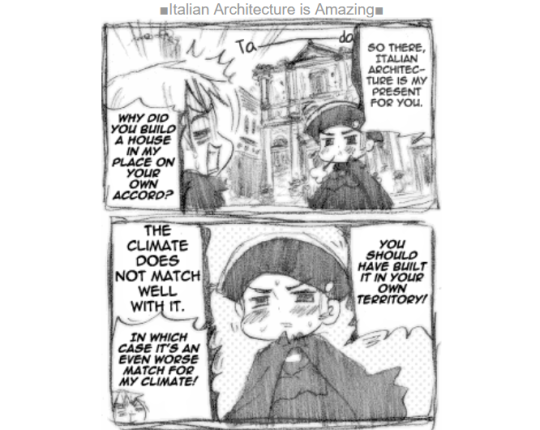
What immediately comes to mind for me is how Holy Rome built
an Italian home in England, without even considering how the architecture
wasn’t designed to endure the harsher English climate.
It would be unprecedented for Germany to pull off something
like that, as he’s always rationalizing and thinking things through enough
times to drive anyone crazy.
You see the organization pun come to life with Germany’s
love for schedules, manuals, and the scientific method. Overall, he’s a much
deeper and rational thinker than Holy Rome.

Further, with unity, comes a stronger sense of national
duty.
On the other hand, due to the fragmentation in his empire,
Holy Rome doesn’t seem to care what happens to it and is more focused on
chasing after Italy. He’s even scolded for neglecting his duties by
Switzerland. Tell me, have you ever seen Germany slack off?

That said, there are more similarities between them than
differences, and Hima sure loves to stress this all throughout the series. They
both share a love for the Italian culture and climate, are flustered easily,
love sweets, own dogs, have Prussia as on older brother, and…
there’s also the obvious fact that they look exactly alike.


[America and Canada having a sleepover]
America: Hey.
Canada: Go to bed, Alfred.
America: Do you ever wonder why we don’t have microwaves that blow cold air?
Canada: Go to bed, Alfred.


Before, I’ve speculated that the reason Italy has his eyes
closed is that he doesn’t see the truth of the world. First, he was sheltered
by the protection his grandfather provided for him and didn’t realize how
brutal the world truly was.
Then, I argued that after the traumas of being conquered and
losing Holy Rome, Italy kept his eyes shut as a conscious decision. In other
words, he refused to see the truth around him.
Following said logic, this would explain why Italy rarely
opens his eyes in front of Germany. Perhaps this is him not wanting to
acknowledge his uncanny appearance to Holy Rome. He may even realize that
Germany is connected to Holy Rome in some way or another, but chooses to ignore
it, sparing himself from the painful reminder of his first true love.

However, that’s not what I want to talk about in this post.
What I do want to talk about is that the Italy we know and love is hinted at
hiding another side of himself…a scary one too.
In the Christmas 2011 event, Italy is requested to keep his
eyes open for a long period of time. Italy’s shocked response prompts Germany
to comment that it can’t be that difficult for him to do so.

What I find suspicious is that Italy conveniently falls
asleep in the following panel, almost as if he doesn’t want to open his eyes.
Given the context, it also wouldn’t make sense for him to fall asleep during Christmas,
as he’s known to love being around people and adores any kind of festivities.
This is completely out of character for him.

Even stranger is that when Italy does open his eyes, he
later remarks that it’s best if he keeps them closed. Okay…


So, what about this side of himself he’s hiding? Well,
there’s one strip that disturbs me every time I think about it, that being
“Mind-reading Binoculars.”
Here, Japan invents binoculars that reveal what
people are thinking. After pointing it at Italy, Japan doesn’t believe what he
sees and concludes that the binoculars are defective. On the contrary, I think
this was purposefully done and that they do in fact work properly.

Scary, right? And yet, it also makes sense for Italy to
possess such a dark side (rather than his excessively cheerful, albeit insecure
one) to him given how brutal his history has been. Once again, we return to
this motif of truth and hidden secrets. Hima’s definitely going somewhere with
this…but…
Would you believe it if I said he’s been planning this other
side of Italy right from the very start?
When Germany first meets Italy, Italy is hiding in an empty
tomato crate and pretends to be a fairy. Germany’s word choice is quite eerie
in this particular scene.

I’m sorry, but “show your true self” (?!). Why so
specific? That is, unless the word “true” has an alternate meaning in terms of
Italy hiding parts of himself.
If so, that’s quite possibly the most brilliant
foreshadowing I’ve ever seen.
I’ve also noticed that when Italy opens both
eyes, it functions as him reassuring someone and/or telling them the truth of
his intentions/ actions. Roughly speaking, it’s comparable to Pinnochio…
Pin-eye-chio… Nah, it doesn’t have quite the same ring to it.

Back to the Christmas Event, this also might explain why
Germany immediately covers Italy’s face once he opens his eyes. How I see it is
that it symbolizes how Germany may indeed know about the truth of his past, but
decides to cover it up and ignore it as opposed to confronting it.

Anyways, every time Italy tells the truth, his eyes open.
So, is he living a lie then? I really do think Hima’s going somewhere with
this, and encourage all of you to look at any examples where Italy opens both eyes.

How they came to be:
At just 20 years old and
now a Sergeant, Ludwig Beilschmidt is taking Berlin’s criminal underground by
storm. He was bred into this lifestyle, having inherited his family’s blue
blood footsteps. He’s a genius (literally) at what he does, and seems to be
able to crack the mind of any culprit he investigates. His mind works like a
clock; calculated, timely, and efficient. There is nothing he can’t figure out,
and is often spotted thinking to himself, so absorbed in his thoughts that you
can practically hear the cogs whirring in his brain.

Among his colleagues, he
is viewed as obstinate and stiff, but is still very much respected for the
outstanding reputation his hard work has contributed to the force. Some say
that he never blinks, let alone sleeps. The tell-tale sign that something is
wrong is when you don’t hear the click and scratch of a pen, that and the
furious patter of typing up reports.

Being on the streets is
another matter entirely. He specializes in cracking down on drug syndicates,
and is comparable to a military commander with the way he and his dogs snap at
the heels of those he’s pursuing. He’s ruthless, obsessive, stubborn, and
refuses to give up until the culprit is behind bars.
Those who are closer to
Ludwig, however, know there is a darker side to him, one that is better left
uninvestigated. A bloodhound himself, Ludwig knows when he is being watched by
those jealous and skeptical of his achievements. There are rumours that he has
an extremely short temper and will completely snap at the mention of his older
brother’s suspected mental illness. It’s best to give Ludwig his space and to
not keep too close. He’s not very sociable, nor is he much of a people pleaser.
Socializing and formalities simply aren’t his forte.

This is just speculation,
but supposedly two officers who suspected Ludwig of using corrupt methods in
gaining evidence were killed in a hit-and-run incident. The reports, Ludwig’s
reports, have deemed it as an accident. There are many who believe otherwise,
but are too afraid to speak up and accuse him of any wrongdoing.
Foul play is indeed
suspected in Ludwig’s work, but he’s established himself to the point that it’s
nearly impossible to challenge his authority – no – his reign over the other
officers.
Killing Methods:
True to some of the other
officers’ suspicions, Ludwig is in fact a very naughty cop.
After agreeing to absolve
their charges, Ludwig formed a mutually-binding contract with two ex-Italian
mafia members. The deal goes as followed: The Italians act as spies and give
him information about the criminal world, and in return, Ludwig lets them seek
refuge in his home, guaranteeing them full protection.
The Italians aren’t the
only ones who get their hands dirty, though. Ludwig has no problem murdering
anyone who obstructs his work, especially
if they’re criminals. His favourite code word is vacation, as his colleagues
know that he has a vast appreciation for them given how hard he works.
Ludwig’s vacations, in
reality, are trips he takes to Switzerland in order to get rid of the bodies of
those whom he and his partners have murdered. Ludwig uses brute physical force
in his interrogations and has killed people on accident more than anything
else. Nonetheless, if he does intend to kill someone, Ludwig is practical and
will go for the neater option. His creativity had once led him to kill a person
with none other than a bottle opener and a single toothpick.

Inner Psychology:
The motto Ludwig and his partners run by is:
What goes around, falls
underground.

That is, they hold a
pessimistic view of life itself. They have very little faith in people,
including themselves, and therefore see their jobs as getting rid of the worst
of the waste rather than the whole garbage dump. All humans are corrupt to
them, so they have no problem getting rid of lower-scoring humans on the
immorality scale. Their job is simply to stay afloat and to sweep away the
toxicity criminals bring into the world, which sometimes includes an occasional
piece of trash here and there. Switzerland, then, as a hub for criminals, is
the perfect place for them to dump their victims.

Note: This post will be looking at potential hints of female pairings or same-sex attraction, as requested. For the most part, the nations I will be mentioning have in fact shown attraction to males too. A more complete post on the nations’ sexuality will eventually be made, though. The examples shown are not all of them either. There are plenty of them, believe me.

Okay, let’s get it out of the way right now: Monaco and Taiwan
are hitting up the charts with their heavily hinted – but not confirmed – attraction
to girls. It makes me incredibly happy to see this possible representation in the
comics, and I’m even more excited to share it with you all.
First, there’s the 2011 Christmas event. There, Taiwan
states that she is unable to concentrate due to the amount of cleavage the Western
female nations are showing. Monaco then reassures her and sweetly waves it off.
Taken alone, this may not seem significant, but you certainly see progress with
Taiwan as you flip forward into later strips.

Now, let’s go over some panels included in the Halloween
2013/2014 event. After spotting Belarus from afar, Taiwan literally exclaims “Gorgeous
lady at 12:00 o’ clock!” and then proceeds to complement Belarus with notable
excitement.

And then comes Ukraine.

I mean, there’s really not that much to say. You can see it
for yourselves: there’s a clear blush on Taiwan’s face and she looks just a little
bit too happy to see Ukraine’s (breasts), don’t you think?
Don’t believe me still? Here’s Taiwan blushing, complementing Vietnam,
and just looking plain elated to be surrounded by them. She doesn’t seem to be
so shy about these feelings anymore.

There also appears to be this scheme where Taiwan purposefully
made Vietnam’s costume smaller and tighter than what it should be, as the costume
is her size as opposed to Vietnam’s – Taiwan is significantly smaller than Vietnam.

Lastly, there’s Monaco, who comments that Ukraine looks “modestly
sexy.” Again, when taken on its own, it doesn’t seem like much.

However, when asked if she would wear a revealing costume,
Monaco says that she’s better at being an onlooker and is then compared to an
old man by Taiwan. I don’t know, I read this as Monaco embodying something akin
to a male gaze…an appreciative male gaze. There’s also the stereotype that old
men are more perverted; obviously this isn’t the case, but it’s a pretty common
gag.


Take what you want from what I just presented, but I personally
believe there is enough evidence in the strips that at the very least hint at the
existence of same-sex attraction among the female nations.


Due to popular request, I’ll be starting to analyze the several instances in the series where it’s alluded that Germany is Holy Rome in some way or another. There’s too many of them to include all in one post, so welcome to yet another new sub-series!
You’ll notice how subtle these hints are, as well as how uncomfortable they make the nations feel as they recall certain memories. Without further ado, let’s get started.
First, there’s England. In the “About why there is Italian architecture in England” strip, France shows surprise at the sight of an Italian-styled house in England and even praises it. England then has a flashback of when Holy Rome gave him this house as a gift, despite it not being suitable for the harsher English climate.


Note the expression on England’s face once the flashback ends. Sure, the reminder of Holy Rome’s legacy must be painful to relive, but why become so nervous and uncomfortable? If he was sad, I could understand, but the former two emotions make me think that something is still unresolved in the present; that is, England is reminded of how HRE is still around today except in the more modern form of Germany.
It almost seems as if the nations are aware of Holy Rome’s reincarnation/rebirth/ revival (whatever you want to call it) but don’t have the courage to tell Germany about his past. It’s not really their place anyway.

Then, you have France. We already know from the Napoleonic Wars, the first world war, as well as the German military occupation of France in WW2, that France has every reason to hate Germany, and is even depicted stating so.

In modern times, he still shows an evident aversion to Germany. Call this a stretch if you want, but I interpret a lot of this aversion more so in terms of guilt. Napoleon’s army ended the Holy Roman empire, after all.
However, it’s also important to note that recently France has slowly been starting to spend more time with Germany and is noted to no longer hate him.

In the “Germany’s playing an impossible game” strip, France is shown to be secretly backing Germany, referring to himself as the latter’s Big Brother. (Yes, I’m aware that France considers himself the Big Brother of the world).

What makes me suspicious is that in a few panels below, Hima mentions how France and Germany’s economic relations in the EU isn’t always agreeable and that they don’t see eye-to-eye in a lot of matters.

Why am I mentioning this? Well, flip back to when Holy Rome and France lived in Rome’s house. They used to refer to each other as brothers then too – they’re not actual brothers, it’s just a form of endearment.
Historically speaking, I can understand France’s grudge towards Germany after the Napoleonic wars. What I’m curious about is that even in modern times, well after WW2, France still appears to be hesitant/ walking on egg-shells around Germany.
That’s why I believe France is not completely open in his support for Germany. Again, I think he still feels guilt for causing the Holy Roman Empire’s demise and doesn’t know how to compensate for this.

Lastly, as I couldn’t possibly leave him out of this, there’s Prussia. Prussia is the one who tells Germany all about his past, being his older brother/ father figure. I say father figure sarcastically, because Prussia is lame enough to be wearing a Dad shirt in the 2011 Christmas event.

Anyways, in that same event, Japan and Italy reminisce about how Prussia, as the Teutonic knights, used to be. Germany expresses his confusion towards these stories by shouting, “What is that brother of mine doing?!”
We then get a brief bit of inner dialogue from Japan, who also seems confused over the fact that Germany believes everything that Prussia tells him about his past. Perhaps Prussia is purposefully fabricating parts of Germany’s birth to spare him from the pain of remembering how he had died before.
More notably, Germany remarks that he’s going to cross-examine Prussia, which may mean that the truth (whatever it is) is going to be revealed to him. Now that’s exciting.

On that note, there’s one last thing I want to talk about. In “The Guns of Italy and Germany”, Germany is completely bewildered by the shoddy guns Italy makes, all for the sake of making them easier to clean. When he asks Prussia if Italy has always been like this, Prussia ominously stares off into the distance and tells him this:

Hmmm. Another potential hint that just like Holy Rome had an ‘appreciation’ for Italy, Germany will eventually develop one too? Questions, questions. So many strips and not nearly enough confirmations…

The answer to the title is no, by the way. To
elaborate on why I believe this is, it’s important to understand that the modern
definition of a nation-state is much different now than what it was centuries
ago. People often organized themselves in terms of city-states, kingdoms,
principalities, or small territories.
That said, during the Renaissance era, Italy
consisted mostly of small city-states. This would explain Italy’s full name,
Italy Veneziano, an obvious reference to the city of Venice. This fragmentation
was due to the larger foreign powers of Austria, Spain, France, and the Holy
Roman Empire coming in and taking land for themselves.

However, as I just said, Italy Veneziano is
repetitively referred to as North Italy, which simply includes Venice. He
doesn’t only represent Venice. I
don’t mean to say that North Italy wasn’t born
to represent Venice, though. That certainly seems to be the case. What I am
saying is that as the concept of a nation changed, so did Italy. He likely absorbed
the entire northern region. I mean, we’ve already seen this multiple times in
the series where nations adopt new lands and titles. Take the Teutonic Knights
and Prussia for example.

Now, this wouldn’t be a theory if I didn’t have any evidence, so here.

Then, at the end of the strip, North Italy mentions
that parts of his house were taken. We already know that a nation’s house, or
rather, an empire to be more applicable to the time period, consisted of other
nations under their rule. However, in Italy’s case, his house consisted of the
many different sovereign city-states of northern Italy.

So no, I wouldn’t worry about Italy Veneziano
disappearing anytime soon just because Venice is likely to sink in the coming
years. He’s got the whole rest of northern Italy to embody.
Further, and as I’ll get into with a much, much larger post, there is no dominant
Italy – between the two Italian brothers, I mean. The south and north are different
enough for them both to personify the land, and Hima makes sure to mention this
countless times.
France: *exists*
Drunk England: Stop seducing me, you sparkly thot.
 Ellawritesficssometimes