image

Note: While I
disagree with a lot of South Korea’s characterization in the series, his shortcomings are not the intended focal point of this post, as designated by the
title. Just wanted to acknowledge that and make it clear.

image

South Korea’s curl is said to represent his soul…probably.
However, knowing Hima, I think this may just be a pun for South Korea’s capital
– Seoul. It’s often said that a capital city is the soul of a nation; they’re
cultural and political hubs that show off its best features.

image

It’s also been speculated that South Korea’s curl represents
the yin-yang symbol on their flag. I believe Hima incorporates this sort of
symbolism more so in how he characterizes South Korea’s polarized personality.

The red half (Yang) symbolizes positive cosmic forces, and
is often associated with the sun and warmth. The blue half (Yin) symbolizes
negative cosmic forces, and is often associated with the moon, darkness, and
coldness. Taken together, the yin-yang is supposed to represent the balance of
the Universe, as well as the mind, body, and yes – the spirit (i.e. soul).  

What I’ll be arguing here is that South Korea is given two
distinct personalities in the series. He’s either very joyous and full of
energy, or there are other times where he seems insecure and unsure of himself.

image

The running gag with South Korea is that he falsely claims
to invent things. He’s very cheerful, and often bugs China and Japan.

image

On the other hand, there are plenty of times where he’s not
depicted this way. For example, Japan shows confusion at the fact that South
Korea willingly makes Japanese food for other countries and mimics his behaviour,
despite the fact that South Korea ‘hates’ him.

There’s another instance where he gets Japan to watch
one of his K-dramas. To me, it seems like he wants Japan’s praise to act as
some sort of validation. He’s mimicking Japan, and appears to be vying for his
approval. Given their economic relations after WW2, I wouldn’t say this is too
much of a stretch.

image

South Korea’s hidden insecurity is revealed further in the
strip where Japan creates mind-reading binoculars. After using them on China,
South Korea refuses to believe that China doesn’t want him around and denies
the truth of the binoculars. He thinks they don’t work properly.

image

In terms of his appearance, South Korea’s photogeneity and
obsession with photoshop is likely a reflection of the cosmetic and plastic surgery
culture in his country. South Korea has one of the highest plastic surgery
rates in the world, and as such, this is often linked to their extremely high
suicide rate, especially among young adults. Beauty is everything in the
country, and it would seem this is important to South Korea too as he
photoshops every-day photos of himself, perhaps unhealthily.

image

There’s also the fact that whenever a photo is taken of him,
it’s impossible for it to be unflattering. He’s naturally photogenic, and yet, he
still takes great lengths to perfect his appearance. Again, I think this is
just reflective of his nation’s notion of beauty and self-care.

image

Lastly, South Korea is shown to have an uncertain relationship
with America. In an uncompleted strip, he immediately agrees to whatever
America says.

image

Then, in another strip, South Korea mentions making a movie
and showing it to America. Once more, we see how he may possibly be trying to
gain respect and validation from the other nations.

image

Overall, it would seem that South Korea isn’t simply a happy
and flat character. Instead, his personality is notably polarized, and there
are indeed moments where his insecurities reveal themselves. It just so happens
that his curl might symbolize these opposite personalities.

image

So, about the whole Prussia situation: since nothing is
confirmed in canon, I’m going to keep coming up with possible theories and
explanations. All of which, in my opinion, make some sort of sense. This time,
I’ll be presenting evidence that suggests that Prussia is neither dying, a
nation, nor quite a human.

image

In “It’s a treasure box of countries”, we’re given a
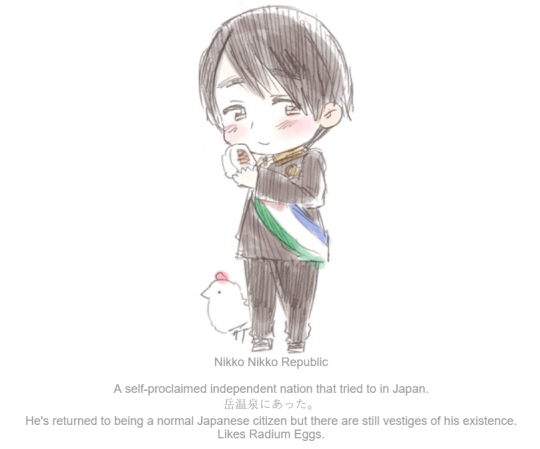
goldmine of information with regards to the rules of nationhood. We learn that NikoNiko,
a human who achieved micro-nation status, went back to being a regular citizen
and human. It’s also stated that it was difficult for NikoNiko to revert back
to being a human, despite resuming normal aging again.

image
image
image

However, the last two bits of information are crucial.
First, we learn that when a nation’s culture or personality dies, said nation
in question will fade; that or the nation entrusts themselves to their
successor. That’s what most people, including myself, have speculated about
Prussia’s fading status as the personification of East Germany.

image

On the other hand, Hima also drops this last little bomb on
us.

image

Yes! It’s possible for the ex-nations to become political
representatives, as opposed to personifications. What’s more, we’ve seen
Prussia attend world meetings with Germany. For example, in the strip titled
“Germany’s Playing an Impossible Game”, Prussia is seen attending an EU
meeting.

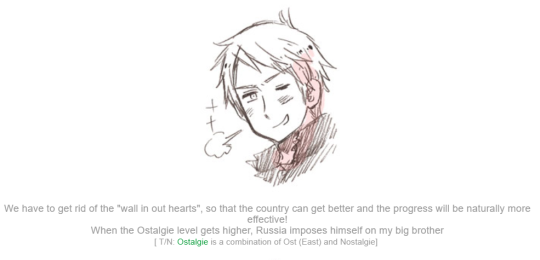
Further, I think this may be a typo on the translator’s
part, but Prussia at the end of the strip states:

image

For the sake of this post, I’ll be making the assumption
that he actually said, “the wall in our hearts.” Why? Because we’ve already
seen with Sealand that the nation’s landmasses are reflected in their physical
bodies. What I mean by this is that because Sealand’s landmass is a minuscule

fort, being a nation would be hard on his heart.

image

Simply put, it would seem the hearts Prussia is referring to
relates back to German Reunification following the fall of the Berlin Wall. Yes,
we get it, it’s very heavily implied that he’s East Germany (especially with that nostalgia pun, geez). Just call him it already, damn it! Enough with these
roundabout East and West nicknames.

Anyways, why do I think Prussia’s a representative then?
Well, aside from the fact that he’s attending world meetings, we’ve seen in the
“Private Concert” strip that he doesn’t heal from his injuries quite as fast as
a regular nation would.

Is he a nation? Probably not.

Is he a human? Not sure.

Is he a representative?

At the very least, he sure seems to be.

image
image

There’s so many subtle hints and Easter Eggs that Hima
includes in his story-lines that I just have to talk about, since they appear to
be dismissed very easily. The amount of detail he puts into each strip, the
placement and sequence of the panels, the symbolism, and the foreshadowing he
uses to connect seemingly random strips together is sheer brilliance. With that
said, let’s start this new series!

In the “Lithuania’s Outsourcing” strips, Lithuania moves in
with America after WW1, as his economy had been experiencing a serious economic
recess­ion.

Immediately,
England gets suspicious, and being the nosy person that he is, he decides to
investigate if Lithuania’s being treated right by America. To me, this just
seems like a subtle form of jealousy in the sense that America is spending time
with someone else.

image

Anyways, America greets England by serving him coffee, which
is noted to be out of spite due to his lingering grudge from the Revolutionary
War. It’s a petty way of getting the last laugh over the situation.

image

Later, in the “Cleaning Out the Storage” strip, America reminisces
about said war and experiences several flashbacks. What Hima does next wraps
everything up subtly, and that’s what makes me admire his craft so much. You
can either enjoy Hetalia for its superficial face value, or you can look deeper
and find nuanced little details…well, everywhere.

image
image

Regardless, the scene ends with Lithuania serving America,
yes, coffee. This is the perfect conclusion in my opinion, as it reveals how
broken and fragmented America and England’s relationship is. It’s just the
right amount of conflict: 

You can see how
fond America is of his early days with England, and yet, it’s clear that he’s
not ready to let go of his grudge just yet.

image
image

                                        LEGALLY AMERICAN:

       “If you’re going to let one controlling prick steal your              freedom, you’re not the country I thought you were.” 

image

       “I don’t need back-ups. I’m going to rule the world.”  

image

                                    “Just bend – and snap!”

image
image
image

A long-standing joke in the fandom is that because England’s
food is poor, America inherits said lack of taste from him and can therefore
eat it without a problem. However, evidence from the strips point otherwise. Just
like he chooses to read the atmosphere or purposefully ignore it, it seems that
America also chooses whether or not to give his true opinion on the food he
eats.

For example, in the sixth comic diary, an adult America reminisces
and bashfully admits that England isn’t very good at cooking.

image

He then has a flashback of his childhood, where his younger
self comments and shows disappointment in the fact that England has burnt his
food again. He also remarks that France is a better cook, which demonstrates
his ability to rank food according to taste.

image

What I’ll be arguing is that America doesn’t want to hurt England’s
feelings, and pretends to like his cooking instead. This is clearly seen in the
strip, as young America notices how intently
England watches him as he eats.

In other words, he wants to make England feel better. Quite frankly,
if England was giving me that look, I’d find it hard to tell him the truth too.
England’s reaction after America tells him that he likes the food is too cute
for words – it’s absolutely priceless – and this is likely why America keeps up
this façade.

image
image

Then, in another strip titled “America and England”, it seems
that America has become so used to ignoring the taste of food, that he’s
forgotten what ‘good’ food tastes like. That’s where I believe his ‘alleged’ lack
of taste comes from.

image

Why do I say this? Because there’s also instances where
America becomes aware of how bad the food he’s eating is, and has no problem making
his opinion known about it. It’s also important to mention that when he does
this, it’s usually in retaliation to England’s insults.

In other words, the moment England is rude to him, America is
no longer worried about trying to avoid hurting his former guardian’s feelings
and gives his honest opinion on the food. Here are just a few more examples:

After being called a collection of hicks by England, America
opens up about how awful the former’s scones are.

image

America is also known for hating the taste of marmite.

image

So, there you have it. It appears that America’s lack of
taste is more of an aversion to hurting England’s feelings. He may not openly
show it, but America truly does care about England; it’s the small hidden
details that you especially have to look out for with them since they’re both so stubborn.

                         Mean Nations, Annexation Powers: 

Austria as Regina George –  

“Get
in, demon douche, I’m heading the Holy Roman Empire.”

image

France as Gretchen Wieners – 

“I’m not sorry that people are so jealous of moi.” 

image

Spain as Karen Smith – 

“Yeah, but he’s my favourite colony…see you got your other
colonies, then your favourite colony…that’s
not right is it?”

image

Prussia as Cady Heron – 

How come your eyes are red if you’re German?

“I used to be a Baltic.”

image