image
image

This post will use
Adlerian theory to examine England’s personality. What I’ll elaborate on is how
he suffers from both an inferiority and superiority complex.

 What’s an Inferiority Complex? 

image

An inferiority complex
is a “condition that develops when a person is unable to compensate for normal
inferiority.” These individuals typically possess poor opinions of themselves
and feel helpless/ unable to cope with the demands of life.

In other words, these
individuals cannot accept that it’s a given that other people will be better
than them, either in a given task or life in general. If they come second to
someone, they take it personally and neurotically believe that it’s reflective
of their self-worth.

There are three
potential sources in childhood that can lead to the development of an
inferiority complex. For the purposes of this post, we only need to know about
neglect, which England experienced.

Neglect in childhood – from this psychological framework – entails
the child being met with an indifferent/ hostile attitude by their parents/
parent figures. As such, the children can develop feelings of worthlessness,
anger, and view others with distrust.

image

England’s Inferiority Complex: 

France and England’s
older brothers – Scotland, Wales, and Northern Ireland – step in as England’s
parent figures.

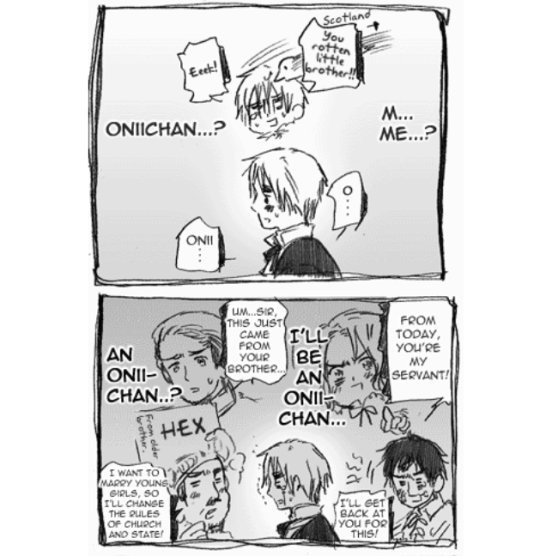
Ex: Since England’s
older brothers would hex and degrade him any time he got near, this satisfies
the indifferent and hostile attitude requirement.

The cycle continues when England, having developed a poor sense of self-worth from the above rejection by his siblings, doubts whether he’ll be able to act as a proper older brother figure to America.

Notice how he cries as
he recalls these unpleasant memories from his childhood. Initially, he doesn’t
even want America to refer to him as onii-chan, but rather, just “England.”

image
image

Likewise, France’s
constant insults toward England, while intended to be teasing, is taken to
heart by the latter. He truly believes France when he says that he’s
“unrefined”, as in being behind on fashion trends.

image

Ex: France mocks
England’s hair for being outdated and ‘unrefined.’

image
image
image

Ex: England’s later
shown to be depressed over France’s comments and becomes insecure about his hairstyle and his failed attempts to change it.

image
image

Ex: England’s worry over
being unrefined is overcompensated for when he spies on France to get ahead of
fashion trends.

This way, his early-bird
conformity prevents him from being subjected to France’s comments. While he may
deny it, England does care about France’s opinion of him. He’s not as confident
as he tries to play himself off.

image
image

Ex: England undermines
France by vowing to have the latter become his vassal.

image

The feelings of
worthlessness that England attained is most seen in how self-deprecating he is.
Overall, he’s an extremely critical person, of both others and himself.

Ex: He’s recently noted
to have become more critical of himself than others.

image
image
image
image

The helplessness that
England experiences stems from his loneliness. He turns to the world of fantasy
(his magical friends) and fiction because it’s a more ideal and less painful
world.

image

The reason for this is
that he’s said to have trouble expressing himself. He often rubs people the
wrong way and isolates himself as a result. The irony is that England knows
that others misunderstand him, but doesn’t do anything about it. Instead, he makes self-deprecating jokes about himself [x].

What’s a Superiority Complex?: 

image

A superiority complex is
a “condition that develops when a person overcompensates for normal
inferiority.” These individuals can be vain, boastful, self-centered, and tend
to degrade others.

England’s Superiority Complex:

image

From England’s
inferiority complex, we know that he grew insecure about being weak and
unrefined.

In return, he
overcompensated by striving to be the best, most powerful nation.

Ex: England boasts about
his empire.

image
image

Even more interesting is
that after America surpasses him as a stronger world power, England attempts to
gain back this strength through physical training.

image

What’s important is that
he feels slighted by his inferiority and engages in a vain attempt to secure
his status once more, albeit failing.

As mentioned, England is
a very critical person.

Ex: He leaves scathing remarks on America’s movies.

image
image

Ex: He picks apart at everything America says during world meetings – most
of it is ridiculous anyway.

image
image

Ex: He and France have consistently insulted and bickered with each other
for centuries.

image

Point is, the insults
and criticisms are reflective of his own insecurities. Insecure people will
often degrade others in order to feel better about themselves.

In conclusion, while
England may be a bitter and pessimistic person, especially in the years
following the American Revolution [x], it’s imperative to realize that he’s just as
critical of himself.

The best thing about his
character is his uncertainty. He flips from being kind and sweet when he’s
feeling secure of himself to rude and bitter when he’s insecure. Lately,
however, this critical nature has become increasingly internalized…

image
image
image

Note: This
theory will make use of Freudian theory. While I recognize that Freud’s ideas
do not bear much contemporary relevance, that shouldn’t take away from the fact
that many of his concepts (e.g., erogenous zones, childhood memory repression,
catharsis) are nonetheless employed by Hima in the series. The purpose of this
post is to give some insight into the psychologies of the characters.

image

Terms I’ll go over: Psychosexual stages of development, Causality, Oedipus
Complex, Electra Complex, Penis Envy, Castration Anxiety.

Yes, that’s right. Freud’s ideas are very much prevalent in the
series. A big area of his work was analyzing the impact of childhood on
personality development. Freud believed in causality, meaning that who you are as
an adult can be directly traced back to your childhood.

How you’re parented and
brought up is the most crucial factor. I don’t need to go into this in too much
detail, but basically, we go through five stages of development titled: Oral,
anal, phallic, latency, and genital.

For the purposes of this
post, I only need to talk about the phallic stage of development.

The phallic stage occurs
between 3-4 until 6-7 years of age. This stage involves the awakening of sexual
desires. However, I cannot stress this enough that the sexual desires are
autoerotic, meaning that the child does not derive any sexual pleasure or
stimulation.

Basically, the child merely
becomes aware of the fact that their genitalia differentiates them physiologically.
This would involve them developing a curiosity of their genitalia given that
they’ve gained a newfound awareness of it.

image

Another tenet of the stage
involves the child being unconsciously attracted – again, not sexually – to their opposite-sex parent and developing a
hostility toward their same-sex parent.

For example, it’s common for
little boys to claim that they want to marry their mothers when they’re older. The
love isn’t sexual, at all. It’s predicated on the child wanting to be closer to
their opposite-sex parent.

If anything, the stage
involves a perceived competition between the child and their same-sex parent
for the attention of the opposite-sex parent. Put another way, a little boy
would perceive his father as a barrier to receiving his mother’s full love and
affection and would thus develop a hostility toward the father.

It’s all unconscious. The child
doesn’t realize why they feel this way, but they do. Another example of this
would be children hopping into bed with their parents. They unconsciously split
up the parents without realizing the meaning behind their actions.

Boys develop an Oedipus Complex,
which involves them desiring to possess their mothers and replace their
fathers.

Girls develop an Electra
Complex,
which involves them desiring to possess their fathers and replace
their mothers.

For this hostility/ stage to
be resolved, the child must learn to identify with their same-sex parent.

If this hostility/ stage goes
unresolved, however, the child can develop another complex depending on their
perceived gender.

Boys develop castration
anxiety, a fear of losing their penis resulting from the jealousy and
competitiveness they feel toward their father.

Just to unpack that a little,
Freud’s theories are allegorical. The child doesn’t actually fear losing their
penis. What they do fear is losing the power associated with it. That said, it’s
critical to situate the context in which Freud came up with these theories.

A little boy perceives his
father in the family to be the most powerful figure – that’s because at the
time, society was strictly patriarchal. Those with power at the time had penises;
male genitalia and power are unconsciously equated together. In competing for
his mother’s affection, the little boy wants to overthrow the father’s power in
the family dynamic.

If the Oedipus Complex goes
unresolved, and the male child fails to identify – form an alliance – with their
father, then they perceive this competition to be lost. As such, they lose
power.

Castration Anxiety at its
core has to do with the male child perceiving themselves to have lost against
their father as opposed to forming a bond with them.

On the other hand, girls who
fail to form an alliance with their mothers develop feelings of Penis [power] Envy.
They are unhappy with the lack of power they have and don’t identify with their
mothers and their respective social position.

Where Hungary Fits Into This: 

Hungary’s tricky, because she
originally didn’t identify as a girl. She thought she was a boy for centuries
and therefore identified as such. Regardless, what you’ll see with Hima is that
he purposefully makes references to Hungary’s confusion over her genitalia.
That’s what really locks her into this stage of development.

Castration Anxiety: 

To begin with, Hungary was
raised as a man by Magyar. He taught her how to fight.

image

That’s why, when she loses to
Turkey on several occasions, she questions whether she’s strong enough. Her
strength is seen as a sign of manhood. This would be her experience of
castration anxiety… of losing power and being weak.

image

Power Envy:

The penis envy complex with
Hungary doesn’t develop right away. She [He] identified with her same-sex
parent without any problem despite the fact that she lacked a mother figure. Point
is, Hungary, as a boy, identified with Magyar, the father-figure.

The complex develops as
Hungary slowly begins to realize that she’s different physiologically from
other boys.

She develops chest pains but
is quick to wave this off. (Her breasts are growing, but she doesn’t realize this.)

image

The differentiation stage
begins when Hungary mistakenly tells Prussia that men grow penises when they’re
older. 

image

Prussia, of course, tells her that that’s not how the male genitalia
works.

image

What’s important here is that
Hungary’s conceptions are beginning to shift, even if she doesn’t believe it
right away.

image

Right before she settles down
in Austria’s house is the last that we see of her dismissing her physiological differences. Prussia’s reaction to her exposed chest as he fixes her injuries is what does it for her.

image

It’s tentative, but she still recognizes her physiological difference.

image

One joke in particular from this scene is
important, silly as the surface of it may be. Prussia offers to treat Hungary’s injuries by ripping off his crotch cloth.

The symbolism of this is that by refusing the crotch cloth, Hungary’s embraced her womanhood.

image

I don’t think Hima did this
for strictly comical purposes.

Not to mention that one of
her character notes explicitly states that she developed a complex over
worrying about her fighting skills getting rusty after settling down. [x]

image

Ex: A lot of this stems from the
fact that she first existed as an equestrian tribe and used to hunt with a bow
and arrow. 

[x]

Under Austria’s rule, notice how
conflicted she is when she says that she has “no interest in hunting.”

image

Nevertheless, this shouldn’t be
any reason for worry considering that Hungary’s also noted to be one of the manliest
characters in the comic…

image
image

…and for a damn good reason
too.

image
image
image
image
image

What this post will explore is the impact of England’s
parenting style on America. There is no good and bad here. All I aim to do is
give reason and meaning to the problematic behaviour and relationships that are
depicted in the series. The characterization is done for a specific purpose;
what I seek to do is bring several parallels to light to prove this.

Horney’s Theory of
Parenting and its Relation to Hetalia:

One of psychologist Karen Horney’s theories explored how
problematic parent-child relationships often result in the child developing
neuroses (mental health complications), such as anxiety or depression.

However, rather than assert all the blame on the parent, she
went on to explain how parents who have been reared in an environment void of
love, care, and affection are typically incapable of raising their kids in any other
manner.

Put another way, parents pass on their neuroses to their
children. You can’t expect someone to consistently provide the care, warmth, and love that
they’ve never experienced and learned themselves. On the other end of the
spectrum, these problematic parent-child-relationships and parenting techniques
are learned and repeated through generation-to-generation. It’s a cyclical
process, that, unless consciously recognized, results in all sorts of emotional
trauma. 

Of course, this doesn’t mean that the parents can’t provide this warmth or affection.

image

What Horney believed to be the Basic Evil of these problematic parenting styles is Parental Indifference, which can also
include a hostile or rejecting attitude of the parents toward the child. This
parental indifference can cause the child to develop feelings of Basic Anxiety or Basic Hostility – both of which, if not attended to, can lead to mental
health issues.

For the purposes of this post, I only need to focus on Basic
Anxiety. Basic Anxiety occurs when the child develops feelings of loneliness
and helplessness in a world that they perceive to be hostile and dangerous.

That said, what I’ll now analyze is how England’s own
upbringing and resulting mental health issues from it were passed down to
America.

Let’s tie this back to the strips.

Loneliness + Black Sheep Syndrome: 

England’s isolated upbringing as the Black Sheep of Europe
leads him to unconsciously replicate this isolation in how he raises America. 

image

Since he grew up alone, he doesn’t see a problem in leaving America for long
periods of time. He even admits to America that this is what he had to go
through as a child. 

Thing is, while this is normal to England, it’s obviously
an abnormal parenting practice.

image

The point to stress here is that England is repeating
the problematic parenting styles of his older brothers, who played no part in
raising him. They would send him hexes or drive him away with arrows if he
got too close for their liking.

image

The parallels of loneliness and helplessness are quite
clear.

Ex: England feels
isolated in Europe, often a result of his hostile attitude toward other nations.

image

Ex: He feels
helpless when he realizes that everyone has turned against him during the
American Revolution.

image
image

The loneliness is most prevalent when England pokes into
America’s business, wanting to bridge the gap in their relationship, but being
too prideful and hostile to get anywhere with this.

Ex: He visits
America to “check up” on Lithuania, who was living with America at the time.

image

America also fears being alone and experiences feelings of
helplessness. This childhood fear still persists.

image

Ex: America pokes
his nose into other nations’ business to the detriment of damaging his
relationships with them. As such, he fears being alone and desperately clings
on to the few he’s able to maintain a good relationship with (e.g., Japan).

image
image

Inferiority Complexes:

Both feel a compulsion to be the #1 at everything. As I’ll
get into in a moment, this likely stems from low feelings of self-worth and
poor self-esteem. What you’ll also see is that England especially hates coming second
to America.

Ex: England training to become physically stronger.

The
strip this is taken from is titled “England’s plan to be the strongest.”
Hmmm…

image

Ex: America mass producing and becoming a dominant economic power.

image

His dethronement of England in becoming the world’s #1
industrial power is not taken well by the latter.

image

Poor Self-Esteem: 

Constantly being ostracized and insulted by other nations
has had a devastating impact on how England views himself.

image

America also struggles with self-esteem issues, although it
mostly has to do with his weight.

Ex: He refuses to
accept the number on the scale and claims that it’s broken.

image

Escaping from Reality:

Both cope with the stresses and difficulties of daily life
by hiding in their imaginations.

Ex: America’s
go-to safety mechanism is imagining superheroes to solve his problems.

image

Notice how England calls out how unrealistic America’s
reality is.

image

Of course, this is hypocritical given that England escapes
into the world of fantasy and magic when he’s feeling lonely or stressed.

image

Overall, what I find interesting and would highly recommend that
others look into is how similar England and America experience themselves and
their problems. Personality-wise, they couldn’t be any more different;
mentally, however, they’re quite alike.

image
image
image

On top of aspects of Freudian theory, I’m also of the
mindset that Hima has incorporated aspects of attachment theory. The dialogue
at one point directly makes reference to it, as I’ll soon reveal.

What this post will explore is how Romano’s inconsistent upbringing
caused him to develop hostile feelings and a distrust of others when he was a
young child.

image

What is Attachment Theory?:

Attachment theory focuses on the relationship between a
child and their caregiver. Central to the theory is the concept of needs. A
child relies on their caregiver to protect them, provide for them, and care for
them. If all these needs are consistently met, the child develops a healthy attachment
to their parents. This healthy attachment style positively affects both the
child’s personality and their capability to establish and maintain healthy
relationships as they grow older.

However, if needs are not met at all, or are sometimes met
and at other times are not, this inconsistency causes the child to develop
unhealthy attachment styles. As such, they develop unhealthy personalities and
form unhealthy relationships with others.

The Ainsworth experiment was where this theory originated.
To test the attachment styles between toddlers and their caregivers, they would
put them in a room together at first. After a while, the parent would leave and
the child would be left on their own. Then, a stranger would be introduced to the
room and leave after the toddler had a chance to react. The last part of the
experiment analyzed the toddler’s reaction once they were reunited with their
parents again.

Being in a “strange situation” – a foreign room, absence of a parent, and meeting a stranger [danger]
created a lot of stress in the child. Since children seek protection from their
caregivers, this stress and fear would typically cause the child to become
upset and seek reassurance from their caregiver. It’s a survival instinct that
innately kicks in.

Those with a secure [healthy] attachment style would cry or
be upset for a bit but would be easily calmed once their caregiver soothed
them. The healthiness of this attachment style means that the child knows that
the parent is there for them – they can be relied on to satisfy their needs.

While there are several different unhealthy attachment
styles, only one is important for this post. An insecure ambivalent/
preoccupied attachment style
is seen where the caregiver returns but is unable
to sooth the child. The child often responds with anger, and sometimes they can
even become aggressive.

The unhealthiness of this attachment style means that the
parent inconsistently meets the needs of the child. In other words, their care
for the child is inconsistent. They’re either overbearing when they meet the
child’s needs, or they’re completely unavailable and don’t meet them.  

This inconsistency causes a sense of hostility and distrust
to develop in the child. They don’t want to rely on their parent, but know that
they have to if they want to survive… a love-hate relationship if you will. The
anger and aggression are symptoms of this contradiction.

Let’s tie this back to the strips.

What’s Romano’s attachment style?

What you’ll see with Romano is that he has an ambivalent/
preoccupied attachment style stemming from two parental relationships. His needs
were not consistently met since Ancient Rome spent most of his time rearing Veneziano.
The unavailability of care.

image

Then, Romano falls under Spain’s rule, someone who goes out
of his way to care and provide for Romano. The
overbearingness of care.

image

Romano’s Hostility:

As stated above, children who don’t have their needs met
consistently react hostilely to their parents. This is especially the case when
the inconsistent parent attempts to provide or care for the child – the child
doesn’t receive it well.

Ancient Rome’s parenting style left a mark on Romano. He
developed a hostility towards parental figures. This is why I believe he
reacted to Spain so harshly at first.

Spain babied Romano. He cleaned for him, cooked for him, and
clothed him. Romano wasn’t used to having these needs being met and responded
with anger because it was the only feelings he had to express. It was likely
the first time he had received affection and care on a consistent basis.

image
image

This would explain what happened when Spain went out of his
way to buy Romano new clothes. He blushes, unsure of how to process this
foreign experience, and simultaneously insults Spain.

image

Why is it that Romano doesn’t clean and Veneziano does? It’s
the constant presence of a parental figure that I believe accounts for their
differences. Veneziano had someone to care for him more often, and as such, he
adopted the modelled behaviours that he was exposed to. Meanwhile, Romano doesn’t
know how to take care of himself because he wasn’t cared for.

[This doesn’t mean to say that Rome didn’t love Romano. Not at all.]

image

Spain changed that. He became Romano’s protector and
caregiver. Romano, while still possessing feelings of hostility, grew to accept
this given that, like a young child, he sought out protection in Spain during
the uncertain and dangerous circumstances of war.

image

This consistency in care eventually results in Romano
learning to trust Spain. The problem is that Spain was initially oblivious to
this. He refers to Romano’s outbursts as “uncute” and expresses confusion
over why Romano acts out like this.

image

More importantly, he questions why Romano isn’t attached to him.

image

What Spain grows to learn is that Romano’s anger is how he
expresses affection – his reciprocal need
for care and affection.

For example, when Spain meets with German soldiers, Romano
perceives them as the enemy and begins to attack them. He tells Spain to run
and ‘sacrifices’ himself. In his mind, he was returning the favor by assuming
the role of the protector.

image

When Spain reprimands Romano for this, the consistency in
care is broken.

image

Spain doesn’t recognize this right away, but Romano helps him
by expressing his frustration at having Spain getting angry with him.

image

This was a big step in Romano’s perspective. You have to
step into his mindset, childish as it is. He was putting Spain first by ‘sacrificing’
himself to the soldiers, only for Spain to criticize him for it. Of course, he’s
going to get upset.

What’s sad is that Romano doesn’t know how to process these
conflictual feelings. He feels both affection and hostility for Spain. Once
again, it’s the inconsistency of care in the relationship that’s causing this.

The beautiful part of this strip [x] is that Spain finally
enters Romano’s world and understands that Romano’s “uncute” behaviour is
actually how he expresses his affection.

Hence the teasing strip title of “Boss Spain Doesn’t
Understand
.”

This understanding, where Spain apologizes for criticizing Romano’s
‘sacrifice’ allows the two to reconcile and meet each other half-way.

image

In sum, Romano’s hostility toward Spain was not him being an
ungrateful and spoiled brat. If anything, this behaviour stems from a child who
had nothing, only to receive everything and being confused as to how to react
to it.

Up next: How some of Romano’s childhood hostility and attachment
style still resides in his adulthood.

image
image
image

Note: This
theory will make use of Freudian theory. While I recognize that Freud’s ideas
do not bear much contemporary relevance, that shouldn’t take away from the fact
that many of his concepts (e.g., erogenous zones, childhood memory repression,
catharsis) are nonetheless employed by Hima in the series. The purpose of this
post is to give some insight into the psychologies of the characters.

Terminology I’ll go over: Psychosexual stages,
causality, regression, fixation.

Yes, that’s right. Freud’s ideas are very much prevalent in the
series. A big area of his work was analyzing the impact of childhood on
personality development. Freud believed in causality, meaning that who you are as
an adult can be directly traced back to your childhood.

How you’re parented and brought
up is the most crucial factor. I don’t need to go into this in too much detail,
but basically, we go through five stages of development titled: Oral, anal,
phallic, latency, and genital.

For this specific post, we
only need to focus on the early stages of development, which focus on sensual
(sensory) pleasure and stimulation, often for the purposes of soothing and
experiencing relief.

Each stage has corresponding needs. If these needs are not met (under-gratification) or
if they are too easily met (over-gratification), then the person develops a
fixation.

fixation essentially means that the person is
stuck at that level of development, which causes them to develop a problematic and
unhealthy personality type.

However, it’s only when that individual is met with confrontation
or a stressful situation that they regress back to the stage in which they developed
this fixation. The stress causes them to revert back to the age where their
needs weren’t met, and as such, they engage in childish behaviours.

For example, if you get into an argument with someone and they
start behaving selfishly, like a toddler, then you have every right to poke fun
at them for having Daddy or Mommy issues. Or, there are those who bite their
nails and pick at their lips, something akin to the soothing acquired from
sucking one’s thumb as a child.

Where America Fits Into This:  

image

America’s tricky in that he’s fixated at two stages of
development. I’ll go over each of them separately.

Oral Fixation: 

The oral stages revolves around gratification through the mouth
and lips. Tension and stress in an infant is reduced as they feed from their
mother. It soothes them.

image

Over-gratification, as in the infant is fed too much or too
easily, results in an oral-incorporative
personality
. In this case, it would apply not to how America was parented,
as England wasn’t present in his life for long periods of his childhood, but
rather the time that he spent in isolation.

In isolation, America only looked after himself. That’s why when
he emerged from this isolation he came across as selfish and egocentric to the
other nations. He had gotten so used to satisfying his own needs that he had
trouble putting others first. [Please note that this is not the case in modern
strips.]

Now, consider how much responsibility America
had when he became a major manufacturing power in the years leading up to WW1.

image

Then, consider how he evolved to the status of a superpower
following WW2. That’s a lot of responsibility for one nation to take, and as
such, you would think that it would have caused America a lot of stress.

Well, it did.

Ex: He’s visibly distressed and disappointed in himself when
the Stock Market crashes in 1939. He assumes all the blame given that it was
his economy that had propped up the global market at the time.

image

While he doesn’t always show it, a lot of America’s habits
help reduce this tension and stress. Not only that, but it helps him cope with
the loneliness and lingering effects of isolation that he still feels when
interacting with other nations.

Oral-incorporative personalities reduce tension through oral
activities (duh). This would include things like smoking, drinking a lot,
chewing gum, eating excessively, and being overly talkative. Hmmmm.

Doesn’t America overeat?

image

Isn’t America an overly-talkative person that just so
happens to get on a lot of the other nations’ nerves?

image

Notwithstanding that America is completely aware of the fact
that he’s not well-received in the international community?

image

This brings me to my next point. An oral-incorporative
personality-type also possesses a high degree of gullibility. Following Freud’s
allegory, they swallow everything they’re told.

With America, this gullibility of not being able to read the
atmosphere is an act. 

image

It’s nothing more than a running gag and shouldn’t be taken seriously, especially if you look closely at his interactions with the other nations.

It’s a stress-reducing mechanism that allows him to avoid
confronting reality, given how stressful his position as a superpower must have
been. Point is, he’s more than capable of reading the atmosphere as seen in the
example above. He simply chooses not to.

Similarly, America also embodies aspects of an oral-sadistic personality type. Under-gratification,
as in the infant is not fed enough, results in this personality type. It means
that they were weaned off early from their mother.

These people tend to be verbally abusive, or, in less
serious cases they use “biting” sarcasm. Note again the use of an allegorical reference to infancy.

That said, we know that the nations often get frustrated
with America for making reckless mistakes. More importantly, these mistakes are attributed to his youth and inexperience.

image
image

In that case, America being
weaned off from England too early and not learning the proper ropes of how to
conduct himself in accordance to tradition would be what is most
relevant here…

image

Not many people know this, but America can be verbally abrasive (it’s not quite abusive) and sarcastic.
The whole arc covering his and Canada’s childhoods are full of heated arguments
between the two of them.

Ex: America gets frustrated with Canada when the latter
refuses to let him see England following the Revolution.

image

The argument ends when Canada slams the front door on
America.

image

Ex: America explodes
at Canada upon hearing that the latter intends to gain his independence by being
on good terms with England.

It’s the softness of the approach that doesn’t sit well with
America. Canada is still fairly sheltered at this point, and hadn’t experienced/
travelled the world like America had. Put another way, Canada comes
across as too idealistic to him.

“Is your head a field of flowers?!” 

image

Ex: Russia gives
America a ticket to Siberia for his birthday. America blows his nose with it.

image
image

Anal Fixation:

[Yes, laugh. I didn’t come up with these terms.]

This stage of development centers around potty training. As
toddlers gain control, autonomy, over
their bodily functions, the authority that their parents assert over them
regarding how they regulate these functions is met with hostility. They want to
enjoy their newly-acquired independence and go whenever they want. The parents
are the only barrier to that. Essentially, this stage is a battle of wills between
the stubbornness of the toddler and their parents.

Sound familiar? Does the American Revolution ring a bell?

image

As America became increasingly sufficient, he realized that
England’s authority was too imposing; it restricted his growth and freedom as a
nation. He therefore pushed back and fought for his independence, his autonomy.

image

America fits best with an anal-retentive personality type. Similar
to how a toddler will sometimes refuse to relieve themselves, these individuals
tend to withhold their emotions and hoard their belongings. This also ties in
nicely with how America pretends not to read the atmosphere.

Ex: America’s been shown on a few occasions to hold his
tongue and not say what he really thinks.

image

Ex: He has a
problem with over-manufacturing [hoarding].

image

Ex: While this doesn’t apply in the present, when he first
came out of isolation, America would only do favors if it served to his own
benefit.

image

Notice how similar that
is to the behavior of a toddler. They lack the intellectual capacity to think
of anyone but themselves.

Lastly, in terms of stress, you’ll also notice that America
is often equated with child-like imagery.

This is especially the case when his ideas are challenged.
The stress of it causes him to revert back to childish behaviour.

Ex: When proposing a world defense plan, he crushes bundled spoons
to intimidate other nations into agreeing with him.

image

England berates him for this childishness too.

In sum, America’s childish behaviour is often an unconscious
reaction to stress than it is arising from selfishness. Not only that, but a
lot of his ‘obnoxious’ habits (e.g., eating excessively) can be attributed to
him relieving his stress through them.

image
image
image

Note: This theory will make use of Freudian theory. While I
recognize that Freud’s ideas do not bear much contemporary relevance, that
shouldn’t take away from the fact that many of his concepts (i.e erogenous
zones, childhood memory repression, catharsis) are nonetheless employed by Hima
in the series. The purpose of this post is to give some insight into the
psychologies of the characters.

Terminology I’ll go over: Psychosexual stages, causality, regression, fixation.

Yes, that’s right. Freud’s ideas are very much prevalent in the series. A big area of his work was analyzing the impact of childhood on personality development. Freud believed in causality, meaning that who you are as an adult can be directly traced back to your childhood.

How you’re parented and
brought up is the most crucial factor. I don’t need to go into this in too much
detail, but basically, we go through five stages of development titled: Oral,
anal, phallic, latency, and genital.

For this specific post, we
only need to focus on the early stages of development, which focus on sensual
(sensory) pleasure and stimulation, often for the purposes of soothing and
experiencing relief.

Each stage has corresponding needs. If these needs are not met (under-gratification) or
if they are too easily met (over-gratification), then the person develops a
fixation.

fixation essentially means that the person is
stuck at that level of development, which causes them to develop a problematic
personality type.

However, it’s only when that individual is met with
confrontation or a stressful situation that they regress back
to the stage in which they developed this fixation. The stress causes them to
revert back to the age where their needs weren’t met, and as such, adopt
childish behaviours.

For example, if you get into an argument with someone and they
start behaving selfishly, like a toddler, then you have every right to poke fun
at them for having Daddy or Mommy issues. Or, there are those who bite their
nails and pick at their lips, something akin to the soothing acquired from sucking
one’s thumb as a child.

Where Prussia Fits into This: 

Prussia
appears to be fixated at the anal stage of development, yes anal – ahem, moving
on.

image

During this stage, children
from 18 months to about 3-4 years undergo a struggle for autonomy. This is the
first point in a child’s life that they have control and an awareness over their
body. What Freud specifically focused on was bowel movements; a biological
need.

Potty training, for most
toddlers, threatens to impinge on the control they’ve only just recently gained
over their body. Some toddlers refuse to let themselves be potty trained and
just go whenever they want, as if they were an infant. Others, through the
encouragement and praise of supportive parents, learn to regulate themselves
when they go to the bathroom.

How a child is parented during this phase is crucial to the type
of personality they’ll develop later in adulthood. Children who are shamed and
ridiculed if they have “accidents” develop an anal-explosive personality type. The over-gratification occurs when the child purposefully has an accident in response to their parents’ hostility.

A
child who is under-gratified still opposes their parents’ authority, but they hold their accident matter in. They refuse to go potty. This leads to the formation of an anal-retentive
personality type.

image

Prussia embodies aspects of both anal personality types. We have
little knowledge over how he was parented, however, we do get enough insight
into what his childhood experience was like. Rather than having shame and
ridicule imposed onto him by someone else, it’s self-inflicted.

For his whole life, he’s struggled to survive having been
surrounded by larger powers [x]

He constantly adopted new titles and territories
to ensure his existence.

image
image

This constant struggle to survive would explain why he has such
a large ego, even from a young age. His self-image is fragile, so he talks big
to reaffirm the strength that he desires to have and occasionally possesses
from time to time.

He wants praise because he likely hardly ever received it. 

image

Notice how selective Prussia’s journal entries are. He doesn’t
acknowledge times where he was weak and only takes note of the “awesome”
moments of his life.

image

One last example of this fragile self image is more implicit.
Prussia’s use of language is highly political; the use of specific words are subtle,
but the meaning behind them are extremely important.

When Frederick I implores Prussia to become a stronger power in
Europe in light of their faltering industries and lacking culture, Prussia’s
confidence is at an all-time low. Nevertheless, he stubbornly, if not
desperately insists that his clothes are still “cool”.

image

The arc then proceeds to follow Prussia as he studies France’s
blooming culture. There, Prussia learns to equate aristocratic clothing with
strength.

image

 After improving his nation and acquiring aristocratic clothing himself, pay attention to how Prussia’s use of language shifts. He and his clothes
are no longer just cool; they’re
awesome, if not “cooler”. Further, his self-confidence is notably stronger here.

image

[Side note: France switches back and forth between thinking that nice clothes = strength in this arc.]

image

For Prussia, it’s not so much about the specifics of this stage,
but rather the underlying theme of it. Anally-fixated persons struggle with issues
of mastery and control. They’re stubborn and don’t like authority being imposed
onto them. Put another way, they do things their own way, and when they lack
the autonomy to have control over their lives, it has a huge impact on their
self-esteem.

image

It’s like a toddler that pouts. They want independence from
their parents, and when this isn’t recognized, they feel inadequate and
helpless. They also tend to get defensive and throw tantrums, as would a child who doesn’t get their way. 

image

Isn’t that exactly what happens with Prussia? Before he grew
strong under Frederick I, the confidence he asserted was weak and delusional –
he didn’t really believe that he was strong, but was too insecure to openly
admit to this. After gaining strength, his ego respectively grew.

It would follow, then, that after losing to Napoleon, Prussia
goes back to wallowing in self-pity. Again, he appears to deny how grim his situation
is, and desperately tries to convince himself otherwise despite the fact that Holy
Rome is on his death bed.

image

Likewise, once Prussia gains back this power in the years
leading up to German Unification, his confidence resurfaces. It’s all about
control and mastery over himself. This mastery extends as Prussia continues in aiming to be
the strongest nation, the best of the best.

image

He’s the center-fielder, just like a toddler is the center of
their own world. 

This doesn’t mean to say that Prussia doesn’t care about
others, because it’s quite the opposite [I’ll get into that in a moment]. It
just means to say that during times of stress and anxiety, Prussia regresses
into this immature, unrealistic, and delusional perception of the world and how
it works.

Let’s end this by going over some of the anal-type personality traits that Prussia embodies.

Personality Traits:

 An anal-expulsive
character
is messy, cruel, and destructive. They can also be generous and
creative.

As seen in the examples above, Prussia is [self]-destructive.
When he’s feeling down, he deludes himself by vocalizing the contrary.

Ex: He claims that he likes being single, despite crying at the
sight of Hungary and Austria on Christmas.

image

 He’s generous.

 Ex: He reads fairy tales to a dying Holy Rome. I can’t imagine how
hard that must have been on him.

image
image

 Ex: He selflessly steps in to protect Germany when he’s first born.

image

 He’s creative.

 Ex: He’s a great inventor.

image
image

 Ex: He plays the flute.

image

On the other hand, an anal-retentive character is a stingy
perfectionist. They are also obstinate, neat, and orderly.

Prussia is just as neat as Germany.

Ex: They both keep their uniforms spick and span.

image

Ex: Coming from a strict military background, Prussia is also
orderly. He’s a very structured person.

image

 With all that said, there’s a much more nuanced meaning behind
Prussia’s egotism. It’s more of an act stemming from his hidden insecurities,
than it is a reflection of his true self. He’s a selfless person who comes across as selfish.

image

hey hey regarding the France and Germany school uniform post: could France be asking the question and referring to Germany as the only one he could relate with because he knows HRE had a thing for maid dresses (as does Germany?)

image

It’s interesting that you brought this up, because I’ve actually developed a mini-theory about it!!

[All of this is making the assumption
that Germany is Holy Rome]

However, we only know that Germany
has a thing for maid dresses. Here, Prussia is reading an entry from Germany’s diary.

image
image

Germany’s embarrassed reaction when he finds out that Prussia has read this is a dead giveaway.

image

What I’ve seen other people validly speculate about,
and what I also believe could be true is that this might be Germany
subconsciously [indirectly] remembering Chibitalia. 

This would fall consistent with how he appears to recall fuzzy memories of Chibitalia in Buon San Valentino. 

image

Now, while the subject of a school
uniform is not quite the same as a maid’s uniform, it’s the fact that they’re similar
enough. In that case, perhaps France is inadvertently trying to jog Germany’s memory
in getting him to remember that he’s Holy Rome.

image

This would explain why France asks
Germany to come over “discreetly” – in a hush-hush manner. Perhaps this is
because the other nations have an unwritten but nonetheless agreed on pact to
not mention Germany’s past.

image

Ex: We’ve seen England grow uncomfortable
upon recalling a memory of Holy Rome, Lithuania is relieved when Germany doesn’t
remember him when they first meet, Japan notices that Prussia doesn’t tell
Germany everything about his past.

Also, notice how Germany is wearing a cloak…. another tribute to Holy Rome?

image
image
image

As a series that works with stereotypes, it isn’t surprising
that Germany comes off as relatively
stiff and cold. However, what’s important to realize is that the stereotype is
used for a specific purpose; it’s essential to Germany’s characterization in proving
that he’s anything but stiff and
cold. Nonetheless he’s still perceived that way because of his stereotype.

In other words, Germany is anything but this stereotype.
Instead, what you’ll see is that he has trouble expressing his sentimental side
as opposed to lacking it entirely. It’s not that he doesn’t want to smile and
be expressive either. He simply isn’t able to.

He’s seen as angry, when all he truly wants is to be able to
be himself with others, void of being fearful, anxious, and hesitant in doing
so. You’ll see that he’s actually quite shy and uncertain with regards to how
he navigates around social situations.

That said, this is a pivotal inner conflict that he’s
consistently experienced. I’ll get into why a little bit later. First, it’s
important to demonstrate how pervasive and repetitive this theme has been.

In Comic Diary 4, he’s revealed to possess an
intimidating aura.

image

As
such, even Italy misinterprets Germany’s genuine intention to get drinks
together as him being angry.

image

A more explicit mention of this frequent misinterpretation of
his mannerisms is found in this character note.

image

He’s troubled because his voice comes across as harsh and he’s seen as angry. The
only beings he feels openly comfortable in expressing his affection for are his
dogs.

image

But, what about his troubles with smiling?

For one thing, he’s once shown to be reading a manual on “how to
smile naturally.”

image

In the 2010 Christmas event, he states that he “can’t smile
the way Italy can.”

image

Likewise, in an exaggerated comic gag from the Strange Laws
mini-series, Germany is kicked out of an area where it is legally required for
people to be smiling all the time.

image

In the few times where we do see Germany smiling [widely],
he’s drunk. If anything, this only reiterates how he’s repressing and
containing a whole other side of his personality. It’s in these rare moments
where we see the masked frontier of inhibitions that he’s constructed fall apart,
thus revealing the realer aspects of his true person.

image

Further, we know for a fact that Germany experiences chronic
loneliness in his character song “Einsamkeit.” The literal translation of this
is loneliness.

This song gives us the best insight into how Germany feels
about constantly coming across as harsh and angry to others. It’s not only
loneliness that he feels in being isolated from others – there’s also a
considerable internal estrangement from himself. He feels lost in his own skin
given that he doesn’t know how to express this happier, more expressive, and
thereby less restricted aspect of his personality.

Though I look like I’m lecturing,
I’m actually just conversing
It’s not really…
At times my face may look grim,
But I’m actually just cold
Though I don’t mind it…

What’s interesting here is that he recognizes that others
tend to misinterpret him. This only ripens the possibility of losing a sense of
one’s self. The social mask he puts on is not who he truly is.

Einsamkeit
Einsamkeit
Einsamkeit
I want to be found.

This could have a plethora of meanings.
I’ll go over the main two. One, it simply means that he wants people to see him
for who he actually is, and that he’s helpless in being able to change these
perceptions.

Two, it could act as a double-meaning
to represent him being unable to recall the lost memories of his childhood [as
Holy Rome]. Simply put, he feels lonely because he’s missing a part of himself.

I’m always said to be scowling,
But my smiling face hasn’t been erased
You may think I’m frightening,
But it’s only because I’m straining to laugh

Now, in a previous post (link here), I
talked about the psychological concept of catharsis. Basically, when a memory
causes a person too much anxiety or trauma, they repress the memory as well as
the emotions associated with it. The result is that the person can no longer
consciously access the memory, and sometimes, depending on how strongly they’ve
repressed the memory, they don’t experience the emotions associated with it at
full capacity. You only experience them partially.

Perhaps this is why Germany is
“straining to laugh.”

The role of the psychologist is to bring that traumatic
memory back into the patient’s conscious mind. Catharsis is the emotional relief
that comes upon recalling and subsequently resolving the internal unconscious
conflict tied to the traumatic memory.

image

Let’s tie this back to the strips.

Germany’s stated before that he doesn’t have much experience
with relationships, hence the reason why he’s constantly referring to manuals
all the time. Similarly, because he was born into war, the hostility and trust
he grew accustomed to also caused him to be relationally-stunted.

image

It’s for this reason that he has trouble interacting with others and
expressing emotions other than anger or frustration; these are more primal. Happiness
and compassion is something that’s taught. In psychology, there’s a general
agreement that how one’s raised impacts how they are as an adult.

This doesn’t mean to say that his personality is fixed
though. All it really means is that he’s still affected and possibly traumatized
by being thrust into war from birth.

On the other hand, let’s take another route in approaching
this. If Germany is Holy Rome, then he would have likely repressed the
traumatic memories of the war that caused his dissolution. However, for that to
happen, he would have also had to have repressed his entire life as Holy
Rome to get rid of this trauma.

As such, this would involve repressing all the happy emotions
that Holy Rome experienced with Chibitalia.

If that’s the case, when Germany feels happiness, his mind
unconsciously subdues it to avoid triggering any accounts of his past as Holy
Rome. It’s because his brain unconsciously minimizes the anxiety generated from
these traumatic memories that Germany is completely unaware as to why he’s
unable to smile. All he knows is that he’s unable to.

Simply put, when Germany experiences happiness, his brain
represses it to prevent him from accessing childhood memories associated with
the same emotions.

In sum…

Germany may have trouble smiling because…

1) He’s relationally-impaired
and inexperienced due to having been originally reared in a world of hostility
and aggression. He can express happiness, but it very rarely has to do with
people. I.e. His dogs, machinery during the Industrial Revolution.

He hasn’t quite learned to become
comfortable in showcasing this other side of himself to others. Maybe this is
because of the anxiety generated from only being seen as stiff and cold and him
not knowing how to compensate for this by expressing how he truly feels.

2)  He’s repressed all childhood memories from his
past as Holy Rome, which just so happens to include the happier ones. If he
smiles and consciously –not drunkenly, which doesn’t involve full awareness–
expresses happiness, he risks recalling his traumatic dissolution. To safeguard
against this, his brain suppresses feelings of joy and happiness. As such, he
isn’t aware of the reason why he has trouble smiling.

He just knows that he can’t smile.

image
image

What other psych-talia posts do you have lined up?

Please note that Freud’s concepts are allegorical in nature and are not meant to be taken on a literal level…

Psychoanalyzing the German brothers’ personalities + childhoods


Psychoanalyzing America’s personality + childhood

The effects of being weaned off too early; in other words, gaining independence and autonomy at a young age.


Psychoanalyzing Belarus: 

She clearly has a phallic fixation, and at least alludes to Freud’s notion of castration anxiety. The amount of times she talks about ripping off male genitalia/ anything to do with them is the biggest clue of this. 


Psychoanalyzing Hungary:

Hungary also has a phallic fixation, except it’s more to do with Freud’s notion of penis envy (again, this is allegorical). The amount of times she talks about having male genitalia during childhood is the most obvious clue of this.

image

Note: This theory will make use of Freudian theory. While I
recognize that Freud’s ideas do not bear much contemporary relevance, that
shouldn’t take away from the fact that many of his concepts (i.e erogenous
zones, childhood memory repression, catharsis) are nonetheless employed by Hima
in the series. The purpose of this post is to give some insight into the
psychologies of the characters.

Comic Diary 3…an old strip
that’s very easily forgotten despite how crucial it is in allowing us to get a
good understanding of what Italy may or may not remember from his childhood.

image

In Italy’s dream, he conjures a lost child that looks exactly
like Chibitalia. When encountered by an unknown man, the child asks to be taken
to a person with a face exactly like them.

image

The pair go up to Italy. What the unknown man says
next is crucial.

 “I have a lost child here.”

image

The scene then takes a disturbing turn for the worse as the
child eerily repeats “Please acknowledge me” over and over again. Even more important
is that Italy refuses to acknowledge the child.

image

Freud had a profound interest in dreams, as they act as a
pathway in gaining access into the unconscious mind of the patient. Your
unconscious mind is where your deepest desires, worries, and insecurities lurk;
you’re not aware of them. If a memory is traumatic enough, especially in
childhood, then they too can be pushed into your unconscious mind so that
you’re unaware of/ unable to remember them.

In the context of dreams,
this is where your unconscious has the free reign to express itself. What you
experience in your dreams has both a literal and a symbolic meaning. It’s the
symbolic meaning of dreams that psychologists look at. Basically, your
unconscious paints the dream in a way that something irrelevant – such as an
ordinary everyday object – could represent a repressed conflict, vulnerability,
or unpleasant trauma that is plaguing your mind.

Manifest Content is the
literal element of the dream. It’s what you see and experience. For example, in
this case, it would be Italy encountering a child that looks just like him and
reacting fearfully towards it.

The Latent Content is the
symbolic element; the underlying meaning. It’s the unconscious aspect of the dream that is masked by
the seemingly normal manifest content. Because these aspects are a representation
of unconscious conflicts, when brought to the conscious level they can cause us
to experience discomfort.

image

What I want to focus on is the latent content of Italy’s dream.
The lost child could be symbolic of ltaly’s lost childhood. Likewise, it can
also act as a lost childhood memory that Italy has repressed and refuses to
acknowledge.

The trauma of losing Holy
Rome could have motivated Italy to actively forget about that part of his
childhood. It would follow, then, that Italy’s childhood self appearing in the
dream is the presence of an unconscious conflict and repressed memory, thus
causing him to respond fearfully.

On the same note, it’s not
impossible for the nations to have limited memories, let alone forget bad
experiences. Russia can surely testify to that.

image

That said, while Italy may have repressed some of his childhood
memories, we know from Buon San Valentino that he hasn’t repressed all of them
as he at least admits that his first love was a boy.

image

Perhaps this vagueness of
statement means that Italy’s memory about Holy Rome is muddled… that he knows
just enough, and yet, not enough to cause
him to remember and relive the pain of losing his first love.

image