image
image

The following post aims
to give a concise breakdown of America and Lithuania’s relationship. Since the
material can be used for both shipping and friendship purposes, I’ve tagged
things accordingly. In analyzing their relationship, I’ve sorted it into three
main themes. Let’s go over them.

Structure:

An overarching theme of
their relationship is structure and the previous lack thereof. Lithuania moved
in with America post–WW1 for employment purposes as his country was
experiencing an economic recession.

Source: Hetarchive, Lithuania’s Outsource pt. 1

image
image

Nonetheless, it’s
important to understand where the two were coming from emotionally prior to the
move.

America was living on
his own, having just recently come out of isolation. He still wasn’t on good
terms with England and hadn’t coped with the feelings of grief and bitterness
that accompanied his declaration of independence.

Point is, America was
lonely.

Ex: During an overseas visit
to Japan for trading purposes, America attempts to befriend a whale. He also
declines England’s offer—who was able to read into America’s covert
loneliness—of friendship. Note that this takes place a little bit before, during the Meiji era of Japan.

Source: Hetarchive, Black Ships Have Come.

image
image
image

Lithuania had it a lot tougher. His empire with Poland had been annexed, culminating in him being
forcefully torn from Poland by Russia. In Russia’s home, Lithuania was likewise
forced into servitude. We also learn that in between the world wars, where he
had briefly gained independence from Russia, Lithuania had accumulated several
scars on his back from the abuse he underwent at the hands of the former.

Sources: Hetarchive, Hetare 4: Pact of Steel + Hetarchive, While You Were Gone.

image
image
image

In light of the turmoil America and Lithuania both experienced, the personal and positive experience of living with someone gave structure to lives that had for too long revolved around the chaos of
politics.

This brings me to my
next theme.

Companionship:

The two became best
friends when they lived with each other. Both experienced the loss of a partner
(America, England, and Lithuania, Poland), so to find a friend in these times
was crucial for them in establishing a sense of normalcy in their lives.

For once, work didn’t
take priority and they were able to relax, enjoy each other’s presence, and essentially become best friends.

Lithuania cooked for
America and basically organized his whole life as he took up a clerical/ assistant position.

Source: Hetarchive, Lithuania’s Out-sourcing pt 1. 

image

Other peak examples of
their friendship would include:

America’s pets taking a
liking to Lithuania and competing for his attention.

image

Lithuania sleeping with
America, since the latter was too scared to sleep alone having just watched a
horror film.

image

Source: Ibid + Hetarchive, Lithuania’s Out-sourcing pt 2.

Coping & Respite:

Lastly, the two’s
friendship was very much a healing experience.

America’s home provided
Lithuania with the sanctity of a healthy, stable, and safe environment—the polar
opposite of Russia’s home. He also felt comfortable enough to confide in America about his separation from Poland.

Source: Hetarchive, Lithuania’s out-sourcing pt. 1 + pt. 2.

image
image
image

Similarly, Lithuania
helped America cope with his separation from England.

Ex: When Lithuania first
moves in with America, we learn that America drinks coffee in spite of his
grudge towards England.

Source: Hetarchive, Lithuania’s out-sourcing pt. 1.

image

This grudge is touched
on again in the Cleaning out the Storage strip, where we learn that America had
shoved away items that reminded him of England (e.g., toy soldiers, a gun from
the revolution, and a suit that England gave him).

The strip involves
America cleaning out the closet—a metaphor for airing out his past and making
peace with it—and reliving his life with England as his parent figure.

Source: Hetarchive, Cleaning out the Storage.

image
image
image

After he’s finished
cleaning, Lithuania is perceptive enough to offer America coffee and the two serenely
enjoy the drink in America’s backyard. The nature is particularly important
because it shows how grounded and calm America has become as he decides to open
up to Lithuania.

The fact that America
drinks coffee too is symbolic in itself, as it shows that while his grudge and
spite are still present, there’s the hope and prospect that things will get
better as he matures. Essentially, Lithuania has become the familiar shoulder
for America to lean on.

image
image
image

In sum, while short-lived
and ending on the sad note where America became too poor to be able to host Lithuania
(following the Great Depression), the two shared a relationship that was full
of genuinity and sentiment.

The sadness on America’s
face as Lithuania is torn away from him says it all; it’s an arc in the manga
that I’ll always appreciate and have a soft spot for.  

Source: Hetarchive, Lithuania’s Out-sourcing pt. 3. 

image
image
image
image

The following post aims to give a concise breakdown of
Lithuania and Poland’s relationship. Since the material can be used for both
shipping and friendship purposes, I’ve tagged things accordingly. In analyzing
their relationship, I’ve sorted it into three main themes. Let’s go over them.

Balanced Imbalance

A core theme of Poland and Lithuania’s relationship is that
the inequality (for lack of a better word) of their dynamic is what balances them out so well. In other
words, while Poland may weld most of the power in their relationship, it’s this
imbalance that makes it both strong and palpable.

Poland is known for being extremely shy
and anxious towards strangers. He felt this way before meeting Lithuania—to the
point that he was crying and begging for the event not to go forward. However, during their first encounter he became strangely receptive to Lithuania.

Source: Volume 3, The First Time the Poland Rule Was Used.

image
image
image

We later learn from an observer that Poland joked around
more with Lithuania than he had previously.

Source: Volume 3, the Legend of the Iron Wolf

image

The power imbalance mostly has to do with how Poland treated
Lithuania. He perceived himself to be the lord and Lithuania, the lackey.

Source: ibid.

image

Other instances of this would include:

Ex: Poland not listening to Lithuania as the latter recites
folklore to him.

Source: Ibid. 

image

Ex: Poland had a tendency to slack off in his duties.

Source: Volume 3, Tannenberg – The Aftermath

image

Nonetheless, the two functioned very efficiently.

Ex: They fought together.

Source: 

Volume 3, The Ruler of Scandinavia and The King of Eastern Europe.

image

Ex: They traded together.

Source: Volume 4, At Netherlands’

image

What you’ll see in later sections is that regardless of
these idiosyncrasies in their relationship, the two made a lasting and inseparable
impression on each other.

Divorce vs Nostalgic
Obligation

This theme involves their forced divorce and the subsequent
end of their empire.

Lithuania was forcefully torn away from Poland. As he begs
for Poland to help him, Poland watches and points out how funny Lithuania’s
face looks. While I attribute the crudeness to the fact that this strip was
created in 2006 and that Himaruya’s characterizations weren’t as sophisticated then as they are now, it’s still material I have to work with.

image

Source: Hetarchive, Main Storyline Chapter 4

This bitter divorce created a lot of resentment in
Lithuania, who became Russia’s servant in the aftermath.

However, a counter for Poland’s behaviour comes later in the
“While you were gone strip,” where he sees the abuse and torture that
Lithuania was subjected to in Russia’s home. In
that case, perhaps Poland didn’t realize the grave implications of what it
would mean to be under Russia’s rule.

Source: Hetarchive, While you were gone.

image

We then learn in a character note that Lithuania was so damaged that he was rehabilitating with Poland during this time (i.e.,
the years between WW1 and WW2). The note
also goes on to mention that although Lithuania may be dragged around by
Poland, he seems to be enjoying himself.

Source: Volume 2

image
image

Lithuania’s resentment is revealed in two instances:

1)     
He feels like he’s in paradise when he moves to
America and lives in the latter’s home in exchange for work, citing how living
with Poland wasn’t exactly the most pleasant option.

Source: Hetarchive, Lithuania’s Out-Sourcing pt. 1.

image

2)     
After being invaded by Russia once more,
Lithuania hears of Russia’s plans to invade Poland. He goes through a series of
conflicted of emotions and flashbacks, calling Poland a bastard for letting
Russia capture him in the past. Regardless, he still has it in his heart to
warn Poland and worry about the latter’s well-being.

The nostalgic obligation, then, pertains to how Lithuania
and Poland’s past, grey and muddled as it may be, still makes them feel a sense
of obligation and duty to look after each other.

Source: Hetarchive, Main Storyline Chapter 4. 

image
image
image

Restoration and
Reconciliation

Although touched on in the last theme, the two haven’t let
the past get in the way of their relationship.

Ex: Poland stands
up for Lithuania and protects him from Russia during a world meeting.

Source: Volume 1, Meeting of the World.

image
image

Ex: Lithuania
doesn’t attend meetings for the Choral Club (in the Gakuen AU) because he’s too
busy showing Poland around.

Source: Hetarchive (Bamboo Thicket, eng trans., July 10, 2011)

image

In sum, whereas political and personal relationships are concerned,
Lithuania and Poland’s has been able to triumph through many obstacles. Their dynamic
has proven to contain considerable resilience as they continue to be life-long
friends.

image
image
image
image

Note: This post
can be taken as both a friendship and shipping post, so I’ll tag it
accordingly. I say shipping in the sense that this material would be useful tools
to incorporate into characterizations should anyone wish to write this pairing
more in tandem to canon.

A trend I’ve noticed in the fandom is that many people are
quick to dismiss the possibility of Japan and England sharing a good
relationship. I suspect that the anime’s portrayal of them in WW2 has a lot to
do with this conception. That said, what I seek to prove is that their
relationship—more specifically friendship because that’s what it is—extends before WW2. The two are and were actually very close allies.

That said, I’ve organized their relationship into three main
themes. All themes are linked to one another and contain substantive parallels
between their characters.

Loss of a Brother
Figure:

Both England and Japan experienced the pain of losing a
brother figure. Japan lost China, who raised him, and England lost America, who
he raised. While Japan’s historical isolation extends into the time where he
and China were still personally involved with each other, there is nonetheless the
unique parallel that both countries have experienced personal isolation.

Ex: China
developed a grudge after Japan betrayed him in WW2. Please note that the grudge
has since eroded away in the present.

Source: Hetarchive, The Story About the Early Days of China and Japan.

image

England and America both experienced a substantial loss and
tear in their personal relationship following the Revolution. This has also
since been rectified in the present.

Ex: America drank coffee in spite of his grudge over the
Revolution.

Source: Hetarchive, Lithuania’s Out-sourcing Series pt. 1

image

Ex: England dreams about raising America, an echo of his
latent and longing desire to live in the past again.

Source: Volume 3, England Dreaming of Long Days Passed.

image

Loneliness and Isolation:

Of course, the two didn’t just experience personal
isolation. They’re both known for their political isolation.

Ex: England,
being geographically isolated from continental Europe, became ostracized from other European nations.

Source: Volume 3, England Dreaming of Long Days Passed.

image

Ex: Japan grew
accustomed to telepathically communicating with other beings. In fact, he grew
so accustomed to it that when he first met Italy, he wasn’t in the habit of
speaking verbally [x]. 

Obviously, this isn’t overlooking the Westernization he
experienced during and after the Meiji era. The point is that his previous
isolation impacted his communication patterns.

image

Ex: In fact,
several strips in the series depicts Japan being overwhelmed upon opening his
country.

Source: Volume 4, Netherlands and Isolationist Japan. 

image

The neat tie between the two characters is that Himaruya
dedicates an entire strip to the two of them forming the Anglo-Japanese
alliance. The title of said strip is pretty self-evident as to how their
isolation impacted them:

“The Anglo-Japanese Alliance Between Two Lonely People.“

image

Lastly, there is also this comic gag that depicts their neko
versions overcoming their isolation by sharing a kitty box [x]. 

image
image

Cultural Sharing:

A last theme coursing through their relationship is the open
dialogue between their cultures. In other words, the two have a history of
sharing their cultures.

Ex: England enlists Japan’s help in teaching him how to make
better industrial design [x].

image

Ex: Japan adds his own spin to a traditional Christmas card and
England reciprocates the favour [x]. 

image
image

Ex: England hosts Japan at his café and aims to give the
latter an authentic English experience of the space [x]. 

image
image

Overall, England and Japan share a very gentle and generous
relationship, overlooked as it may be in light of other relationships that tend
to be underscored in fanon.

image
image
image

The following post will examine hints of romance and/or useful
tools that can be incorporated when characterizing this pairing.

Backdrop:

Briefly, it’s important to situate the course of their
relationship.

When they were younger, Hungary used to beat up Austria. Remember
that Austria was originally born as a fighting nation and only became an
indoors person after he resorted to marriage to solve his problems [x]

image

This power-balance later shifts when Austria acts as the
head of the Holy Roman Empire household and Hungary becomes his subordinate [x]

image

Although it’s not depicted, the two are later married under
their dual monarchy. Hungary’s cited birthday (June 8th) is also
their wedding day and corresponds with the Austro-Hungarian Compromise of 1867 [x]. 

Negotiating Behind
the Scenes:

It would be inaccurate to say that Hungary passively
accepted being under Austria’s rule with open arms, not to mention that it
would disparage the strength of her character. It’s a lot more “complicated”
than that.

Hungary is described as having “defiant feelings” over having been under Austria’s rule. In tandem, she’s also said to have “complicated,
yearning-like feelings towards him,” [x]

How I’ve interpreted this before is that the nations have
two selves: the personal and the political. While Hungary may have resented
Austrian power, she didn’t represent Austria the person despite the fact that
he was the embodied personification of the nation in question. Hungary was
ultimately caught between a rut of representing her nation’s best interest and
her own experience as a person in her own right.

Still, even when she was a servant to him, Hungary still
considered those in the HRE household to be her family. Regardless of the difficult
nuances of their political statuses, there were deep personal bonds present that
shouldn’t be overlooked.

image

Likewise, we also know that Hungary developed a complex over
settling down and feared that her battle skills would get rusty [x]. 

image

This is far from the case.

Ex: Hungary was keen to fight for Austria during the War of Austrian Succession [x]. 

image

Aftermath:

image

As mentioned, the series doesn’t cover the course of their marriage
and instead depicts the aftermath. On the other hand, several hints of romance
are enough to suggest the likely possibility that the two did and still do hold romantic feelings for each other.

Ex: Hungary is too shy to visit the then annexed Austria and
instead asks Germany how he’s doing. Her reason for not wanting to see Austria
is that the state of her economy had caused her to develop a dishevelled appearance.

image

Either way, it seems that she still cared about how she
looked around Austria. Notice how she blushes too.

Ex: In the same time period, Hungary secretly cleans up
Austria’s room without him noticing.

image

The most well-known example is during Buon San Valentino.

Ex: Hungary receives a Valentine’s Day gift from an
anonymous source. The deliverer gives a description that matches Austria’s [x]. 

However, it’s not so anonymous to the reader given that the
strip’s title is “Hides his name but not his Mariazell.”

image

The two are also very close in modern times.

Ex: They spend the Christmas 2007 event together as a
couple. Their relationship is enough to make Prussia—who was already
feeling lonely—cry [x]. 

image
image

Ex: They coordinate their Halloween Costumes together—
Hungary dresses up as Austria’s prince in the Halloween 2011 event [x]. 

image
image

In sum, while historical tensions may have caused reciprocal
tensions in their political relationship, this doesn’t necessarily mean that
the same tensions were reflected as strongly in their personal relationship.
The two genuinely do care for each other and haven’t seemed to have abandoned
their husband and wife roles; this is on top of the suggested romance between them.

image
image
image

The following post will examine Denmark and Norway’s
relationship. It serves to summarize their dynamic, which, while complicated,
is still nonetheless a friendship. For those wishing to characterize them in a
romantic relationship, these strips will also be useful tools to incorporate into
your works.

I’ve organized their relationship into three themes: Childhood
Nostalgia, Rocky Waters, and Nexus of Inseparability.

image

Childhood Nostalgia:

The first theme is particularly important because it sets
the framework for how the two associate with each other. Because they were
childhood friends, Denmark believes that Norway still thinks of him as his best
friend [x]

Meanwhile, in the same character note section, Norway is
noted to “somberly pick on Denmark” despite the latter not noticing this [x]. In
other words, Denmark isn’t aware of Norway’s quips or criticisms, while it’s
left unspecified how Norway truly feels about Denmark. What I’ll show soon is
that Norway does care about Denmark but is also easily agitated by him,
remaining externally aloof in their interactions.

Overall, a panel that bests captures their dynamic is this
one. The prompt is what they would be like as
elementary students. Of particular importance is that they’re closely depicted
together [x]. There’s a reason for that…

image

Rocky Waters:

image

This theme is in reference to how the sea has been used as a
metaphor for time in the series. Historically, Denmark and Norway have had
several ups and downs in their relationship (e.g., fighting against each other,
fighting with each other, and being separated by force).

As mentioned above, the two were childhood friends.

One thing that fans don’t often mention is that Himaruya’s acknowledged
that his depiction of Denmark and Norway’s union gives off the “impression that
Norway is completely disinterested in Denmark.” Not only that, but he goes on
to mention that the two were in actuality working together very well at that time [x]

Ex: They fought together side by side [x]. 

image

He also makes note of Norway’s oppression leading up to
their separation and how the two drifted apart afterwards. Denmark even went so far as to throw a
tantrum and send a letter that cut his ties with Norway when he had heard about
the latter’s new union with Sweden.

Ex: This panel depicts their mutual poor relations in the
aftermath of their separation [x]. 

image

On the topic of Norway’s oppression and the poverty/
turmoils he experienced under their union, it’s important to recognize
that Denmark was initially unaware of this.

Ex: He cries when he realizes the delipidated living
conditions Norway experienced because of him. In this strip, Denmark had
originally been tasked with increasing taxes onto the Norwegian population but
was unable to follow through with it [x]. 

image
image

Ex: He becomes distressed when a naval blockade prevents him
from reaching Norway [x]. 

image

Lastly, even though Norway may come off as indifferent and
make several jabs at Denmark, he still expresses concern for him. It’s not that
he doesn’t care at all. What confuses a lot of people is that Norway will act
indifferently one moment and then express concern for Denmark in the same
scene.

Ex: Norway tells Denmark not to worry about him. He then reassures
him by admitting that he knows Denmark was trying his best despite his
impoverished circumstances [x]. 

image

Ex: Denmark doesn’t want to look uncool in front of Norway
and engages in a fight with Sweden that he knows he’s going to lose. Norway
makes a few remarks about Denmark’s well-being but is waved off as a worrywart.
It’s only after Denmark is defeated that Norway goes back to the trope of
remaining indifferent…which brings me to my next point [x]. 

image
image

Nexus of Inseparability:

The most resounding theme of their relationship is that the
two are inexplicably bound to each other, regardless of how many ups and downs
they’ve experienced.

What I haven’t seen anyone point out is that while one of
Norway’s hobbies is to “gently poke fun” at Denmark (vol 4), this stems from a Norwegian
stereotype.

image

Although Norway is perturbed by the fact that Denmark thinks
they’re best friends, he’s resigned to it. He isn’t exactly the type of person
to say something as explicit as that, which is why the phrase “competent
partner” was probably used [x].

image

Make no mistake either. Denmark irritates Norway, but the
two always end up together.

Ex: Iceland chides Norway for being contrary to  Denmark, as it’s completely
ineffective. Denmark is described as a person who ignores unkindness, so Norway’s
jabs go right over his head [x]. 

image

As is the same for anyone who wants to depict the Nordics,
Himaruya touches on how historical tensions between them have been replaced by
cooperation and closeness in the present [x]. 

Conclusion:

All in all, it would be a misnomer to claim that Denmark and
Norway hate each other or that it would be impossible to depict them in a romantic
relationship. Just be mindful that they’re not buddies like Denmark sees them
and that they have a complicated personal dynamic stemming from their history together.

image
image
image

The following post is to give a snapshot of
examples in the series that support these ships. Not all examples used are
romantic per say, but they are useful tools should you wish to incorporate them
when depicting these ships.

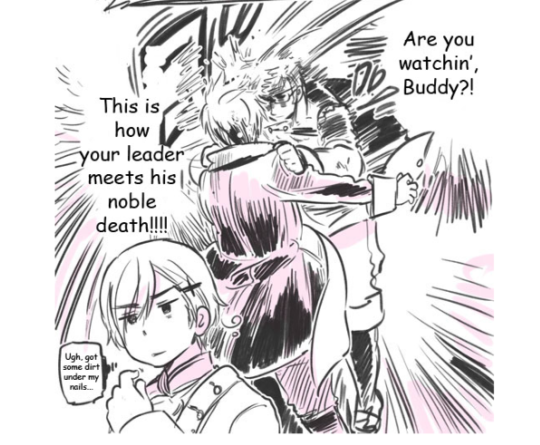
To break the ice, I’d like to point out that
Prussia is equally as fond of Romano as he is Italy. Himaruya goes on to state
that Prussia’s attracted to their climate and topography [x]. Both ships are one-sided. 

That said, let’s tie this back to the strips.

Italy: 

In response to a fan question, Himaruya said
that Germany constantly worrying after Italy is a Prussian tradition [x]. 

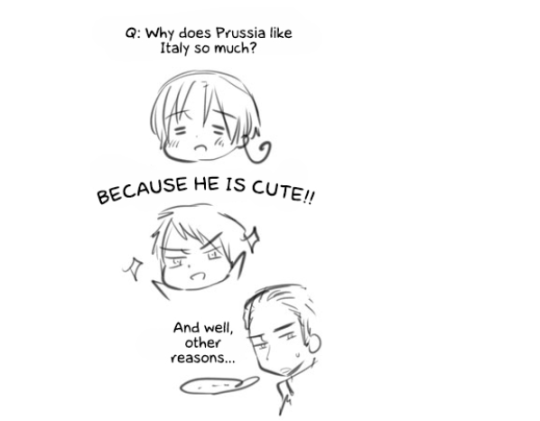
In another Q & A, he claims that Prussia
likes Italy because “a lot of things happened when they fought together,” [x]. Take
that how you will.

Several years later, we also get this panel,
where Prussia declares that he likes Italy by virtue of the latter simply being
cute [x]. 

image

This could just be attributed to him being drunk, but Prussia might also be blushing and ogling at Italy here [x]. 

image

The most obvious and explicit example is that
Prussia literally asks Italy out on a date [x]. 

Romano: 

Again, this isn’t romantic, but it serves as an
appropriate backdrop for their relationship. When they were younger, Romano
aspired to hit “Prussia’s smirky face someday,” but settled for verbal attacks because he was scared of him [x]. 

Of course, this doesn’t stop Prussia from taking an interest in Romano [x].

image

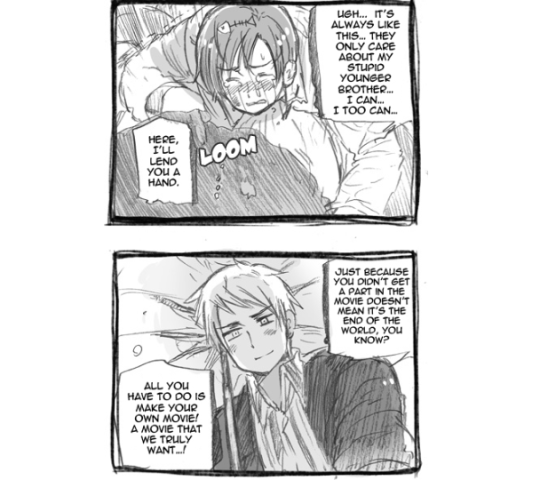
A more notable and sweet example of an
interaction between them is Prussia comforting Romano when he doesn’t get a
part in a movie. The two then decide to make a movie of their own [x]. 

image

Lastly, there’s also this strip, where Prussia unabashedly
admits to watching Romano on other occasions. In this instance, he’s watching
Romano work [x].

image
image
image
image

Below will be a list of parallels between America and Russia
that I think would benefit any RusAme writer should they wish to incorporate
them into their works. While in canon there is minimal romantic substantiation,
this post merely aims to provide writers with tools that highlight the similar chemistries
and complexes that America and Russia both experience. In no way is this
forcing the ship onto anyone either.

image

Child Imagery:

America:

Both are equated to children, albeit in different aspects.

America is seen as young, brash, and inexperienced by older
nations [x] [x].

image
image
image

Ex: He categorizes the world into good guys and bad guys.

image

Russia:

Meanwhile, having been abused and traumatized in his
childhood, Russia later inflicts this same abuse onto others as an adult. He’s
described as child-like and is respectively noted to be unaware of his cruelty [x]. 

image
image

Point is, Russia isn’t cognitively aware of all this. I should also warn that
this abuse isn’t something that should be romanticized.

Instead, a more appropriate linkage would be the similar childish
perception of the world that he has.

Ex: He thinks that everyone he meets is his friend.

image

Ex: He naively believes that the Allies are his friends.
Lithuania has to point out to him that self-interest will always come first in
politics.

image
image
image

Weight Issues: 

Both are insecure about their weight and physique [x] [x] [x] [x]

image
image
image
image
image
image

Strength:

They both possess immense strength [x]. 

image
image

Loneliness and Fear of Being Alone: 

America:

At one point his only friends were Japan and England.

image
image

He struggled to make friends and was fully aware of the fact
that he wasn’t viewed in high regard by other nations [x]. 

image

Russia:

He’s had trouble making friends his whole life.

image
image

ellawritesficssometimes:

image
image

Before I get into how Prussia fits into Hungary and
Austria’s relationship dynamic (platonic or romantic), it’s important to
briefly go over Prussia’s background, as it allows more insight into his
behaviour.

In one of his character notes, it’s stated that he’s never
had to marry. It would follow, then, that Prussia’s narcissism likely derives
from the fact that he’s long grown accustomed to fending for himself. He
doesn’t rely on others.

image

Yes, he’s been subordinated by other nations before (i.e.
Poland, France, Russia), but the point here is that other than Germany, Prussia
hasn’t formed a meaningful and trusting relationship with another nation.

It’s not just a lack of intimacy either; Prussia’s lonely
and desperately craves company.

In the 2007 Christmas event, he tells [lies to] himself that
he’s happy being alone. Likewise, he attributes the tears welling in his eyes
upon seeing couples spending time together on the holiday to this happy mood.

image
image

The strip then pans on Hungary and Austria acting seemingly
couple-like, where Austria buys Hungary a hat. Pretty romantic if you consider
how stingy Austria is.

The fact that Prussia cries at the sight of Hungary being
with Austria hints at an unrequited romance. I’ll touch on this again soon.

image
image

Prussia’s alone because he lacks the skills to socialize and
develop relationships with others. The most obvious evidence of this is where
he attempts to read a book instructing him on how to socialize with people,
only to get bored and quickly abandon his commitment to learning from it.

image

Buon San Valentino also touches on how relationally-stunted
Prussia is.

Just a quick refresher: Germany reads a book about dating
and marriage, thinking that Italy has romantic feelings for him. Austria has
also read this book.

The comedic relief in the strip, is that after failing to
propose to Italy – given that Germany had misread the situation – the scene flips
to Hungary making a remark on the absurdity of the romance book.

image

Austria gets flustered, keeping that he had also read the
book a secret. He and Hungary then set off to the book store to fix this mess.

image
image

Notice how the scene deliberately shifts to Prussia. On cue,
he claims how happy he is to be alone. He then secretly watches from afar as
Hungary and Austria ask the store owner if they have a book on how to comfort
someone who’s “been rejected in his romance.”

image
image

The store owner doesn’t appear to have a book of that kind, so of
course Prussia takes things into his own hands and pulls a prank on Austria by
forging a fake book.

I would like to thank @shirokage218 for correcting my original misinterpretation of this part. I really appreciate it.

image
image

Take note of the title.

How to properly comfort a German man who has failed in love.”

Here, it seems like Prussia might be projecting his own insecurities, even in something as trivial as a book title.

image

With all this in mind, I want to end by pointing out that
Prussia isn’t entirely alone either. He, Austria and Germany have lived together before, likely during Germany’s annexation of Austria.

image

Lack of romance aside, Prussia is close enough with Austria
and Hungary for them to be considered family. Yes, he does tease Austria by
referring to him as a “lesser German”, but they still spend their holidays
together.

image
image
image

That said, the irony in Prussia’s
life is that he feels alone and depressed despite being surrounded by others. 

image
image

Note: Spamano is
not confirmed in canon and should not be taken as such. What this post aims to
do is show some of the hints revealing
at a more intimate and romantic relationship between them. Believe me, there’s
plenty.

image

Well, you guys asked for it! Ah, Spamano. Where to start?
There’s just so many hints at them sharing romantic feelings. The problem is that
whenever it occurs it’s always one-sided.

Still, I’ll start with the most obvious hint. Yes, Spain does
in fact propose to Romano. While Romano doesn’t say yes, he doesn’t say no
either. Instead, Romano sets conditions, which, in my opinion, makes it seem
like he’s not entirely opposed to the idea of it.

image

In “Spain’s lazy morning,” Spain dreams (more like
fantasizes) about Romano. As he rouses to consciousness, there’s notable drool
on his face.

image
image

In the April Fools’ 2008 event, after hearing what happened,
Romano chastises Spain for letting himself get fooled into stripping. Notice
how embarrassed and flustered Romano is – he’s
blushing
.

image

That said, there’s a really sweet dynamic between the two of
them that’s also in desperate need of being talked about. While none of what I’m
about to show you is romantic per say, it still nonetheless fleshes out their
relationship.

During a financial crisis, Spain lies on his alleged deathbed
and is running a high fever. Romano panics and starts sending imports en masse
to Spain despite having a cold himself.

image

Even when the Italian mafia threatens to steal these
imports, Romano finds the willpower to stand up to them. In any other normal circumstance,
Romano is terrified of them and will comply with whatever they ask of him. It
just goes to show you how important Spain is to Romano, even if he’s not the best
at vocalizing this.

image
image

Romano also finds it easier to talk to Spain, given how forced
and rushed the unification with his brother was.

While this next strip takes place right after Unification, what’s
important is that this tension between Romano and North Italy still persists
today. Romano’s far closer with Spain than he is with his own brother.

What’s also interesting is that Spain is the person Romano goes to whenever he’s lost, experiences discomfort, or needs help. When he moved to America and was in an unfamiliar and foreign environment, Romano’s first choice is to call Spain.  Admittedly, Spain is initially surprised by this. 

image

Sometimes they can read each other’s thoughts too, despite
not always being in synch all the time.

image

The mutual support
and shared history between Spain and Romano makes for a good relationship of
any kind. Platonic, mentorship, or romantic, the bond that Spain and Romano
share is truly touching.

image

I’ve heard some stuff about this going around that Himaruya confirmed that England was gay for America? Is this even a thing? Where did this even come about from? Also, favorite crack ships of yours that have little to no canon interaction? Mine’s Italy x America, but that’s just me.

image

All right. I’ve seen this pop up every now and then, and this
is what I have to say. I can’t find anything that would confirm this. You would
think that if Hima revealed something as
big as that
, there would be screenshots to prove it. Any fangirl would leap
at the chance to prove that their ship is ‘better’ than others.

That said, there is no evidence that Hima ever said this; it’s
all just hearsay with contradictory statements that don’t line up. Likewise, there’s been many similar
instances where fans make posts, claiming to quote directly from Hima. This is disrespectful
on so many levels, and I highly encourage that it stops.

However,
and this is a big however, I’m pretty sure I know where these rumours came from.

Some fan likely used the transcript of this video
made my Hima and changed it in order to promote their ship and spread false
information.

In it, Mochi America says, “He is a British, and he is gay.” 

Can you see how easy that would be to manipulate?

image

Watch the video herehttp://www.hetarchive.net/scanlations/nonlinear.php?omochi

Personally, I wouldn’t consider America x Italy to be a crack ship at all 😊.
They get plenty of interaction together, and even share a few commonalities.
For example, there’s the running gag that they’re both supposedly unable to
read the atmosphere.

image
image