I do, yes! How about I talk about his clairvoyance abilities?
What I especially love is that Hima has been consistent in
portraying this. You can find Easter Eggs of this ability in some of the
earliest strips.
Post coming up soon!

I do, yes! How about I talk about his clairvoyance abilities?
What I especially love is that Hima has been consistent in
portraying this. You can find Easter Eggs of this ability in some of the
earliest strips.
Post coming up soon!

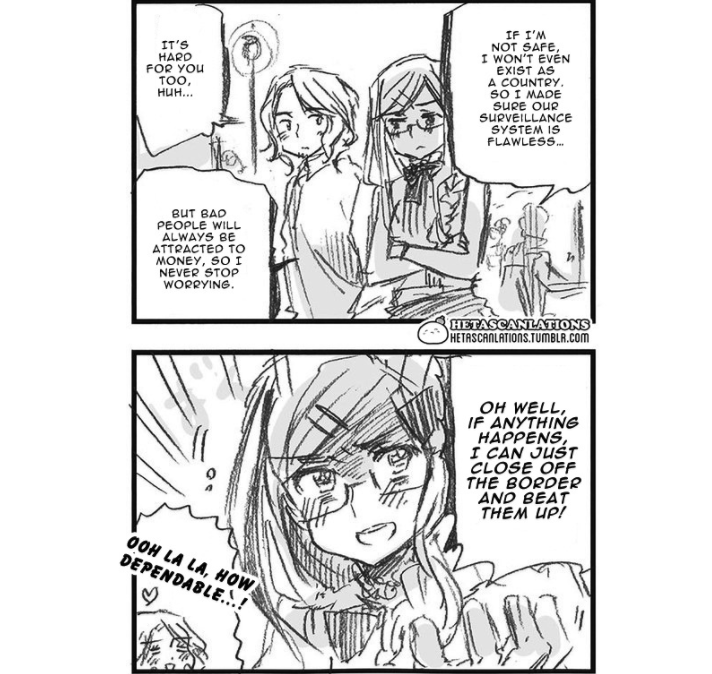
“What do you think of the new strip?”
I think it’s very
interesting, mainly because it confirms earlier conceptualizations of
nationhood!
Since Monaco isn’t a big
country and has a small population, they mainly rely on tourists to sustain
themselves.


However, because the
country is resort and luxury-based (i.e casinos, hotels), it doesn’t attract a
ton of people, as not many people can afford going there.

Instead, it attracts for
the most part richer classes, both good and bad. What Monaco and France are
discussing here with regards to public safety is that the corrupt rich people Monaco’s
attractions bring in threaten the possibility of other people wanting to visit
her country.
When she says that she
won’t exist if she’s not safe, she’s basically saying that she’s nothing
without people visiting her. Likewise, because she doesn’t have a large
population, her existence is heavily dependent on tourists.
So, it would follow that
Monaco needs to dispose of the dangerous classes by getting rid of them,
therefore upping her country’s safety and making it a more desirable place to
travel to.
This strip echoes what
we saw back in chapter 307, where France confirms that their nationhood derives
from their citizens.

In sum…
A nation is nothing
without their people. But, because Monaco is tourist-based, they comprise a big
part of her population, albeit temporarily.
She “doesn’t stop
worrying” because if corrupt tourists with money keep visiting her, it can act
as a disincentive for other tourists to visit.
There’s also an issue
with expensiveness that she has to tackle if she’s to attract more kinds of
people to her country.

I don’t see the immigrant side of his life portrayed all that often. He traveled to America for work during the Second Industrial Revolution.
This arc adds a lot more depth to his character given that it reveals his willingness to take responsibility for himself and not be, well, lazy.


Admittedly, he did complain considerably while he lived at America’s house.


Nonetheless, he still did his work, and I think he took a lot from this experience.


Overall, this arc is wonderful in that it entails Romano’s growth as an individual. It wasn’t just about learning to take care of himself and work for a living; it was also about learning how to cooperate with others in a mutually-dependent relationship.

I’m
not so sure about that. I wouldn’t say always.
Young America was shown to
develop this strength at an early age because of the abundance of settlers that
propelled his economy forward. However, because he lacked true independence,
was taxed a lot by England and fought wars for the latter, there were times
where America was considerably weakened. His “economy [became] strained.”

Likewise, he had initially lost a lot of battles in the
Revolution before making a comeback. He wasn’t as strong then compared to what
we see depicted of him more in the strips.

Once he became independent, America likely gained this super
strength back + some. You also have to consider how he lost strength again as a
result of the Great Depression.
Nonetheless, he didn’t become a Superpower, which includes
global political and economic dominance until after WW2. A Superpower status
only added to his physical strength, allowing it to grow to unprecedented
levels unlike any other nation but Russia, his rival.
In other words, America’s strength fluctuated as a result of his
economic situation. Now add independence and a Superpower status, and you have
an unprecedented amount of strength.
From what I understand, yes. Let’s take you through it.

Basically, I believe that
America and Russia’s super humanness stems from a historical allusion to their
status as world Superpowers during the Cold War.
The rule in the series is
that a nation’s strength derives from the strength of their economy, the
stability of their government, and whether or not they hold a dominant position
in global politics. Since both Russia and America emerged as the two leading
powers following the end of World War 2, they achieved a Superpower status. The
logic, then, is that they would be physically stronger than the other
nations. Yes, they were stronger than usual beforehand, but this accelerated their abilities even more.
You even see Finland during
the 2010 Christmas Event referring to America and Russia as super humans.
Again, I think this is a reference to the Cold War, as the power balances in
the world have long shifted since their time spent as unmitigated Superpowers.

Also
important to note here is that Finland mentions that the nations normally are
not that much different than humans. This is
consistent with the rule that a nation is more resilient than a human (aside
from their obvious immortality), but that they still nonetheless need to be a
powerful figure themself in comparison to the other nations if they’re to
possess this additional strength.
I believe that Russia doesn’t
possess his super strength anymore mainly because he’s no longer a Superpower.
He’s still stronger than most, as Finland said, but I think it’s suggested that
his super strength has waned in this strip.
When asked about their current relations, Russia responds by
stating that he used to want to “squeeze” and “snap” America.

He then goes on a sidetracked tangent about how America always
makes friends with people first. More importantly is that after showing annoyance at
Russians stereotypically being made into villains in Hollywood, he admits that
he still wants to smash America’s glasses into “ten equal parts.”
The scene ends with Russia
quickly changing the subject and proving that his relationship with America nevertheless isn’t all that bad. To me, that seems that likewise to his country’s loss of a Superpower status, Russia doesn’t have the same strength to fight America than he used to. Meanwhile, America still remains as a powerhouse today.

That said, for transparency’s sake, I really want to stress that
Russia and America still get along really well despite irking each other and
bearing old grudges.

Lastly, while acquiring a Superpower status allows younger nations
to possess additional super strength, this doesn’t seem to be the case with the older
nations. Like humans, the nations’ bodies age, albeit gradually.
This especially applies to
China and Japan. Japan held the title of the world’s second largest economy,
but if you pay close attention in the strips, a consistent theme with him is
that he’s grown weaker from old age. Ex: He has high
blood pressure, can’t do
strenuous exercise, and is referred to as an old man.
Likewise, you have the same
situation with China, who’s even older than Japan and is also referred to as an
old man/grandpa. Currently, China would be considered a superpower, and figures
suggest that they’ll eventually surpass the US economy. However, because
China’s body has aged considerably, even if he’s a Superpower, his physical
body may not be able to gain back this strength again.

Personally, I wouldn’t think so. Here’s why:
1) The nations’ strength/ health are reliant on their economy and position in the world. Russia also had this super strength.
2) The nations themselves are already noted to be strange beings. The super strength is just an ability that comes with part of their existence. In other words, while it’s not common, it’s still a natural feature.
All of them can attain it if their country is strong enough. Meanwhile, seeing spirits/ magical creatures is more dependent on their populations’ cultural belief in them.

A lot considering that his boss had to place a limit on how much he’s allowed to have.

Even better is that America commends England’s boss for doing this.

Sure thing! It’s no problem at all 🙂
It’s not an easy subject, considering that all the potential examples of this possibility are mostly hinted at. Of course, with the exception of Niko Niko.
Post coming up tonight!

This is an
excellent question, but to me, I felt like this strip was more open-ended in
how you interpreted it. That’s why I didn’t include France, as it wasn’t solidly
confirming anything.
Here’s the
full justification for it.
England’s
sleeping, surrounded by his fairie friends. Like you said, they get scared when
they hear France knocking on the door.

Judging by
France’s reaction here, this is the first time he’s seeing fairies.
Then, you
have England’s flustered reaction about France not knocking.

Taken together,
it seems like England letting his guard down by sleeping might have actually
activated his powers in allowing France to see the fairies. We’re only given
information about the fact that he has this ability when nations come to his house, not whether he can consciously
or unconsciously evoke and control it.
Of course,
with Hetalia, the one exception to the rule always seems to be Halloween. The
fairies/ ghosts have no problem showing themselves to skeptics then.
Ex: France
encounters Napoleon’s ghost during the 2013-2014 Christmas Event.

 Ellawritesficssometimes