Look! Look! Look at him being a considerate, charming little bean again.
He’s not over-rated at all.

Look! Look! Look at him being a considerate, charming little bean again.
He’s not over-rated at all.
For a reason other than recording his own awesomeness? Yeah, I sure do. Post coming up soon!
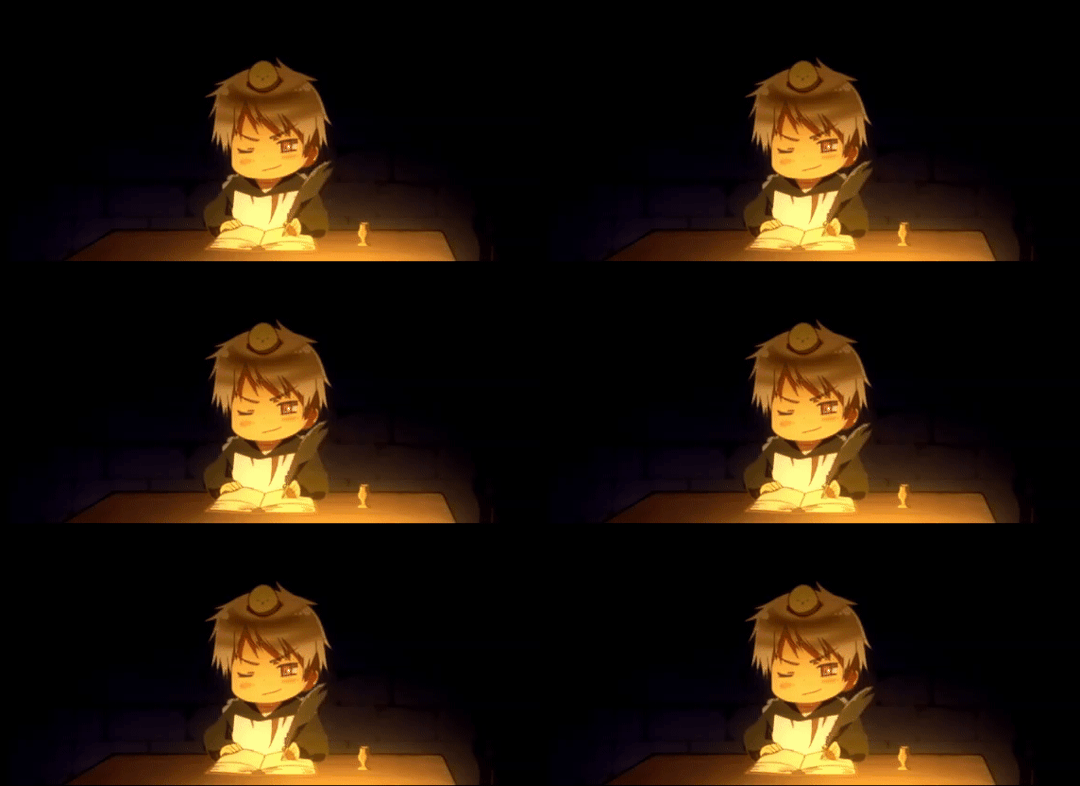


Again! There’s so many strips that can do that for me, but since this is the most recent one to jog my memory, here:
[Descriptive writing, brought to you by Prussia]


By now, you should realize how damn clever and intricate
Hima’s characterization is. It’s honestly mind blowing to me how chapters and
strips spaced out years apart from
each other are nonetheless effortlessly bridged together to form a logical connection.
On a similar note, you see a lot of similarities and
respective foreshadowing between Holy Rome and Germany. It’s uncanny how they
will say literally the exact same things, like a mimic or relic of the past in
Germany’s case.
As designated by the
title, this post will focus on how fairy tales are used to hint at Germany’s
infamously known, but unconfirmed connection to Holy Rome.

In chapter 187 of World Stars, we learn that Holy Rome hasn’t
died, even though he should have given that he’d already been dissolved at said
time. Still, his end is near as he lays on his death bed.
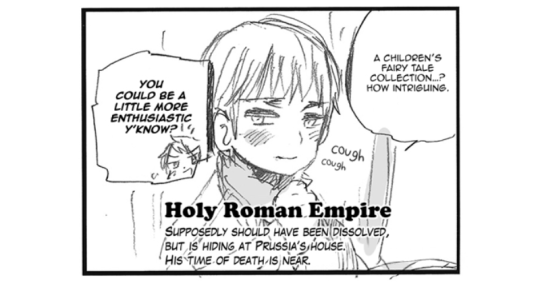
A “heartbroken” Prussia takes to
consoling Holy Rome by reading the latter Brothers Grimm fairy tales.

Notice how Prussia is not only grief-stricken,
but he’s also in partial denial. He refuses to accept that he’ll have to be a subordinate
to France and adopt French manners of propriety.
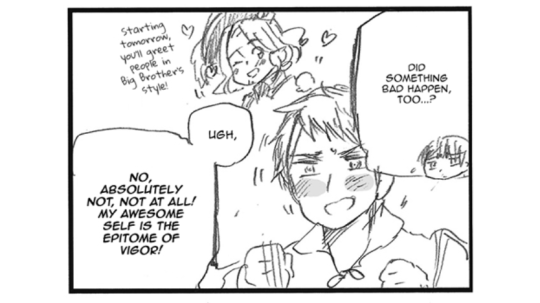
Meanwhile, even while on the verge of death, Holy Rome is
the more logical of the two. He has no problem in skeptically pointing out the
plot holes in the stories Prussia fabricates. (The original tales contained too
much eroticism, so Prussia had to take a bit a liberty when recounting them to
Holy Rome).

Regardless, what’s important to emphasize is the motif of
fairy tales – which will come up again later – as well as Holy Rome’s use of
concrete logic.
In Chapter 222 of World Stars, as Italy talks about feline
nonsense, Germany responds by saying: “Isn’t that a little too fairy tale like?”

I’m sorry, but I really do think that Hima did this on
purpose. Germany’s skepticism eerily echoes that of Holy Rome. Also, when have
you ever heard of a fairy tale that involves cats?
That one piece of
dialogue, trivial as it might seem on its own, serves as a key link to chapters
which would otherwise be completely unrelated.


Chapter 5 is up!
Read it here 🙂 https://www.fanfiction.net/s/12544732/1/Green-Skies-Ahead
Summary: Isabel pretends to be happier than she is. Romano isn’t as rude as he lets on. It’s never easy coping with demons on your own, but perhaps friendship and a little something more can change that? (Fem! Spain x Romano/ Spamano. Fem! Italy).
Of all the many things to possibly scar me, both have to do with Hanatamago.
One, I’ve seen it spelled as Hanatamango. No, I’m not kidding.
Two, there was this one Hetaconfession where someone admitted that they’ve always imagined deValier with Hanatamago’s head. This really screwed me up.
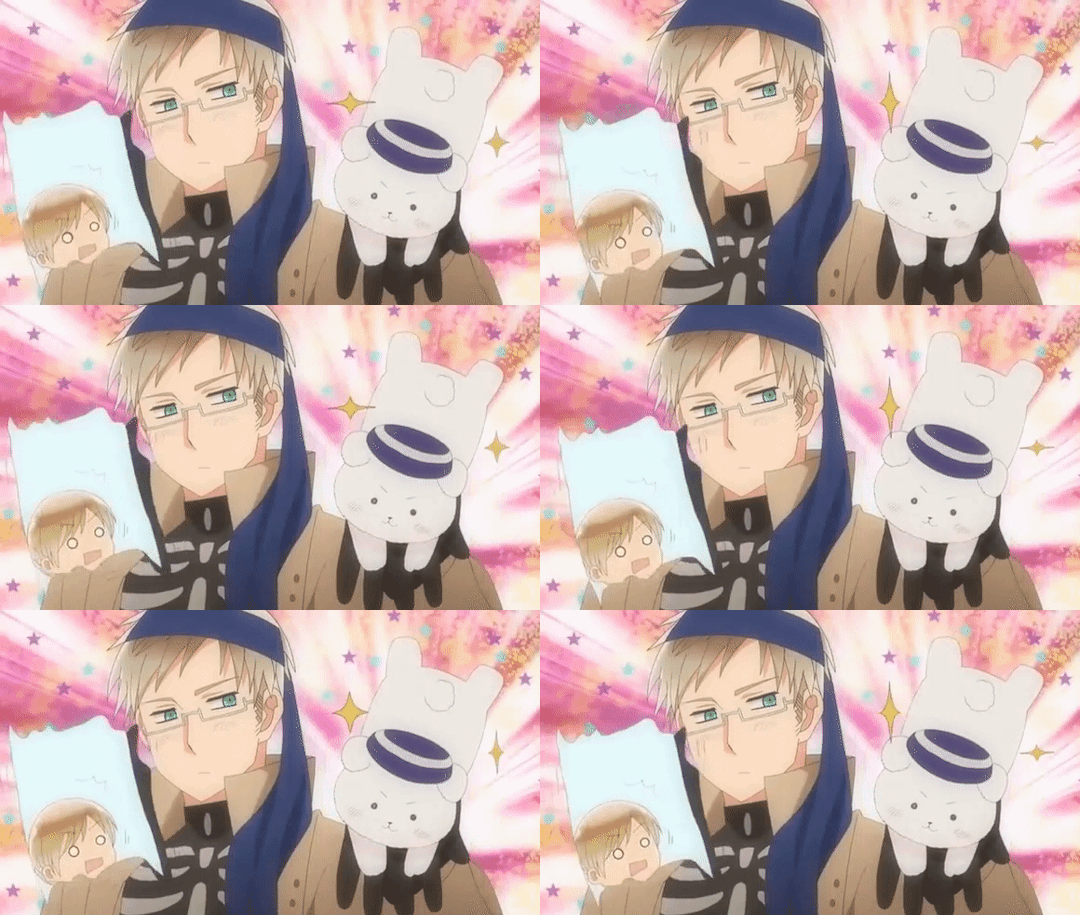


I’ve said this before, and I’ll say it again. Hetalia is far
from simple and trivial. The amount of religious and mythical themes and
respective inter-texts woven into Hima’s writing is easy to go unnoticed
because of how comical the series is.
What this post will focus on is how Hima recreated Hans
Christian Anderson’s “The Snow Queen” with respect to Russia’s characterization.
Now, before I get started, it’s important to mention that Hans Christian
Andersen has in fact made an appearance in World Stars, so no, I’m not just
pulling this out of nowhere.


That said, here’s a brief rundown of the fairy tale. A devil
creates a magic mirror that “distorts” appearances, only choosing to reveal the
ugly qualities of those reflected in it. The mirror eventually shatters and
falls down to Earth, the shards of which are so miniscule that they’re able to
get into people’s eyes and hearts.
What’s relevant here is that the hearts of those who were
struck by the glass shards were frozen into blocks of ice.
The story later focuses on a little boy named Kai, who’s also
struck with a glass shard. Subsequent to being struck and without realizing it, he becomes cold, cruel, and aggressive. His
heart slowly starts to freeze over, but the turning point of this
transformation is when he meets the Snow Queen.
The simplest way to explain the Snow Queen is that she’s
basically like a female equivalent of General Winter. She’s able to assume a
human appearance, but for the most part, represents elements of winter in
either the forms of a snowflake, frost, or the harsh winter wind.

Nonetheless, the Snow Queen takes on a human appearance when
she entrances and abducts Kai, taking him to her ice palace. There, Kai’s heart
– and body – continues to freeze as he
becomes numb to the cold and begins to lose his sense of humanity. In the end, Kai’s saved
by his friend, Gerda.
Anyways, let’s tie this
all back to Hetalia, shall we?
As stated above, while I recognize that Hima didn’t invent
General Winter himself, it’s the relationship he has with Russia that echoes
Andersen’s fairy tale.
The Snow Queen
inflicts harm onto Kai by kissing him, and each time she does so, the numbness
of the cold makes him forget about his humanity.
General Winter does a similar thing to Russia. He attacks
Russia to the point that Russia is completely terrified of him.

Russia hates the cold, and on several occasions communicates the desire to live in a place that experiences warmer weather.

Russia’s place is so cold
that his emotions are numbed. I mean, he literally used to spend his
winters buried under snow, praying that he would be able to survive it.


This theme of numbness and losing one’s humanity is most
seen in how Russia interacts with the other nations. He’s often oblivious to
how cruel, aggressive, and harmful his actions are.
For example, he once tries to get Latvia to stop trembling
by snapping the latter’s neck.


What really ties this all together is how Russia’s heart falls out at times. This could possibly represent how his heart has yet to
thaw as a result of his cold climate, which, in turn, could explain his cruel
and aggressive behaviour.

It’s not something he can control, but is rather an undesirable
product of the madness generated by a history of childhood victimization,
bloodshed, and unforgivingly frigid weather.

 Ellawritesficssometimes