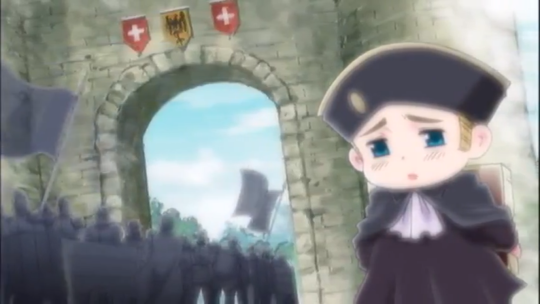
image
image

I know this might sound like a radical thing to say, but
honestly, after reviewing the strips, there’s enough evidence that points
towards the fact that… yes, Holy Rome never truly
died.

Before I start, let’s just get a few disclaimers out of the
way. Otherwise, this theory won’t work.

There’s a deleted comic where France tells Italy that Holy Rome
is dead. Note the word deleted. As such, the strip should not be taken for
canon value.

image

Next, there’s also the fact that people have said that Holy Rome
is given a teenage appearance in one of the requests Hima completed for the Christmas
2011 event. If this were true, then there would be a notable inconsistency
regarding his other appearances.

However, to me, this hardly seems to be the case. Holy Rome
doesn’t look like a teenager at all here. He still very much looks like a
child, judging by his height and his size when Hungary carries him in her arms.
It’s important that I mention this, because Holy Rome’s appearance in the 2011
strip is consistent with his appearance in World Stars.

image

With that out of the way, let’s get to the good stuff. In
chapter 187 of World Stars, we find out that even though he’s been dissolved
and should have died already, Holy Rome is very much alive and is hiding away
in Prussia’s house. He’s still very sick though, as “death is near.”

image

Since Holy Rome’s so weak, a “heartbroken” Prussia reads him
fairytales, likely to distract the former from the fact that he’s dying.

image

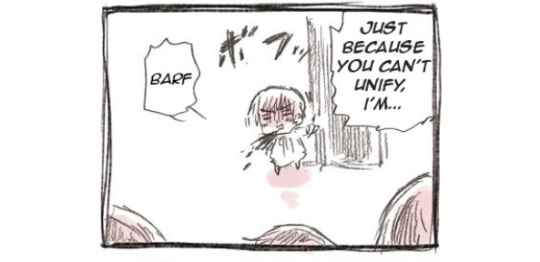
Moving forward a bit, we know that it was Prussia who led
the German Unification movement. He would have every reason to, as we’ve seen
from the Christmas strip how negatively a lack of unity among the German states
affected Holy Rome’s health.
image

If Holy Rome hadn’t died at this point, which I’m assuming
to be the case, then it would be in Prussia’s best interest to unify the states
and form a stronger country in order to save his younger brother.

image

This strip takes us to just before the unification process. Pay
attention to the language used by the German states here. “New Country” and “New
brother.”

image

It seems like they might not be aware of the fact that Holy
Rome is still alive. Being nations themselves, they would know that it’s
possible for personifications to adopt new titles. But, judging by the words
they use, they believe him to be dead. Because of this, the possibility of Holy
Rome adopting a new title wouldn’t have even crossed their minds.

It seems that only
Prussia knew about Holy Rome still being alive…whenever that strip took place
as it’s not entirely clear. (It’s sometime after the first publication of the Brothers Grimm Fairytales.)

Anyways, before the German Confederation is able to form, Austria, also
thinking that they’re about to form a new
country, insists that he will be the one to raise the newborn Germany.
Yadda yadda, Prussia and Austria go to war, skip forward, and now we’re at
Germany’s actual birth (???).

image

This is so important and I cannot stress it enough. There’s
a massive difference in how the anime portrays Germany’s birth versus how the strips
do.

In the anime, it makes it seem like the German states huddle
together, only to have Germany emerge once they’re finished unifying.

image

The strips, which I’ll be using as the basis for this
theory, depicts an entirely different reality. When Germany’s born for real, it
doesn’t show the German states huddled together. Instead, it only shows a young
Germany being helped up and/or greeted.

image

He’s wearing a nightgown…exactly like the one Holy Rome was
wearing in chapter 187. 

image

Yes, I’m aware that the nations are born in nightgowns,
but there’s multiple ways of interpreting this. The nightgown/birth motif is definitely
there, but…

Look at the one German nation holding Germany’s hand. He’s
crying. Now, put this into perspective. How would you feel if you thought your
little brother was dead, only to find out that he’s been alive all this time?

Maybe I’m biased, but Germany being helped up as well as
wearing the nightgown seems as if he’s standing for the first time after being
bed-ridden with illness for who knows how long. There’s also the fact that his
age is consistent with the Holy Romes from the Christmas event and chapter 187.

Which brings me to my next point. At the end of the chapter,
it states that Germany wasn’t born as a baby because he already had an existing
body.

image

We all know Hima and how much he loves to make puns. What if
“existing body” literally means an existing
body. Holy Rome adopted the title of the German Confederation and became a
stronger nation, but never actually died.

The German identity never died either, despite a lack of
formal unification. Maybe that’s why Holy Rome still managed to exist,
regardless of how physically weak he was.

The only setback to this is that there’s hints of Germany
(aka Holy Rome) suffering from amnesia. Remember that in World Stars, it’s been
made canon that it’s possible for the nations to acquire new personalities upon
changing what they personify.

image

Now, isn’t it weird that in the same strip where Germany’s
born, Prussia takes to reminding Germany that it’s okay to refer to him as an
older brother…482 times? It’s like Prussia’s attempting to trigger Germany’s
memory in the hopes of getting the latter to remember that he’s Holy Rome.

image

It would seem that on top of adopting a new title and
personality, it might be possible for the nations to also lose memories from
their past personifications.

It’s reincarnation, and yet it isn’t. I’m going to take the
liberty and coin it as “re-personification” from now on.

Housekeeping Announcements

Blog Recommendations, Fic Recommendations, and Requests:

image

I just wanted to emphasize again how truly grateful I am to have such amazing and wonderfully supportive followers.

image

Announcement 1: Blog
Recommendations

First, I want to be able to reciprocate this support. It’s
come to my attention that the conditions I’ve set for recommending other blogs
is too strict regarding activity levels (completely unintentional, oops).

That said, I’ve updated the rules to fix this problem. If
you’re a primarily Hetalia blog and want to have it recommended, please refer
to my “Blog/Fic recs submissions” page
for rules on how to submit.

Announcement 2: Fic
Recommendations

University, life, and consistently running this blog has
sucked up my free time. I am therefore unable to read fics. But, that doesn’t
mean I can’t recommend them.

I’m opening up the field for you guys to send in your own
fic recommendations. I’ll happily publish them, just like I will be doing soon
with the fic recs still lingering in my ask box.

Fic recs are now to be sent to my “Blog/Fic rec submissions” page. You can find the rules of
submittng there.

Announcement 3: Asks/
Requests

To avoid confusion, all requests are to be sent to my inbox. 

Thank you all so much again~!

image
image

England:
you either love him or hate him. Those who hate him tend to only focus on
England’s critical and pessimistic side, ignoring how sweet and thoughtful he can
be sometimes. Likewise, those who like him tend to ignore this negative side and only
focus on his charming and charismatic idiosyncrasies as a refined gentleman.

Problem is,
England’s both. While this post will highlight the assets of England’s
character, it’s also important to show just how…harsh he can be. There’s very
fair reasons as to why people don’t like him. However, in my opinion, if you take the time
to dig deeper into his motivations, it becomes clear why he acts the way that
he does.

Regardless,
England has always been somewhat of a loner, being referred to as the Black
Sheep in Europe. During the imperial age, he was especially arrogant, rude, and
blunt, and as such, wasn’t very well-liked by the other nations. This loathing
really came to light during the American Revolution, where he’s literally
pitted against everyone.

image

From a
fandom point of view, one could make the argument that he’s extremely critical
of America. This would be 100% correct. England makes a point to constantly
degrade and belittle America by calling him a child/brat.

image

His reviews
of America’s movies are also pretty brutal, albeit being funny for the reader.

image

However,
putting things into context, England being extra hard on America can stem from
the hurt he still feels as a result of their fragmented relationship. After
all, it’s stated that England suffered from 100 years of heartbreak, which most
people assume to be a reference to the American Revolution.

That said, while
criticizing others, England is also noted to be self-deprecating. Essentially,
he doesn’t want people to make the same mistakes that he did. To me, this
implies a hidden guilt. He’s attempting to overcompensate by helping others get
on better than he did.

image

It’s also
important to mention the difference between guilt and shame. Shame is feeling
hurt as a result of your self-image being damaged. Guilt, on the other hand, is
feeling bad for the harm you’ve caused others. Yes, England takes pride in
being a gentleman, but this guilt and possible regret reveals a sensitive and
sentimental side of him that you don’t see very often.

With all
that in mind, England can be extremely kind and thoughtful. Here are some of my
favourite moments.

Japan sends
England a Christmas card, and England recognizes how Japan has made the effort
to understand his culture. The amount of time and consideration that England
puts into making his own Christmas card wards against any accusations of his
character being ridden with egocentrism.

image
image

During the
Industrial Revolution, England asks for Japan’s help on improving the designs
of his manufactured products. Japan compliments him, and this sets off a flustered
reaction in England.

“I’ll blush
if you keep praising me like that.”

That hardly
sounds like the words of someone who holds a lot of pride in themselves.

image

Oh look! A
cheery England, now that’s unheard of!

Just kidding, but once again, you see England wanting to impress Japan by adopting some of the latter’s culture in order to establish an authentic maid café.

image

Oh look x
2! France and England are getting along! So much so that England takes pride in
having a French chef working at his maid café.

image

Thing is, in
later strips, England likes to give advice and help the other nations, but is
too shy to overtly do so. Personally, I
think this has a lot to do with the fact that during his delinquent phase, he
grew used to being rejected. Now, he helps them discreetly and is unsure how to
express this ‘uncharacteristic’ kindness.

Here,
France wants to go sightseeing at England’s house and asks for a hotel recommendation.
England immediately denies helping him, but then gives France the link anyway.

image

Still think
that England’s too prideful?

Even when
it caused him immense pain and illness to celebrate America’s centennial,
England still came to it. Bitter-minded or not, England cares deeply about the
other nations.

image

Make no
mistake either. England’s personality is complex, shifting from sweet and
caring in one strip to being a total dick in another. Nonetheless, this makes
for a truly interesting character.

Personally,
I think Hima does this on purpose. When he’s critical, England is engaging with
his past inferiority and anxieties; his delinquent self. When he’s being sweet
and thoughtful, England engages with his gentleman persona. The challenge for him will be to merge these two sides into one.

It’s easy
to say that England is cruel and harsh. What’s difficult is going beyond what’s
observed and looking at the deeper internal reasoning for his behavior. Not
only is he lonely, but England’s also at odds with himself. He wants to fix the
mistakes of his past, only to realize that building the bridges he previously
burned involves making oneself even more vulnerable to judgement.

England judges
others in light of his own past mistakes. As stated above, he’s
self-deprecating, albeit implicitly. His weakness, however, is that he’s too
insecure to have this judgement directed at him.

So…I was wondering. The whole who are related/siblings thing is really confusing to me. Any thoughts?

Knowing how volatile the fandom can be, I would likely have to switch to video format just to show enough evidence to get people to stop throwing around petty and unsupported accusations. There are real problems with some ships, don’t get me wrong. It’s just other ships are given the same labels that trivialize the actual problem without bothering to look at the information provided in the series.

It’s a simple matter of reading the strips and not showing any bias as a result of your own OTP, which sadly, not a lot of people are capable of.

But, if I were to sum it up quickly, it’s this. There’s specific capitalization/ phrases used to differentiate between relationships, even if Hima doesn’t explicitly clarify this (I wonder why).

There’s a difference between:

Big Brother (no direct familial relation).

big brother

little brother

brother

(The latter three can be used to refer to close friends, a sibling, or a guardian.)

Guardian (takes on parenting role, may or may not become a parental figure, but is not actually a true parent.)

“I’ll make you my little brother/family” vs “That’s my little sister/brother.”