Having
lived for centuries, or sometimes even for thousands of years, it’s no wonder that
the nations are capable of accomplishing so many feats. They have the
intelligence and knowledge of several lifetimes at their disposal.
You have
your philosophers.
You have your artists.
And you have your inventors.
That said, let’s not sell these characters short by dumbing them down.
Mhmmm. You
see this happen in chapter 145 of World Stars. France gives Russia a tour of
the Mont Saint-Michel monastery. When Russia inquires about why most of the
rooms are barren of furniture, France “flinches” and “winces.”
Note: This theory
will make use of Freudian theory. While I recognize that Freud’s ideas do not
bear much contemporary relevance, that shouldn’t take away from the fact that many
of his concepts are nonetheless employed by Hima in the series. The purpose of
this post is to give some insight into the psychologies of the characters.
Terminology I’ll go
over: Psychosexual stages, causality, regression, fixation.
Yes, that’s right. Freud’s ideas are very much prevalent in
the series. A big area of his work analyzed the impact of childhood on
personality development. Freud believed in causality, meaning that who you are
as an adult can be directly traced back to your childhood.
How you’re parented and brought up is the most crucial factor.
I don’t need to go into this in too much detail, but basically, we go through
five stages of psychosexual development titled: Oral, anal, phallic, latency, and genital.
For this specific post, we only need to focus on the early
stages of development, which focus on sensual (sensory, not sexual) pleasure and
stimulation, often for the purposes of soothing and experiencing relief.
Each stage has corresponding needs. If these needs are not
met (under-gratification) or if they are too easily met (over-gratification),
then the person develops a fixation.
A fixation essentially
means that the person is stuck at that level of development, which causes them
to develop a problematic personality type.
However, it’s only when that individual is met with confrontation
or a stressful situation that they regress back to the stage in which they
developed this fixation. The stress causes them to revert back to the age where
their needs weren’t met, and as such, adopt childish behaviours.
For example, if you get into an argument with someone and
they start behaving selfishly, like a
toddler, then you have every right to poke fun at them for having Daddy or
Mommy issues. Or, there are those who bite their nails and pick at their lips,
something akin to the soothing acquired from sucking one’s thumb as a child.
The stage that the Italy brothers appear to be fixated on is
the first stage: Oral.
The Oral stage involves the stimulation and pleasure of the
mouth. It’s where babies get their nourishment. The feeding phase within the oral stage of development is labelled
as Incorporative.
Thus, if the baby is given too much nourishment, they’ll
develop an Oral Incorporative personality type.
An Oral Incorporative personality type is someone who’s fixated
on activities that involve the use of the mouth. This can include being
extremely talkative, as well as excessive drinking, smoking, and chewing. In a figurative sense, they’re also
extremely gullible as they will “swallow” anything they’re told.
Sound familiar? If you thought of Italy, then you’d be
correct. Because Ancient Rome coddled and spoiled him, Italy’s needs were overgratified.
Italy’s extremely talkative and social, flirting with girls
left and right.
He’s also quite gullible.
Lastly, he absolutely loves to eat.
Romano, on the other hand, is the product of what happens to
a child that’s been weened off prematurely, meaning that the baby stops drinking
its mother’s milk too early. This second phase within the oral stage of
development entails teething, merely titled as Sadistic.
In the context of Hetalia this weening and subsequent
teething would be better fitted to parental neglect. Romano’s needs weren’t met
by Ancient Rome, as the latter focused most of his attention on Italy.
It’s this lack of nourishment/ care that results in an Oral Sadistic
Personality type.
An Oral Sadistic Personality type is someone that is
verbally abusive. They use “biting” sarcasm.
I mean, come on. That’s literally Romano. Cue montage.
That said, there can also be a mix of these personality
types. It isn’t just one or the other. I think we all know by now that the
characters in the series are extremely fleshed out. They remain likeable
despite bearing so many flaws.
Still, using Freud’s terminology, isn’t it uncanny how well
the Italy brother’s personality/ childhood experiences fit into this chart?
If the nations had Snapchat…
England to France:
“You whenever we have to get ready and be somewhere.”
*is literally in awe at how fast you picked up on Freudian theory* Well done!!!
There is a connection with Italy’s childish behaviour and his childhood, but it more has to do with how Ancient Rome parented him.
The trauma young Italy experienced in his childhood is another thing altogether if you’re looking at how it impacts him today. In other words, how he grew up and the trauma he experienced influenced his personality in different ways.
Tell you what. I’ll save the trauma for another time, and will focus on the childish behaviours part tonight. I’ll even add Romano into the picture too. Post coming up soon!
Marriage with the nations is a lot different than
traditional, primarily Western notions of it. It arises more out of a sense of
political duty, an arranged alliance or
partnership, and sometimes it just so happens that a romance forms between
the two countries involved.
Typically, what I’ve seen is that marriage at its core in
the series involves two countries merging together, either into a co-state empire,
a co-state kingdom, or a separate sovereign nation with distinct ethnic groups
and cultures. There aren’t any ceremonies, but rather, it entails a mutual dependence
and relative respect between two political entities.
That said, it’s important to mention that two countries joining
together via annexation does not fit into this marriage equation. There’s a
difference between being conquered and subordinated and forming a mutual
union. On the other hand, that doesn’t go to say that there’s perfect equality or
power balances in marriages between nations; Austria’s control over Hungary is
a perfect example of that.
All right. Let’s go over some examples of marriages, shall
we?
Austria’s character is known for his quirky tendency to
solve his problems through marriage.
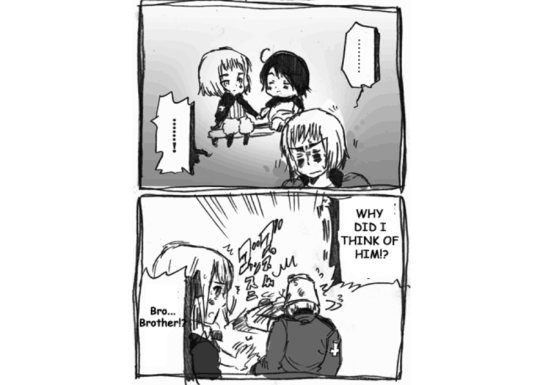
First, there was arguably his early ties with Switzerland. I’m
counting this as a marriage mainly because it involves the use of the word
partnership and honeymoon (albeit jokingly).
Notice how as soon as one tries to control the other, the partnership ends. While Switzerland does
reveal some fondness over his early memories spent with Austria, there’s
nothing particularly romantic about it, especially given the fact that they
were young children at the time. Again, marriage for them is essentially the
joining together of nations.
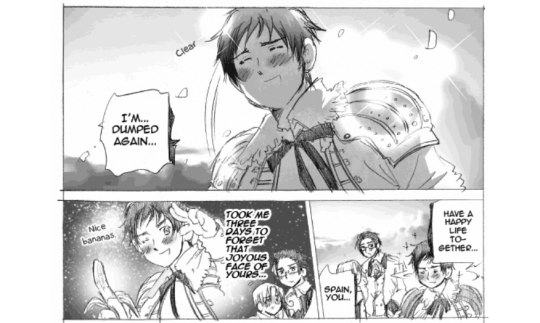
Next, Austria marries Spain via the Hapsburgs Monarchy.
Here, you actually see a hint that Spain harboured romantic feelings for
Austria during the Austrian Wars of Succession. It was a political merger
that likely later involved the development of some intimacy between the two.
Then, you have Hungary. After the dissolution of the Austro-Hungarian
empire, it’s very heavily hinted that Austria still bears feelings for Hungary.
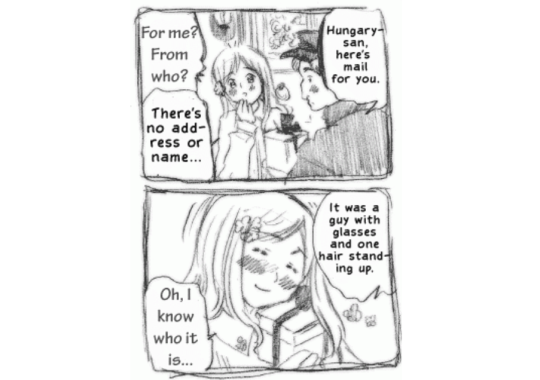
In Buon San Valentino, Hungary receives roses from an anonymous man that’s
conveniently described as having glasses and one hair sticking up.
On the other hand, there are marriages that involve little
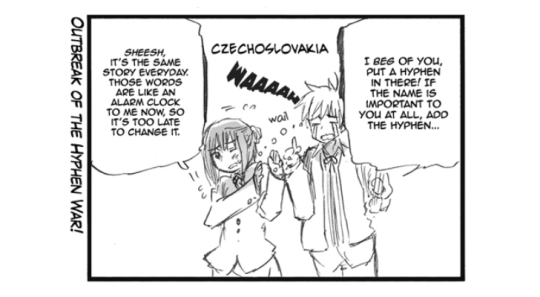
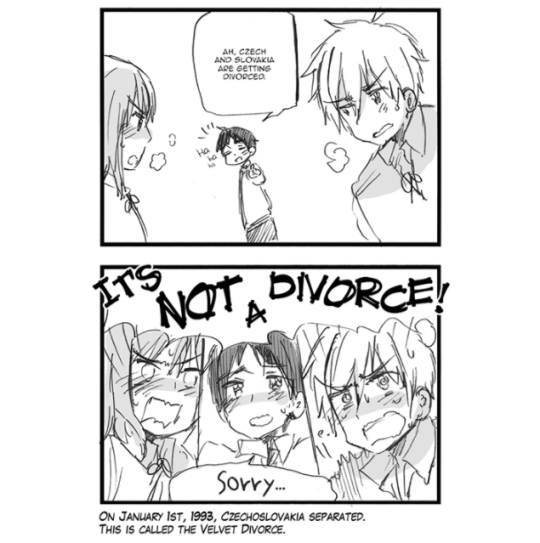
or no romance at all. Take Czechoslovakia for example, two countries united by a
hyphen. Yes, that’s an actual joke in the series.
Still, what’s interesting is that when Bulgaria talks about
their separation in terms of a divorce, they’re quick to deny the claim, mainly
because of the romantic connotation marriage carries.
How I interpret this is that the two may have developed
feelings, but never told each other.
Bulgaria bringing up the topic of marriage in a casual political
sense merely may have caused them to get defensive because of these unvoiced feelings.
This isn’t confirmed, so don’t take it at canon value.
I know I’m repeating this, but it’s important that I make
this as clear as possible:
Marriage = a merger between two countries.
I say this because I’m going to apply these rules to Belarus
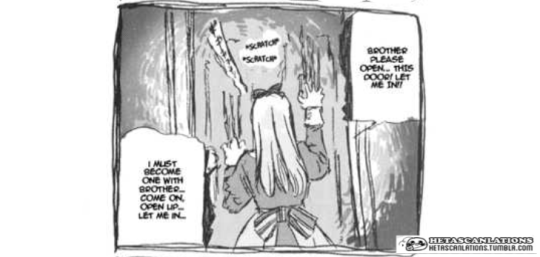
and Russia. Belarus wants to marry Russia and loves him to the point of obsession.
She’s even forgotten her own language at one point in favour of learning Russian.
But, does it ever say that Belarus loves Russia in a
romantic way?
No.
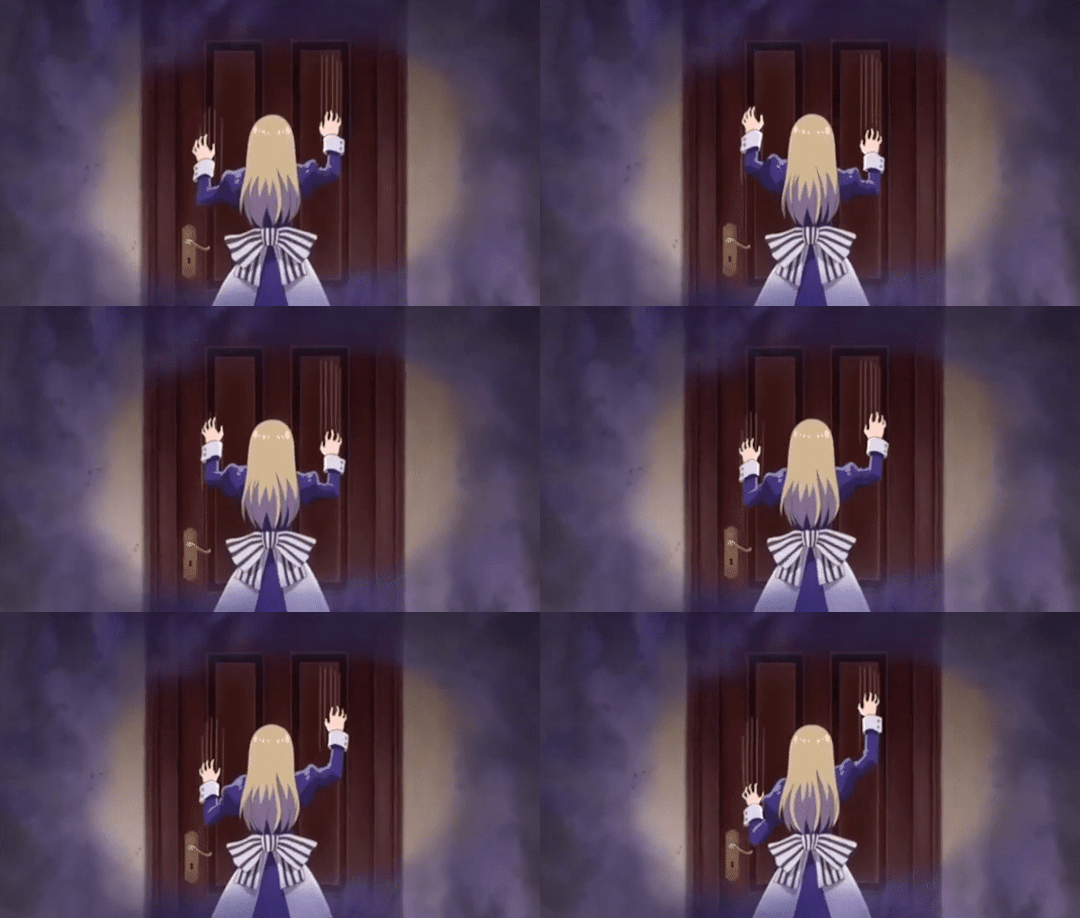
What it does say is that she wants to “become one” with him.
Sounds like a merger if you ask me.
When Belarus says marriage, she wants their countries to
join together. There’s nothing romantic about it, so hopefully this stops
people from misinterpreting their relationship.
In summary, marriage between the nations seems to involve a political
merger between two countries (partnership, co-ruled kingdom/empire). It can have
a romantic element to it, but this isn’t always the case.










 Ellawritesficssometimes