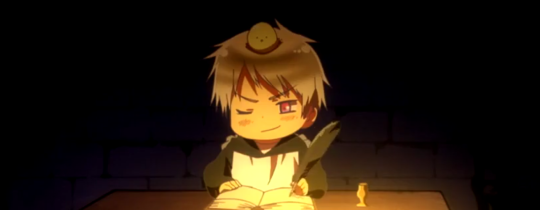
I’ll admit. At first I was skeptical as to whether Prussia
shooting birds out of his hands had any particular reason outside of comedical
purposes. While what I’m about to say may still be a stretch, the symbolism of
the type of bird used adds a whole new understanding to this strip. It’s fascinating
and incredibly clever if Hima truly did mean to employ this extra layer of
meaning.
In Chapter 12 of World Stars, we’re given insight into the
origins of Germany. Right from birth, he was thrust into wars. It’s a good thing Prussia was there to step in and protect him.
Now, I think it’s already assumed by most that Prussia’s
birds are canaries. As a spirit animal, the canary represents new beginnings. The
sound it makes is also seen as a sort of healing song, one that cures the wounds
from a past life.
Tying this back to the strips, if Germany is reincarnated
from Holy Rome, then the canary’s symbolism of birth, new beginnings, and the
healing of wounds from past lives is especially relevant.
What’s more, we also
know that Prussia plays the flute, which in Greek mythology symbolizes the shepherd.
The shepherd’s role is to tend to their flock of sheep; that, as well as
herding said flock together.
I went into this in
an older theory, but basically, Prussia’s flute-playing – while also stemming from
the influence of Old Fritz, who also played the instrument – may in fact
symbolize how he herded the ‘flock’ of German states together into one sovereign
nation. Remember that it was Prussia who led this unification.
Taken together, Prussia shooting canaries out of his hands in a figurative sense can mean several
things. One, it represents Prussia soothing the wounds of the before fragmented
Germany. Two, it symbolizes Germany’s new beginning. Three, it can serve as a
reference to the brutal wounds that were
inflicted onto Holy Rome before he died in, yes, war.
And four, it can also be a reference to the number of new
beginnings Prussia himself has undergone. He started out as the St. Maria’s
order, evolved into the Teutonic Knights, somehow became Prussia, and then presumably
into East Germany.
I still don’t know how to feel, considering that the most
asinine thing – a bloody bird – can actually
symbolize all this.
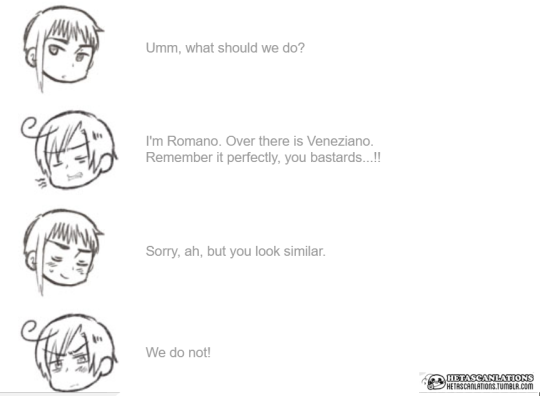
Actually, the Italy brothers have been confused for each
other before. During the Christmas 2011 event, Cyprus can’t differentiate between
them and comments on how similar they look. Romano’s annoyed response hints that
this isn’t the first time he’s explained their differences.
Likewise, just before, Canada isn’t remembered. What I find interesting is that it’s Italy who recognizes him.
I think what distinguishes Italy and Romano from each other
more so than the NA brothers is that the formers’ personalities are conspicuous;
they stand out more.
Because Canada is soft-spoken, he’s easily overlooked. Meanwhile, America’s boisterousness is more memorable.
Oh yeah, for sure. The Brothers Grimm and Hans Christian Andersen even make a few appearances in later chapters of World Stars.
I’ve always thought that the idea of Russia’s heart being frozen has really similar parallels with what happened in Andersen’s “The Snow Queen.”
Basically, shards from a magical mirror get splintered in a little boy’s heart. He slowly begins to freeze and looses his sense of humanity, becoming increasingly aggressive and cruel without realizing it. There’s also the antagonist of the Snow Queen, a rough female equivalent of General Winter.
I guess I’ll have to make a post on that some time soon, huh?
Sure! I’m sure you’ve noticed that the concept of marriage in Hetalia is different depending on the context and nations in question.
Sometimes there’s love, sometimes it’s a political alliance, or sometimes it’s just an awkward meshing of countries without any real significance to it. Post coming up soon!
For comedic value, Belarus’s
obsession with her brother is exaggerated. However, what you’ll find in the
series is that history and puns are often molded together. In particular,
Belarus’s name, Natalia/ Natalya, may serve as one of those puns.
History time! Falling back
to the late 17th century, Russian ruler Peter the Great ascended to
power. He was known for, well, being great. A lot of it had to do with reforming
Russia’s culture, as due to previous oppressive Mongol rule, the nation had
missed out on a lot of the cultural and artistic achievements that occurred in
Western Europe during the Renaissance period.
Basically, it was a
modernization project that involved bringing in Western ideas of art, politics,
and science. For example, many Russian aristocrats learned French dress and
spoke the language too.
What also made Peter great
was that he had transformed the Tsardom (the Russian kingdom) into an extremely
successful and powerful imperial empire. A lot of the structures in Russian political
institutions today still echo some of the traditions from these initial
reforms.
Peter arguably represents
the pinnacle of Russian achievement; again, all that is great.
Now, what’s interesting is
that Peter had a very supportive sister named Natalya (Kirillovna Naryshkina). She and Peter shared a close
relationship, one where it’s reported that she would like anything that her
brother did. Sound familiar?
Side note: I’m aware that Peter
eventually co-ruled with his half brother, Ivan. For the purposes of this post,
it’s not that important. Given that the first part of a Russian name is their Christian
one, many males and females will share the names of Saints. It’s more about the
personalities of the figures who held the names that I’m looking at here.
Belarus, Natalya, is also extremely supportive of
her brother, going so far as to want their countries to unite into one. She
will agree with almost anything Russia says, perceiving him as the greatest
nation out there…
She wants to remain with him
forever.
This obsession with Russia
and its culture has even caused her to forget her own language at one point.
Notice how Belarus’s love
and devotion for Russia echoes the human Natalya’s love and devotion of Peter,
who’s highly regarded as representing the greatness of Russia.
Quite the contrary. Hima incorporates several of Freud’s ideas.
Freud was interested in dreams, sexuality (which includes erogenous zones, cough cough, Italy brothers and Austria), death, parenting/ its impacts on personality, and the inner workings of the mind.
Sound familiar?
Note: This theory
makes the assumption that Germany was reincarnated from Holy Rome.
A lot of people seem to be confused about why it is that
Germany can be seemingly emotionless at times, or rather, too logical and
rational. This is especially true in Buon San Valentino, as Germany is noted to
experience emotions like shame, confusion, and heartbeat (presumably love) for the first time.
From the point of a psychoanalyst, however, they would understand
this perfectly, as Hima consistently adopts Freud’s ideas into his craft. It’s
not so much that Germany is emotionless; it’s more like he’s repressed traumatic
memories where these emotions have been experienced.
This puts the person in an emotionally-stunted and subdued
state. The emotions are subdued because experiencing them can trigger the
recollection of these traumatic memories.
Now, it’s not directly said that Freud’s ideas are used, but
both Germany and Austria have been shown to read psychology books. As the most
famous psychologist and being an Austrian himself, it wouldn’t be a farfetched
guess to assume that Germany and Austria have read some of Freud’s work.
Terminology I’ll go
over: Defense mechanisms, repression, the unconscious mind, catharsis.
Bear with me here. I’m slowly going to go through some
concepts before tying this all back to the strips.
For Freud, anxiety is something that we all experience the
moment you exit the womb. You’re in an unfamiliar environment, and anxiety is
there to warn you of impending danger. Basically, because it’s so uncomfortable
to experience, anxiety controls your behaviour by causing you to avoid
threatening environments or situations.
However, if it’s a certain reality you can’t cope with, a
person will employ defense mechanisms to
avoid confronting it.
Repression is one
of those mechanisms, whereby the person is either unable to reflect upon or
remember an event in their conscious mind. The memories are no longer accessible
to them, hence repression; the burying away of emotions.
The unconscious part
of our mind extends beyond our conscious awareness. It’s where all our
repressed memories, emotions, instincts, and biological urges are stored.
All right, not so bad I hope? Let’s tie this all together.
Holy Rome’s dissolution ended a brutal series of wars. That
said, if Germany is his reincarnate, wouldn’t it make sense to repress these
memories? How nice would it be
to be born, only to have a wave of pain and heartbreak immediately hit you?
It would be too hard for the recently-born nation to handle.
That’s why I believe Holy Rome’s memories were repressed before Germany was
even born. Again, it acted as a safe guard to protect him from the trauma Holy
Rome endured beforehand.
There’s even a small hint that Germany has amnesia and has
possibly repressed his memories. Once born, Prussia reminds Germany that it’s
okay to refer to him as a brother several hundred times. To me, that seems like
Prussia may be attempting to trigger Germany’s memory, only to realize that
Germany doesn’t remember anything from his past.
Last term, I promise.
The job of a psychoanalyst is to bring these unconscious
memories or thoughts to their patient’s conscious mind. In this case, it would
allow Germany to remember the past he’s repressed. The goal of psychotherapy is
to achieve catharsis – emotional relief.
When a patient goes through catharsis and their unconscious conflicts are
resolved, they’re able to healthily experience all emotions again.
As I’ve said before, patients who have repressed traumatic memories
to their unconscious minds are subdued emotionally. Because they are unable to
confront these emotions, they have trouble expressing them, or in the most
extreme cases, don’t express them at all.
You see this with Germany too. He’s emotionally-stunted, not
only from his past, but also as a result of his early life. He was immediately
thrust into wars and likely missed out on learning how to form healthy
relationships with the other nations.
For Freud, what you experience in childhood determines your
personality. So, basically, Germany not being good at socializing and
expressing his emotions is a product of his childhood. Now combine that with
repressed memories from a previous life and you have some serious emotional stunting
at play here.
Repeatedly throughout the series, he’s stated to have trouble
smiling.
Likewise, he also has a habit of improperly expressing his
emotions, coming off as angry and scary to other people.
In summary…
The reason Germany has trouble with his emotions is that he’s
likely repressing memories that prevent him from expressing these emotions
freely. If he does, then it puts him at risk of remembering the trauma from his
past. It’s not a conscious decision to not remember things either, it’s something
he can’t control.
In other words, Germany does experience emotions, but some
of them he may not experience fully or properly. He’s emotionally stuck from
this repression, and his troubled childhood only adds more fuel to the fire.
For Freud, if Germany wanted to be able to smile and express
his emotions more freely, then he would have to confront his past. Until Germany
goes through the emotional relief brought on by catharsis, then he won’t be
able to overcome the present hurdles he faces in forming healthy relationships
with the other nations.
You didn’t offend me at all, no worries. I said that Latvia’s short height was a result of multiple factors. His economy isn’t strong, he was repressed by Russia for a significant part of his life, and later, while being sovereign, he didn’t achieve full independence until the USSR’s dissolution.
What distinguishes Hong Kong is that his economy is huge (being a low-tax trading port), hence the taller height.






 Ellawritesficssometimes