image

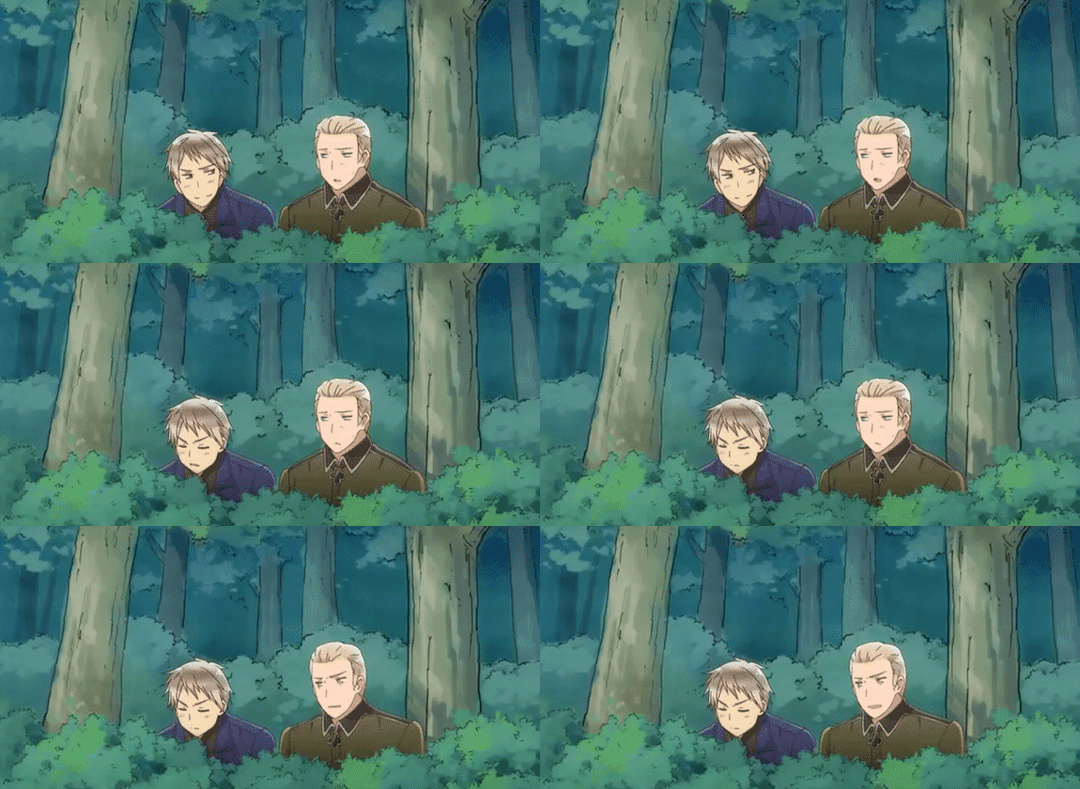
Note: This theory makes the assumption that Germany was reincarnated from Holy Rome.

Those who have read the strips will know that a recurring theme is Germany’s love for Italian culture and history; he thinks of the nation as a sort of paradise.

image

What strikes a chord with me is this specific panel. Here, Germany has a revelation while vacationing in Italy. Basically, because Italy is such a paradise, he understands why Goethe wrote so many poems about the nation.

image

All right. I’ll point out the obvious first before delving down into the deeper meanings of all this. Both Holy Rome and Germany have a profound love for the Italian nation, which most people see as a link between the two.

image

What I’ll be proposing is that this reference to Goethe hints at something extremely significant about Germany’s personality and characterization. It strongly alludes to his possible reincarnation from Holy Rome as well.

Goethe is most known for his play “Faust”, whereby the demon Mephistopheles makes a wager with God. Mephistopheles claims that he will be able to succeed in “luring” God’s favourite human, Faust, away from his pursuit of knowledge of all kinds.

What’s important here is that Faust outgrows scientific, religious, and humanitarian-philosophical teachings, choosing instead to learn magic as it will provide him with “infinite knowledge.”

image

Sound familiar? It should, because we know that Germany is obsessed with science and data.

image

He’s also quick to deny the existence of the supernatural because it’s unscientific.

image

However, there are strips that paint a different picture, one that shows that just like Faust moved from the scientific to that which is otherworldly, Germany is too. There are brief moments where he drops the scientific method and reveals that he may in fact be aware of the supernatural.

It’s possible in canon for deceased nations and humans to fly down from heaven and visit Earth. A human example would be Quintillus, an old Roman Emperor.

Previous to this strip, Germany was collecting ancient records of Rome, and Quintillus visits to give a more favourable account of his older brother, Gothicus, who isn’t depicted favorably in textbooks. Initially, Germany dismisses Quintillus as playing pretend and escorts him home.

image

What happens next is surprising. Germany privately refers to Quintillus as a “Roman boy”, which to me, seems as if he recognizes that it truly was a Roman Emperor who had just visited him.

Pay attention to the shifting of Germany’s mentality; it doesn’t seem like science is upheld within him as strongly as it used to be.

image

Perhaps the most important instance of this is when Ancient Rome visits Germany. At first, Germany believes this visit to be a strange dream, but soon falls into the swing of things and starts asking questions.

This question in particular is critical.

image

Again, notice how uncomfortable Germany looks when he asks this. Disappearing, huh? Could this possibly be a reference to Holy Rome and his newest incarnate, ahem, himself? Just think about it: reincarnation is a supernatural and seemingly magical occurrence…

It’s one thing if Germany merely asked about why and how a nation dies, but the discomfort on his face is likely an indicator of a painful memory.

This isn’t that far of a stretch either. Remember that in Buon San Valentino, after embarrassing himself by clumsily proposing to Italy, Germany panics and blacks out.

It’s precisely when people are distressed that repressed memories resurface according to Freudian psychology, and that’s exactly what seems to be the case here. The strip ends with fuzzy memories of Chibitalia.

image

It appears that Germany’s belief in science is waning. Either that, or he’s resorted to using science as an explanation to deny the reality of his reincarnation.

And with that, comes the repression of memories.

image

When you think of Italy, what immediately comes to mind is a
charming, womanizing, and fashionable individual, someone who’s full of smiles,
laughter, silly pranks, and overall joy.

On the other hand, I don’t see Italy’s anxious, flighty, and
insecure side depicted all that much. Italy isn’t always confident and flashy,
as he’s often low on money, but, nevertheless, there are brief moments in the
strips that reveal how truly broken he is on the inside.

This post will go over some of these insecurities, traumas,
and intrapersonal conflicts.

What you’ll see is that several people leaving Italy over
the course of his life has affected and devastated him in more ways than one;
he’s clingy, but is afraid that he’s being a burden; he keeps lots of private
secrets; and, perhaps most important of all, he’s terrified of being alone.

In “Axis Powers Jokes,” Italy lets his anxiety best him and
worries that his contribution in his alliance with Germany isn’t up to par. He
claims that there isn’t any reason for Germany to like him, and is unable to
get any sleep because of this.

Italy’s worry grows, and he crosses over the border into
Switzerland – in the middle of the night, mind you – to confirm whether Germany
likes him or not. When asked, Germany reassures Italy and puts the latter’s
mind at rest. What I want people to pay attention to is this isn’t the first
time Italy’s asked Germany this question.

There
are some real self-esteem issues present in Italy, and as the strip progresses
this becomes even more evident. Immediately after, Italy gets Germany to repeat
his answer again, except this time more clearly. If that wasn’t enough, he then
requests that Germany say this several times over. 

Notice now how uncertain and unsure Italy is of himself. He
wants to make sure that he’s liked by the people around him. That way, from his
perspective, they won’t have any reason to leave him.

In Chapter 7-8 of World Stars (the webcomic), Italy gains some
weight, and of course, this rouses him into another fit of panic. Despite
Germany’s reassurances, Italy still worries to the point that Germany has to
pull out a poll which concludes that most people don’t care if a “handsome
Italian man” has a bit of stomach fat.

Italy’s trouble with relationships didn’t start with Holy
Rome, either. Italy and Romano don’t exactly have the greatest brotherly bond.
Albeit complimenting Italy when the former can’t hear him, Romano explicitly
puts down his brother, often enough to cause quite a large rift between them.

There’s also the fact that Romano left Italy during the second Industrial Revolution, just so he wouldn’t have to rely on him. Which
leads me to my next point…

During this same time, England comes to Italy for help on
attaining better designs for his manufactured goods. Italy’s reaction here is
crucial.

It seems that Romano leaving Italy has deeply hurt him, even
if he doesn’t vocalize these feelings. It’s also important to mention that
Italy hasn’t even met Germany at this point, as this time period ends just
before WW1.

With Ancient Rome and
Holy Rome dead and Romano overseas, as well as not having the best relations with Austria and Hungary, Italy likely grew very lonely during this period. He didn’t
really have any support.

That said, there’s a lot more to Italy than reveals the eye.

What do you think are some important themes running throughout the series?

Hmmm. I’ll go with the less obvious and underlying ones.

-The Italy Brothers’ eyes
-Germany’s inability to smile.
-Germany’s love for Italy’s climate and culture + his deep interest in Roman history (*cough Holy Rome)
-Japan’s clairvoyance abilities + his limited memory
-Russia’s curse
-America’s dual personality
-China and Japan’s old age
-England’s alienation
-France’s loneliness and overcompensation as a Big Brother figure

image
image

Misconception #1: Romano swears only using the word
bastard.

Misconception #2: Ugh! The fandom’s got it all wrong! They exaggerate
how                                      much Romano swears!!!

Reality: Romano swears a
lot,
but has a very…colorful language.

Let’s go over one Romano-centric strip, shall we?

image
image
image
image
image
image
image
image
image
image
image

 Final Swear Count: 17

Kids learn how to swim by being thrown into a lake against
their will. 

Meanwhile, the nations learn how to fight by being thrown
into war. 

Germany: I’ll always resent you for doing that.

Prussia: Doing what?

Germany: You abandoned me in the middle of a battle and
shouted, “It’s the circle of life.”

Prussia: You’re welcome.

Who’s Charles Lee in Hamilton?

         Hamiltalia, “Stay Alive”:

America as Alexander Hamilton

North Italy as Charles Lee

Prussia as George Washington


Instead of me

He promotes Feli Vene

Makes him second-in-command

“I’m defecting, veeeeee!!!”  

image

Everyone Attack! 

image

Italy: Retreat!

image

Prussia: Attack!

Italy: Retreat!

Prussia: What are you doing, Feli? Get back on your feet! 


             “Nation Refuted”: 

Holy Rome as Samuel Seabury


Hear ye, hear ye! My name is Holy Rome 

And I present “Free thoughts on the

 proceedings of my crumbling empire”

Heed not the rabble who scream dissolution

They have not my interest at heart 

image

France: Mon dieu, let me tear this brat apart.

image

AU Finished! 8/8